Why did Napoleon invade Russia?
Napoleon sent 600,000 soldiers into Russia to enforce an economic blockade of Britain. Fewer than 10,000 came back fit for duty.
In June 1812, Napoleon Bonaparte crossed the Niemen River into Russia with roughly 600,000 soldiers, the largest army ever assembled to that point. He expected the campaign to last six weeks. It lasted six months, and fewer than 10,000 of those soldiers came back fit for duty. The invasion destroyed Napoleon's empire, killed hundreds of thousands of people, and gave Russia its founding story about itself: that its geography and endurance make it unconquerable.
The scale of the disaster raises an obvious question. Why did he do it? Napoleon was not reckless. He had beaten every major power in Europe at least once. He understood logistics, winter campaigns, and the risk of fighting far from home. The answer is not ambition or madness. It is Britain.
The country Napoleon could not reach
Napoleon's real enemy was Britain, and he had no way to get to it. In October 1805, the Royal Navy destroyed the French fleet at Trafalgar, ending any realistic plan to cross the English Channel. Napoleon controlled most of continental Europe, from Portugal to Poland, but Britain sat behind its navy, out of reach.
His alternative was economic warfare. In 1806 he issued the Berlin Decree, which banned every country under his control from trading with Britain. The idea, known as the Continental System, was simple: if all of Europe stopped buying British goods, British factories would close, British banks would fail, and the British government would have to make peace. For the system to work, every major European port had to close. If even one large trading partner kept dealing with Britain, the blockade would leak, and the economic pressure would drop.
Russia was the largest trading partner still in play.
The deal on the raft
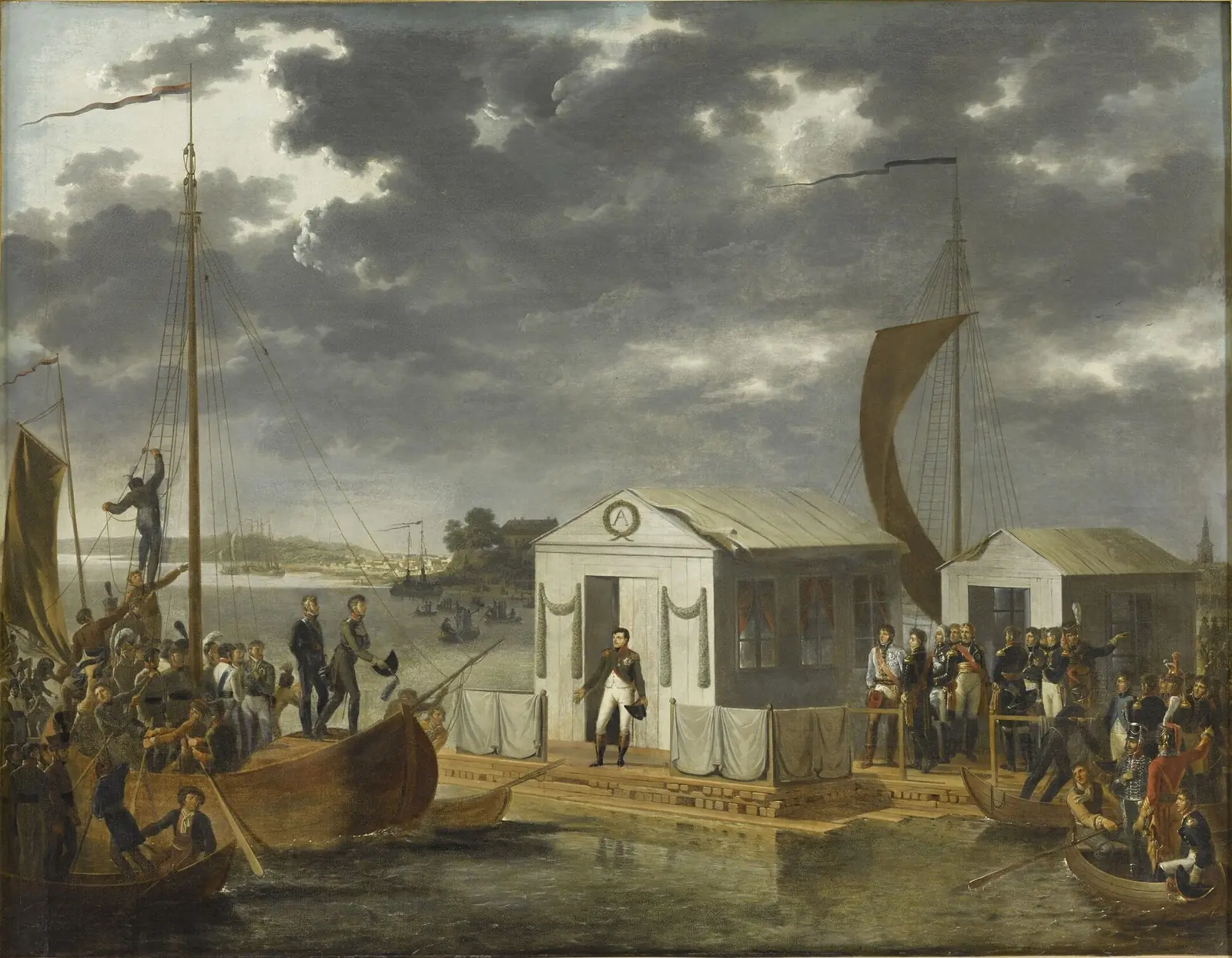
In June 1807, after two crushing defeats at Austerlitz and Friedland, Tsar Alexander I met Napoleon on a raft anchored in the middle of the Niemen River, near the town of Tilsit in what is now Lithuania. Alexander was 29, tall, well-mannered, and badly shaken. Napoleon had just destroyed a Russian army for the second time in two years, and Alexander had no appetite for a third round.
The treaty they signed turned Russia from an enemy into an ally. Russia would join the Continental System and close its ports to British trade. In return, Napoleon gave Alexander a free hand to expand into Finland and the Ottoman Empire's Balkan territories. The two emperors parted on warm terms, having agreed, at least on paper, to divide Europe's spheres of influence between them.
The problem was that the deal was terrible for Russia's economy. Russian landowners sold grain and timber to Britain. British merchants supplied the manufactured goods that Russian cities depended on. When those trade routes closed, the ruble lost roughly a quarter of its value between 1807 and 1810. Warehouses along the Baltic filled with grain that had nowhere to go. By December 1810, Alexander had seen enough. He issued a ukase, a formal decree, that reopened Russian ports to neutral shipping (which in practice meant British goods) and imposed heavy tariffs on French imports. The Continental System, Napoleon's only strategy for defeating Britain, was falling apart.
The invasion was about Britain, not Russia
Napoleon's decision to invade did not come from a single grievance. Several disputes reinforced each other. Alexander had broken the Continental System. He had also stalled Napoleon's proposal to marry his youngest sister, Anna Pavlovna, a delay Napoleon took as a deliberate insult. He married the Austrian archduchess Marie Louise instead. Then in January 1811, Napoleon annexed the Duchy of Oldenburg, whose duke was Alexander's brother-in-law, folding it into the French Empire without warning.
But the core reason was the blockade. Napoleon had spent six years trying to strangle Britain's trade, and Russia's defection made the whole strategy collapse. If Russia traded freely with Britain, so would every other country that had been squeezed into the system by force. Napoleon did not invade Russia to conquer it. He invaded to force it back into an economic war against a country he could not reach by sea.
He expected a short campaign. Russia had lost to him at Austerlitz in 1805 and Friedland in 1807. He would cross the Niemen, force a decisive battle near the border, and dictate terms. The plan rested on one assumption: that Russia would stand and fight where Napoleon wanted it to fight.
Russia refused to lose on Napoleon's terms
The Russian commanders understood the odds. They could not beat Napoleon in a pitched battle near the border. General Barclay de Tolly chose to retreat east instead, burning crops and villages as he went, stripping the landscape of anything the French army could eat. Napoleon pursued, winning engagements at Vilna, Vitebsk, and Smolensk, but never getting the decisive battle he needed. His soldiers were dying of heat, disease, and starvation before the main fighting even came.
On September 7, 1812, the two armies finally met at Borodino, 110 kilometers west of Moscow. It was the bloodiest single day of the Napoleonic Wars: roughly 70,000 men killed or wounded, split almost evenly. Napoleon held the field, but the Russian army under Mikhail Kutuzov withdrew in good order. Napoleon had his battle. He did not have a victory that ended the war.
A week later he entered Moscow. It was empty. The military governor, Fyodor Rostopchin, had ordered most of the city burned rather than let the French use it for winter quarters. Napoleon sat in the ruins for five weeks, waiting for Alexander to send peace envoys. None came. Russia's political class, shamed by the loss of Moscow, would not accept the humiliation of negotiating from weakness. Napoleon had assumed that taking an enemy's capital forces a peace deal. It had worked against Austria and Prussia. Alexander refused to follow the same logic.
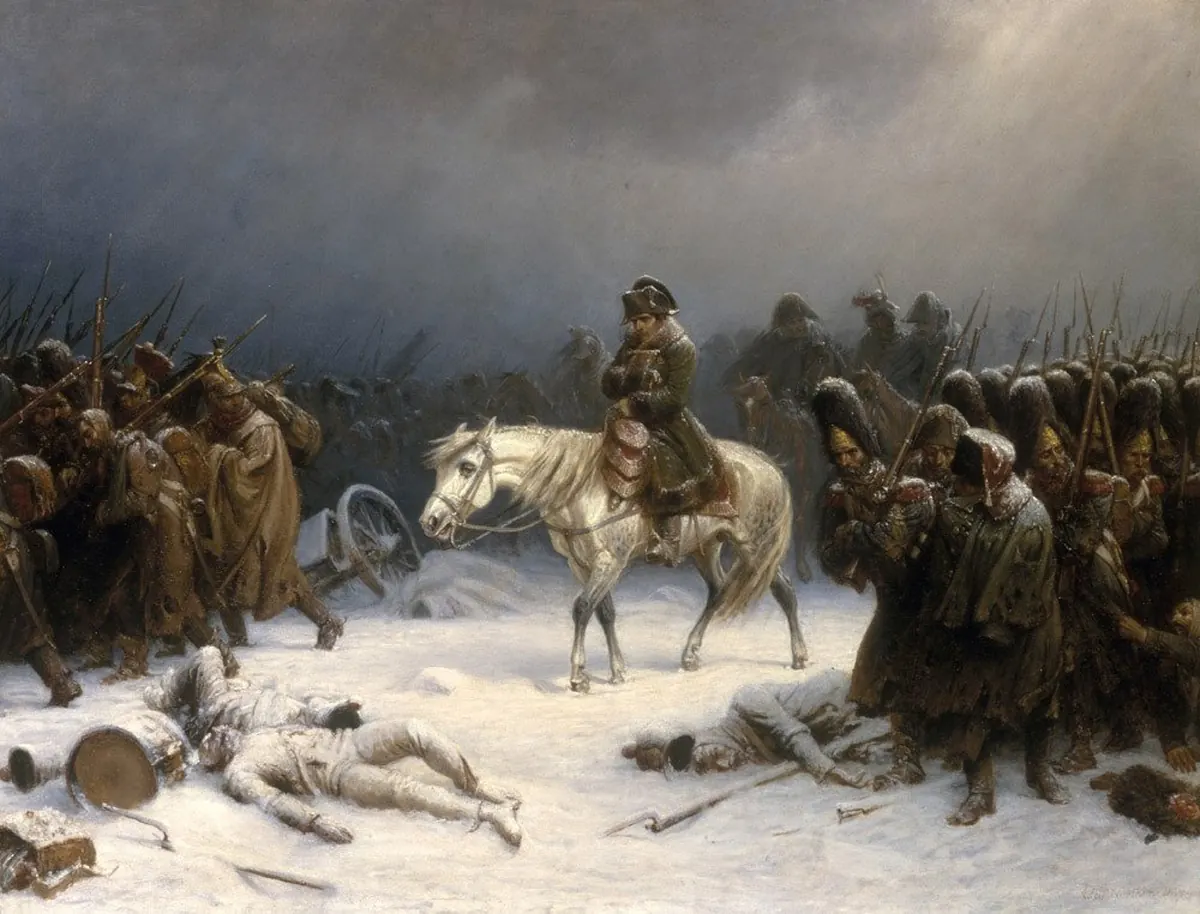
On October 19, with winter closing in and food running out, Napoleon ordered the retreat. What followed was one of the worst military disasters in history. The army crossed a landscape that had already been stripped bare on the way in. Cossack cavalry struck supply columns. Men froze. Units dissolved. At the Berezina River crossing in late November, French engineers built pontoon bridges under fire in icy water while thousands drowned or were captured behind them. By December, perhaps 120,000 men made it back to French-controlled territory in some form. Fewer than 10,000 were fit for duty.
The pattern that keeps repeating
Napoleon invaded Russia for a specific, strategic reason: to enforce an economic blockade of Britain. It was not irrational. It followed from the logic of his whole continental system. The mistake was believing that Russia could be forced into obedience by the same short, decisive campaign that had broken Austria and Prussia.
Russia's geography made that impossible. The country was too deep, the distances too great, and the population was willing to burn its own capital rather than surrender. Hitler made the same miscalculation in 1941, sending nearly four million soldiers into the Soviet Union and expecting victory in weeks. He got the same result: rapid advances, overextended supply lines, a Russian winter, and catastrophic losses.
The lesson Russia took from 1812 shaped its politics for the next century. Because traditional, autocratic Russia had beaten Napoleon, Russia's ruling class concluded that the system worked and reform was unnecessary. Every time Western governments have imposed pressure on Russia since, from the Crimean War sanctions of the 1850s to the sanctions over Ukraine in the 2020s, Russian state media has reached for the same story: Russia has survived worse. That confidence has a real historical basis. It also has a cost. The refusal to reform after 1812 stored up the crises that arrived as the Crimean War, the revolutions of 1905 and 1917, and the collapse of the Russian Empire. Napoleon's invasion gave Russia its most powerful national myth. The myth, in turn, made Russia slower to change. The Congress of Vienna that followed Napoleon's fall tried to freeze Europe in place. Russia took the same approach with itself, and the bill came due a century later.
Test what you learned
5 questions on this article. About two minutes, no signup.
Orbis has a full course on this
Russia: Empire to Superpower. 38 lessons, each ending with a quiz like this one.