
Why does Iran hate America?
Iran's hostility is built on a specific list of things America did, from a CIA coup in 1953 to a broken nuclear deal in 2018.
"Death to America" has been a fixture of Iranian politics since 1979. The slogan is painted on murals, shouted at rallies, and broadcast on state television. To most Americans it sounds irrational. But the anger behind it is not abstract. It is built on a list of specific things the United States did to Iran, most of them within living memory. Most Americans have never heard of more than one or two. Most Iranians could recite them all.
Seventy years ago, Iran and America were close allies. The Shah bought American fighter jets, sent students to American universities, and hosted American military advisers in Tehran. The hatred that replaced that alliance was not ancient or civilizational. It grew out of a sequence of specific events, and every one of them is documented.
How the CIA overthrew Iran's elected government
In 1953, Iran had an elected prime minister named Mohammad Mosaddegh. He had nationalized the country's oil from a British company that paid Iran less in royalties than it paid the British treasury in taxes. He was 68, an aristocrat who had studied law in Switzerland. He had spent time in prison under the previous Shah and had a reputation for being impossible to bribe. He famously received foreign diplomats while propped up in bed in his pajamas.
Britain wanted him gone. The CIA agreed to help. The agency spent about a million dollars paying crowds, bribing generals, and planting fake communist threats to convince Iran's clergy and military that a Soviet takeover was coming. On August 19, 1953, mobs and army units overthrew Mosaddegh and restored the Shah to the throne. It was the first time the CIA overthrew a foreign government. The operation was run from the basement of the US Embassy in Tehran by a CIA officer named Kermit Roosevelt Jr., a grandson of President Theodore Roosevelt.
The United States denied its role for decades. In 2000, Secretary of State Madeleine Albright acknowledged that "the United States played a significant role in orchestrating the overthrow." In 2013, the CIA released its own internal history confirming the operation. By then the damage had been compounding for sixty years. Every Iranian schoolchild since 1979 has learned the story of the 1953 coup.
Twenty-six years of America's Shah
The Shah ruled as an autocrat for the next 26 years with full American backing. He bought F-14 Tomcat fighter jets, the most advanced plane in the US inventory. He founded a secret police called SAVAK, trained by the CIA and Israeli Mossad, that jailed, tortured, and killed political opponents across the spectrum. Washington looked the other way because the Shah kept Iran's oil flowing and stood as America's Cold War anchor in the Persian Gulf.
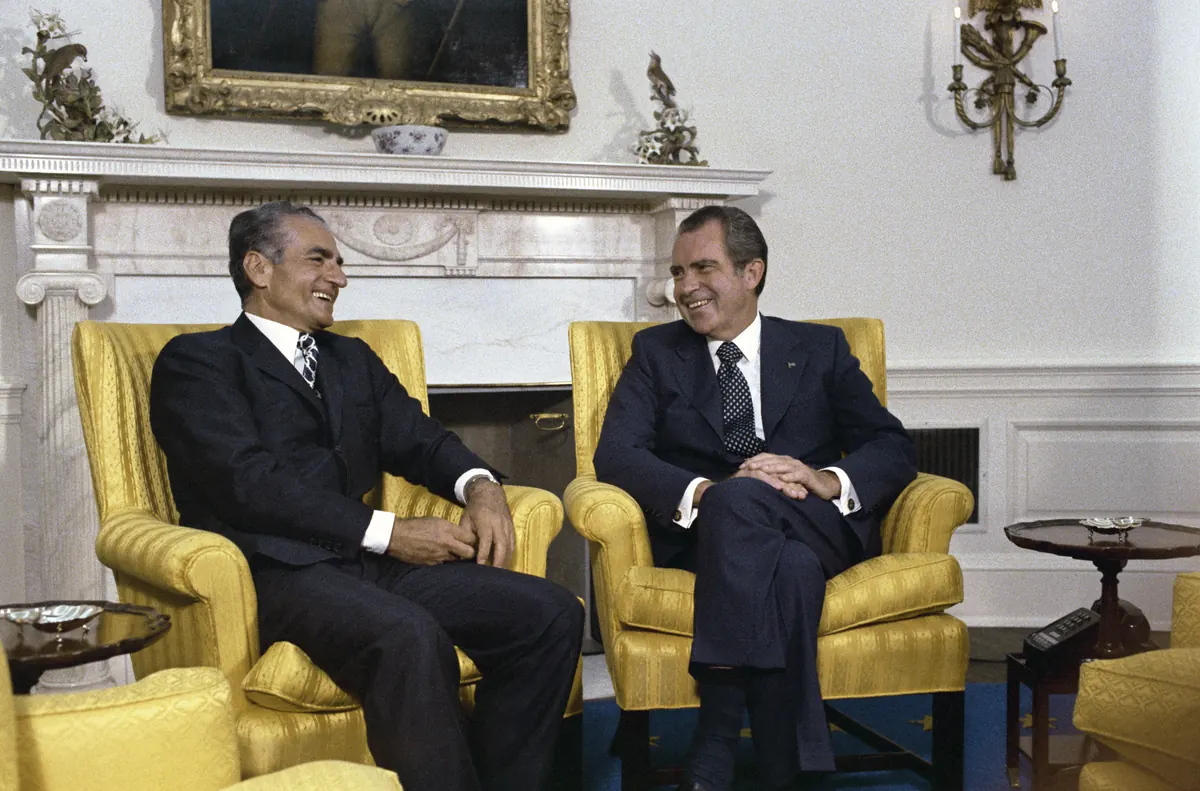
The Shah modernized the country. He redistributed land, gave women the vote, and pushed literacy into villages. But the modernization ran on top of a police state. Every opposition movement, secular or religious, drew the same conclusion: if you tried to change Iran through legitimate politics, America would prevent it. When the oil boom slowed in 1977 and the Shah's grip loosened, the dam broke. Millions protested. On January 16, 1979, the Shah left Iran. He never came back. On February 1, Ayatollah Ruhollah Khomeini flew home from exile in Paris to a crowd of three million.
Why the students seized the embassy
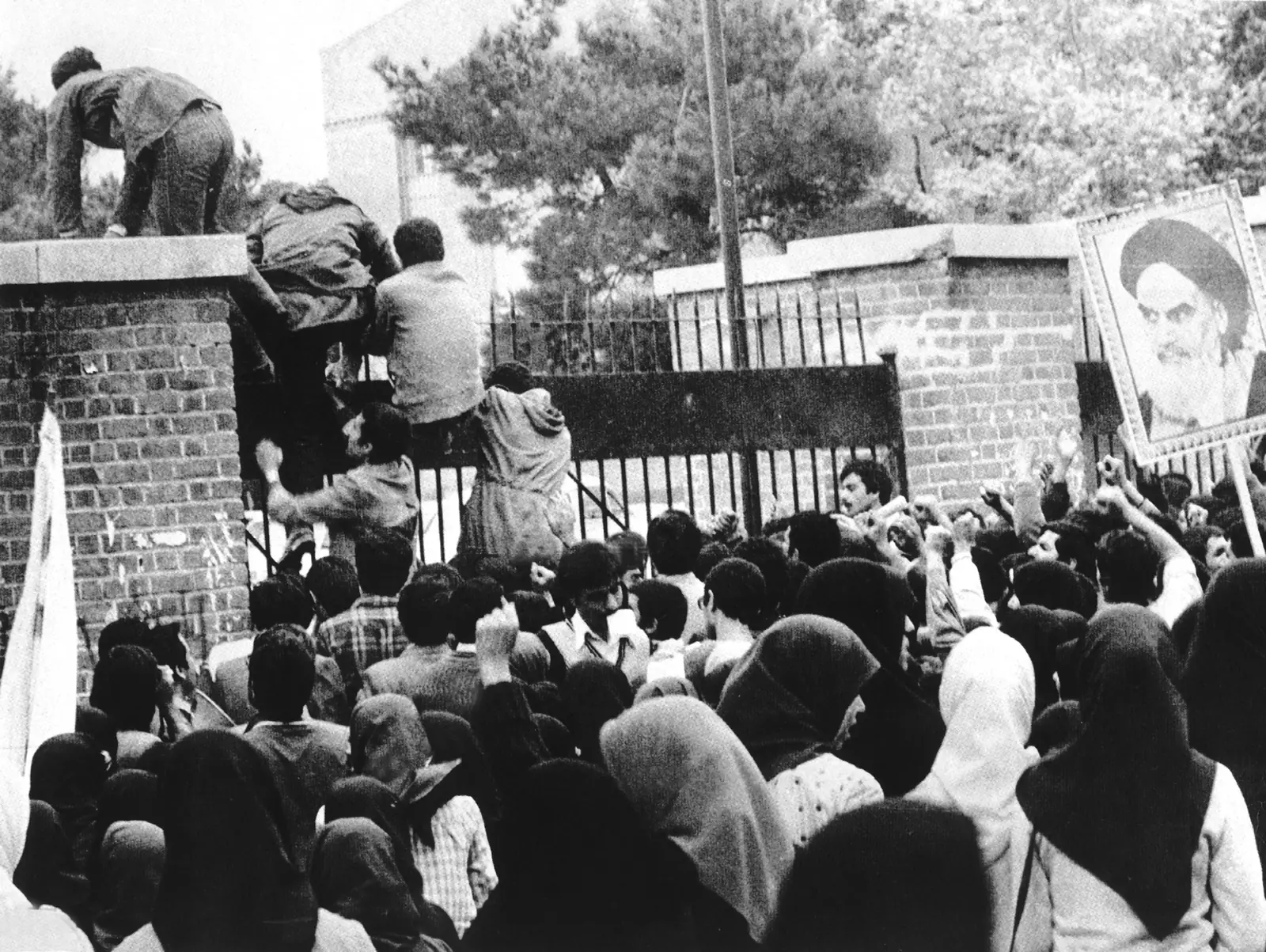
On November 4, 1979, Iranian students climbed the walls of the US Embassy in Tehran and took 52 American diplomats hostage. They held them for 444 days.
The building they chose was not random. It was the same compound from which Kermit Roosevelt had run the 1953 coup 26 years earlier. The students knew exactly what it meant. When the Carter administration admitted the dying Shah to a New York hospital for cancer treatment, Iranians feared a repeat: the last time the Shah fled the country, the CIA had put him back. Two weeks after he arrived in New York, the students went over the wall.
Khomeini endorsed the seizure and called America "the Great Satan." President Carter's rescue attempt, Operation Eagle Claw, ended in flames in the Iranian desert on April 25, 1980 when helicopters collided with a transport plane and eight American servicemen died. The hostages were released on January 20, 1981, minutes after Ronald Reagan was sworn in. No American and Iranian officials would meet in any serious negotiation for the next 32 years.
Chemical weapons, an airliner, and no apology
In September 1980, Saddam Hussein invaded Iran. The eight-year war that followed killed roughly half a million people and moved the border almost nowhere.
What matters for Iran's view of America is who helped whom. The United States restored diplomatic relations with Iraq in 1984 and shared satellite intelligence on Iranian troop movements with Saddam's military. Saudi Arabia and Kuwait lent Iraq $30 to $40 billion to keep fighting. Starting in 1983, Iraq used chemical weapons against Iranian soldiers, including nerve agents. No major power punished it. At the same time, the Reagan administration was secretly selling weapons to Iran in exchange for help freeing American hostages held by Hezbollah in Lebanon, then funneling the profits to rebels in Nicaragua. When the Iran-Contra affair became public in 1986, it confirmed what Iranians already believed: Washington would arm both sides of the same war.
Then, on July 3, 1988, the cruiser USS Vincennes shot down Iran Air Flight 655, a civilian airliner on a scheduled route from Bandar Abbas to Dubai. All 290 people on board died, including 66 children. The US Navy said its crew had mistaken the Airbus for an F-14 fighter. The United States paid compensation in 1996 through the International Court of Justice, but never formally apologized. For ordinary Iranians, Flight 655 is not a footnote. It is proof that American power kills Iranian civilians and walks away.
The nuclear deal America signed and broke
In 2015, after years of negotiation, Iran signed the JCPOA nuclear deal with the United States and five other world powers. Iran capped its enriched uranium stockpile, limited enrichment to 3.67 percent, and accepted the most intrusive inspections in arms-control history. In return, sanctions were lifted and Iran could sell oil again.
International inspectors confirmed Iran was in full compliance. Then on May 8, 2018, President Donald Trump withdrew the United States and reimposed sanctions. Iranian oil exports collapsed from 2.5 million barrels a day to under 500,000. The economy contracted 6 percent. The rial lost 70 percent of its value against the dollar.
From Tehran the conclusion was straightforward: Iran did what was asked, signed the agreement, followed every rule, and America broke its word. Within two years Iran was enriching uranium past the deal's limits. By 2024, breakout time had shrunk from over a year to weeks. In June 2025, Israel and the United States bombed Iran's nuclear sites. In February 2026, the two countries went to war.
Why the anger outlasts any government
The reason Iran's hostility toward America is so durable is that it does not depend on the Islamic Republic. Iranians who support the clerics and Iranians who despise them agree on the list: the 1953 coup, the Shah's American-trained secret police, the backing of Saddam while he gassed Iranian soldiers, Flight 655, and the nuclear deal that was signed and shredded. The secular opposition, the reformists, the young people who filled the streets in 2022 after the death of Mahsa Amini, they know the same history.
That does not make the Islamic Republic's policies defensible. It means that any future Iranian government, democratic or otherwise, will inherit the same list and the public that carries it. The clerics did not invent the anger. They built a state on anger that already existed. The hatred of the Great Satan will outlive the government that named it.
Test what you learned
5 questions on this article. About two minutes, no signup.