Jihadist group · Somalia · Al-Qaeda branch
Al-Shabaab
At war with Somalia’s governmentUpdated November 13, 2026
Al-Shabaab is a Sunni jihadist group that controls much of rural south and central Somalia. It pledged allegiance to al-Qaeda in 2012. The group is largely self-funded through taxation and extortion, with income the United Nations estimated at more than $150 million in 2023. It holds its de facto capital, Jilib, and large stretches of countryside, while Somalia's government and African Union troops hold the main cities. Its fighters use car bombs, improvised explosives, mortars and small arms. It builds its bombs itself and gets most other weapons from battlefield captures and black-market purchases, according to the UN Panel of Experts.
- Leader
- Ahmed Diriye (Abu Ubaidah)
- since September 2014
- Fighters
- 7,000 to 12,000
- US estimate, April 2026
- Holds
- Much of the rural south
- and central Somalia
- Affiliate
- Al-Qaeda
- pledged allegiance in 2012
- Designated by
- US, UN, UK and others
- FTO since 2008
Who funds al-Shabaab?
Al-Shabaab is mostly self-funded through taxes, extortion and road checkpoints across Somalia.
- From abroad
- Houthi weapons and trainingUN panels found that the Houthis sent weapons, trained 150 to 400 al-Shabaab fighters and sent two engineers to Jilib. The relationship is described by the Congressional Research Service as transactional.
- AQAP cooperationAl-Shabaab fighters entered Yemen to coordinate with al-Qaeda in the Arabian Peninsula. The UN Monitoring Team reported in 2026 that al-Shabaab helps fund AQAP.
- At home
- Road checkpointsCheckpoints on roads and trucks are one of its main income sources, according to the UN Panel. Its 2025 advances gave it new checkpoints on the roads into Mogadishu.
- Mogadishu extortionThe group collects from businesses in Bakara market and other parts of Mogadishu. In 2026 the UN estimated collections there fell to $5 to $9 million a month, down from $12 to $15 million.
- Zakat on farms and livestockIt taxes farmers and herders in the areas it holds. The UN Panel reported that in November 2024 al-Shabaab forced seven minority-clan leaders in Lower Shabelle to hand over 100 recruits, $100,000, 100 camels and 300 sheep.
- Port taxationThe group taxes importers, exporters and transporters who use the port of Mogadishu, according to UN investigators cited by Garowe Online in 2020.
Al-Shabaab
Harakat al-Shabaab al-Mujahideen
The money pays for fighters, weapons and the group's system of courts and administration across rural Somalia. About a quarter of its budget goes to weapons and explosives, according to the Council on Foreign Relations.
The UN Panel of Experts estimated al-Shabaab's total income at more than $150 million in 2023. The US Treasury said about $100 million a year in 2022. The Congressional Research Service said up to $200 million a year in 2026.
ConfirmedReported, denied
What territory does al-Shabaab control?
Al-Shabaab holds much of the countryside in south and central Somalia. The government and African Union troops hold the main cities.
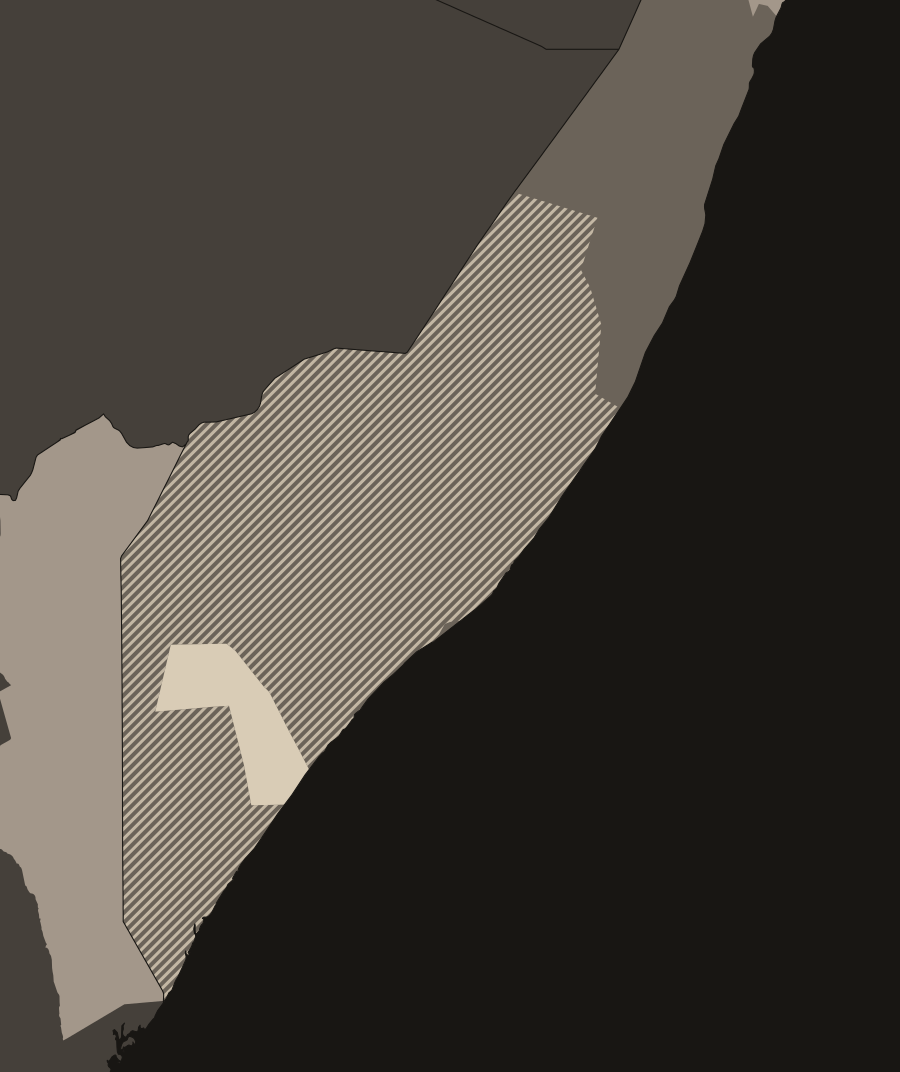
Middle Juba, its baseHolds much of the countrysideRaids and cellsWhole regions are shaded. In most of them the government and African Union troops hold the main towns and al-Shabaab holds rural areas and roads.
- JilibCapitalAl-Shabaab's de facto capital in Middle Juba. The group runs its administration from here. US and Somali strikes have killed commanders in and around Jilib in 2025 and 2026.
- MogadishuGovernmentSomalia's capital, held by the government. Al-Shabaab extorts businesses, fires mortars at the airport and carries out bombings. A truck bomb at Zoobe junction on October 14, 2017 killed more than 500 people.
- BalcadFront lineA town 30 to 40 km north of Mogadishu. Al-Shabaab briefly held it from February 26 to 28, 2025. The group also set up checkpoints on the road between Balcad and Mogadishu.
- Adan YabaalAl-ShabaabA district in Middle Shabelle that the government recaptured in 2022. Al-Shabaab retook it on April 16, 2025.
- MoqokoriAl-ShabaabA town in Hiraan that the government had recaptured in 2022-2023. Al-Shabaab retook it on July 7, 2025, along with large stocks of army weapons.
- BeledweyneClan militiaThe capital of Hiraan. The government held it until November 1, 2026. On that day about 2,000 fighters from a Hawadle clan militia seized it, according to local media cited by the Council on Foreign Relations. The militia is not part of al-Shabaab. Its fighters left front-line posts at Mataban and Buulo Barde to take the city.
- BaidoaGovernmentThe capital of South West State. Federal forces took it on March 30, 2026. Fighting broke out again on August 17, 2026.
- KismayoJubalandA port city and the capital of Jubaland. Al-Shabaab lost Kismayo in October 2012. The city is held by Jubaland's administration.
- El Adde2016 attackA Kenyan African Union base that al-Shabaab overran on January 15, 2016. Kenya never published a death toll. Estimates range from at least 141, by the International Peace Institute, to about 200, by Somalia's president.
- ManderaKenyaA Kenyan border town where al-Shabaab carries out the most attacks in Kenya. On November 10, 2026 an ambush that local officials blamed on al-Shabaab killed 8 people.
What weapons does al-Shabaab have?
Car bombs and improvised explosives are its main weapons. The group builds them itself. Most of its other weapons are captured on the battlefield or bought on the black market, according to the UN Panel.
Car bombs and truck bombs
Vehicle-borne IEDs (VBIEDs) · Locally built
The group's signature weapon. A truck bomb at Zoobe junction in Mogadishu on October 14, 2017 killed more than 500 people. Twin car bombs at the Education Ministry on October 29, 2022 killed 121.
Improvised explosive devices
Roadside and remote-controlled IEDs · Locally built, Houthi IED training
UNMAS recorded about 600 IED incidents in Somalia in January to September 2025, causing 1,400 to 1,500 casualties.
Mortars
Various · Captured and purchased
Fired at Mogadishu airport and Halane compound on March 19, April 6 and May 20, 2025. The UN says the group is seeking better mortar range and accuracy.
Small arms
AK-pattern rifles, machine guns, RPGs · Battlefield captures, smuggled from Yemen
Most weapons come from captured army stocks and black-market purchases. UN experts say dhows and skiffs bring a steady supply from Yemen.
Anti-aircraft guns
ZU-23 · Captured from the Somali army
In March 2025 al-Shabaab ambushed army units in Adan Yabaal district and captured a pickup truck mounted with a ZU-23 anti-aircraft cannon, according to the UN Panel.
Drones
Surveillance drones · Houthi training reported
Used for surveillance. UN panels report that the Houthis have trained al-Shabaab fighters in drone technology. No confirmed armed-drone attack by al-Shabaab has been reported.
- Killed, October 14, 2017
- 500+
- Zoobe junction truck bomb in Mogadishu
- IED incidents
- About 600
- in Somalia, January to September 2025 (UNMAS)
- Killed at Garissa
- 148
- university attack, April 2, 2015
Which governments list al-Shabaab as terrorist?
The United States, the United Kingdom, Canada, Australia, New Zealand and Kenya list al-Shabaab as a terrorist group. The UN and the EU apply sanctions to it.
 United StatesForeign Terrorist Organization since March 2008
 United KingdomProscribed since March 2010
- UN Security CouncilUnder the UN’s own al-Shabaab sanctions
 CanadaListed entity since March 2010
 AustraliaListed terrorist organization since August 2009
 New ZealandDesignated terrorist entity since February 2010
 KenyaSpecified entity under the Prevention of Terrorism Act
 European UnionUN sanctions copied into EU law
 RussiaEnforces the UN sanctions only
 ChinaEnforces the UN sanctions only
How much money does al-Shabaab make?
Al-Shabaab earns most of its money from taxing roads, businesses and farms inside Somalia. The UN Panel of Experts estimated its total income at more than $150 million in 2023. The US Treasury said about $100 million a year in 2022. The Congressional Research Service said up to $200 million a year in 2026.
The group runs checkpoints on major roads and collects from businesses in Mogadishu, including Bakara market. The UN estimated that its Mogadishu collections fell from $12 to $15 million a month to $5 to $9 million a month by 2026. It also collects zakat from farmers and herders. The US government calls it "al-Qa'ida's wealthiest component."
The US Treasury sanctioned al-Shabaab financial networks in 2022 and 2024. In October 2022 it designated 9 people, including the group's head of weapons procurement, Abdullahi Jeeri, and two finance officials. In March 2024 it designated 16 more people and entities, including companies in Dubai, Kenya and Uganda that moved money through the hawala system. The UN says it "has not been able to further investigate in detail how Al-Shabaab raises, moves or stores its money."
Annual income
$150m+
Al-Shabaab's estimated income in 2023
The UN Panel of Experts estimated more than $150 million. The US Treasury said about $100 million in 2022. The Congressional Research Service said up to $200 million in 2026.
Who leads al-Shabaab?
Ahmed Diriye, also known as Abu Ubaidah, has led al-Shabaab since September 2014. He took over after the United States killed co-founder Ahmed Abdi Godane in a strike near Barawe on September 1, 2014. The UN Panel said in November 2025 that Diriye had "cemented his leadership role in the past two years." UN monitors said in June 2026 that he is "active and believed to be in southern Somalia." The United States offers up to $10 million for information leading to his capture.
The UN Panel named two deputies in 2025. Abukar Ali Adan is deputy emir and former military chief. Mahad Karate oversees the amniyat, al-Shabaab's intelligence wing, and the zakat collection system. The United States raised its reward for Karate to $10 million in November 2022. The overall military emir is Bashir Furqan.
Several senior figures were killed in late 2025 and early 2026. In December 2025 Somali intelligence and partners killed Abdullahi Osman Mohamed, known as Engineer Ismail, the chief of explosives. The UN confirmed his death. In January 2026 finance chief Abdullahi Hassan Abdi Osoble was killed. His designated successor, Mohamed Sahal Idl, was killed in February 2026. UN terrorism experts, cited by the Congressional Research Service, say the loss of leaders is "unlikely to affect the group's stability."
The leadership
- EmirAhmed Diriye (Abu Ubaidah). Since September 2014. The US offers up to $10 million for information on him.
- Deputy emirAbukar Ali Adan. Former military chief.
- Deputy emir, intelligence and financeMahad Karate. Oversees the amniyat and zakat. US reward raised to $10 million in 2022.
- Military emirBashir Furqan. Commands overall military operations.
- SpokesmanAli Mahmoud Raage (Ali Dheere). Gave a speech at a training camp in September 2025.
Is al-Shabaab winning in Somalia?
Neither side is winning, according to the International Crisis Group. In June 2026 it described the situation as a stalemate, saying "neither is close to collapse, neither is close to victory."
In August 2022 Somalia's President Hassan Sheikh Mohamud declared "total war" on al-Shabaab. The offensive, backed by clan militias, made what the Congressional Research Service called "the most important territorial gains in a decade." But the gains stalled by 2024. In 2025 al-Shabaab retook most of the land it had lost in Hiraan and Middle Shabelle. It seized Adan Yabaal on April 16, Moqokori on July 7 and several other towns. It briefly held Balcad, 30 to 40 km from Mogadishu, in February 2025. In August 2026 it retook Teedaan for the first time since 2022.
The government retook Bariire in August 2025 and Awdheegle on October 4, 2025. AFRICOM's register listed 88 US airstrikes in 2026 through early November. But the African Union mission that backs Somalia's army is running out of money. It needs about $196 million and had only $24.6 million pledged by late September 2026. The United States said in July 2026 that it would not support the UN office that supplies the mission after December 31, 2026. Uganda began pulling out its roughly 2,000 bilateral troops on November 2, 2026.
The war since 2022
- Aug 2022President Mohamud declares "total war" on al-Shabaab.
- Oct 2022Twin car bombs at the Education Ministry in Mogadishu kill 121 people.
- Jan 2025AUSSOM replaces ATMIS as the AU mission.
- Feb 2025Al-Shabaab briefly takes Balcad, 30 to 40 km from Mogadishu.
- Apr 2025Al-Shabaab retakes Adan Yabaal.
- Jul 2025Al-Shabaab retakes Moqokori.
- Oct 2025Government forces retake Awdheegle.
- Aug 2026Al-Shabaab retakes Teedaan.
- Nov 1, 2026A clan militia seizes Beledweyne, opening gaps in the front.
- Nov 2, 2026Uganda begins pulling out its bilateral troops.
What attacks has al-Shabaab carried out in Kenya?
Al-Shabaab says it attacks Kenya because Kenya sent troops into Somalia. Kenya's army entered Somalia in October 2011 and joined the African Union mission in 2012. Kenya has the largest number of al-Shabaab attacks outside Somalia. The group's Kenyan operations are run by a unit called Jaysh Ayman under a commander named Musab Yare, according to the UN Panel.
The deadliest attack was the assault on Garissa University on April 2, 2015, when four gunmen killed 148 people. On September 21, 2013 four gunmen attacked the Westgate Mall in Nairobi, killing 67 people in a four-day siege. On January 15, 2019 attackers hit the DusitD2 hotel in Nairobi, killing 21 people, including one US citizen. On January 5, 2020 al-Shabaab attacked Camp Simba at Manda Bay, killing one US soldier and two US contractors.
Attacks continue. The UN Panel reported about six attacks a month in Kenya in 2025, mostly in the border areas from Mandera to Lamu. On November 10, 2026 an ambush in Mandera killed 8 people. Local officials suspect al-Shabaab carried it out.
Major attacks in Kenya
- Westgate Mall, NairobiSeptember 21, 2013. 67 killed in a four-day siege.
- Garissa UniversityApril 2, 2015. 148 killed by four gunmen.
- DusitD2 hotel, NairobiJanuary 15, 2019. 21 killed, including 1 US citizen.
- Camp Simba, Manda BayJanuary 5, 2020. 1 US soldier and 2 US contractors killed.
- Mandera ambushNovember 10, 2026. 8 killed. Local officials suspect al-Shabaab.
What is the United States doing in Somalia?
The United States has carried out airstrikes in Somalia since 2003. Under President Trump, the pace rose sharply. AFRICOM carried out about 125 strikes in 2025, according to Stars and Stripes. The Congressional Research Service counted more than 130. By early November 2026 AFRICOM's register listed 88 strikes for the year. January 2026 alone saw 26 strikes.
The strikes target both al-Shabaab and the rival ISIS-Somalia faction. In December 2025 Somalia's intelligence agency said an operation with international partners killed Engineer Ismail, al-Shabaab's chief of explosives. On April 16, 2025 AFRICOM struck a vessel it said was smuggling weapons for al-Shabaab.
The United States also funds the African Union mission in Somalia. It has given nearly $1.6 billion to troop contributors and almost $2 billion to UNSOS, the UN office that supplies the mission, according to the Congressional Research Service. But on July 1, 2026 the US said it would not support UNSOS after December 31, 2026. On September 10 it proposed a 12-month drawdown of the mission instead. The Security Council's authorization for the mission ends on December 31, 2026.
US airstrikes in 2026
88
Strikes on AFRICOM's register through early November
January 2026 alone saw 26 strikes. AFRICOM carried out about 125 strikes in 2025. The US has struck in Somalia since 2003.
How did al-Shabaab start?
Al-Shabaab formed in the early 2000s as the youth militia of the Islamic Courts Union, a coalition of sharia courts that governed parts of southern Somalia. In June 2006 the Islamic Courts Union took Mogadishu. In December 2006 Ethiopian forces invaded and removed it. Al-Shabaab then led the insurgency against Ethiopia's presence.
The Ethiopian invasion helped al-Shabaab grow. It went from about 400 fighters to several thousand by casting itself as the resistance to a foreign occupation, according to the Council on Foreign Relations. The Council on Foreign Relations says its forerunner was al-Ittihad al-Islami, a 1990s Salafi group partly funded by Osama bin Laden.
In February 2012 al-Shabaab pledged allegiance to al-Qaeda. By then it had already lost Mogadishu. African Union forces pushed it out of Mogadishu in August 2011 and took the port of Kismayo in October 2012. The group shifted to controlling rural areas and taxing trade, making it what US intelligence calls "al-Qa'ida's wealthiest component." Ahmed Abdi Godane, described by the Pentagon as a co-founder, led the group until a US strike killed him on September 1, 2014. Ahmed Diriye took over on September 6, 2014 and has led it since.
How al-Shabaab rose
- Jun 2006The Islamic Courts Union, with al-Shabaab as its militia, takes Mogadishu.
- Dec 2006Ethiopian forces invade and remove the Islamic Courts Union.
- Mar 2008The United States designates al-Shabaab a Foreign Terrorist Organization.
- Jul 2010Bombings in Kampala, Uganda kill 76 people. It is al-Shabaab's first attack abroad.
- Aug 2011African Union forces push al-Shabaab out of Mogadishu.
- Feb 2012Al-Shabaab pledges allegiance to al-Qaeda.
- Oct 2012Al-Shabaab loses the port city of Kismayo.
- Sep 2014A US strike kills co-founder Godane. Ahmed Diriye takes over.
- Oct 2017A truck bomb at Zoobe junction in Mogadishu kills more than 500 people.
- Aug 2022Somalia's president declares "total war" on al-Shabaab.
Questions about al-Shabaab
Is al-Shabaab part of al-Qaeda?
Yes. Al-Shabaab pledged allegiance to al-Qaeda in February 2012. US intelligence calls it "al-Qa'ida's wealthiest component" as of 2025. A rival faction split off in October 2015 and pledged allegiance to the Islamic State instead.
How many fighters does al-Shabaab have?
US intelligence estimated 7,000 to 12,000 fighters in April 2026. The Congressional Research Service said the group "may have up to 18,000" in July 2026. Al-Shabaab does not publish its own number.
How many rockets does al-Shabaab have?
No long-range rockets or missiles have been reported in al-Shabaab's hands. Its fighters do use rocket-propelled grenades (RPGs). Its main weapons are car bombs, improvised explosives, mortars and small arms. Most of its weapons are captured from the army or bought on the black market, according to the UN Panel. Some are smuggled by boat from Yemen.
Is al-Shabaab part of the Somali government?
No. Al-Shabaab has no political wing, no seats in parliament and no role in Somalia's government. Its stated goal, as recorded by the UN, is to remove the government, expel foreign forces and establish strict Islamic rule across all ethnic Somali territory.
Has al-Shabaab attacked the United States?
Al-Shabaab has attacked US forces in Kenya and killed US citizens, but it has not carried out an attack inside the United States. In January 2020 it attacked a US military base at Manda Bay, Kenya, killing one US soldier and two US contractors. In January 2019 one US citizen was among 21 people killed at the DusitD2 hotel in Nairobi. US intelligence says al-Shabaab has killed more US citizens since 2014 than any other al-Qaeda affiliate.
What happened at Westgate Mall?
On September 21, 2013 four al-Shabaab gunmen attacked the Westgate Mall in Nairobi, Kenya. The siege lasted four days. It killed 67 people and wounded about 200. Al-Shabaab said the attack was retaliation for Kenya's military presence in Somalia.