Criminal factions · Brazil
Comando Vermelho and the PCC
Fighting police and rival gangsUpdated November 13, 2026
The Comando Vermelho is Brazil's oldest criminal faction. It formed in a Rio de Janeiro prison in 1979 and now controls 779 of the 1,530 armed-group communities in Rio state. It is also present in about 20 states and 286 Amazon municipalities. The PCC, its rival, dominates São Paulo, operates in 23 or 24 states and ships cocaine to Europe. Both fund themselves through drug trafficking and extortion and launder money through legal businesses. No foreign government backs either one. Their main weapons are rifles, almost all of foreign origin.
- CV members
- About 30,000
- InSight Crime estimate, 2020
- PCC members
- About 40,000
- sworn members; plus ~60,000 associates
- CV controls
- 779 communities
- of 1,530 armed-group areas in Rio (ISP, 2025)
- PCC operates in
- 23-24 states
- and 26 to 28 countries abroad, including Paraguay and Bolivia
- US listing
- June 5, 2026
- both designated Foreign Terrorist Organizations
Who funds the Comando Vermelho and the PCC?
No foreign government backs either group. Both pay for themselves through crime.
- PCC income
- Cocaine through SantosThe port of Santos is the exit point for most of the PCC's cocaine exports to Europe. Brazilian customs seized 7 tons of cocaine there in 2025, up from 5.2 tons in 2024.
- Fuel stationsInvestigators in Operation Carbono Oculto said that more than 1,000 fuel stations linked to the PCC moved R$52 billion from 2020 to 2024. One payment institution handled R$46 billion in untraceable flows. These figures measure money moved. They do not measure PCC profit.
- US laundering networkThe US Treasury said on July 1, 2026, that a network led by Victor Henrique de Oliveira Shimada laundered over $30 million for the PCC, partly in cryptocurrency, through Florida.
- CV income
- Amazon cocaine routesThe Comando Vermelho runs cocaine from Colombia, Peru and Bolivia through the Amazon. A September 2026 report describes the use of semi-submersibles and divers.
- Neighborhood extortionPolice and prosecutors say the Comando Vermelho charges fees on cooking gas, internet and housing in Rio's favelas. In October 2026, prosecutors charged 12 alleged members over a cooking-gas scheme, and a court froze R$327 million.
- Laundering networksRio police said in May 2026 that one network moved R$435 million in four years through scrapyards and false invoices. In a second case, Operation Red Fox, a court froze up to R$500 million in June 2026.
CV and PCC
Comando Vermelho and Primeiro Comando da Capital
The PCC invests in fuel companies, fintechs and real estate. The Comando Vermelho runs monopolies on everyday goods in Rio's favelas, from cooking gas to internet service.
Prosecutor Lincoln Gakiya told the Senate in November 2025 that the PCC moves at least R$10 billion a year (about $1.8 billion). No official estimate exists for the Comando Vermelho.
Confirmed
Where do the Comando Vermelho and the PCC operate?
The Comando Vermelho dominates Rio de Janeiro and the Amazon. The PCC dominates São Paulo and reaches 26 to 28 countries.
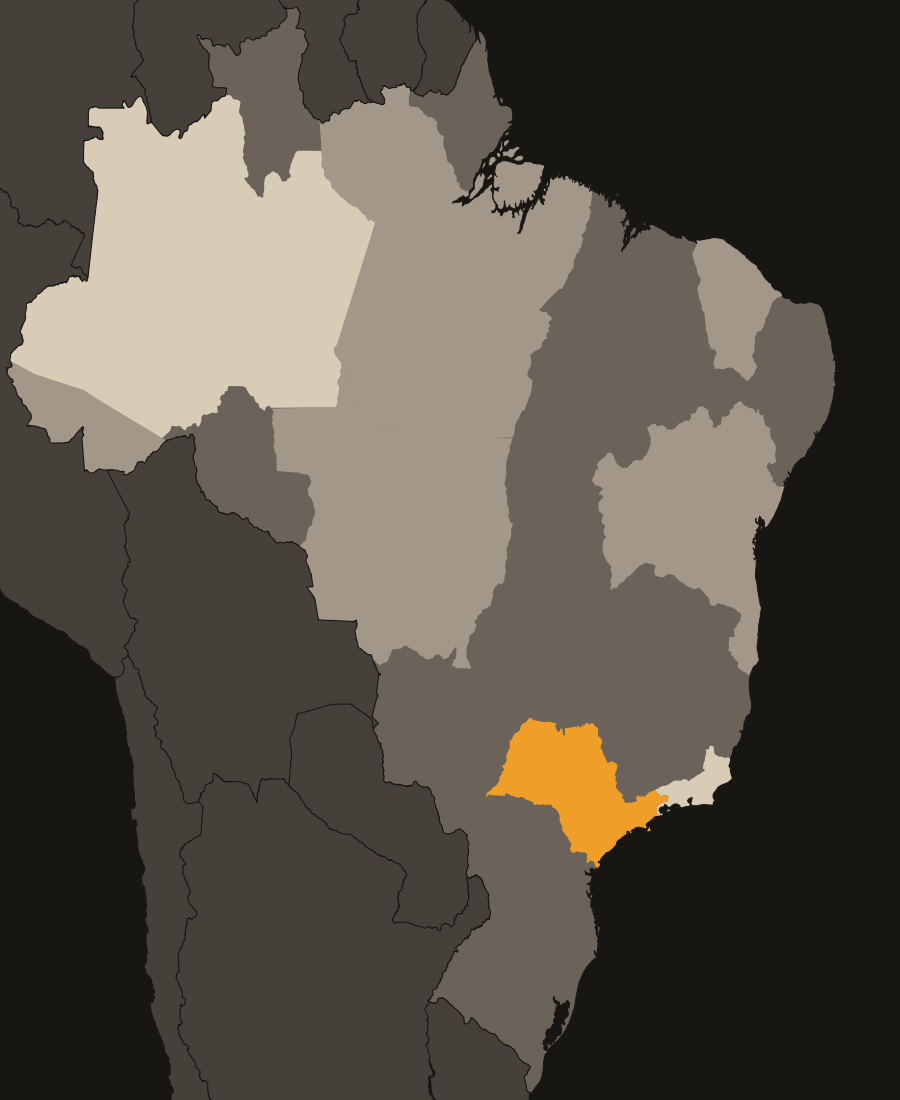
Comando Vermelho strongholdsOther states where the Comando Vermelho has a strong presenceSão Paulo, home of the PCCRest of BrazilThe map shades whole states to keep it simple. The factions control neighborhoods, prisons and trafficking routes inside those states. The Comando Vermelho is in about 20 states and the PCC in 23 or 24, plus Paraguay and Bolivia.
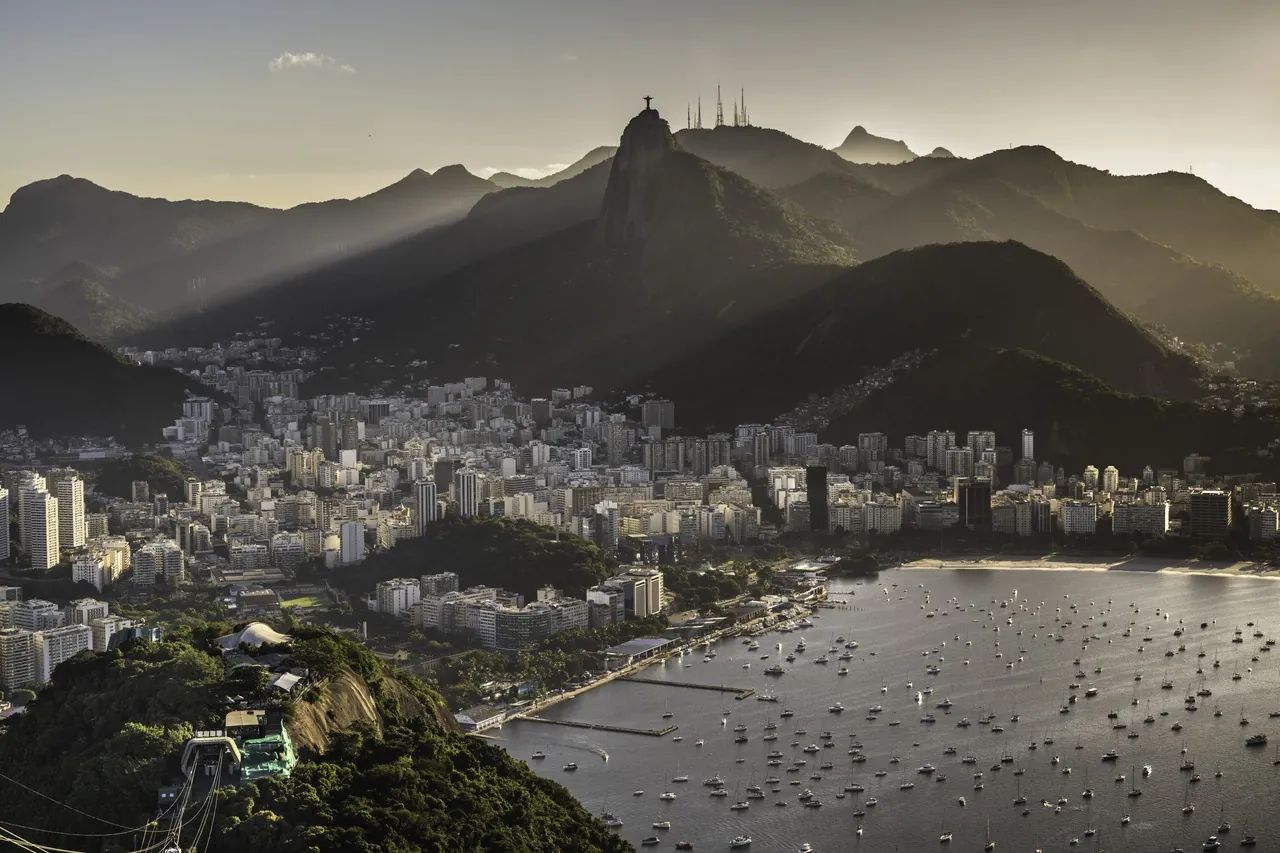
- Complexo do AlemãoRio strongholdThe Comando Vermelho's historic base, along with the neighboring Complexo da Penha. Rio's Public Security Institute counted 779 of 1,530 armed-group communities in the state under Comando Vermelho control in 2025. On October 28, 2025, about 2,500 police raided the area in Operation Containment, Brazil's deadliest police raid.
- São PauloPCC homeThe PCC's home city, where it dominates the drug trade and the prisons. Operation Carbono Oculto in August 2025 found that fintechs and investment funds that investigators linked to the PCC operated through Faria Lima, São Paulo's financial district. The port of Santos, nearby, is the exit point for most PCC cocaine bound for Europe. Customs seized 7 tons there in 2025.
- Presidente VenceslauPrisonA São Paulo state prison where top PCC leaders were held until February 2019, when they were moved to federal prisons. That transfer was meant to cut their control over the organization.
- Pedro Juan CaballeroParaguay borderA Paraguayan border town where the PCC established dominance after the killing of local trafficker Jorge Rafaat in June 2016. In July 2026 Paraguay's anti-drug agency raided a PCC meeting there, arresting an alleged leader and 13 others.
- Santa CruzBoliviaA Bolivian city the BBC described as a PCC refuge. The PCC leader known as Tuta was arrested there on May 16, 2025. The PCC's Uruguayan ally Sebastián Marset was arrested in Bolivia on March 13, 2026.
- ManausAmazonThe Comando Vermelho became dominant in Manaus after attacking its former ally, the Família do Norte, in 2020. It is now present in 55 of the 62 municipalities in Amazonas state. On January 1, 2017, 56 prisoners were killed in a massacre at the Compaj prison in Manaus.
- FortalezaExpandingThe Comando Vermelho took key neighborhoods in Fortaleza in September 2025, including Vicente Pinzón and Lagamar. Its local rival, the Guardiões do Estado, collapsed in 2025 and allied with the Terceiro Comando Puro.
- SalvadorExpandingInvestigators say the Comando Vermelho is expanding in Salvador. On November 4, 2025, Operation Freedom arrested 33 people in Bahia and 2 in Ceará suspected of links to the group.
What weapons do the Comando Vermelho and the PCC have?
Rifles are the dominant weapon, almost all made abroad.
Rifles
AK-pattern, AR-15, FAL · Mostly foreign: only 33 of 900+ seized in 2025 were made in Brazil
Rio state seized a record 922 rifles in 2025. Weapons from the armies of Venezuela, Argentina, Peru and Brazil were found after the October 2025 raid.
Heavy machine guns
.50-caliber machine guns · Not reported
Reported among the groups' weapons. Official data do not break down seized weapons by model.
Grenade-dropping drones
Commercial drones modified to carry grenades · Locally modified
Police images showed drones dropping grenades on officers during the October 28, 2025, raid on Complexo do Alemão and Penha.
Barricades
Stolen vehicles · Local
On October 28, 2025, gangs blocked roads with 71 stolen buses to slow the police advance.
Small arms
Pistols · Mixed
The October 2025 raid seized 91 rifles and 29 pistols, plus 14 explosive devices.
Semi-submersibles
Custom-built vessels · Not reported
Used in cocaine logistics through the Amazon and Atlantic, according to a September 2026 report by the Global Initiative Against Transnational Organized Crime.
- Rifles seized in Rio, 2025
- 922
- a record, up from 732 in 2024 (ISP)
- Rifles seized in the October 2025 raid
- 91
- plus 29 pistols and 14 explosive devices
- Made in Brazil
- 33
- of more than 900 rifles seized in 2025
Are the Comando Vermelho and the PCC terrorist groups?
The United States listed both as Foreign Terrorist Organizations in June 2026. Most other major governments have not.
 United StatesForeign Terrorist Organization since June 2026
 ParaguayDesignated both as international terrorist organizations by presidential decree, October 30-31, 2025
 ArgentinaAdded both to its RePET terrorism registry as narco-terrorist organizations, October 2025
 European UnionNot listed
 United KingdomNot listed
- UN Security CouncilNot listed
 RussiaNot listed
 ChinaNot listed
 BrazilLei 15.358/2026 sets 20-40 years in prison for faction crimes but does not use the word terrorist. President Lula opposes the label.
What happened in Rio's deadliest police raid?
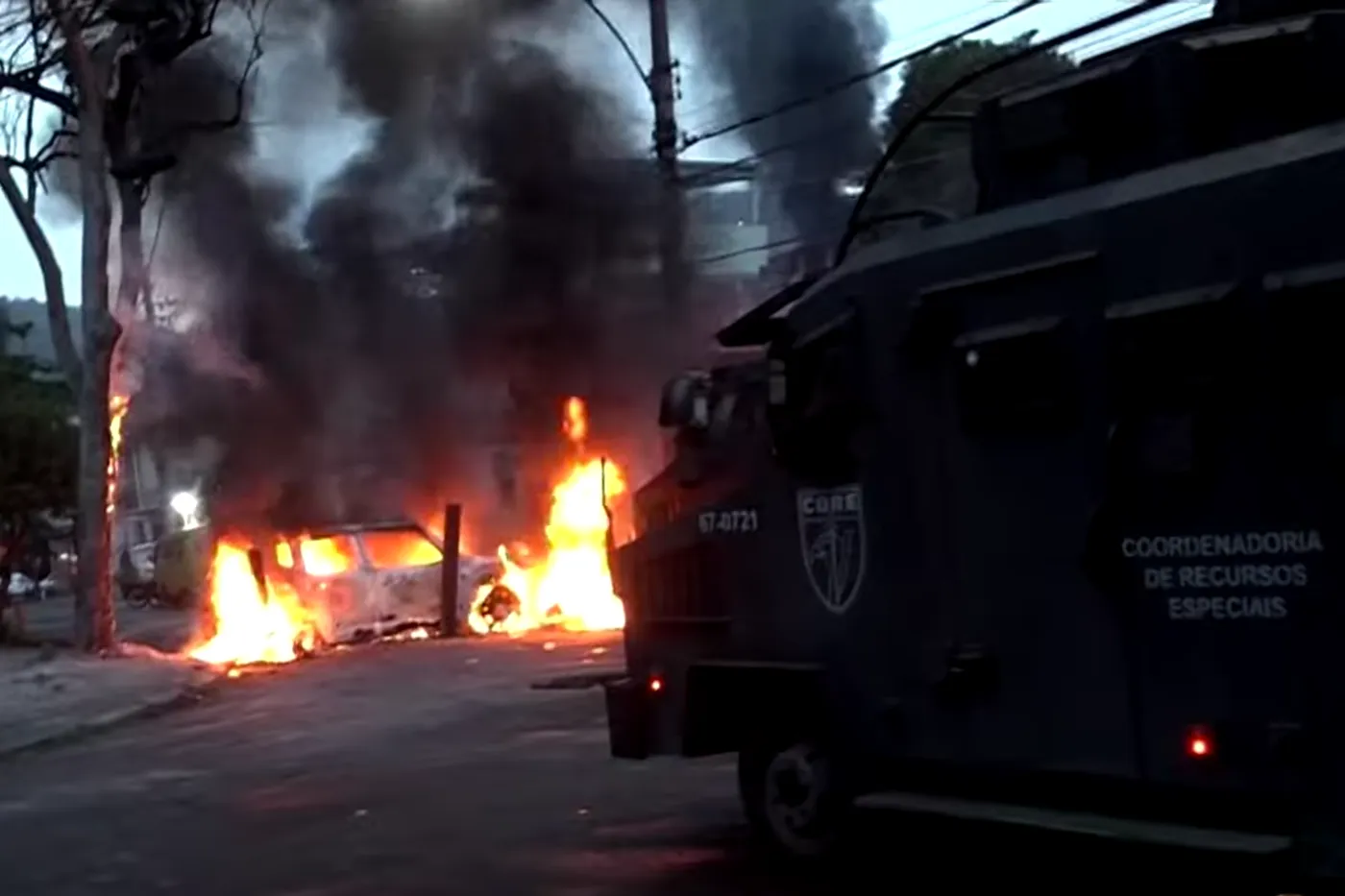
On October 28, 2025, about 2,500 police entered 26 communities in Complexo do Alemão and Complexo da Penha in Rio de Janeiro. The operation, called Operation Containment, targeted the Comando Vermelho. Police used 32 armored vehicles and 2 helicopters. By the state government's final count, 122 people were killed: 5 police officers and 117 people the government described as suspects. The fifth officer died on November 22, 2025.
Police said 108 of the dead had proven Comando Vermelho links and 59 had open warrants. The state government said those killed had resisted police. Police images showed drones dropping grenades on officers, and gangs blocked roads with 71 stolen buses. Residents laid out dozens of bodies in São Lucas Square in Penha. Amnesty International said several bodies showed signs of possible extrajudicial execution, such as shots to the back of the head and bound hands. Reuters reported that none of the 69 named targets on the wanted list was killed. Only 5 of the 69 were arrested. The main target, Edgard Alves de Andrade, known as Doca, escaped. Police seized 91 rifles, 29 pistols, 14 explosive devices and about 1 ton of drugs.
Cláudio Castro, then Rio's governor, called the operation "a success," apart from the deaths of the police officers. President Lula said on November 4 that "the judge's decision was an arrest warrant, there was no order for a massacre, and there was a massacre." The United Nations human rights office said it was "horrified" and called for independent investigations and reform of policing methods. An AtlasIntel poll found that 87.6% of favela residents supported the operation. As of October 2026, Rio prosecutors had filed no charges over the deaths. The Senate opened an inquiry on organized crime on November 4, 2025. It closed on April 14, 2026, without a report, after the rapporteur's text was rejected 6 to 4.
Operation Containment
122
People killed in Brazil's deadliest police raid
5 police officers and 117 people the state called suspects died on October 28, 2025, and in the weeks after. Reuters reported that none of the 69 named targets was killed.
How much of Rio does the Comando Vermelho control?
The Comando Vermelho controls 779 of the 1,530 communities in Rio de Janeiro state that are under the control of armed groups, according to the state's Public Security Institute, using 2025 data published on November 12, 2026. That is 50.9% of those communities, home to about 3 million people. Militias, which are paramilitary groups often linked to police officers, control 300 communities. The Terceiro Comando Puro holds 274 and the Amigos dos Amigos holds 91.
A study by GENI at the Fluminense Federal University, using 2024 data for the Rio metropolitan area, found that about 4 million people live under armed-group control or influence. The Comando Vermelho held 150 square kilometers, or 47.5% of the controlled territory, covering about 1.6 million people. ISP data show that since 2019 the Comando Vermelho has taken 39 areas from militias, 24 from the Terceiro Comando Puro and 21 from the Amigos dos Amigos.
Police and prosecutors say the Comando Vermelho charges residents fees on cooking gas, internet and housing. In October 2026, prosecutors charged 12 alleged members over a cooking-gas scheme, and a court froze R$327 million. A gas cylinder cost R$170 in the Rocinha favela in 2026, 84% above the government reference price. Firjan, Rio's industry federation, estimates that armed groups cost the state's formal economy R$21.4 billion a year.
Communities controlled by armed groups in Rio state (ISP, 2025)
How does the PCC make its money?
The PCC makes money from cocaine trafficking, according to investigators, and launders it through legal businesses. It ships cocaine through the port of Santos to Europe, working with partners including the Italian 'Ndrangheta. Brazilian customs seized 7 tons of cocaine at Santos in 2025, almost 40% of all the cocaine the Federal Revenue seized nationwide that year.
The PCC also launders money through legal businesses. In August 2025 Operation Carbono Oculto, run by the Federal Revenue, the São Paulo prosecutor's office and the Federal Police, said that more than 1,000 fuel stations linked to the PCC moved R$52 billion from 2020 to 2024. One payment institution acted as a "parallel bank," handling R$46 billion in untraceable flows. At least 40 investment funds held over R$30 billion. About 140 stations had no real sales but still received over R$2 billion in invoices. Those figures are flows and assets. They do not measure profit.
In May 2026, Operation Fluxo Oculto targeted six fintechs that investigators linked to the PCC that moved more than R$26 billion from 2022 to 2025. Prosecutor Lincoln Gakiya told the Senate in November 2025 that the PCC moves "at least R$10 billion a year," about $1.8 billion. On July 1, 2026, the US Treasury sanctioned a Florida-based network that it said laundered over $30 million for the PCC, partly in cryptocurrency.
Operation Carbono Oculto
R$52 billion
Moved through 1,000+ fuel stations, 2020-2024
These are financial flows. They do not measure PCC profit. The same investigation found R$46 billion in untraceable flows through one payment institution and over R$30 billion in investment funds.
How did Brazil's gang factions start?
The Comando Vermelho formed in 1979 at the Cândido Mendes prison on Ilha Grande, in Rio de Janeiro state. Common criminals jailed alongside left-wing guerrillas during the military dictatorship (1964 to 1985) organized a self-protection pact against guard abuse. The political ideology was soon dropped. The press coined the name "Comando Vermelho" that year. Its founders were William da Silva Lima, José Carlos dos Reis Encina and Rogério Lemgruber. The group moved into cocaine in the 1980s.
The PCC was founded on August 31, 1993 at the Taubaté prison in São Paulo state, the year after the Carandiru massacre of October 2, 1992, in which police killed 111 prisoners. Its stated aim was to fight oppression in the prison system. In May 2006 it shut down São Paulo for days with coordinated attacks after its leaders were moved to stricter prisons. The violence killed 564 people statewide, counting police reprisals.
The two groups had a rough truce for about 20 years. It collapsed in late 2016, as they fought over cocaine routes through Paraguay and the Amazon. In January 2017 prison massacres across northern Brazil killed more than 100 people. In February 2019 the government moved PCC leaders, including Marcola, to federal prisons to cut their contact with the organization. A brief truce in February 2025 collapsed by late April.
How Brazil's factions rose
- 1979The Comando Vermelho forms at the Cândido Mendes prison on Ilha Grande.
- Oct 2, 1992Police kill 111 prisoners in the Carandiru massacre in São Paulo.
- Aug 31, 1993The PCC is founded at the Taubaté prison in São Paulo state.
- May 2006PCC attacks shut down São Paulo. The violence, including police reprisals, kills 564 people statewide.
- Nov 2010Security forces occupy Complexo do Alemão, the Comando Vermelho's Rio stronghold.
- late 2016The roughly 20-year PCC-CV truce collapses.
- Jan 2017Prison massacres across northern Brazil kill more than 100 people.
- Feb 2019PCC leaders, including Marcola, are moved to federal prisons.
- Feb 2025The PCC and Comando Vermelho announce a truce. It collapses by late April.
- Oct 28, 2025Operation Containment in Rio kills 122 people, Brazil's deadliest police raid.
- Jun 5, 2026The United States designates both groups as Foreign Terrorist Organizations.
- Oct 25, 2026Lula is re-elected president. Douglas Ruas had already won the Rio governorship in the first round on October 4.
Who leads the Comando Vermelho and the PCC?
Authorities regard Márcio dos Santos Nepomuceno, known as Marcinho VP, as the Comando Vermelho's most senior leader. He has been in prison since 1996 and is held at the federal prison in Campo Grande. His sentences were declared served out in April 2026, but he remains in custody on two preventive warrants upheld by Supreme Court Justice André Mendonça. He won a 384-day sentence reduction for writing four books in prison. His wife and son were arrested in October 2026.
Luiz Fernando da Costa, known as Fernandinho Beira-Mar, has been sentenced to more than 300 years. He was arrested in Colombia in 2001. A 2025 report says he still helps lead the group from the federal prison in Catanduvas. Edgard Alves de Andrade, known as Doca, was the main target of the October 2025 raid. He escaped. Prosecutors call him the Comando Vermelho's "brain" in Rio state. He faced 26 warrants as of November 2025, and there is a R$100,000 reward for his capture.
The PCC's leader is Marcos Willians Herbas Camacho, known as Marcola. He has led the group since November 2002 and has been sentenced to more than 300 years. He is held at the federal prison in Brasília. His top deputy outside prison, known as Tuta, was arrested in Santa Cruz, Bolivia, on May 16, 2025. Both factions are run from prison.
The leadership
- CV leaderMarcinho VP (Márcio dos Santos Nepomuceno). In prison since 1996. Won a 384-day sentence reduction for writing four books.
- CV leader in Rio state (at large)Doca (Edgard Alves de Andrade). Escaped the October 2025 raid. R$100,000 reward for his capture.
- CV senior leader (imprisoned)Fernandinho Beira-Mar (Luiz Fernando da Costa). Arrested in Colombia in 2001. Sentenced to more than 300 years.
- PCC leaderMarcola (Marcos Willians Herbas Camacho). Has led the PCC since 2002. Held in the federal prison in Brasília.
- PCC leader (imprisoned)Tuta (Marcos Roberto de Almeida). Arrested in Bolivia in May 2025. Once the top PCC leader outside prison.
Why did the US list Brazil's gangs as terrorists?
Secretary of State Marco Rubio said the United States listed the groups because they are "two of the most violent criminal organizations in Brazil." On May 28, 2026, the United States designated both the Comando Vermelho and the PCC as Specially Designated Global Terrorists. On June 5, 2026, both designations as Foreign Terrorist Organizations took effect. The PCC had already been under separate US narcotics sanctions since December 15, 2021.
The designation came about 24 hours after Senator Flávio Bolsonaro met President Trump on May 25-26, 2026. Bolsonaro said he had asked for it. He was running for president on a platform that included declaring the groups narco-terrorist organizations and building prisons modeled on El Salvador.
President Lula opposes the terrorist label. His foreign-affairs adviser, Celso Amorim, said "international cooperation is welcome, especially in matters of money laundering and arms trade," but any "pretext for intervention" is "unacceptable." In early July 2026 Brazil's Foreign Ministry told the Chamber of Deputies that the designation carried a "risk of use of US military force against national territory." The US State Department called that assessment "absurd."
Brazil passed its own anti-faction law, Lei 15.358, on March 24, 2026. It punishes criminal faction crimes with 20 to 40 years in prison but does not use the word terrorist. Paraguay designated both groups as international terrorist organizations on October 30-31, 2025. Argentina added them to its RePET terrorism registry in October 2025. Lula was re-elected on October 25, 2026.
Questions about the Comando Vermelho
Is the Comando Vermelho part of the Brazilian government?
No. The Comando Vermelho has no political wing and no seats in any legislature. It is a criminal faction that controls neighborhoods and prisons. A Rio state deputy, TH Joias, was arrested in 2025 over alleged links to the group.
How many members does the Comando Vermelho have?
About 30,000, according to a 2020 estimate by InSight Crime that the UK Home Office also uses. The group is present in about 20 Brazilian states. Experts quoted by the Associated Press in May 2026 put the two groups together at more than 50,000 members.
How many members does the PCC have?
About 40,000 sworn members, according to São Paulo prosecutors. Including about 60,000 associates, the total reaches roughly 100,000. The Global Initiative Against Transnational Organized Crime says the PCC has over 40,000 members active in 28 countries.
What is Operation Carbono Oculto?
A Brazilian law enforcement operation launched on August 28, 2025, targeting PCC money in the fuel and financial sectors. About 1,400 agents worked across 10 states. Investigators found that more than 1,000 fuel stations moved R$52 billion from 2020 to 2024. The amounts are financial flows. They do not measure PCC profit.
What is Brazil's anti-faction law?
Brazil's anti-faction law is Lei 15.358, enacted on March 24, 2026. It creates a separate criminal offense for belonging to or leading a criminal faction, with sentences of 20 to 40 years. It does not call the factions terrorist groups. The government sent the bill to Congress on October 31, 2025. The law was published on March 25, 2026.
Does the Comando Vermelho work with the PCC?
No. The two groups had a rough truce for about 20 years, which collapsed in late 2016. They fought over cocaine routes through Paraguay and the Amazon, and prison massacres followed in January 2017. A short truce in February 2025 broke down by late April. The Comando Vermelho publicly declared the PCC its enemy.