
Country profile · Central America
 Guatemala
 is Central America's most populous country and its largest economy, with about 18 million people. President Bernardo Arévalo won in 2023 promising to fight corruption, but his party was dissolved and 78% of Guatemalans disapprove of him. Guatemalans abroad sent home a record $25.5 billion in 2025, about a fifth of GDP. Guatemala is one of the last countries to recognize Taiwan.
Where Guatemala ranks
All rankings →Who runs Guatemala?
President Bernardo Arévalo was born on October 7, 1958 in Montevideo, Uruguay, where his father, former president Juan José Arévalo, was in exile. A sociologist and former diplomat, he won the August 2023 runoff for the Movimiento Semilla party with 58% of the vote. He promised to fight corruption. Prosecutors under Attorney General Consuelo Porras, whom the United States and the EU sanctioned, tried to block him from taking office. He was sworn in just after midnight on January 15, 2024. After a judge's order, Semilla was cancelled in March 2026. Most of its former deputies now sit in a new party, Raíces. Arévalo has no majority in the 160-seat Congress. Porras's term ended on May 16, 2026. Arévalo replaced her with Gabriel García Luna, a judge, who shut down her special prosecutor's office. A CID Gallup poll in September 2026 found 78% disapprove of Arévalo. The constitution bars him from running again. The next general election is on June 27, 2027.
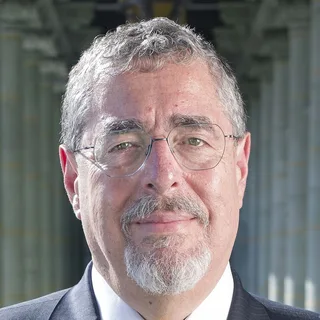
Official portrait (2024): Government of Guatemala, Wikimedia Commons, public domain (cropped)
Who are Guatemala's allies and rivals?
The United States is Guatemala's most important partner. Secretary of State Marco Rubio visited in February 2025, and President Bernardo Arévalo agreed to accept more deportation flights and to take deportees from other countries. Since April 2026 the United States has also flown deported Mexicans to Guatemala. By late September 3,411 had arrived. A trade agreement with the United States was signed in January 2026. Guatemala is one of 12 countries that recognize Taiwan instead of China. Arévalo visited Taiwan in June 2025. In 2018 Guatemala moved its embassy in Israel to Jerusalem, two days after the United States. Guatemala claims about 11,030 sq km of Belize, almost half the country. Both sides voted to send the case to the International Court of Justice, which holds hearings in February 2027. Mexican cartels fight over the 956 km border with Mexico. Guatemalan special forces serve with the UN in Congo, and in 2026 Arévalo began doubling troops in the Gang Suppression Force in Haiti to 300.
Allies and partners
 United StatesBiggest trade partner; Guatemala takes deportees, including other nationalities
 TaiwanOne of 12 countries that recognize it; Arévalo visited in 2025
 IsraelEmbassy in Jerusalem since 2018
 El SalvadorSecond-largest export market; new border bridge in October 2026
Tensions
 BelizeGuatemala claims almost half of it; ICJ hearings in February 2027
 ChinaNo relations; supplies 16% of Guatemala's imports
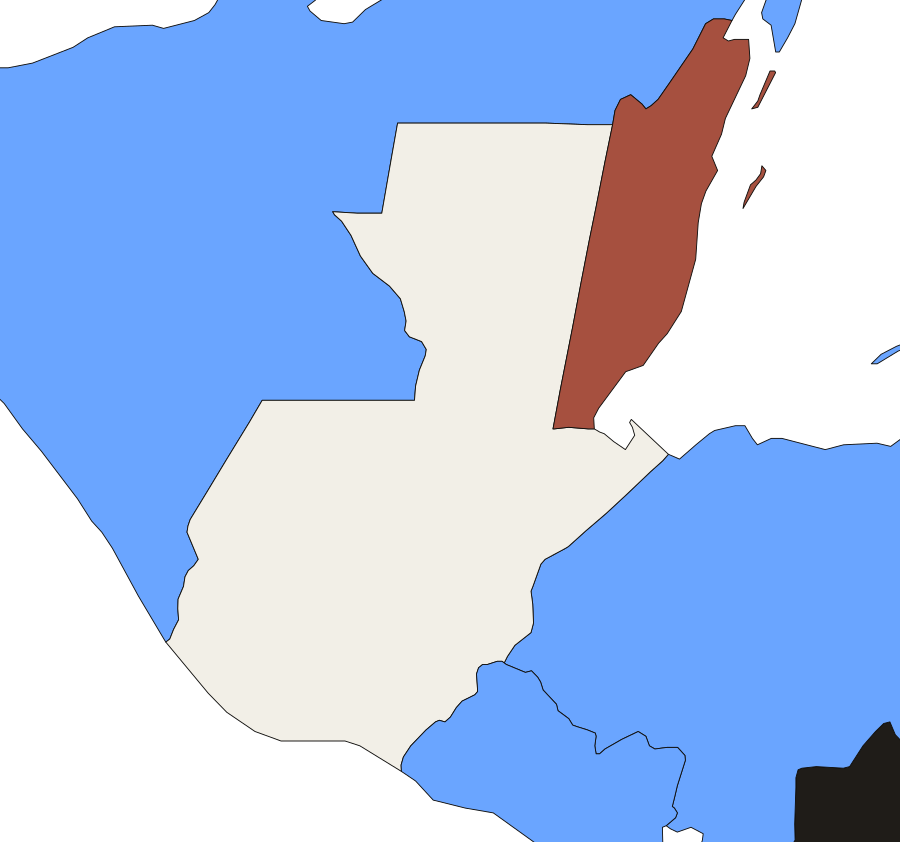
- Sapodilla Cayes Belizean islands also claimed by Guatemala and Honduras. The ICJ hears the case in March 2027.
- La Mesilla Border town where Mexican cartels fight. Arévalo doubled troops on the border in December 2025.
- Poptún Base of the Kaibil special forces. US officials visited in October 2026 to plan joint training.
- Fraijanes Prison from which 20 Barrio 18 gang members escaped in October 2025. Nine were still free a year later.
- Guatemala
- Partner
- Tensions
Who does Guatemala trade with?
Guatemala exported $15.6 billion of goods in 2025 and imported $34.6 billion (Bank of Guatemala). The gap is covered by money sent home from abroad: a record $25.5 billion in 2025, about 21% of GDP. The United States bought 30% of exports (chart), but Central America together bought more, at 36%. Clothing was the biggest export, followed by coffee, bananas, sugar and palm oil. Guatemala sells more than half of the world's cardamom, mostly to Saudi Arabia and other Gulf countries, but the 2025 crop collapsed. The United States supplied 32% of imports and China 16%. Since July 2026 the United States has charged a 10% tariff on about 28% of Guatemala's exports. Coffee, bananas and sugar are exempt. The economy grew 4.3% in 2025. Government debt is low, about 27% of GDP, but so are taxes, about 12% of GDP. Over half of Guatemalans are poor, and 42% of children under five are stunted by chronic malnutrition (2025).
Sells to
Share of Guatemala's exports
- United States30.4%
- El Salvador13.7%
 Honduras11.4%
 Nicaragua7.0%
 Mexico4.4%
Buys from
Share of Guatemala's imports
- United States31.5%
- China15.9%
- Mexico9.9%
- El Salvador4.7%
 Panama3.7%
Goods, 2025, preliminary. Bank of Guatemala.
Why do so many Guatemalans go to the United States?
About 1.3 million people born in Guatemala lived in the United States in 2023 (Migration Policy Institute). About 2.2 million people of Guatemalan origin live there, counting those born in the United States. Most leave because of poverty, extortion and crime. Drought keeps destroying maize harvests in the Dry Corridor in the east. In 2019 US border agents caught about 264,000 Guatemalans. The numbers stayed above 200,000 a year until 2024, then fell to 36,113 in the year to September 2025. The United States deported 48,405 Guatemalans in 2025. By October 8, 2026, 55,061 had been returned from the United States and Mexico, already more than in all of 2025. The money they send home is worth about a fifth of GDP, among the highest shares in the world (chart). It still grew in the first nine months of 2026, by 5.5%, but more slowly than the 19% of 2025. Guatemala has never had Temporary Protected Status, which shields some migrants from deportation.
Money sent home by migrants, share of GDP, Central America and Mexico, 2025
Full ranking →- Honduras30.1%
- El Salvador27.5%
- Guatemala20.8%
- Belize3.7%
- Mexico3.6%
 Costa Rica0.8%
World Bank World Development Indicators, from KNOMAD and IMF balance of payments data, October 2026
How dangerous are Guatemala's gangs?
Two gangs that grew out of Los Angeles, Barrio 18 and MS-13, run extortion rackets in Guatemala City and other towns. On October 12, 2025, 20 Barrio 18 members escaped from the Fraijanes II prison. Days later Congress declared both gangs terrorist groups, as the United States had done that year. In January 2026 gang members rioted in three prisons and killed police officers, 11 by final counts. President Bernardo Arévalo declared a 30-day state of siege, followed by rolling 15-day states of prevention. There were 17.4 murders per 100,000 people in 2025 (InSight Crime), up from 16.1 in 2024, but the rate fell in the first seven months of 2026. Guatemala is also a main route for cocaine heading north to Mexico and the United States. It seized a record 18.2 tonnes in 2024. It sent at least 26 suspects to the United States for trial in 2026. On October 17, 2026 a former prosecutor who had exposed links between gangs, traffickers and politicians was shot dead in Guatemala City.