
Country profile · Central America
 Nicaragua
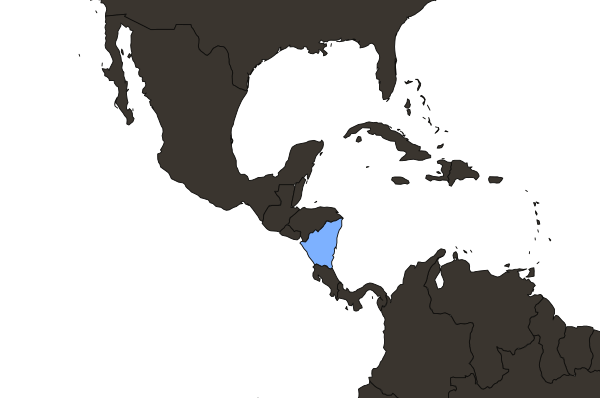
 is the largest country in Central America and the poorest, with about 7 million people. Daniel Ortega has ruled since 2007, and since 2025 his wife, Rosario Murillo, has been co-president. The government has stripped 451 critics of their citizenship and drawn close to Russia and China. In July 2026 Ortega said there will be no more elections.
Where Nicaragua ranks
All rankings →Who runs Nicaragua?
Daniel Ortega, born in 1945, was a guerrilla in the Sandinista National Liberation Front (FSLN), which overthrew the Somoza family dictatorship on July 19, 1979. Ortega led the country until he lost the 1990 election to Violeta Chamorro. He returned to power in January 2007 and has won every election since. Before the 2021 vote, about 40 opponents were jailed, including seven would-be presidential candidates. The FSLN won 75 of the 90 elected seats in the National Assembly, and the other parties are its allies. His wife, Rosario Murillo, became vice president in 2017. A constitution passed in January 2025 made her co-president and moved the next election from 2026 to November 2027. If Ortega dies, Murillo takes over alone. On July 19, 2026 Ortega said there will be no more elections. On September 1, 2026 the Assembly gave a first approval to seven-year terms, a 2028 election and a ban on candidates it calls traitors. Ortega turns 81 in November and appears in public less and less.
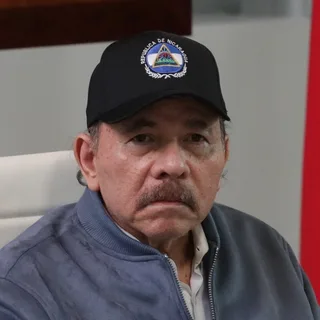
Photo (July 2024): State Duma of the Russian Federation, Wikimedia Commons, CC BY 4.0 (cropped)
Who are Nicaragua's allies and rivals?
Russia is Nicaragua's closest partner. It sold Nicaragua 50 T-72 tanks in 2016 and opened a satellite ground station and a police training center in Managua in 2017. Every six months a presidential decree lets foreign troops enter for training. A military cooperation pact signed in September 2025 took effect in 2026, and in June 2026 Russia confirmed it has military advisers in Nicaragua. In July 2025 Ortega recognized Crimea and four other Ukrainian regions as Russian. Ukraine cut ties. Nicaragua switched recognition from Taiwan to China in December 2021, and a free trade deal with China took effect on January 1, 2024. Nicaragua left the Organization of American States in 2023 and has quit nine international bodies, most recently the Central American Parliament in October 2026. The United States and the European Union sanction the Ortega family and officials. In October 2026 Nicaragua refused to accept the new US ambassador, and the US recalled its top diplomat from Managua.
Allies and partners


Rivals
 United StatesSanctions on the Ortega family; ambassador refused in 2026
- European UnionSanctions on 21 people and 3 entities
 Costa RicaHosts most exiles; no Nicaraguan ambassador since 2022
 UkraineCut ties in 2025 over Nicaragua's recognition of Russian annexations
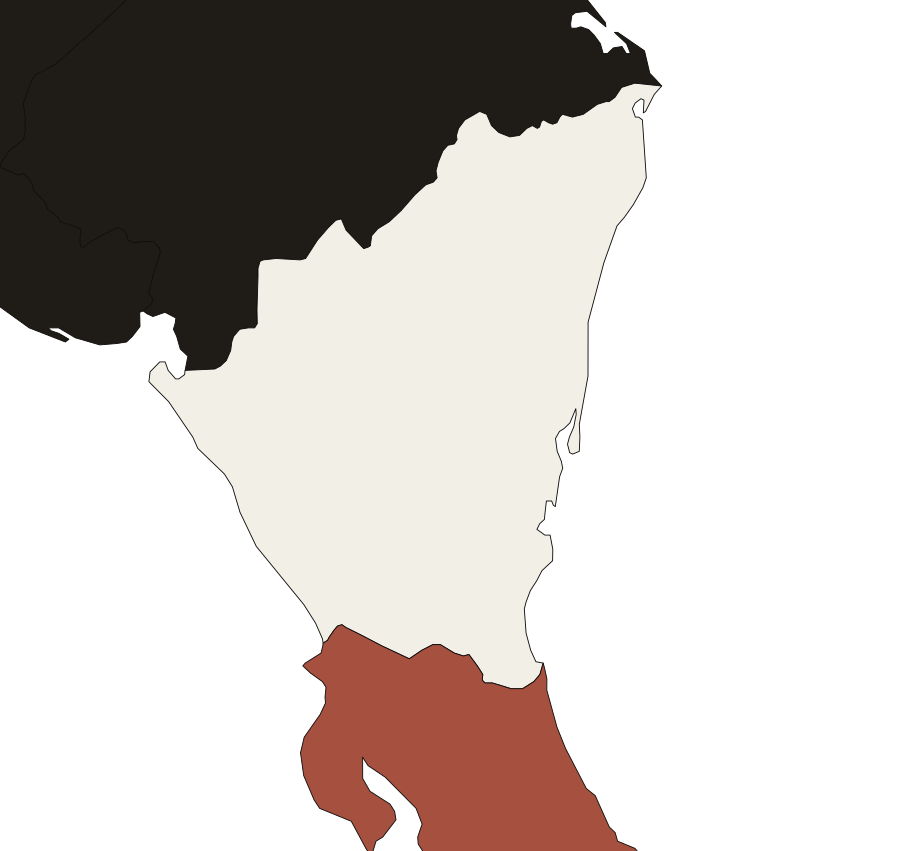
- Managua The capital. Russia opened a satellite ground station and a police training center here in 2017.
- Bluefields Caribbean end of a 445 km canal route that Ortega offered China in November 2024. Nothing has been built.
- Isla Portillos Border wetland ruled by the International Court of Justice in 2015 and 2018 to belong to Costa Rica.
- San Andrés Colombian islands. In 2012 the ICJ gave Nicaragua about 70,000 sq km of the surrounding sea.
- Nicaragua
- Tensions
Who does Nicaragua trade with?
Nicaragua exported $8.7 billion of goods in 2025, counting the free trade zones, and imported $12.4 billion (UN Comtrade). The United States bought 46% of exports (chart). Gold was the biggest single export, worth $1.97 billion in 2025, and gold sales rose 79% in the first half of 2026 as prices climbed. Beef and coffee follow. Factories in the free zones sell clothing to the United States and wire harnesses to Mexico. China supplied about 17% of imports, and its share has grown since a free trade deal took effect in 2024. The US Supreme Court struck down the 18% tariff of 2025. Since July 2026 the US has charged 12.5% on goods that do not qualify for the CAFTA-DR free trade deal, and another tariff on such goods rises to 10% on January 1, 2027. Free-zone exports fell 10% in the first half of 2026. The IMF estimates that Nicaraguans abroad sent home $6.3 billion in 2025, about 29.5% of GDP. The economy grew 4.9% in 2025.
Sells to
Share of Nicaragua's exports
- United States46.3%
 Mexico12.2%
 Canada10.7%
 El Salvador6.1%
 Honduras5.4%
Buys from
Share of Nicaragua's imports
- United States21.4%
 China16.8%
- Honduras9.3%
- Mexico8.1%
 Guatemala7.5%
Goods, 2025, as reported by Nicaragua. UN Comtrade.
Why have so many Nicaraguans left?
In April 2018 protests against a pension reform grew into a national uprising. Police and armed government supporters crushed it. The Inter-American Commission on Human Rights counted at least 355 dead by July 2019. Since then the government has jailed or exiled almost every critic. On February 9, 2023 it flew 222 political prisoners to Washington and stripped them of their citizenship. With later expulsions, 451 Nicaraguans have lost their nationality, and about 200 others have been barred from coming home. More than 5,600 groups have been shut down, including the Jesuit university in Managua. Three bishops have been expelled. In September 2026 UN experts verified 161 forced disappearances since 2018 and 8 deaths in state custody. By civil-society estimates about 800,000 Nicaraguans, more than one in ten, have left since 2018. Costa Rica has received about 280,000 asylum applications from Nicaraguans since 2018. At the end of 2025 UNHCR counted 35,341 Nicaraguan refugees (chart) and 269,315 asylum seekers abroad.
Refugees by country of origin, Central America and the Caribbean, 2025
Full ranking → Haiti180,702
- Honduras94,449
- El Salvador68,182
- Nicaragua35,341
- Guatemala34,994
 Cuba29,395
UNHCR Refugee Population Statistics Database
Will Nicaragua build a canal?
Since the 19th century people have dreamed of a canal across Nicaragua, through Lake Nicaragua, to rival the one in Panama. In June 2013 the National Assembly gave a 50-year concession to HKND, a Hong Kong company owned by the Chinese businessman Wang Jing. The project was valued at about $40 to $50 billion. A groundbreaking ceremony was held in December 2014, but no work followed. The Assembly revoked the concession on May 8, 2024. In November 2024 Daniel Ortega offered China a new 445 km route from Bluefields on the Caribbean through Lake Managua to Corinto on the Pacific. The transport ministry estimated the cost at about $64.5 billion. The 2025 constitution allows the state to grant canal concessions. By October 2026 no agreement, study or financing had been reported, and the 2026 budget gave the canal authority about 9 million córdobas.