
Country profile · Central America
 Costa Rica
 is a Central American country of about 5.2 million people that abolished its army in 1948. President Laura Fernández took office in May 2026, with her predecessor Rodrigo Chaves as finance minister. The United States buys about half of its goods exports. Homicides hit a record 905 in 2023, most of them linked to drug gangs.
Where Costa Rica ranks
All rankings →Who runs Costa Rica?
Costa Rica is a presidential republic. Presidents cannot serve two terms in a row. President Laura Fernández was born on July 4, 1986 in Puntarenas province. She studied political science at the University of Costa Rica. Under President Rodrigo Chaves she served as planning minister from 2022 and minister of the presidency from 2024. Fernández won the election of February 1, 2026 in the first round with 48.53%, against 33.65% for Álvaro Ramos of the National Liberation Party. She took office on May 8, 2026, the second woman to lead Costa Rica. She made Chaves minister of the presidency and finance minister. As a minister he keeps immunity from prosecution. The Legislative Assembly had twice failed to lift it in 2025. Her party, Pueblo Soberano, holds 31 of the 57 seats (chart), but changes to the constitution need 38. Fernández promises a "Third Republic" with a smaller state. She called an order by the Constitutional Chamber a "judicial coup" in July 2026.

- Pueblo Soberano 31
- National Liberation (PLN) 17
- Frente Amplio 7
- Others 2
Photo (May 8, 2026): Esteban Rojas Saurez, Legislative Assembly of Costa Rica, Wikimedia Commons, public domain (cropped)
Who are Costa Rica's allies and rivals?
The United States is Costa Rica's closest partner. It bought 49.8% of Costa Rica's goods exports in 2025 (INEC). Since July 24, 2026 the United States has charged a 12.5% tariff on most of them. In February 2025 Costa Rica took in 200 migrants deported from the United States, mostly from Asia, and held them at a center near the Panama border. Since April 2026 it has accepted up to 25 deportees a week under a new agreement. Costa Rica switched recognition from Taiwan to China in June 2007. A free trade deal with China took effect in 2011. In 2023 a decree kept China's Huawei out of the country's 5G network. Relations with Nicaragua are poor. The International Court of Justice ruled in 2015 that Nicaragua had violated Costa Rica's territory at Isla Portillos. About 200,000 people have sought protection in Costa Rica, 85% of them Nicaraguans. Costa Rica broke relations with Cuba in March 2026.
Allies and partners
 United StatesBuys about half of goods exports
 ChinaRecognized since 2007; trade deal since 2011
 El SalvadorSecurity pact signed in October 2026

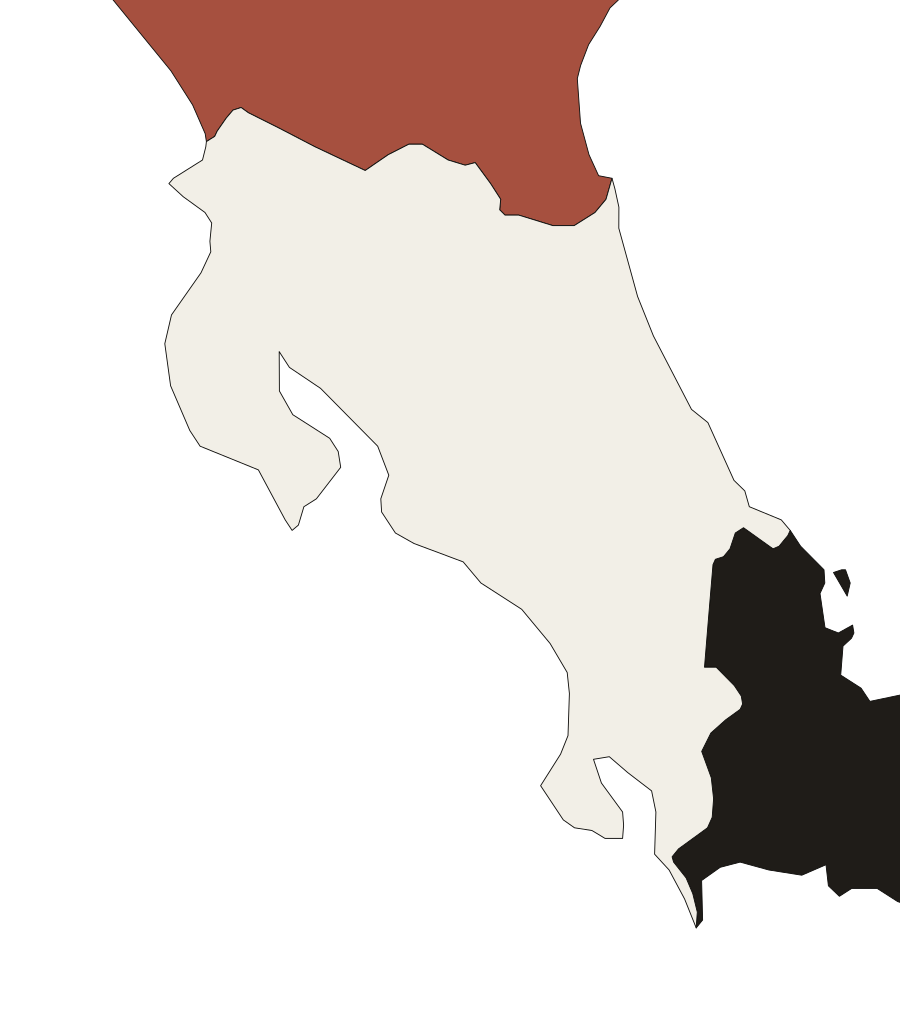
- Isla Portillos The ICJ ruled in 2015 it belongs to Costa Rica. Nicaragua had dug channels and stationed troops there.
- Port of Moín Container port where scanners have found more than 23 tonnes of cocaine since July 2023.
- CATEM, Corredores Migrant center near the Panama border where deportees from the United States were held in 2025.
- Costa Rica
- Tensions
Who does Costa Rica trade with?
Costa Rica exported a record $22.86 billion of goods in 2025 (PROCOMER). Medical devices made up 48% of that, $10.93 billion, mostly made in free trade zones. In 2024 the United States bought 47.9% of Costa Rica's goods exports and supplied 36.5% of its imports, as reported to UN Comtrade (chart). China supplied 17.1% of imports that year. Costa Rica is the world's largest exporter of pineapples, with about 49% of world trade in 2024 (FAOSTAT). Intel announced in July 2025 that it would close its chip assembly plant near San José. More than 2,000 staff stay in engineering. Tourism brought 2.69 million visitors by air in 2025. The economy grew 4.6% in 2025, and the IMF expects 3.3% in 2026. Renewable sources made 98.6% of the country's electricity in 2025, mostly hydropower. In a 2024 drought the share fell to about 86%.
Sells to
Share of Costa Rica's exports
- United States47.9%
 Netherlands8.6%
 Guatemala5.2%
 Belgium5.0%
 Nicaragua3.7%
Buys from
Share of Costa Rica's imports
- United States36.5%
- China17.1%
 Mexico6.4%
 Brazil2.9%
- Guatemala2.6%
Goods, 2024, as reported by Costa Rica. UN Comtrade.
Why does Costa Rica have no army?
In 1948 a disputed presidential election led to a civil war that lasted 44 days, from March 12 to April 24, and killed about 2,000 people. The rebel leader José Figueres Ferrer won. On December 1, 1948 he declared the army abolished. He struck a wall of the Bellavista barracks with a sledgehammer. The barracks is now the National Museum. Article 12 of the 1949 constitution bans an army as a permanent institution. It allows military forces only under a continental agreement or for national defense, under civilian control. In January 1955 rebels backed by Nicaragua invaded. Costa Rica asked the Organization of American States for help, and the United States sold it four fighter planes for $1 each. Today civilian police, a coast guard, an air surveillance service and a border police keep order. December 1 has been a national holiday since 2020. President Óscar Arias won the Nobel Peace Prize in 1987 for a Central American peace plan.
Why is crime rising in Costa Rica?
Costa Rica had a record 905 homicides in 2023, 17.2 per 100,000 people. There were 876 in 2024 and 873 in 2025 (Judicial Investigation Agency, OIJ). About 69% of the 2025 killings were classed as settling scores, which usually means gang and drug violence. Cocaine from South America passes through Costa Rica on its way to the United States and Europe. Police seized 46.5 tonnes in 2025 and 40.6 tonnes from January to August 2026, 49.5% more than a year earlier. In March 2026 the former security minister Celso Gamboa was extradited to the United States on cocaine trafficking charges, after a 2025 change to the constitution allowed Costa Ricans to be extradited for drug crimes. On October 14, 2026 President Laura Fernández opened CACCO, a prison for 5,100 inmates modeled on El Salvador's CECOT. Two days later she toured CECOT and met President Nayib Bukele. Killings fell slightly in 2026: 590 by September 21, 43 fewer than a year earlier.