
Country profile · Western Balkans
 Serbia
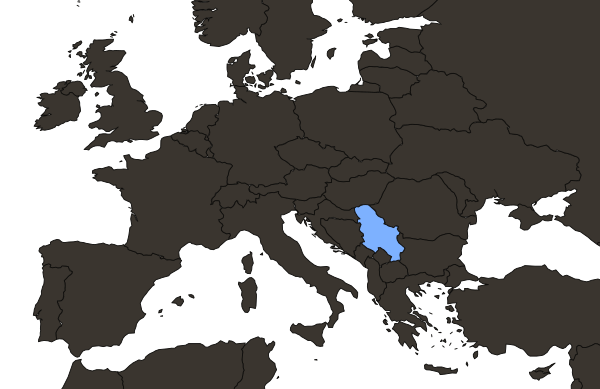
Serbia has about 6.5 million people, not counting Kosovo, and its population shrinks every year. Aleksandar Vučić has dominated its politics since 2012. He resigned as president on September 27, 2026 to run for prime minister in a snap election on October 25. Serbia wants to join the EU but stays close to Russia and China.
Where Serbia ranks
All rankings →Which alliances is Serbia in?
All alliances →Disputed territories involving Serbia
All disputed territories →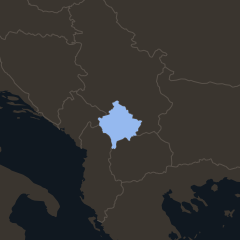
Who runs Serbia?
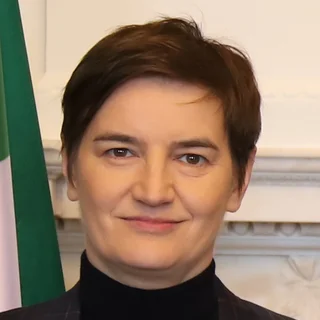
Aleksandar Vučić has led Serbia's politics since his Serbian Progressive Party came to power in 2012. He was born in Belgrade in 1970 and served as information minister under Slobodan Milošević from 1998 to 2000. He was prime minister from 2014 and president from 2017. On November 1, 2024 the roof over the entrance of the newly rebuilt Novi Sad railway station collapsed and killed 16 people. Students blamed corruption and led protests across the country. The prime minister resigned in January 2025. On September 9, 2026 Vučić dissolved the parliament elected in December 2023 (chart) and called an early election for October 25. On September 27 he resigned as president, eight months before his term ended, to run for prime minister. Ana Brnabić, the speaker of parliament, is acting president. A list backed by the protesting students is his main rival, and polls disagree on who leads. A presidential election must follow by late December 2026.
- SNS-led list 129
- Serbia Against Violence 65
- Other parties and minority lists 56
Photo (2023): Houses of the Oireachtas, Wikimedia Commons, CC BY 2.0 (cropped)
Who are Serbia's allies and rivals?
Serbia has been a candidate to join the European Union since 2012. The EU buys about 60% of its exports and holds the largest share of foreign investment. But the talks have stalled. Serbia has opened 22 of 35 negotiating chapters and closed two, and in April 2026 the EU froze its aid payments over new judicial laws. Serbia is the only EU candidate in the Western Balkans that has not joined EU sanctions on Russia. It gets most of its gas from Russia, and Aleksandar Vučić met Vladimir Putin in Moscow in May 2025. China is Serbia's largest single foreign investor. Xi Jinping called the relationship an "ironclad friendship" when Vučić visited Beijing in May 2026. Serbia declared itself militarily neutral in 2007. It uses Chinese air defenses, and in 2024 it ordered 12 Rafale fighter jets from France. In March 2025 Croatia, Albania and Kosovo signed a defense declaration that Belgrade called a provocation.
Allies and partners


Tensions
 KosovoIndependent since 2008; Serbia rejects it
 CroatiaDefense pact with Albania and Kosovo in 2025
- Novi Sad A station canopy collapsed here on November 1, 2024 and killed 16 people, setting off nationwide protests.
- Pančevo NIS refinery. US sanctions on its Russian owners stopped it for 36 days in late 2025 to early 2026.
- Bor Copper and gold mines run by China's Zijin Mining, Serbia's largest exporter.
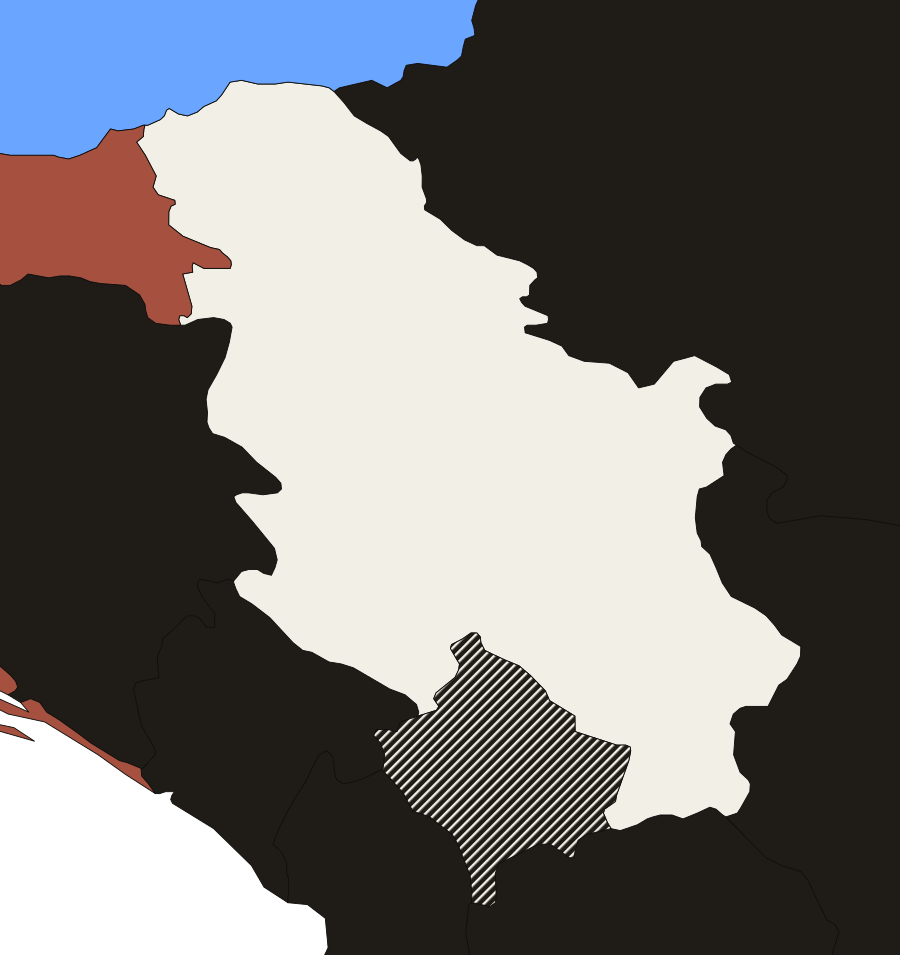
- Banjska A Serb armed group attacked Kosovo police here on September 24, 2023. Four people died.
- Serbia
- Partner
- Tensions
- Kosovo, independent since 2008, claimed by Serbia
Who does Serbia trade with?
Serbia exported goods worth €33.1 billion in 2025 and imported €41.9 billion (Statistical Office). The European Union takes about 60% of its exports, and Germany is the largest single market (chart). China sells Serbia more than any other country, and a free trade deal with China took effect in July 2024. Chinese companies also run some of Serbia's biggest exporters. Zijin Mining's copper and gold mines at Bor are the largest. In June 2026 the United States stopped imports of Zijin's Serbian copper over forced labor claims. Stellantis builds the Fiat Grande Panda in Kragujevac, and Serbia is the world's largest exporter of frozen raspberries. Protests stopped a lithium mine planned by Rio Tinto at Jadar in 2022. A court revived it in 2024, but Rio Tinto paused the project in November 2025, citing no progress on permits. Belgrade will host the world's fair, EXPO 2027, from May 15 to August 15, 2027.


Why doesn't Serbia recognize Kosovo?
Kosovo was a province of Serbia where Albanians were a large majority. In 1998 and 1999 Serbian forces fought Albanian rebels there. About 13,500 people were killed or went missing, more than 10,000 of them Albanians (Humanitarian Law Center). NATO bombed Serbia for 78 days in 1999, and Serbia withdrew. The UN ran Kosovo until it declared independence on February 17, 2008. Serbia's constitution calls Kosovo an integral part of Serbia, and changing that needs two-thirds of parliament and a referendum. Many Serbs see Kosovo as the cradle of their nation, with old Orthodox monasteries and the site of the 1389 Battle of Kosovo. About 100 to 120 countries recognize Kosovo. Russia and China do not, and they block its UN membership. In 2023 the EU brokered a deal under which Serbia would stop blocking Kosovo in international bodies, but neither side signed it. On September 24, 2023 a Serb armed group attacked Kosovo police at Banjska. Its leader still lives freely in Serbia.
Why does Serbia depend on Russian gas?
Serbia has almost no gas of its own. It buys most of it from Russia's Gazprom, through the TurkStream pipeline under the Black Sea and on through Bulgaria. Russia supplied about 88% of the gas Serbia imported in 2025 (chart). Serbia's long-term contract ran out in 2025. Gazprom has since extended it a few months at a time, most recently to December 31, 2026. A pipeline from Bulgaria, opened in December 2023, brings up to 400 million cubic meters a year from Azerbaijan. Russian companies also own most of NIS, Serbia's only oil refiner. The United States put sanctions on NIS in October 2025, and its refinery at Pančevo stopped for 36 days. Hungary's MOL agreed in January 2026 to buy the Russian stake, but the deal is not signed. US permission for NIS to keep working runs only to October 30, 2026. Coal makes about two-thirds of Serbia's electricity.
Share of gas imports from Russia, 2025
Full ranking → Kyrgyzstan98.1%
 Bosnia and Herzegovina96.0%
 Kazakhstan88.7%
- Serbia87.6%
 Armenia82.3%
 Hungary73.4%
 Slovakia63.3%
 Bulgaria54.4%
 North Macedonia46.2%
 Greece40.8%
 Turkey36.6%
UN Comtrade Database