
Country profile · Central Asia
 Kazakhstan
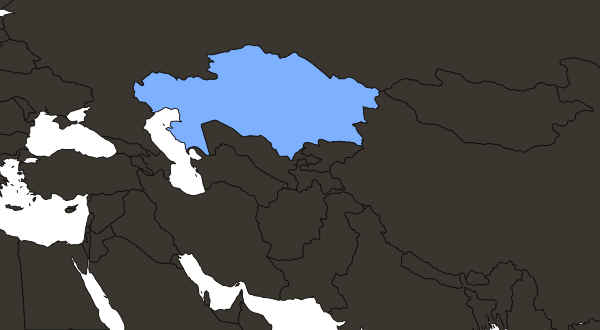
Kazakhstan has about 20.8 million people (UN, 2025). It is the ninth-largest country and the largest with no coastline. President Kassym-Jomart Tokayev has led it since 2019. Kazakhstan mines about 40% of the world's uranium, and about 80% of its oil exports cross Russia in one pipeline. It keeps close ties with Russia, China, the United States and Europe.
Where Kazakhstan ranks
All rankings →Resources Kazakhstan leads in
All resources →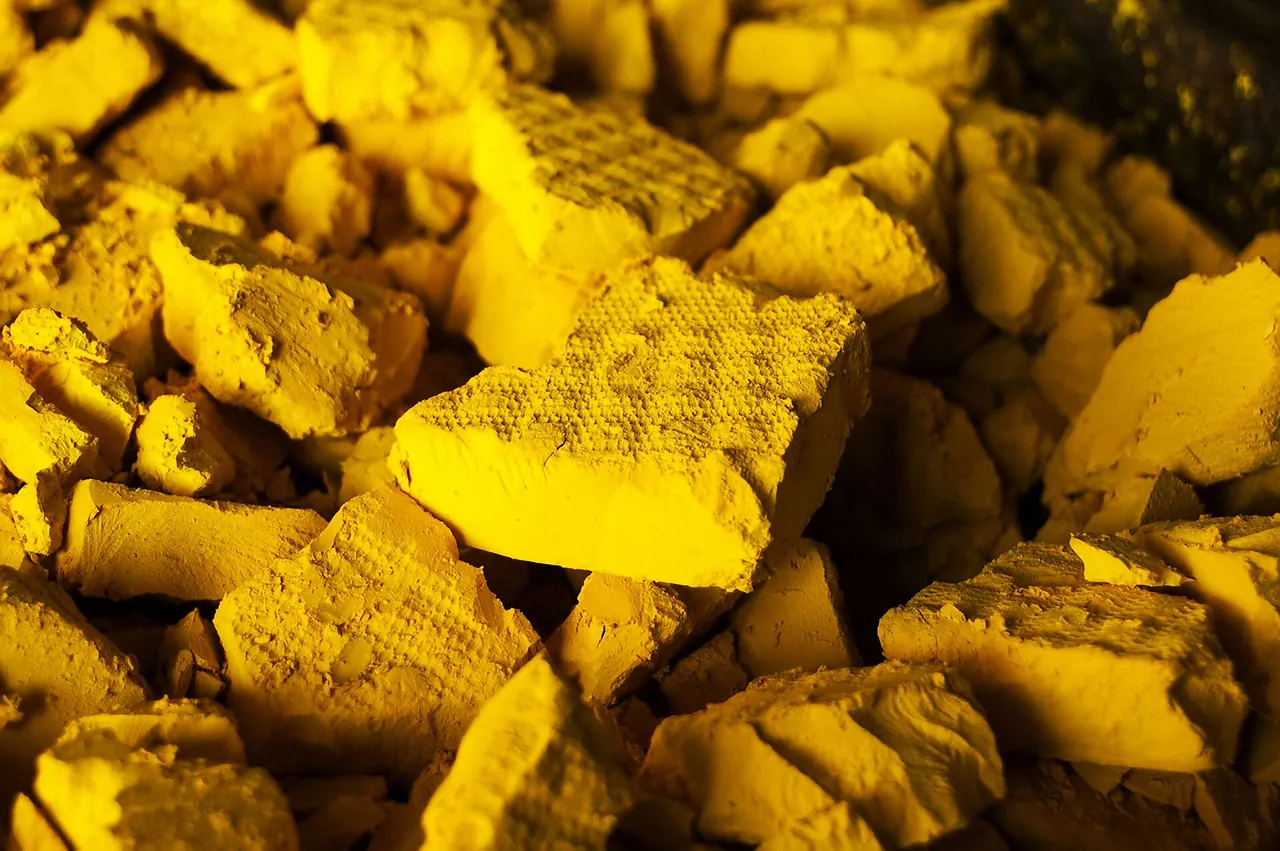
Which alliances is Kazakhstan in?
All alliances →Who runs Kazakhstan?
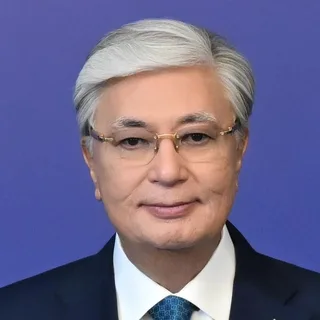
President Kassym-Jomart Tokayev was born on May 17, 1953, in Almaty. He studied in Moscow, learned Mandarin and served as a Soviet diplomat in Beijing. He was later foreign minister and prime minister, and he headed the UN Office at Geneva. Tokayev became president in March 2019, when Nursultan Nazarbayev resigned after ruling since independence. In January 2022 protests over fuel prices turned violent, and 238 people died. Tokayev ordered troops to shoot without warning and called in Russian-led troops. A new constitution, approved by 87% of voters, took effect on July 1, 2026. It replaced the two chambers of parliament with one, the 145-seat Kurultai. In its first election, on August 23, 2026, Tokayev's Adilet party won 110 seats (chart). OSCE observers found limited pluralism. The president serves one seven-year term, but a court ruled that Tokayev's earlier terms do not count, so he can run again in 2029.
- Adilet, the president's party 110
- Auyl (10) and Respublica (9) 19
- Aq Zhol (8) and the Social Democrats (8) 16
Photo (May 2025): Government of Kazakhstan, Wikimedia Commons, CC BY 4.0 (cropped)
Who are Kazakhstan's allies and rivals?
Kazakhstan calls its foreign policy "multi-vector": it keeps close ties with Russia, China, the United States and Europe at once. Its 7,644 km border with Russia is the longest continuous land border in the world. Both countries belong to the CSTO, a military alliance led by Russia, and in November 2025 they signed a declaration of "alliance". But in June 2022, sitting next to Putin, President Tokayev refused to recognize the Russian-backed breakaway republics in Donetsk and Luhansk. Ethnic Russians made up 37.8% of the population in 1989 and 14.4% in 2026. China's leader Xi Jinping announced his Belt and Road plan in Astana in 2013. In 2022 he promised to back Kazakhstan's territorial integrity "no matter how the international situation changes". In November 2025 Kazakhstan agreed at the White House to join the Abraham Accords. That month it also protested to Ukraine about a drone strike on its main oil terminal in Russia.
Allies and partners
 RussiaTreaty ally in the CSTO; biggest supplier
 ChinaBelt and Road launched in Astana; top buyer in 2026
 United StatesChevron and ExxonMobil lead at Tengiz
 ItalyBiggest buyer of Kazakh oil in 2025
 TurkeyFellow Turkic state; agreed to build drones
 UzbekistanBorder marked in 2023; buys most Kazakh wheat
Tensions
 UkraineKazakhstan protested a drone strike on its oil terminal
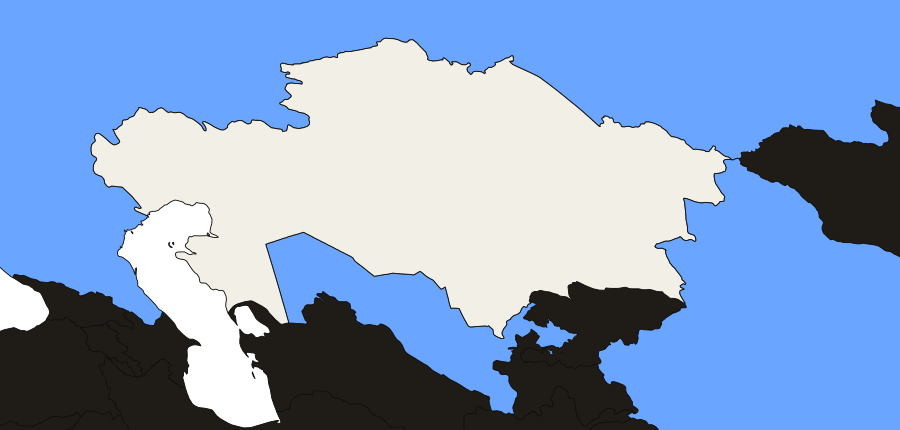
- Baikonur Russia rents this space center until 2050 for $115 million a year.
- Semipalatinsk test site The Soviet Union set off at least 456 nuclear tests here from 1949 to 1989. Closed August 29, 1991.
- Ulken On Lake Balkhash. Rosatom signed a contract on September 3, 2026, to build Kazakhstan's first nuclear power plant.
- Khorgos The main rail and road gateway to China. Its dry port handled 372,000 containers (TEU) in 2025.
- Kazakhstan
- Partner
Who does Kazakhstan trade with?
Kazakhstan sells mostly to Europe and China and buys mostly from its two big neighbors. In 2025 it exported $79.0 billion of goods and imported $64.9 billion (Bureau of National Statistics). Italy and China each bought about a fifth of its exports, and Russia and China supplied 59% of its imports (chart). Crude oil made up half of exports. In 2026 China overtook Italy as the biggest buyer. The economy grew 6.5% in 2025, and the IMF expects 4.4% growth in 2026. Prices rose 9.3% in the year to September 2026, and VAT went up from 12% to 16% in January. Government debt is low, about 24% of GDP. Gold makes up about 78% of the central bank's reserves. Kazakhstan also exports wheat: a record 8.87 million tonnes in the year to August 2026, mostly to Uzbekistan. The EU has sanctioned some Kazakh firms for supplying Russia with goods that have military uses.
 Netherlands
Buys from
Share of Kazakhstan's imports
- Russia29.7%
- China29.2%
 Germany4.8%
 South Korea3.5%
- United States3.3%
Goods, 2025. Bureau of National Statistics of Kazakhstan.
How does Kazakhstan get its oil to market?
Kazakhstan produced a record 99.4 million tonnes of oil and condensate in 2025 (chart). Most of it comes from three giant fields: Tengiz, Kashagan and Karachaganak. Chevron and ExxonMobil lead the venture at Tengiz. Kashagan, under the Caspian Sea, cost at least $53 billion to develop. Kazakhstan has no coastline, so about 80% of its oil exports go through the Caspian Pipeline Consortium (CPC) pipeline. It runs 1,500 km across Russia to the port of Novorossiysk on the Black Sea. Drones hit CPC sites in 2025 and struck tankers at the terminal again and again in July 2026. Russia blamed Ukraine, which denied the July attacks. Tengiz cut its output by more than half for a time. Other routes are small: in 2025 about 1.1 million tonnes went to China and 1.3 million tonnes across the Caspian to Baku. Kazakhstan belongs to OPEC+, but in September 2026 it pumped 1.85 million barrels a day, above its quota of 1.63 million.
Oil production, 2025
Full ranking →- United States13,586,000
- Russia9,885,000
 Saudi Arabia9,556,000
 Canada4,964,000
- China4,325,000
- Kazakhstan2,047,000
 Norway1,858,000
 Azerbaijan561,000
US Energy Information Administration, International Energy Statistics
Why did Kazakhstan give up its nuclear weapons?
The Soviet Union tested nuclear weapons in Kazakhstan for 40 years. It set off at least 456 blasts at Semipalatinsk from 1949 to 1989, and the Kazakh government says more than 1.5 million people were affected. Nursultan Nazarbayev, then the republic's leader, closed the site on August 29, 1991. At independence Kazakhstan held about 1,410 strategic warheads, the fourth-largest arsenal in the world, but Moscow kept control of them. Kazakhstan promised to give them up in 1992 and joined the Non-Proliferation Treaty in 1994. In December 1994 the United States, Britain and Russia gave it security assurances. The last warhead left for Russia on April 21, 1995. Today Kazakhstan is the world's biggest uranium miner, with 39% of world output in 2024 (World Nuclear Association). It has no nuclear power plant yet. Voters approved one in 2024, and on September 3, 2026 Russia's Rosatom signed a contract to build two reactors at Ulken, on Lake Balkhash.