State force · Iran · Iran's network
Iran’s Revolutionary Guards (IRGC)
At war with the US and Israel since 2026Updated November 19, 2026
The Islamic Revolutionary Guard Corps is a branch of Iran's armed forces, founded in 1979 to protect the Islamic Revolution. It runs Iran's missiles, drones and navy, and through its Quds Force it arms and funds partners including Hezbollah, the Houthis and Iraqi militias. Iran's state budget allocated the IRGC about $6 billion in the year ending March 2026, according to Iran Open Data. It operates throughout Iran, and its navy enforces Iran's closure of the Strait of Hormuz. Its arsenal includes ballistic missiles with ranges up to 2,000 km, one-way attack drones and fast boats.
- Commander
- Ahmad Vahidi
- since March 1, 2026
- Personnel
- About 190,000
- IISS estimate, about half conscripts
- Branches
- 6
- Ground, Aerospace, Navy, Quds Force, Basij, Intelligence
- Founded
- 1979
- by decree of Ayatollah Khomeini
- Supreme Leader
- Mojtaba Khamenei
- since March 2026
Who funds the Revolutionary Guards?
A state force paid by Iran's budget, oil revenue and a business empire.
- State budget
- Iran's military budgetIn the Iranian year 1404 (ending March 2026) the IRGC was allocated about $6 billion, roughly a third of the official military budget, according to Iran Open Data. About 47% of military funding is paid in crude-oil quotas rather than cash.
- Oil-export revenueA draft budget for 1405 (from March 2026) would raise the IRGC's share of oil-export revenue from 30% to 50%, worth more than $13 billion if exports held, the Middle East Forum reported. The 2026 war and US blockade have cut those exports.
- Khatam al-AnbiyaThe IRGC owns Khatam al-Anbiya Construction Headquarters, which builds roads, tunnels, pipelines and water projects. Its commander said in 2014 that it employed 135,000 people and 5,000 contractors.
- Abroad
- Shadow oil fleetThe US Treasury has sanctioned Chinese refineries and shipping firms it says bought Iranian oil through Quds Force fronts. In August 2026 Treasury said one broker had processed over $100 million in crypto payments for Quds Force oil sales since 2023.
- Hormuz transit feesIn May 2026 an IRGC-linked body, the Persian Gulf Strait Authority, began charging ships fees to transit the Strait of Hormuz. The US Treasury designated it on May 27, 2026 under a counterterrorism executive order for supporting the IRGC.
IRGC
Islamic Revolutionary Guard Corps
The IRGC uses its budget to run Iran's missile and drone programs, its navy in the Persian Gulf, and its network of partners abroad. The US State Department estimated in 2020 that Iran passed nearly $1 billion a year to Hezbollah, Hamas and other partners.
SIPRI put Iran's total military spending at $7.4 billion in 2025. The IRGC's full income, including off-budget oil sales and business revenue, is not publicly known.
Confirmed
Where do the Revolutionary Guards operate?
The IRGC is a state force present throughout Iran. Through its Quds Force it arms and funds partners in Lebanon, Iraq, Yemen and Gaza. It lost its access to Syria when President Bashar al-Assad fell in December 2024.
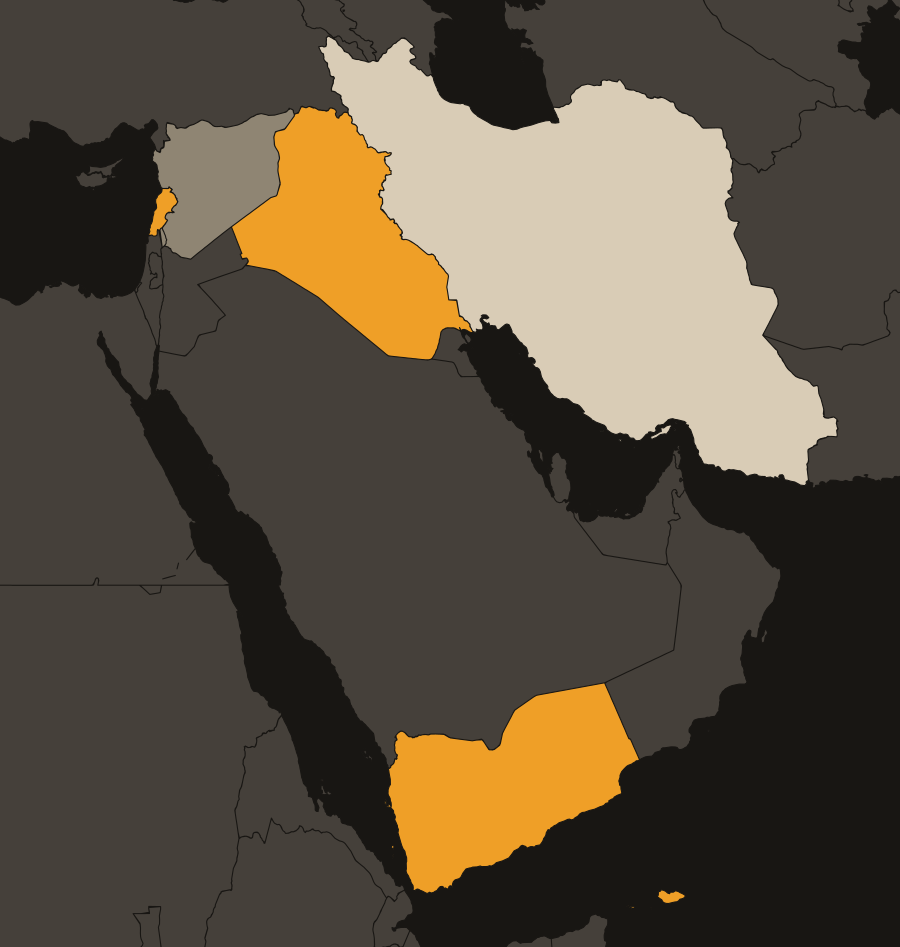
IranWhere its partners operateSyria, lost in December 2024Its partners hold only part of each shaded country.
- TehranHeadquartersThe IRGC is headquartered in Tehran. US and Israeli strikes on February 28, 2026 killed Supreme Leader Ali Khamenei and IRGC commander Mohammad Pakpour in the capital.
- Strait of HormuzClosedThe IRGC Navy has enforced Iran's closure of the strait since the war began in February 2026. The UKMTO counted at least 30 attacks on ships in the strait in October 2026, a record.
- Bandar AbbasNavyBandar Abbas is the main base for the IRGC Navy, which patrols the Persian Gulf and the Strait of Hormuz with fast attack craft and mines.
- BaghdadPartnersThe Quds Force works through Iraqi militias including Kata'ib Hezbollah and Nujaba. The US killed Quds Force commander Qasem Soleimani at Baghdad's airport on January 3, 2020.
- BeirutPartnersHezbollah, the IRGC's main partner, is based in Beirut's southern suburbs. The US Treasury estimated in 2018 that Iran gave Hezbollah about $700 million a year.
- SanaaPartnersThe Houthis hold Sanaa and much of northwestern Yemen. The United States says Iran arms them. Iran denies it. They fired missiles at Israel from March 2026 during the war.
- GazaPartnersThe IRGC has funded Hamas and Palestinian Islamic Jihad. The US State Department estimated Iran gave Palestinian groups up to $100 million a year.
- DamascusLostThe Quds Force used Syria as a land bridge to send weapons to Hezbollah. That ended when President Assad fell on December 8, 2024.
What weapons do the Revolutionary Guards have?
Ballistic missiles, drones, cruise missiles and a navy built for the Persian Gulf.
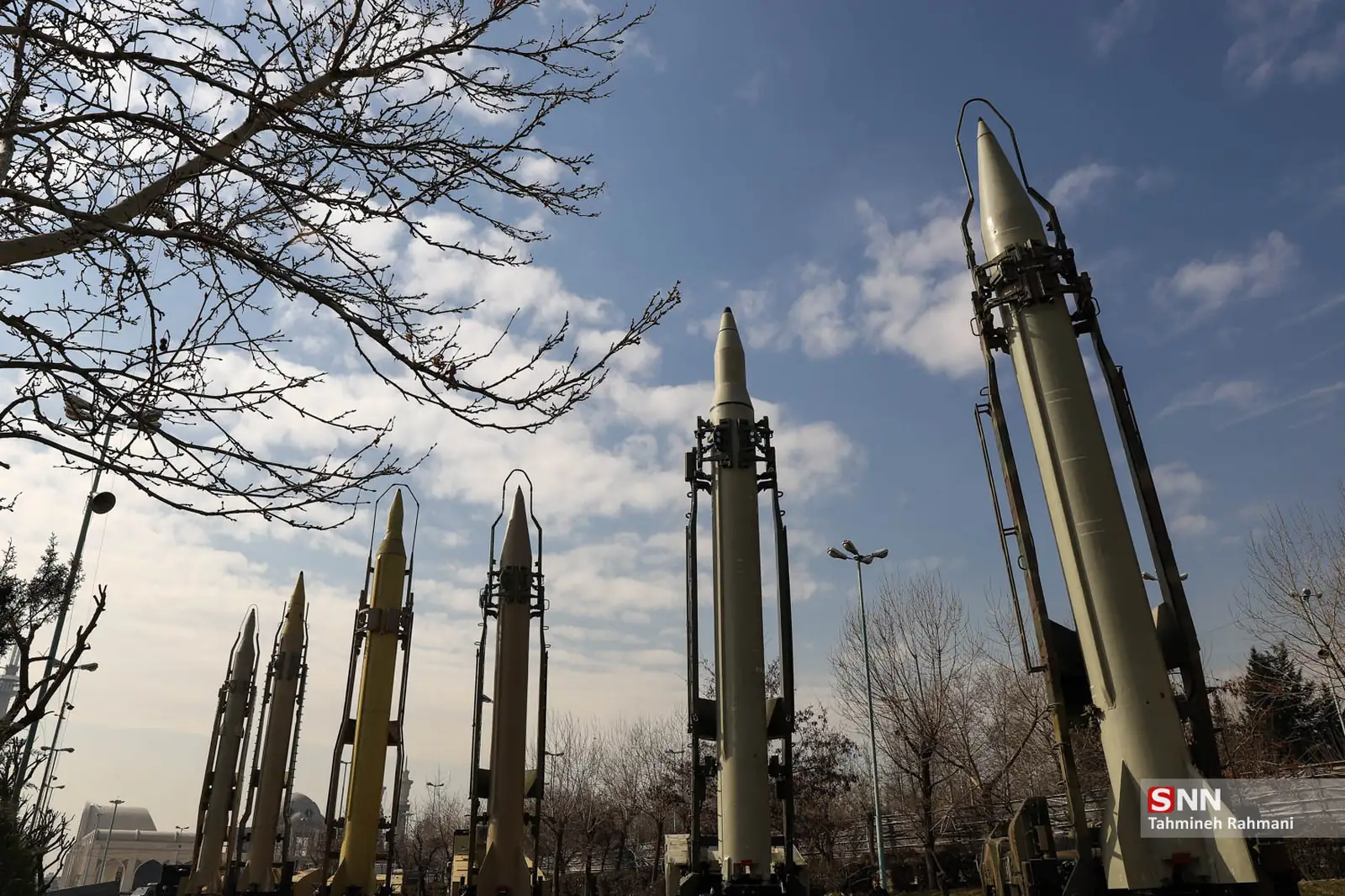
The Fateh-110 is a solid-fuel missile with a range of 200 to 300 km. The Zolfaghar reaches about 700 km.
The Emad is a guided version of the Shahab-3. The Ghadr-1 is also based on the Shahab-3.
The Sejjil is a two-stage solid-fuel missile. The Khorramshahr carries a warhead of about 1,500 kg, according to Anadolu.
Iran says the Fattah reaches Mach 13 to 15. It unveiled the Kheibar Shekan in February 2022. The IDF says both were used in the October 2024 attack on Israel.
CSIS lists the Soumar with a range of 2,000 to 3,000 km.
Distances from Tehran. Ranges are the longest reported for each kind of weapon.
Drones
Shahed-136, Shahed-131, Mohajer · Iranian-made
The Shahed-136 and Shahed-131 are one-way attack drones. They have been used against Israel. Iran began supplying Shahed drones to Russia in summer 2022. The Council on Foreign Relations estimates up to 3,000 were delivered. Iran says it sent only a limited number, months before the Ukraine war.
Navy fast boats and mines
Fast attack craft, naval mines · Iranian-made
The IRGC Navy uses fast boats and mines to control the Strait of Hormuz. Israel and the US claim 155 Iranian naval vessels were destroyed or damaged in the 2026 war.
- Missiles and drones at Israel, April 2024
- 320+
- 170 drones, 30+ cruise missiles, 120+ ballistic missiles (IDF count)
- Missiles at Israel, October 2024
- 180+
- mainly Fattah-1 and Kheibar Shekan (IDF count)
- Attacks on ships in Hormuz, October 2026
- 30+
- a record, according to UKMTO
Are the Revolutionary Guards a terrorist group?
The United States, the European Union, Canada and several other governments have listed the IRGC. The United Kingdom designated it under state-threats law but has not proscribed it. Iran calls the listings illegal because the IRGC is part of its armed forces. In return it has named US Central Command, Canada's navy, the navies and air forces of EU states, Britain's Royal Navy and RAF, and, in November 2026, Argentina's navy and air force as terrorist organizations.
 United StatesForeign Terrorist Organization since April 2019
 European UnionOn the EU terrorist list since February 2026
 CanadaListed as a terrorist entity on June 19, 2024
 Saudi ArabiaListed IRGC and Quds Force officers on October 23, 2018
 BahrainListed IRGC and Quds Force officers on October 23, 2018
 ArgentinaListed as a terrorist organization on March 31, 2026, after the Quds Force in January
 AustraliaListed as a state sponsor of terrorism on November 27, 2025
 United KingdomDesignated under the National Security Act in July 2026, not proscribed
- UN Security CouncilSome IRGC-linked entities under UN nuclear sanctions restored in 2025, which Russia and China reject
 RussiaNot listed
 ChinaNot listed
Who leads the Revolutionary Guards?
Major General Ahmad Vahidi has commanded the IRGC since March 1, 2026. He took over after his predecessor, Mohammad Pakpour, was killed in US and Israeli strikes on Tehran on February 28. Vahidi was the first commander of the Quds Force from 1988 to 1998. He later served as Iran's defense minister and interior minister. Interpol has issued a red notice for him at Argentina's request over the 1994 bombing of the AMIA Jewish community center in Buenos Aires, which killed 85 people. On September 21, 2026, Argentine federal judge Daniel Rafecas charged Vahidi and seven others over the bombing, ahead of a trial in absentia. One of them is Mohsen Rezaee, who commanded the IRGC in 1994. Iran denies involvement.
The Supreme Leader is Ayatollah Mojtaba Khamenei, the son of Ali Khamenei, who was killed on February 28, 2026. The Assembly of Experts chose him, and his selection was announced overnight on March 8 to 9. He was long his father's gatekeeper and was sanctioned by the United States in 2019. He has rarely appeared in public. CNN, citing a source, reported that he suffered a fractured foot on February 28.
Brigadier General Esmail Qaani has led the Quds Force since Qasem Soleimani was killed by a US strike on January 3, 2020. Rumors in March 2026 that Qaani had been killed or executed as an Israeli spy were never confirmed. He was seen in Baghdad in April and August 2026. Brigadier General Majid Mousavi has commanded the Aerospace Force, which runs the missiles and drones, since June 2025.
The leadership
- Supreme LeaderMojtaba Khamenei. Since March 2026. Son of Ali Khamenei, long his gatekeeper, rarely seen in public.
- IRGC commanderAhmad Vahidi. Since March 1, 2026. First Quds Force commander (1988 to 1998). Subject of an Interpol red notice, at Argentina's request, over the 1994 AMIA bombing. Charged by an Argentine judge in September 2026. Iran denies involvement.
- Quds Force commanderEsmail Qaani. Since January 2020. Reported in Baghdad in April and August 2026.
- Aerospace Force commanderMajid Mousavi. Since June 2025. Runs the missile and drone programs.
- Deputy commanderMostafa Izadi. Since August 10, 2026.
- Navy commanderAli Ozmaei. Since August 10, 2026. Replaced Alireza Tangsiri, who Israel says it killed in March 2026.
What is the Quds Force?
The Quds Force is the IRGC's branch for operations abroad. Its name means "Jerusalem Force." It was consolidated as a separate unit after the Iran-Iraq war ended in 1988, with Ahmad Vahidi as its first commander. It arms, trains and funds a network of partner groups that Iran calls the "Axis of Resistance."
The US State Department estimated in 2020 that Iran gave nearly $1 billion a year to its partners. The largest share went to Hezbollah, at about $700 million a year, according to the US Treasury in 2018. Palestinian groups including Hamas received up to $100 million a year, the State Department said.
The network has shrunk since 2024. The Quds Force lost its land bridge to Hezbollah when President Assad fell in Syria in December 2024. Lebanon's cabinet approved an army plan to disarm Hezbollah in September 2025. Lebanon's government has banned Hezbollah military activity since March 2026. In Iraq, Prime Minister Ali al-Zaidi dropped a September 30, 2026 target and on October 1 set a new deadline of June 30, 2027 to bring all weapons under state control. Kata'ib Hezbollah said the factions were not bound by any timetable. An Atlantic Council researcher said in 2026, "The axis of resistance is over." The International Crisis Group wrote that a weaker axis "is not necessarily synonymous with diminished Iranian commitment."
The Quds Force's partners
 Hezbollah (Lebanon)About $700 million a year (US Treasury, 2018). Joined the 2026 war on March 2.
 Houthis (Yemen)The US says Iran arms them. Iran denies it. They fired missiles at Israel from March 2026.
 Iraqi militiasKata'ib Hezbollah, Nujaba and other factions. Fired drones at US sites in March 2026.
 Hamas and PIJ (Gaza)Up to $100 million a year (US State Department, 2020).
 Syria (lost)The Quds Force's land bridge to Hezbollah ended when Assad fell in December 2024.
How big is the IRGC's business empire?
The IRGC runs businesses across Iran's economy through Khatam al-Anbiya Construction Headquarters, a conglomerate that builds roads, tunnels, pipelines and water projects. Its subsidiaries helped build the Fordow uranium enrichment site, according to IranWatch. Its commander said in 2014 that it employed 135,000 people and 5,000 contractors.
The IRGC also receives large shares of Iran's oil revenue. In the draft budget for the Iranian year starting March 2026, the IRGC's share of oil-export revenue was set to rise from 30% to 50%, the Middle East Forum reported. SIPRI noted that Iran "also uses off-budget oil revenues to finance its military, including the production of missiles and drones."
The US has targeted the IRGC's finances in waves of sanctions. In August 2026 the Treasury made nearly 60 designations in what it called "Economic D-Day," and it named digital assets, technology, gold, aviation and shipping as sectors open to sanctions. Treasury Secretary Bessent said the goal was to "sever every economic lifeline" for Iran's government. Iran calls the US sanctions illegal.
Oil blocked
$25 billion
Iranian crude exports the US says it has blocked
CENTCOM said on October 16, 2026 that its blockade of Iranian ports, begun in April and reinstated in July, had stopped about $25 billion of crude exports. By the end of October it had redirected 144 vessels.
What has the IRGC done in the 2026 war?
US and Israeli strikes hit Iran on February 28, 2026, killing Supreme Leader Ali Khamenei and IRGC commander Mohammad Pakpour. Iran closed the Strait of Hormuz the same day. The IRGC fired hundreds of ballistic missiles at Israel, the UAE and other Gulf states. By the April 8 ceasefire, about 650 ballistic missiles had been fired at Israel, according to the Israeli military. About 66 got through, and 50 of those carried cluster munitions, according to tallies of Israeli reports. The UAE said its air defenses engaged 537 ballistic missiles and 2,256 drones. Iran's Health Ministry said 3,483 people were killed in Iran in the 40 days of fighting. Israel's ambulance service said missiles from Iran and Lebanon had killed 23 people in Israel by April 10. Reuters counted 13 US service members dead, seven of them killed in action.
The US began a blockade of Iranian ports on April 13. President Trump and Iran's President Masoud Pezeshkian signed the Islamabad Memorandum on June 17. The US lifted the blockade on June 18. The ceasefire collapsed on July 8 after the IRGC attacked three ships. The US reinstated the blockade. Hostilities resumed in September. The IRGC Navy attacked tankers at least 12 times between September 28 and October 5, Reuters reported. The UKMTO counted at least 30 attacks on ships in the strait in October, a record.
As of November 2026, Hormuz remains closed. Senior official Mohsen Rezaei said on November 11 that it stays shut to adversaries until seven conditions are met, including lifting the blockade and sanctions, releasing frozen funds and formally ending the war. US Secretary of State Rubio said on November 8 that the sides are not "on the verge of a breakthrough." On November 15 the IRGC said it had launched drones at a US radar in Bahrain. Bahrain and US Central Command said the drones were intercepted. On November 17 US jets struck an IRGC missile launch site on Qeshm Island, which a US official called self-defense. On November 18 Iran's army said its drones had targeted Ali Al Salem Air Base in Kuwait, which US forces use, and Kuwait said its air defenses engaged them. Qatar warned that the escalation endangered a deal and held new talks with Iranian officials on November 17.
The IRGC in the 2026 war
- Feb 28, 2026US and Israeli strikes kill Ali Khamenei and IRGC commander Pakpour. Iran closes the Strait of Hormuz.
- Mar 1, 2026Ahmad Vahidi takes command of the IRGC.
- Mar 2, 2026Hezbollah joins the war. Iraqi militias fire drones at US sites.
- Mar 18, 2026Iran strikes the Ras Laffan LNG complex in Qatar.
- Apr 8, 2026A ceasefire begins, brokered by Pakistan.
- May 27, 2026The US Treasury designates an IRGC-linked Hormuz toll authority.
- Jun 17, 2026Trump and Iran's President Masoud Pezeshkian sign the Islamabad Memorandum. The blockade is lifted the next day.
- Jul 8, 2026The IRGC attacks three ships. Trump says the deal is "over." The US reinstates the blockade.
- Oct 2026At least 30 attacks on ships in Hormuz, a record, according to UKMTO. CENTCOM says the blockade has stopped $25 billion of crude.
- Nov 11, 2026Iran sets seven conditions for reopening Hormuz, including lifting sanctions and ending the war.
- Nov 17, 2026US jets strike an IRGC missile site on Qeshm Island. Iran answers with drones at a US air base in Kuwait.
Why was the IRGC created?
Ayatollah Ruhollah Khomeini ordered the creation of the Revolutionary Guards in the spring of 1979, shortly after the Islamic Revolution. The decree is commonly dated May 5, 1979. Khomeini wanted a force loyal to the revolution as a counterweight to the regular army, which had served the Shah. The IRGC grew rapidly during the Iran-Iraq war of 1980 to 1988, when it fought alongside the regular army.
The IRGC also built a network abroad. In 1982 it sent a contingent to Lebanon, where Hezbollah was founded. After the Iran-Iraq war ended in 1988, the Quds Force was consolidated to manage operations abroad. Over the following decades the Quds Force built a network of partners across the Middle East.
At home the IRGC became an economic force through Khatam al-Anbiya and oil allocations. It answers to the Supreme Leader. The elected president does not command it. Iran's constitution says the Corps exists "to continue in its role of guarding the Revolution and its achievements." Since 2024 it has lost its top commanders and the Supreme Leader who empowered it, but it remains central to Iran's state. Its veterans now lead the Supreme National Security Council and the armed forces. Its navy enforces Iran's closure of the Strait of Hormuz. Iran has made reopening the strait conditional on ending the war.
How the IRGC rose
- 1979Khomeini orders the creation of the Revolutionary Guards after the Islamic Revolution.
- 1982An IRGC contingent deploys to Lebanon. Hezbollah is founded.
- 1988The Iran-Iraq war ends. The Quds Force is consolidated under Ahmad Vahidi.
- Apr 2019The United States designates the IRGC a Foreign Terrorist Organization, the first such designation of another state's military.
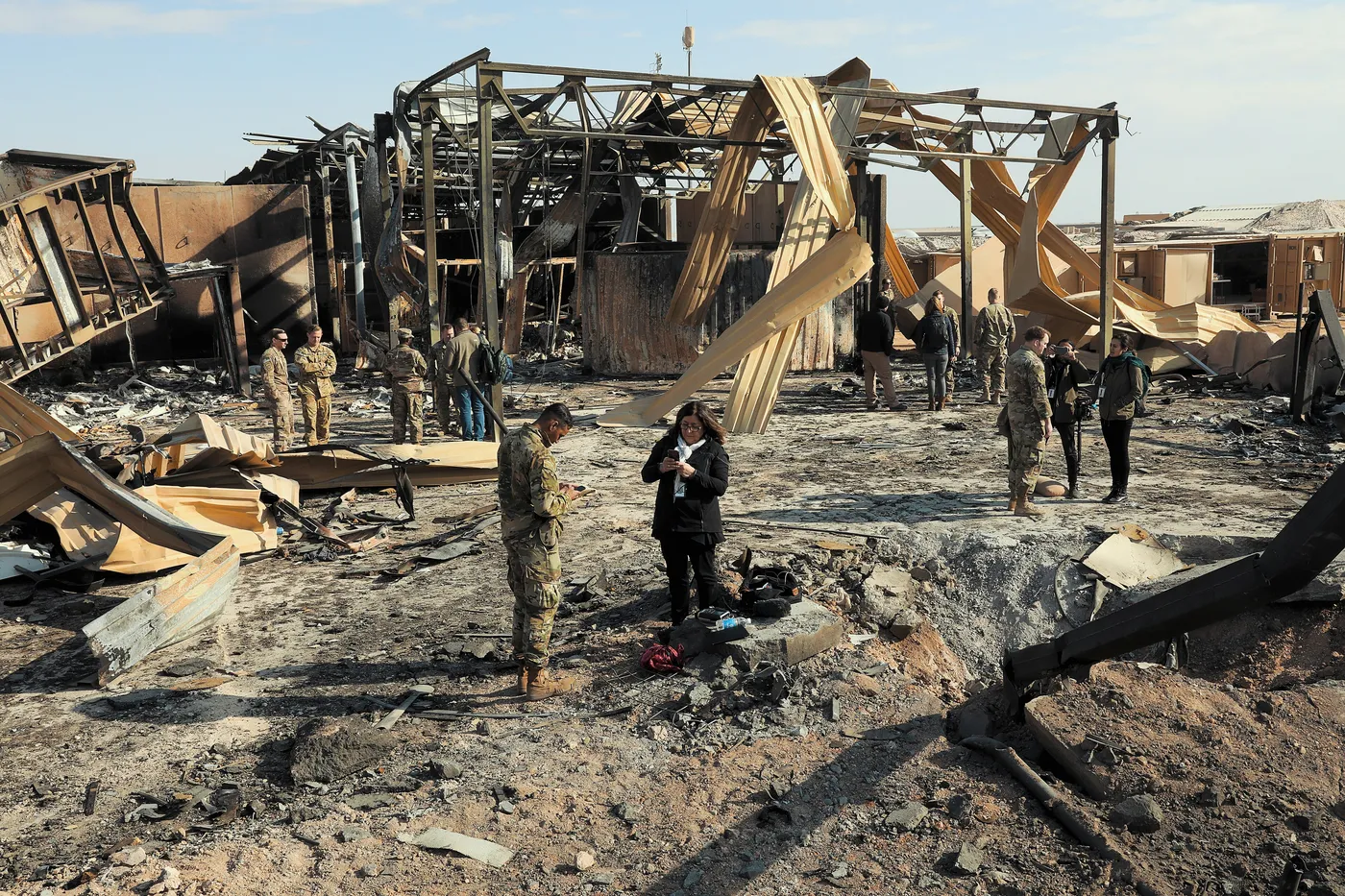
- Jan 2020A US strike kills Quds Force commander Qasem Soleimani in Baghdad. The IRGC strikes Al Asad Air Base in Iraq in retaliation.
- Apr 2024The IRGC fires more than 320 missiles and drones at Israel, its first direct attack. Iran calls it retaliation for an April 1 strike on its embassy compound in Damascus that killed IRGC generals, which it blames on Israel. About 99% are intercepted, according to the IDF.
- Oct 2024A second attack on Israel: at least 180 ballistic missiles, mainly Fattah-1 and Kheibar Shekan. Iran says it is avenging the killings of Hamas leader Ismail Haniyeh and Hezbollah leader Hassan Nasrallah.
- Jun 2025Israel strikes Iran, starting a 12-day war. IRGC chief Salami and Aerospace Force chief Hajizadeh are killed. Iran fires about 550 ballistic missiles and 1,000 drones, according to the IDF. Iran's government says 1,062 people were killed in Iran, and HRANA counted 1,190. Israel says 28 were killed in Israel.
- Feb 2026The 2026 war begins. Ali Khamenei and IRGC commander Pakpour are killed. Iran closes the Strait of Hormuz.
Questions about the Revolutionary Guards
Is the IRGC part of Iran's military?
Yes. The IRGC is a branch of Iran's armed forces, separate from the regular army (called the Artesh). It has about 190,000 personnel, according to the IISS. Iran's total active armed forces number about 610,000.
How many missiles does the IRGC have?
No one knows for sure. The IDF says "several hundred" ballistic missiles remain but admits its estimate is uncertain. A leaked US assessment in May 2026 said Iran kept about 70% of its pre-war missiles and launchers. The IDF said Iran had about 2,500 ballistic missiles before June 2025 and 1,000 to 1,500 after the 12-day war.
Is the IRGC the same as the Quds Force?
No. The Quds Force is one branch of the IRGC, responsible for operations abroad. The IRGC also includes a ground force, an aerospace force that runs the missiles and drones, a navy, the Basij militia and an intelligence organization.
What happened to the IRGC's commander?
Two IRGC commanders have been killed since 2025. Hossein Salami was killed by Israeli strikes on June 13, 2025. His replacement, Mohammad Pakpour, was killed by US and Israeli strikes on February 28, 2026. Ahmad Vahidi, who took command on March 1, 2026, leads it now.
Why did the EU list the IRGC?
The European Union listed the IRGC after Iran's January 2026 crackdown on protesters. The listing took legal effect on February 19, 2026. The human rights group HRANA says it has verified 6,872 deaths in the crackdown. Iranian state media put the toll at 3,117 and said 2,427 of them were civilians and security forces. Iran's Supreme National Security Council blamed the violence on the United States and Israel. Amnesty International names the IRGC and its Basij militia among the forces in the crackdown. The EU had debated the listing for years.
Is the Strait of Hormuz still closed?
Yes, as of November 2026. Iran closed the strait when the war began on February 28, 2026. Senior official Mohsen Rezaei said on November 11 that it stays shut to adversaries until seven conditions are met, including lifting sanctions and formally ending the war.