
Country profile · Baltic states
 Latvia
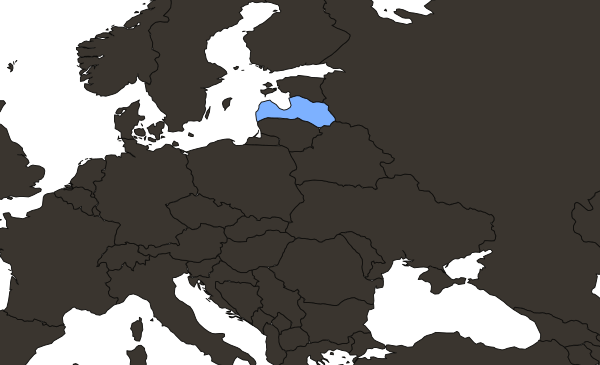
 is a Baltic country of about 1.85 million people between Estonia, Lithuania, Russia and Belarus. It joined NATO and the EU in 2004. Prime Minister Andris Kulbergs's United List won 41 of 100 seats in the election of October 3, 2026, and he is forming a new government. About a third of Latvians speak Russian at home.
Where Latvia ranks
All rankings →Which alliances is Latvia in?
All alliances →Who runs Latvia?
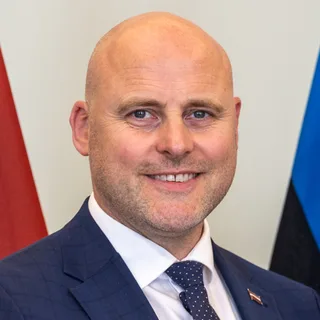
Prime Minister Andris Kulbergs was born in Riga in 1979. He worked as a business manager, including at car importers, before he entered the Saeima, the parliament, for the United List in 2022. Kulbergs became prime minister on May 28, 2026, after the government of Evika Siliņa fell. On May 7, 2026, two stray drones from Russian airspace hit an oil depot in Rēzekne. Officials said they were most likely Ukrainian drones diverted by Russian jamming. Siliņa fired her defense minister, the Progressives withdrew their support, and she resigned on May 14. In the election of October 3, 2026, the United List won 41 of the 100 seats, the best result by any party since 1991 (chart). Siliņa's New Unity fell from 26 seats to seven. Kulbergs opens coalition talks on October 28, and the new Saeima first meets on November 3. President Edgars Rinkēvičs has been head of state since July 2023. He was the first openly gay head of state in the EU.
- United List (Kulbergs) 41
- Latvia First 17
- Sovereign Power 15
- National Alliance 10
- Progressives 10
- New Unity 7
Photo (June 2026): Stenbock House, Estonian Government Office, Wikimedia Commons, CC BY 4.0 (cropped)
Who are Latvia's allies and enemies?
Latvia joined NATO on March 29, 2004, and the EU on May 1, 2004. It adopted the euro in 2014. Canada leads a NATO brigade of about 3,000 troops from 14 allies at Ādaži, near Riga. Canada planned to have up to 2,200 of its own soldiers there in 2026. Latvia cut relations with Russia to the level of chargé d'affaires in February 2023. Belarus has pushed migrants at the border since 2021. Border guards stopped 12,046 crossing attempts in 2025 and more than 12,000 by mid-October 2026. On October 6, 2026, masked, armed men from Belarus pushed about 20 migrants across and stole border cameras. Latvia gives Ukraine at least 0.25% of its GDP in military aid each year and leads a drone coalition for Ukraine with the United Kingdom. In August 2022 Latvia and Estonia left China's 16+1 group. Latvia has a seat on the UN Security Council for 2026 and 2027.
Allies and partners
 LithuaniaLargest trade partner; Baltic neighbor
 EstoniaBuilding a defense line together
 CanadaLeads the NATO brigade at Ādaži
 United KingdomCo-leads the drone coalition for Ukraine
 UkraineGets at least 0.25% of GDP in aid


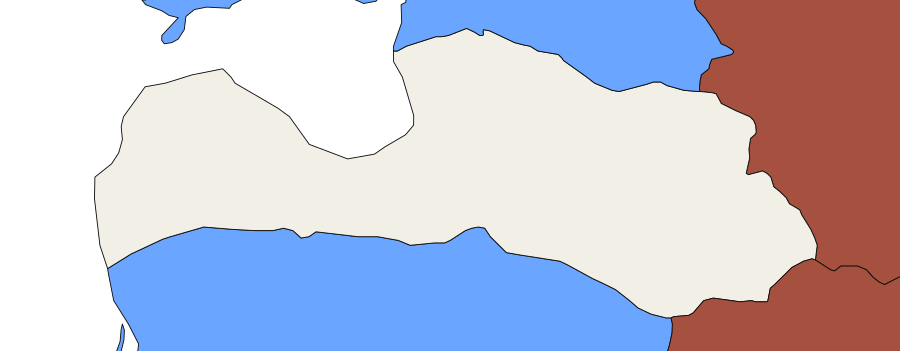
- Ādaži Base of the Canadian-led NATO brigade of about 3,000 troops from 14 allies.
- Rēzekne Two stray drones hit an oil depot here on May 7, 2026. The crisis brought down the government.
- Daugavpils Second city, near the Belarus border. Only about a fifth of its people are ethnic Latvians.
- Ventspils Port whose undersea cable to Gotland was damaged in January 2025. Sweden ruled it an accident.
- Latvia
- Partner
- Rival
Who does Latvia trade with?
Latvia exported $22.41 billion of goods in 2025 and imported $26.48 billion (UN Comtrade). Lithuania bought 18.2% of exports (chart) and Estonia 11.3%. Lithuania also supplied 20.4% of imports, Germany 12.3% and Poland 11.1%. Wood and wood products made up 15.3% of exports, and in 2024 Latvia was the EU's largest exporter of wood pellets. Russia still bought 4.9% of exports in 2025, but imports from Russia fell to 0.5% (Central Statistical Bureau). The war ended most Russian transit through Latvia. Freight on Latvian railways fell from 41.5 million tonnes in 2019 to 9.5 million in 2025. The state airline, airBaltic, filed for bankruptcy protection in New York on September 14, 2026. The economy shrank by a quarter in the crisis of 2008 and 2009. It grew 2.2% in 2025 (Eurostat). Latvia's GDP per person at purchasing power was 71% of the EU average in 2025, below Estonia's 79% and Lithuania's 87%.


Why does Latvia have so many Russian speakers?
Latvians made up 77% of the population in the 1935 census. The Soviet Union occupied Latvia in June 1940 and deported more than 15,000 people in June 1941 and about 42,000 in March 1949. After the war many workers moved in from Russia, Ukraine and Belarus. By 1989 Latvians were only 52%. When Latvia restored its independence on August 21, 1991, it gave citizenship only to citizens of pre-1940 Latvia and their descendants. In 1995 there were 735,966 non-citizens, about 29% of residents. At the start of 2026 there were 162,682. Ethnic Latvians are now 63.8%, and about 35% of people speak Russian at home. In a 2012 referendum 75% voted against making Russian a second official language. Since September 2025 all schools teach in Latvian only. Russian citizens with permanent residence must pass a basic Latvian test or lose their permits. Russia calls the measures discrimination. In October 2026 the Russian speakers' party Sovereign Power won 15 seats.
How is Latvia preparing for a war with Russia?
Latvia spent 3.6% of its GDP on its military in 2025, according to SIPRI (chart). Its 2026 defense budget is €2.16 billion, or 4.91% of GDP. A law passed on March 26, 2026, makes 5% of GDP the minimum from 2027. Latvia brought back conscription in 2023, and service became compulsory for men in 2024. In July 2026, 1,277 conscripts started service, and the plan for 2027 is up to 2,800. A fence of about 280 km along the 283.6 km border with Russia was finished in December 2025. With Estonia and Lithuania, Latvia is building the Baltic Defence Line, and on October 20, 2026, it added 27 km of anti-tank trenches. Latvia left the treaty that bans anti-personnel mines on December 27, 2025. In October 2026 it approved a factory for anti-tank mines with Germany's Dynamit Nobel Defence, due to open in 2028. Six HIMARS rocket launchers arrive from 2027.
Which country has the biggest army? Largest armies in the world →

