
Country profile · Southeast Asia
 Malaysia
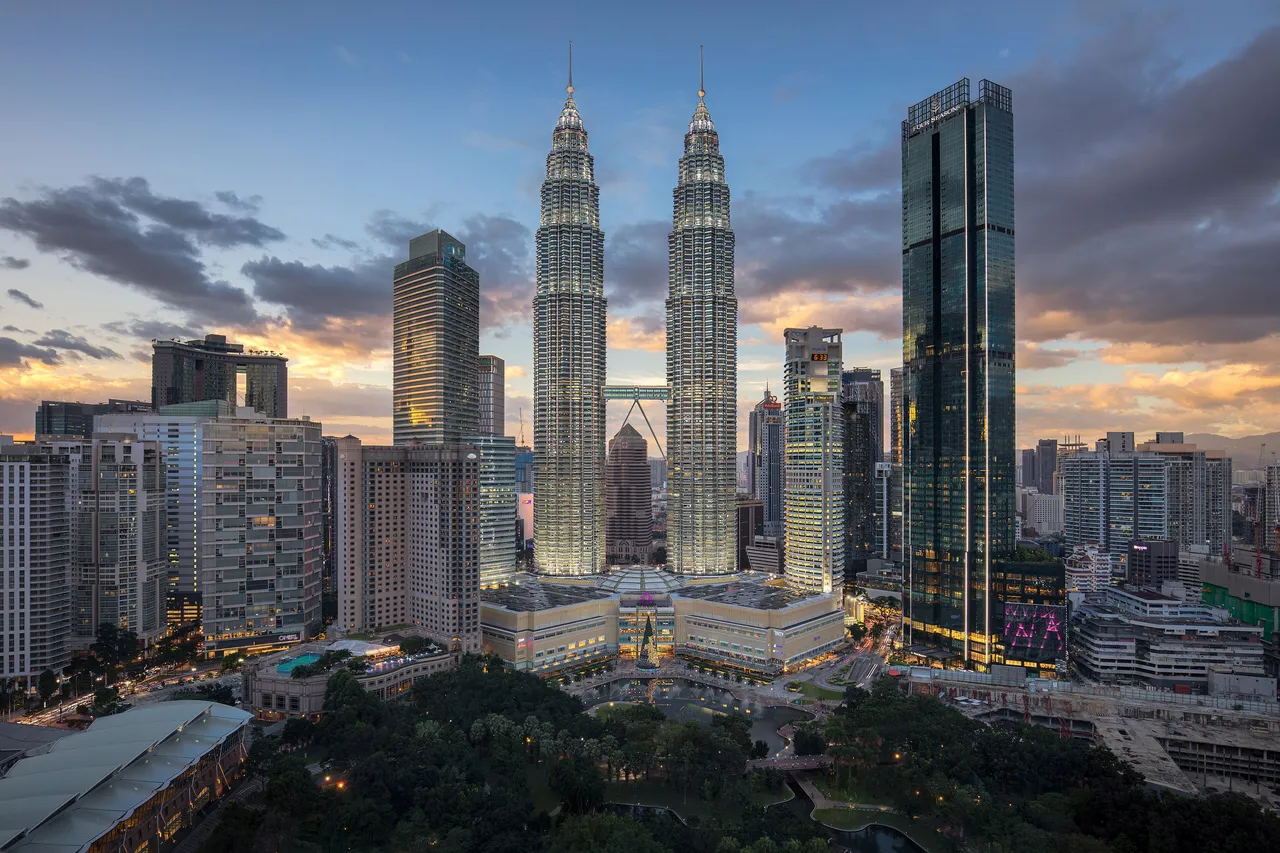
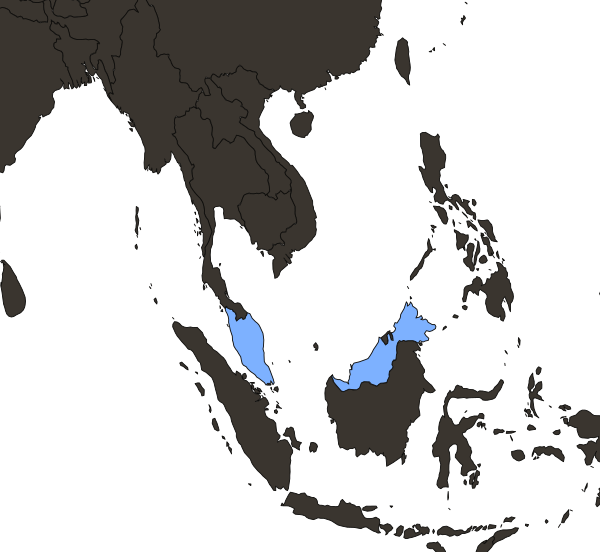
Malaysia has about 34.4 million people (official estimate, 2026). Prime Minister Anwar Ibrahim has led a coalition government since November 2022. Malaysia has no treaty allies and stays neutral between the United States and China. It is one of the world's main places where chips are packaged and tested, and chips were about a quarter of its exports in 2025.
Where Malaysia ranks
All rankings →Which alliances is Malaysia in?
All alliances →Disputed territories involving Malaysia
All disputed territories →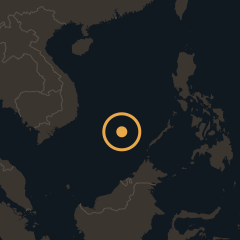
Who runs Malaysia?
Prime Minister Anwar Ibrahim was born on August 10, 1947, in Penang. He joined the ruling party, UMNO, in 1982. He rose to finance minister and deputy prime minister under Mahathir Mohamad, who sacked him in September 1998. Anwar was then jailed for corruption and sodomy until 2004, when the sodomy conviction was overturned. He was convicted of sodomy again and jailed from 2015 until a royal pardon in May 2018. After the November 2022 election no coalition had a majority, and Anwar became prime minister. He governs with UMNO, which led the governments that jailed him. His government holds 149 of 222 seats, one more than two-thirds (chart). The Islamist party PAS is the largest single party, with 43 seats. In 2026 UMNO won Johor's state election, and in Negeri Sembilan it took power from Anwar's coalition with the help of PAS. Former Prime Minister Najib Razak was convicted in December 2025 over the 1MDB state fund. US prosecutors say more than $4.5 billion was stolen from it. The next general election must be held by early 2028.
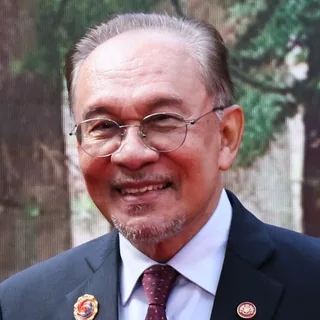
- Unity government (Pakatan Harapan, Barisan Nasional and Borneo parties) 149
- PAS (Islamist opposition) 43
- Other opposition and 4 empty seats 30
Photo (October 2025): Cabinet Public Affairs Office, Cabinet Secretariat of Japan, Wikimedia Commons, CC BY 4.0 (cropped)
Who are Malaysia's allies and rivals?
Malaysia has no treaty ally. Prime Minister Anwar Ibrahim says it is neutral between the big powers. Under the Five Power Defence Arrangements of 1971, Britain, Australia and New Zealand consult with Malaysia and Singapore if either is attacked. China has been Malaysia's largest trading partner for 17 years in a row. Malaysia became a BRICS partner country in 2025, and in August 2026 Anwar called Taiwan "part of China, period". But China claims waters off Sarawak, on Borneo. Its claim reaches James Shoal, about 80 km off the coast. A Chinese coast guard ship was at the Luconia Shoals on 359 days of 2024, sometimes within 1,000 meters of gas platforms run by Petronas, the state oil company. In 2024 China told Malaysia to stop drilling there. Malaysia refused and keeps such incidents quiet. Malaysia holds regular military exercises with the United States. The Philippines has never dropped its claim to Sabah. In 2013 gunmen from the southern Philippines landed at Lahad Datu in Sabah, and about 72 people died.
Allies and partners
 SingaporeLargest export market in 2025; Five Power Defence partner
 ChinaLargest trading partner; coast guard patrols off Sarawak
 United StatesTop export market in August 2026; military exercises
Tensions
 PhilippinesHas never dropped its claim to Sabah
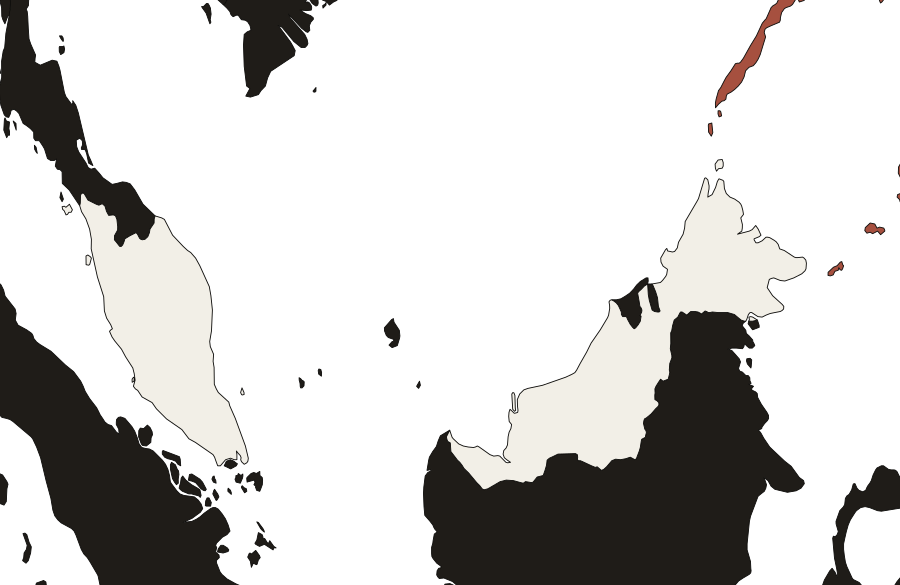
- Strait of Malacca Over 102,500 ships passed in 2025, carrying about 23 million barrels of oil a day.
- Penang Chip-packaging hub since Intel opened its first factory outside the United States here in 1972.
- Johor Data center boom next to Singapore. About 350,000 people cross the border every day.
- Luconia Shoals Gas fields off Sarawak where a Chinese coast guard ship was present 359 days in 2024.
- Lahad Datu Gunmen from the southern Philippines landed here in 2013 to press the old Sulu claim to Sabah.
- Malaysia
- Tensions
Who does Malaysia trade with?
Malaysia exported 1.61 trillion ringgit of goods in 2025, about $375 billion, and imported 1.46 trillion ringgit, about $340 billion (Ministry of Investment, Trade and Industry). Singapore and the United States are the biggest buyers, and China supplies about a quarter of imports (chart). Electrical and electronic goods were 44% of exports. Chips alone earned about $91 billion, 24% of exports. Malaysia packages and tests about 13% of the world's chips, by the government's estimate. It is the world's second-largest palm oil producer after Indonesia, with a record 20.3 million tonnes in 2025, and the fifth-largest exporter of liquefied natural gas. Since July 24, 2026 the United States has charged a 10% tariff on most Malaysian goods, but chips are exempt. Demand for AI hardware pushed exports up 31% in the first eight months of 2026. Malaysia imports about half the crude oil it uses. The closing of the Strait of Hormuz raised its fuel subsidy bill to about 40 billion ringgit in 2026. The economy grew 5.2% in 2025.
Sells to
Share of Malaysia's exports
- Singapore15.5%
- United States14.5%
- China11.8%
- Hong Kong6.0%
 Taiwan5.5%
Buys from
Share of Malaysia's imports
- China24.3%
- Singapore10.5%
- Taiwan10.0%
- United States9.2%
 Japan4.6%
Goods, 2025. Ministry of Investment, Trade and Industry, Malaysia.
Why did Singapore leave Malaysia?
Malaysia was formed on September 16, 1963, when Malaya joined with Singapore, Sarawak and North Borneo, now Sabah. Malaya's 1957 constitution gave Malays a special position. Most Singaporeans were Chinese, and Singapore's leader, Lee Kuan Yew, campaigned with other parties for a "Malaysian Malaysia" not tied to any one race. Race riots in Singapore in July and September 1964 killed 36 people. On July 1, 1965 Malaysia's prime minister, Tunku Abdul Rahman, proposed cutting Singapore loose, and secret talks followed. On August 9, 1965 Malaysia's parliament voted 126 to 0 to separate, and Lee wept on television. The two countries are still closely tied. Singapore can draw water from the Johor River until 2061 under a 1962 agreement. About 1.13 million Malaysians lived in Singapore in 2022, and a new rail link across the border is due to open in February 2027. Singapore is now about seven times richer per person (chart).
GDP per person, 2025
Full ranking →- Singapore$99,365
 Brunei$34,678
- Malaysia$13,949
 Thailand$8,057
 Indonesia$5,082
 Vietnam$4,829
- Philippines$4,270
IMF World Economic Outlook (April 2026)
What is Malaysia's bumiputera policy?
Bumiputera means "sons of the soil". The word covers Malays and the native peoples of Sabah, Sarawak and the peninsula, who are 70.7% of citizens. Chinese are 22.0% and Indians 6.5% (2026). Article 153 of the 1957 constitution protects the "special position" of Malays and the natives of Sabah and Sarawak. It allows quotas in the civil service, education and business licenses. After the election of May 1969, riots in Kuala Lumpur killed 196 people by the official count; Western diplomats estimated about 600. The New Economic Policy of 1971 set out to raise bumiputera ownership of companies from 2.4% to 30% by 1990. It reached 19.3% in 1990 and was 17.2% in 2019. Poverty fell from 49% on the peninsula in 1970 to 6.2% of households in 2022. A 1971 amendment makes it an offense to question these rights, even in parliament. The policy is still in force. Nine in ten places in the government's pre-university matriculation program are reserved for bumiputera, and Budget 2027 nearly doubled the contracts set aside for bumiputera firms, to 7.5 billion ringgit.