
Ranking · Military
Countries without an army
Twenty-one sovereign states have no standing army, navy or air force. Costa Rica has the most people, about 5.2 million. Panama is second with about 4.6 million. Together they hold about 71% of the roughly 13.7 million people living in army-free states. Most of the rest are microstates with fewer than 200,000 people.
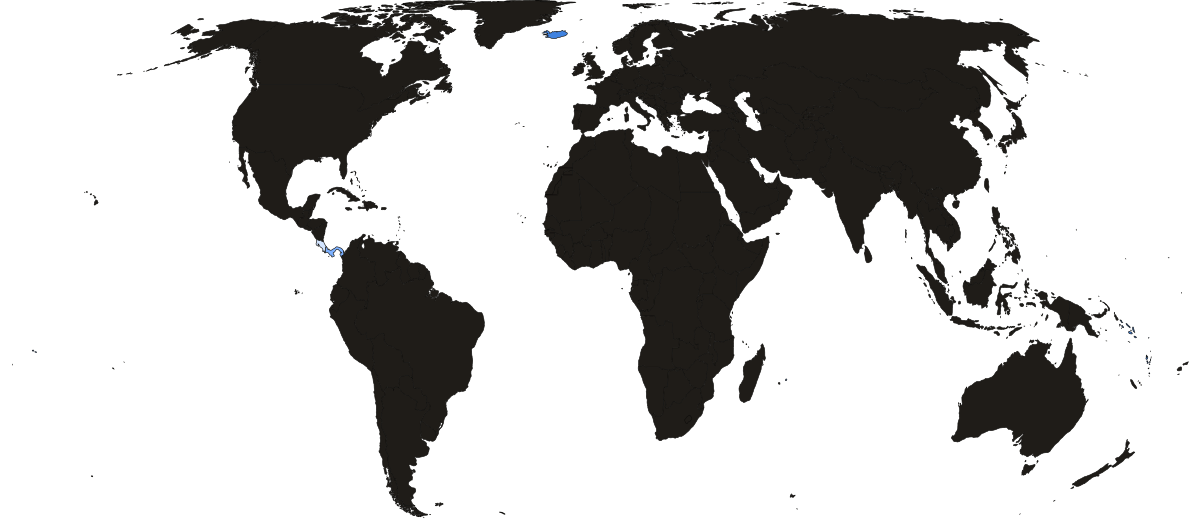
- Under 0.1m
- 0.1m–1m
- 1m–5m
- Over 5m
- Not in this ranking
| # | Country | Population |
|---|---|---|
| 1 |  Costa Rica |
5.2 million |
| 2 |  Panama |
4.6 million |
| 3 |  Mauritius |
1.3 million |
| 4 |  Solomon Islands |
0.8 million |
| 5 |  Iceland |
0.4 million |
| 6 |  Vanuatu |
0.3 million |
| 7 |  Samoa |
0.2 million |
| 8 |  Saint Lucia |
0.2 million |
| 9 |  Kiribati |
0.1 million |
| 10 |  Grenada |
0.1 million |
| 11 |  Micronesia |
0.1 million |
| 12 |  Saint Vincent and the Grenadines |
0.1 million |
| 13 |  Andorra |
0.1 million |
| 14 |  Dominica |
0.1 million |
| 15 |  Liechtenstein |
0.0 million |
| 16 |  Monaco |
0.0 million |
| 17 |  Marshall Islands |
0.0 million |
| 18 |  Palau |
0.0 million |
| 19 |  Nauru |
0.0 million |
| 20 |  Tuvalu |
0.0 million |
| 21 |  Vatican City |
0.0 million |
Why they rank where they do
-
Costa Rica
Costa Rica abolished its army on December 1, 1948. Junta leader José Figueres struck a wall with a sledgehammer at the Cuartel Bellavista barracks in San José. The barracks became the National Museum. Article 12 of the 1949 Constitution bans the army as a permanent institution but allows military forces by continental agreement or for national defense.
-
Panama
The US invasion of December 20, 1989 destroyed Manuel Noriega's Panama Defense Forces. The Endara government dissolved them in February 1990. A constitutional amendment in 1994 wrote into Article 310 (current numbering) that Panama will have no army.
-
Mauritius
Mauritius has never had an army and is the only African country on the list. All security units sit inside the Mauritius Police Force, including the paramilitary Special Mobile Force and the National Coast Guard.
-
Iceland
Iceland is the only NATO member with no armed forces. The only armed state bodies are the police and the Icelandic Coast Guard. Allied fighter jets have guarded Icelandic airspace from Keflavík on rotation since 2008.
-
Grenada
The People's Revolutionary Army was dissolved after the US-led invasion of October 1983. The Royal Grenada Police Force now includes a special services unit that the US State Department calls similar to a military division.
-
Dominica
The Dominica Defence Force was dissolved in 1981 after a coup plot linked to former Prime Minister Patrick John. On December 18, 1981, ex-soldiers led by Major Frederick Newton attacked police headquarters in Roseau. Newton was executed in 1986.
-
Liechtenstein
Prince Johann II abolished the military on February 12, 1868. The small contingent had guarded the Stilfserjoch pass during the Austro-Prussian War of 1866 without fighting. The deployment was unpopular, and the Landtag refused to keep paying for the force.
-
Vatican City
Vatican City is a borderline case. Pope Paul VI disbanded the Noble Guard and Palatine Guard in 1970, but the Pontifical Swiss Guard (founded 1506) remains. The guard's target strength is 135 men. Twenty-eight recruits were sworn in on May 6, 2026, with Pope Leo XIV attending.
Why did Costa Rica abolish its army?
After the 1948 civil war, junta leader José Figueres abolished the army on December 1, 1948 at the Cuartel Bellavista barracks. The commonly given reasons are to prevent military coups and to spend the money on schools and health instead.
The 1949 Constitution made the ban permanent but keeps an exception: forces may be raised by continental agreement or for national defense. Costa Rica handles disputes through law. When Nicaragua moved forces into disputed territory in 2010, Costa Rica went to the International Court of Justice and won the case on December 16, 2015.
Does Iceland have a military?
No. Iceland has no military. The police and the Icelandic Coast Guard, which falls under the Justice Ministry, are the only armed state bodies. The Coast Guard runs the patrol ships Þór and Freyja.
Iceland is still a founding NATO member. Allied fighter jets have rotated through Keflavík for air policing since 2008, two years after the US closed its base there. On February 3, 2026 the Althing unanimously adopted a defense and security policy, which builds on Iceland's 2016 National Security Policy. The policy does not create an army.
- Costa Rica5.2 million
- Panama4.6 million
- Mauritius1.3 million
- Solomon Islands0.8 million
- Iceland0.4 million
- Vanuatu0.3 million
- Samoa0.2 million
- Saint Lucia0.2 million
Who defends countries without an army?
Most rely on a bigger partner. The United States defends Micronesia, the Marshall Islands and Palau under the Compacts of Free Association, and Iceland under a 1951 defense agreement and NATO. France guarantees Monaco. Spain and France guarantee Andorra. The Regional Security System covers Dominica, Grenada, Saint Lucia and Saint Vincent. Australia and New Zealand back most of the Pacific states. Costa Rica and Panama belong to the Rio Treaty, a regional mutual-defense pact. Liechtenstein, Mauritius and the Vatican have no defense treaty with any state.
Is Panama's army really gone?
Yes. The Panama Defense Forces were destroyed in the US invasion of December 20, 1989 and dissolved in February 1990. The constitution has banned an army since 1994.
Panama does have armed security services. SENAFRONT guards the border and SENAN runs naval and air operations, but both are legally police. A Security Ministry resolution of July 27, 2026, in force since August 6, placed the police, SENAN and SENAFRONT under one joint command to guard seven canal areas. Critics argue these bodies work like a military in practice.
How many countries have no army?
Twenty-one sovereign states have no standing army, navy or air force. The Pacific has nine, Europe has five (including Iceland and the Vatican), the Caribbean has four, Central America has two (Costa Rica and Panama), and the Indian Ocean has one (Mauritius). Fourteen of the twenty-one have fewer than 200,000 people. Monaco and the Vatican are borderline cases because both keep small guard units with military status.
- Costa Rica5.2 million
- Panama4.6 million
- Mauritius1.3 million
- Solomon Islands0.8 million
- Iceland0.4 million
- Vanuatu0.3 million
- Samoa0.2 million
- Saint Lucia0.2 million
Read more
-
 Blog
Why does the United States have 750 military bases around the world?
The US operates roughly 750 military sites in 80 countries, more than every other nation combined. Here is where they are, what they cost, and why they keep growing.
-
 Blog
Who controls the Panama Canal in 2026?
Panama owns the canal and an agency in Panama City runs it. The 2026 fight is over the ports at each end, the flag on the sterns, and the water in the lake.


