
Overseas Collectivity of France · South Pacific
French Polynesia
Self-governingUpdated November 11, 2026
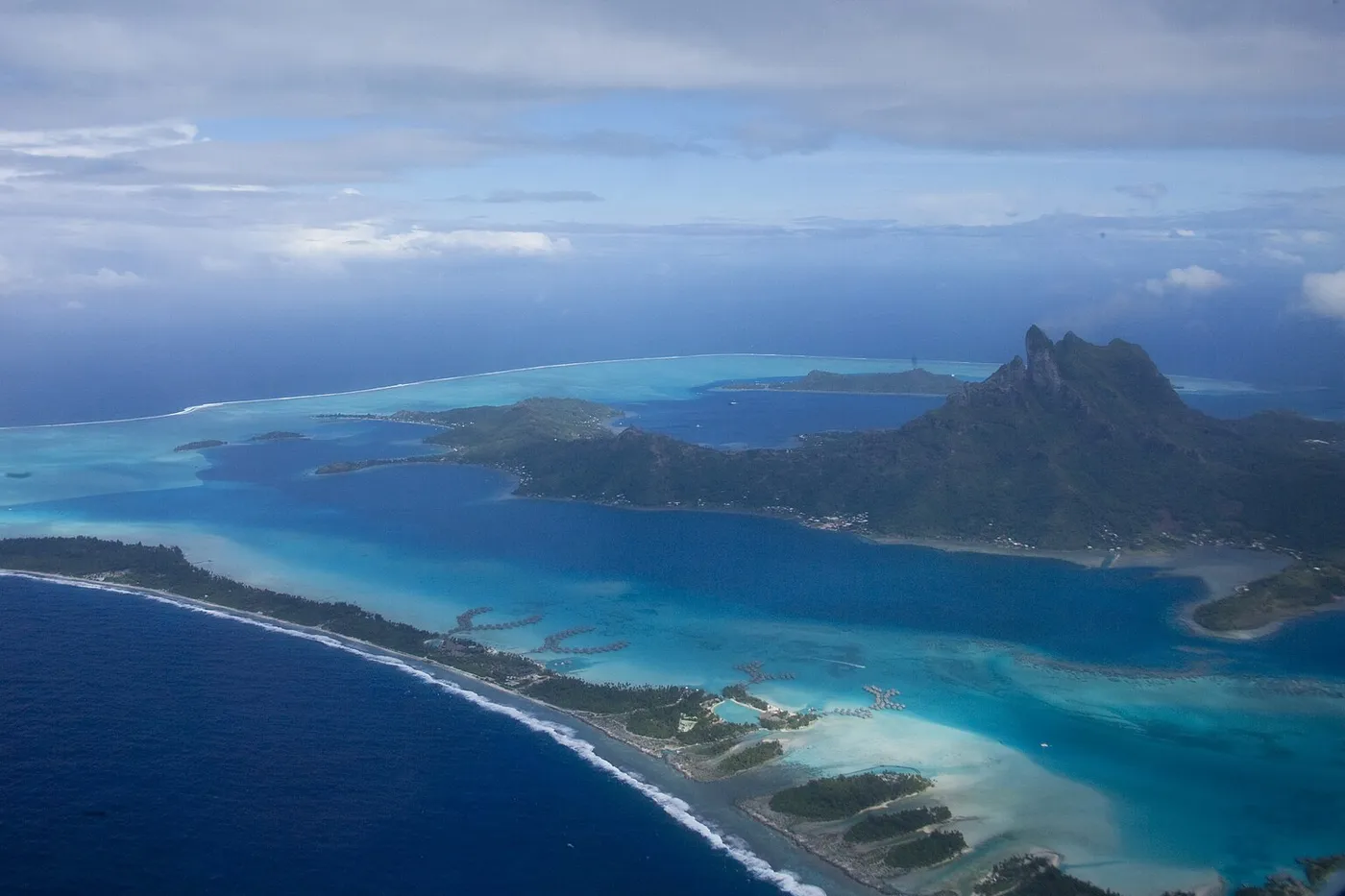
French Polynesia is an overseas collectivity of France in the South Pacific. Its 118 islands span an ocean area about the size of the European Union, but about 75% of the population lives on Tahiti and Moorea. France controls defense, foreign policy, currency and justice. French Polynesia runs most other affairs under a 2004 autonomy law. France carried out 193 nuclear tests there from 1966 to 1996. A bill to improve compensation for victims passed the Senate unanimously in May 2026 and awaits a final vote.

- People
- 279,500
- end of 2025, essentially flat
- Islands
- 118
- 76 inhabited, in 5 archipelagos
- Sea zone (EEZ)
- About 4.8 million km²
- entirely a marine protected area since 2025
- Visitors (2025)
- 281,227
- an all-time record
- From Paris
- 15,700 km
- as the crow flies
French Polynesia in 30 seconds
- French Polynesia is a French overseas collectivity with broad autonomy under a 2004 law. France keeps defense, foreign policy, currency, justice and citizenship. Residents are French citizens and hold French passports.
- France carried out 193 nuclear tests on Moruroa and Fangataufa from 1966 to 1996, including 46 atmospheric tests. A compensation bill passed both houses of parliament unanimously in 2026 and awaits a final vote.
- The pro-independence Tavini Huiraatira won 38 of 57 assembly seats in 2023. The party split in 2026. President Moetai Brotherson formed a new party and favors a gradual approach to independence over 10 to 15 years.
- The sea zone of about 4.8 million km² is the largest marine protected area in the world. Seabed mining is banned. Tourism hit a record 281,227 visitors in 2025, and French state spending makes up about 31% of GDP.
Is French Polynesia a country?
French Polynesia is not a sovereign state. It is an overseas collectivity of France, governed under Article 74 of the French Constitution. The 2004 autonomy law calls it a “pays d’outre-mer au sein de la République” (“overseas country within the Republic”). The label does not make it a sovereign state. France itself described it in October 2026 as “an overseas collectivity endowed with a high degree of political autonomy.”
French Polynesia has its own president, a government of up to 10 ministers and a 57-seat Assembly that passes local laws called “lois du pays.” It runs taxes, health, education, labor law, tourism, fisheries and the environment. France keeps control of defense, foreign policy, justice, public order, currency and citizenship.
Residents are French citizens and hold French passports. They vote in French national elections and send 3 deputies and 2 senators to the French parliament. The UN General Assembly put French Polynesia back on its list of Non-Self-Governing Territories in 2013. France does not accept the UN decolonization committee’s role in deciding the territory’s future.
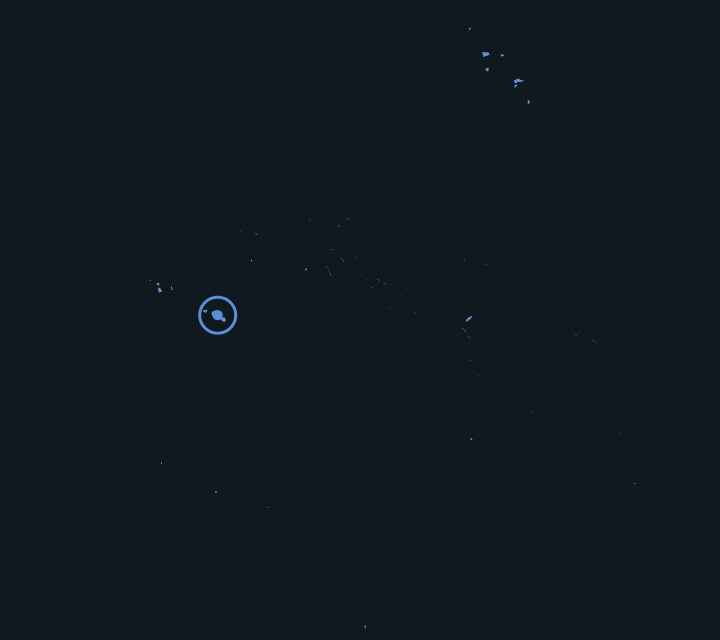
 Tahiti
Papeete
Society Islands
Tuamotu Islands
Marquesas Islands
Austral Islands
Gambier Islands
Moruroa and Fangataufa
South Pacific Ocean
 Tahiti
Papeete
Society Islands
Tuamotu Islands
Marquesas Islands
Austral Islands
Gambier Islands
Moruroa and Fangataufa
South Pacific Ocean
What did France’s nuclear tests do to French Polynesia?
France carried out 193 nuclear tests on the atolls of Moruroa and Fangataufa from July 2, 1966, to January 27, 1996. Of those, 46 were atmospheric tests conducted from 1966 to 1974. The remaining 147 were underground. Fallout from early tests reached the Gambier Islands. Fallout from the Centaure test in July 1974 also reached Tahiti. A 2021 study by researchers working with the investigative site Disclose estimated that about 110,000 people received more than 1 millisievert, the threshold then used for compensation. France’s nuclear safety authority, ASNR, estimated in 2025 that Centaure doses on Tahiti ranged from under 1 to a few millisieverts.
President Emmanuel Macron visited Papeete on July 27, 2021, and said “the Nation has a debt” to French Polynesia. He acknowledged that the atmospheric tests “cannot be called clean.” He did not apologize. Under the Morin law of 2010, the compensation committee CIVEN accepted 1,538 claims between 2010 and 2025 and paid 108 million euros.
A National Assembly inquiry commission reported on June 18, 2025, that France should ask “pardon” (forgiveness). A bill to replace the old exposure threshold with an irrefutable presumption of exposure passed the National Assembly unanimously on January 29, 2026, and the Senate unanimously on May 28, 2026. A second reading in the National Assembly is scheduled for December 1, 2026.
Nuclear tests, 1966 to 1996
193
Total tests on Moruroa and Fangataufa
46 atmospheric tests from 1966 to 1974. 147 underground tests from 1975 to 1996. The compensation committee CIVEN paid €108 million on 1,538 accepted claims between 2010 and 2025.
Does French Polynesia want independence?
Opinion is divided, and no independence referendum has ever been held. The only status vote was on September 28, 1958, when 64.4% voted to stay in the French Community. Pouvanaa a Oopa led the No campaign. After fires in Papeete in October 1958 he was arrested, then convicted and exiled. A French court annulled his conviction in 2018. The pro-independence movement is led historically by Oscar Temaru, the 82-year-old founder of the Tavini Huiraatira party. Independence supporters call the territory Mā’ohi Nui.
In the April 2023 territorial election, the Tavini won 38 of 57 seats, the first time a pro-independence party took a majority. It won 44.3% of the second-round vote. The two pro-autonomy lists won 55.7% combined. A seat bonus for the winning list gave the Tavini its majority. President Moetai Brotherson, who won office on that ticket, favors a gradual approach with a 10-to-15-year horizon. In 2026 the Tavini split. Brotherson formed a new party, A Fano Ti’a, and since then no single group has held a majority in the Assembly. In March 2026 municipal elections, the independence camp fell back.
On September 24, 2026, 54 of the Assembly’s 57 members voted to ask for a United Nations visiting mission. France has always refused such missions. On October 5, 2026, Brotherson told the UN Fourth Committee he wanted an agreed path to a referendum with “no predetermined outcome, no unilateral imposition.” France said it had “taken note” and would consult all Polynesian stakeholders.
Key steps in French Polynesia’s status
- 1842Queen Pomare IV accepts a French protectorate under threat of force
- 1946Becomes a French overseas territory
- 195864.4% vote to stay with France in a constitutional referendum
- 1977First autonomy statute gives the territory limited self-management
- 1984Internal autonomy statute gives the territory its own elected government
- 1996France conducts its last nuclear test on January 27
- 2004Organic law sets the current autonomy statute, with the “overseas country” label
- 2013The UN General Assembly re-lists the territory for decolonization
- 2023Pro-independence Tavini wins a majority; Brotherson becomes president
- 2026The Tavini splits; the Assembly asks the UN for a visiting mission
Who runs French Polynesia?
President Moetai Brotherson has led French Polynesia since May 12, 2023. He was elected by the Assembly with 38 votes. Born on October 22, 1969, in Papeete, he holds a master’s degree in computer science and worked in France, Japan, Germany and the United States before returning to Tahiti. He is Oscar Temaru’s son-in-law. He wrote a novel, Le Roi absent, in 2007.
President Brotherson won office on the Tavini Huiraatira ticket, but the party struck him off in 2026. He now chairs A Fano Ti’a, a party he founded on June 20, 2026. The Tavini named Assembly President Antony Geros as its candidate to replace him and tried from July 2026 to build support for a no-confidence motion. By early November 2026 it had not gathered enough votes. A motion needs 35 of 57 votes to pass.
France is represented by High Commissioner Alexandre Rochatte, who took office around September 1, 2025. He was formerly the prefect of Guadeloupe. French Polynesia sends 3 deputies and 2 senators to the French parliament.
Assembly seats after the 2023 election and 2026 split
How does French Polynesia make money?
French state spending is the largest single source of income. The French government spent 225.6 billion CFP francs in French Polynesia in 2025, about 31% of GDP. Much of this dependence dates from the nuclear testing era, when the Pacific Testing Centre brought money, state jobs and migration to Tahiti.
Tourism is the main private-sector driver. French Polynesia received a record 281,227 tourists in 2025, up 6.6% on 2024. The territory’s GDP reached an estimated 729.3 billion CFP francs in 2025, with real growth of 1.2%.
Black pearls, known as Tahitian cultured pearls, are the top goods export. Raw pearl exports earned about 7 billion CFP francs in 2024, down 59% after a social-media-driven boom in 2023. Volume rose 32% in 2025. Total goods exports reached 13.8 billion CFP francs in 2025. The currency is the CFP franc, pegged to the euro at 1,000 CFP francs to 8.38 euros. Prices were 31% higher than in mainland France in 2022.
Where the money comes from
 French state spending€1.89 bn
- Goods exports€116 m
- Black pearls (2024)€59 m
Why does French Polynesia matter?
A sea zone about the size of the European Union
The exclusive economic zone of about 4.8 million km² is the largest in the Pacific for any French territory. The entire zone became a marine protected area in 2025, with 1.1 million km² highly protected. In June 2026 President Brotherson announced an expansion of the highly protected area to 1.6 million km². Seabed mining is banned. Only Polynesian crews may fish inside it.
The nuclear legacy
France carried out 193 nuclear tests from 1966 to 1996. Health concerns and distrust of the French state still shape politics. A bill to improve compensation for victims passed both houses of parliament unanimously in 2026. President Macron said in 2021 that the Nation has “a debt.”
France’s Pacific presence
About 950 French military personnel are based in French Polynesia. The territory gives France a strategic footprint in the central South Pacific. Australia opened a consulate in Papeete in 2022. In 2023 President Brotherson said he wanted the United States to upgrade its consular agency to a full consulate.
Tourism and local life
A record 281,227 tourists visited in 2025, drawn by Bora Bora, Tahiti and the other islands. GDP per person is about half the French mainland level. Prices were 31% higher than in mainland France in 2022. The population is about 279,500 and no longer growing.
Questions about French Polynesia
Do French Polynesians have French passports?
Yes. Residents of French Polynesia are French citizens and hold French passports. They are also EU citizens, even though EU law largely does not apply in French Polynesia.
What currency does French Polynesia use?
The CFP franc, issued by IEOM, the French overseas issuing bank. It is pegged to the euro at a fixed rate of 1,000 CFP francs to 8.38 euros, guaranteed by the French state. French Polynesia is not in the eurozone.
Is French Polynesia in the EU?
No. French Polynesia is an Overseas Country and Territory associated with the EU, and EU law largely does not apply there. However, residents are French citizens and therefore EU citizens.
Is Tahiti a country?
No. Tahiti is the largest island in French Polynesia, with a land area of 1,072 km². About 75% of French Polynesia’s population lives on Tahiti and neighboring Moorea. The capital, Papeete, is on Tahiti.
How many people live in French Polynesia?
About 279,500 at the end of 2025. The 2022 census counted 278,786. The population is essentially flat. The fertility rate fell to 1.6 children per woman in 2025, the lowest ever recorded. About 1,350 people emigrate each year on a net basis.
What language do people speak in French Polynesia?
French is the official language of government and law. Tahitian and other Polynesian languages are recognized as part of the territory’s cultural identity. One undated estimate puts the share of people who speak Tahitian as their first language at about 44%.
Other territories of France
All territories → French GuianaEurope's spaceport at Kourou launches Ariane rockets; over 95% of the land is Amazon rainforest.Part of the country
 GuadeloupeIn 2009 a 44-day general strike over the cost of living shut Guadeloupe down and spread to Martinique.Part of the country
 MartiniqueThe banned pesticide chlordecone, used on banana farms until 1993, is found in the blood of 85.5% of adults.Part of the country
 RéunionFrance's most populous overseas region, home to Piton de la Fournaise, one of the world's most active volcanoes.Part of the country
 MayotteVoted to stay French when the rest of the Comoros chose independence; the Comoros still claim it.Part of the country
 New CaledoniaVoted three times (2018-2021) to stay French, the third vote boycotted; riots in 2024 left 14 dead.Self-governing
 Saint Pierre and MiquelonThe last French remnant of New France, 25 km off the coast of Newfoundland, Canada.Self-governing
 Wallis and FutunaThree customary kings still reign inside the French Republic and are paid allowances by the French state.Run by an administrator