
Territory of the United States · Caribbean
US Virgin Islands
Self-governingUpdated November 16, 2026
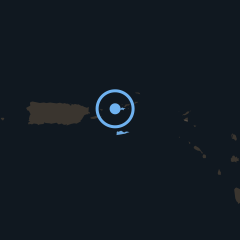
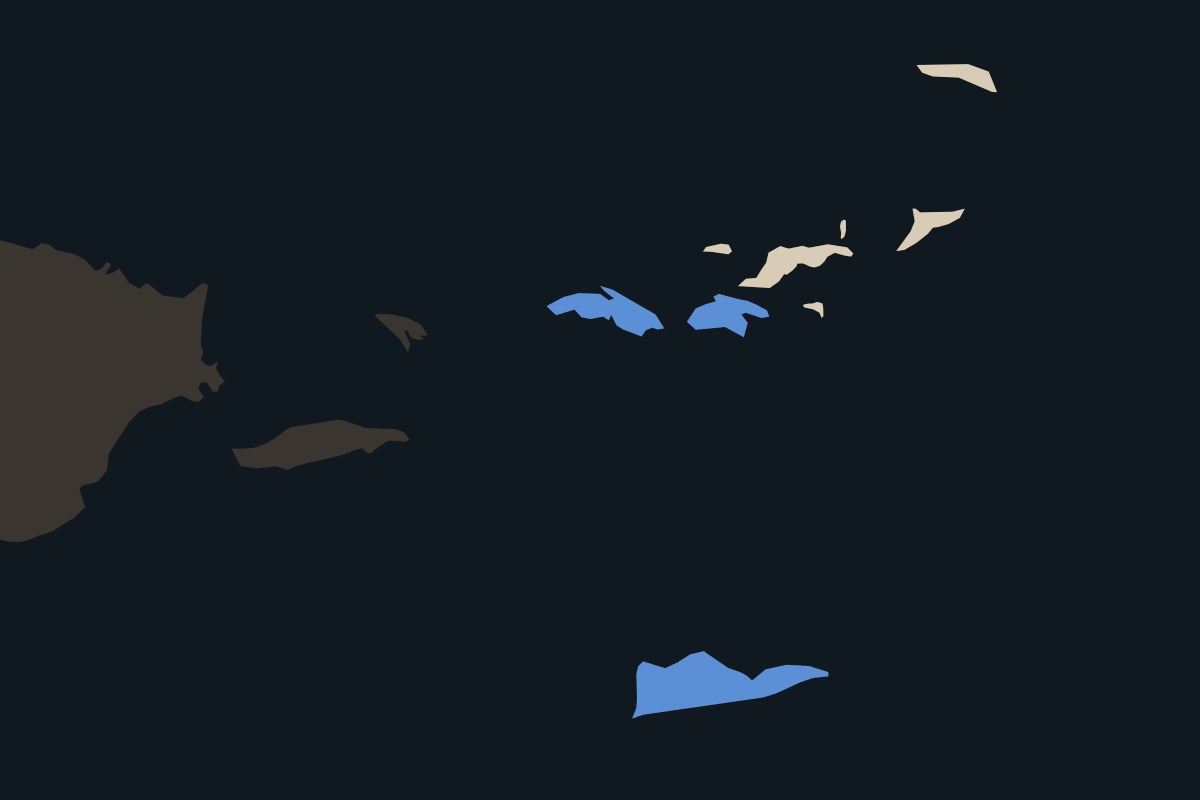
The US Virgin Islands are an unincorporated territory of the United States in the Caribbean, about 65 km east of Puerto Rico. The United States bought them from Denmark in 1917 for $25 million in gold. Residents have been US citizens since 1927 but cannot vote for president. On November 3, 2026, Stacey Plaskett, the territory's non-voting delegate to Congress, was elected the first woman governor with 62.97% of the vote. The results were certified on November 13. She takes office on January 4, 2027.
- Capital
- Charlotte Amalie
- on St. Thomas
- GDP
- $4.67 billion
- 2022, the latest official year
- Cruise passengers
- 1.83 million
- 2025
- Unemployment
- 3.8%
- February 2026
- From Washington
- 2,600 km
- as the crow flies
 United States
US Virgin Islands in 30 seconds
- The US Virgin Islands are an unincorporated territory of the United States. Residents are US citizens but cannot vote for president. They elect one non-voting delegate to the House of Representatives.
- The United States bought the islands from Denmark in 1917 for $25 million in gold, fearing that Germany might use them as a submarine base on the approaches to the Panama Canal.
- Tourism is the largest private-sector industry. The territory received nearly 1.83 million cruise passengers and almost 1 million air arrivals in 2025. The rum cover-over, a return of federal excise tax, was made permanent in July 2025.
- A sixth constitutional convention is drafting the territory's first constitution. A referendum is set for July 3, 2027, on Emancipation Day. Five earlier attempts failed.
Are the US Virgin Islands part of the United States?
The US Virgin Islands belong to the United States but are not fully part of it. They are an unincorporated organized territory. Only some parts of the US Constitution apply there. The Revised Organic Act of 1954 is the territory's governing law. The federal government controls defense, foreign policy, currency, citizenship and immigration. The elected territorial government runs local laws, the local budget, local taxes and local courts.
People born in the US Virgin Islands have been US citizens since 1927. They carry ordinary US passports. They cannot vote in presidential general elections. They elect one non-voting delegate to the House of Representatives. The delegate can vote in committee but not on the final passage of bills. The territory is on the United Nations list of 17 non-self-governing territories.
 St. Thomas
St. John
St. Croix
Charlotte Amalie
Christiansted
Little St. James
British Virgin Islands
Puerto Rico
Caribbean Sea
Atlantic Ocean
 St. Thomas
St. John
St. Croix
Charlotte Amalie
Christiansted
British Virgin Islands
Caribbean Sea
Atlantic Ocean
Why did the United States buy the Virgin Islands?
The United States bought the islands to keep them away from Germany. During World War I, President Woodrow Wilson and Secretary of State Robert Lansing feared that Germany might absorb Denmark and use the islands as a submarine base on the approaches to the Panama Canal. Lansing hinted that the United States might occupy the islands if Denmark refused to sell.
The two countries signed a treaty on August 4, 1916, for $25 million in gold. A non-binding Danish referendum on December 14, 1916, passed with 64.2% in favor. The formal handover took place on March 31, 1917, now celebrated as Transfer Day. The US Navy ran the islands until 1931, when control moved to the Department of the Interior. Congress granted US citizenship in 1927. The Organic Act of 1936 set up local self-government. The Revised Organic Act of 1954 expanded it. Residents elected their own governor for the first time in 1970.
From Danish rule to self-government
- 1848Abolition of slavery in the Danish West Indies after an uprising on St. Croix
- 1878The Fireburn labor revolt on St. Croix, led by women including "Queen Mary" Thomas
- 1916Treaty signed on August 4 for $25 million in gold
- 1917Transfer Day on March 31; the US Navy takes over
- 1927Congress grants US citizenship to Virgin Islanders
- 1936The Organic Act sets up local self-government
- 1954The Revised Organic Act expands self-government
- 1970Residents elect their own governor for the first time
- 2025The sixth constitutional convention begins drafting a constitution
Who runs the US Virgin Islands?
Governor Albert Bryan Jr., a Democrat, has led the territory since January 7, 2019. He is term-limited. Bryan was born on St. Thomas, studied at Wittenberg University, earned an MBA at the University of the Virgin Islands and served as Labor Commissioner from 2007 to 2015.
On November 3, 2026, Stacey Plaskett won the governor's race with 62.97% of the vote, according to the results certified on November 13. She will be the first woman elected governor of the territory. Plaskett grew up in the Bushwick housing projects in Brooklyn. Her father was an NYPD officer and her parents were from St. Croix. She attended Georgetown and served as a Bronx assistant district attorney before working in the George W. Bush Justice Department. She was a Republican until 2008. She has served as the territory's non-voting delegate to Congress since January 2015. She takes office on January 4, 2027, with Lieutenant Governor-elect Milton E. Potter, the current Senate president.
The Legislature of the Virgin Islands has 15 senators. The new legislature, elected on November 3, will have 10 Democrats and 5 Independents. Janelle K. Sarauw won the delegate seat with 76.88%.
Governor's race, November 3, 2026
62.97%
Stacey Plaskett (Democrat)
Plaskett and her running mate, Milton E. Potter, won 12,427 of 19,735 votes, write-ins included. They beat four independent tickets. She will be the first woman elected governor of the territory. The Elections System certified the results on November 13, 2026.
What is the Jeffrey Epstein link to the Virgin Islands?
Jeffrey Epstein, a financier and convicted sex offender, owned two private islands in the territory. He bought Little St. James, a roughly 72-acre island near St. Thomas, in 1998 for $7.95 million. He later bought Great St. James in 2016 for $22.5 million. After his death, the Epstein estate settled with the territorial government in November 2022 for more than $105 million. The estate also returned more than $80 million in economic development tax benefits and paid $450,000 for environmental damage. Both islands were sold in May 2023 to financier Stephen Deckoff for about $60 million.
The territory sued JPMorgan on December 27, 2022, alleging the bank facilitated Epstein's sex trafficking. Governor Bryan removed Attorney General Denise George days later. JPMorgan settled on September 26, 2023, for $75 million with no admission of liability. In November 2025, released documents showed text exchanges between Epstein and Delegate Plaskett during a 2019 congressional hearing. Plaskett said Epstein was a constituent and that his investigation was not public at the time. A House censure resolution against Plaskett failed 209 to 214 on November 18, 2025. In February 2026, CNN reported 2019 texts in which Governor Bryan told Epstein he had asked the territory's environmental chief to pause enforcement against Epstein. Plaskett won the governor's race in November 2026.
Key facts
- Little St. JamesBought by Epstein in 1998 for $7.95 million; sold in May 2023 for about $60 million (both islands)
- Estate settlement (2022)More than $105 million to the territory, plus return of more than $80 million in tax benefits
- JPMorgan settlement (2023)$75 million, no admission of liability; the territory had sought at least $190 million
- Epstein Files Transparency ActSigned November 19, 2025; the DOJ released about 3.5 million pages by January 30, 2026
How do the US Virgin Islands make money?
Tourism is the largest private-sector industry. In 2025, the territory received nearly 1.83 million cruise passengers and almost 1 million air arrivals. The projection for 2026 is 1.96 million cruise passengers.
The rum cover-over is a major revenue source. The US Treasury returns federal excise tax on rum to the territory. The rate of $13.25 per proof gallon was made permanent on July 4, 2025. In 2021 the territory received about $281 million in cover-over money. The St. Croix refinery, one of the largest in the Western Hemisphere, has been idle since May 2021 after emission incidents. Its new owner, Port Hamilton Refining and Transportation, is targeting a 2027 restart.
The proposed budget for fiscal year 2027 is $1.64 billion, of which about $543.3 million is federal funds. The power utility, WAPA, carries about $207 million in debt. Its own consultants say it needs about $375 million to stabilize. Multi-day blackouts hit St. Thomas and St. John in October 2026. The governor's office reports about $12 billion in hurricane recovery projects still in the pipeline.
Federal money, rum revenue and utility debt
Why do the US Virgin Islands matter?
Tourism
The territory received nearly 1.83 million cruise passengers and almost 1 million air arrivals in 2025. Charlotte Amalie on St. Thomas is one of the busiest cruise ports in the Caribbean. Tourism is the largest private-sector industry.
Rum and the refinery
The rum cover-over returns federal excise tax to the territory. The rate of $13.25 per proof gallon was made permanent in July 2025. The St. Croix refinery has been idle since May 2021. Its last configuration handled 220,000 barrels per day. Its new owner, Port Hamilton Refining and Transportation, is targeting a 2027 restart.
Caribbean location
The islands sit on the Anegada Passage between the Atlantic and the Caribbean. The United States bought them in 1917 to guard the approaches to the Panama Canal. In August 2025, Air Force special tactics units practiced seizing the St. Croix airport during an exercise.
Questions about the US Virgin Islands
Do you need a passport for the US Virgin Islands?
Not if you are a US citizen traveling from the United States. The US Virgin Islands are US territory. There is no customs or immigration check for flights from the mainland. Travelers flying back to the mainland clear US Customs and Border Protection before departure. The tourism department advises carrying proof of citizenship, such as a passport or a birth certificate with photo ID. Non-US citizens should check their visa requirements as they would for any US destination.
What currency do the US Virgin Islands use?
The US dollar. The territory uses the same currency as the 50 states.
Why do they drive on the left in the US Virgin Islands?
It is a legacy of Danish colonial rule. Denmark governed the islands until 1917, and driving stayed on the left after the American purchase. Most cars on the islands are left-hand drive, imported from the US mainland.
Can the US Virgin Islands vote for president?
No. Residents cannot vote in the presidential general election and the territory has no electoral votes. Both major parties hold primaries or caucuses there, and the territory sends delegates to the national conventions.
How many people live in the US Virgin Islands?
The 2020 Census counted 87,146 people, down 18.1% from 106,405 in 2010. The three main islands are St. Thomas (42,261), St. Croix (41,004) and St. John (3,881).
Is there a US military base in the US Virgin Islands?
There is no large permanent base. The Virgin Islands National Guard and the Coast Guard are present. In August 2025, Air Force special tactics units practiced seizing the Henry E. Rohlsen Airport on St. Croix during a military exercise.
Other US territories
All territories → Puerto RicoIts 3.2 million people are US citizens but cannot vote for president and have no voting seat in Congress.Self-governing
 GuamAndersen Air Force Base and Naval Base Guam make it the westernmost US territory with major military bases.Self-governing
 American SamoaPeople born there are US nationals, not US citizens, the only such case among inhabited US territories.Self-governing
 Northern Mariana IslandsThe 1945 atomic bomb missions against Hiroshima and Nagasaki took off from Tinian, one of its islands.Self-governing
 US Minor Outlying IslandsNo permanent residents, only rotating military, contractor and wildlife staff; Midway gave its name to the 1942 battle.Run by an administrator