
General Assembly vote · October 25, 1971
How countries voted on UN Resolution 2758 in 1971
On October 25, 1971, the General Assembly voted 76 to 35, with 17 abstentions, to seat the People's Republic of China as China's representative. The resolution expelled "the representatives of Chiang Kai-shek", meaning the Republic of China delegation, which had held China's seat since the UN's founding in 1945 and had been based in Taipei since 1949. The text does not mention Taiwan. China says it settled Taiwan's representation, but Taiwan's government and the United States say it did not.
- Yes
- 76
- No
- 35
- Abstained
- 17
- Didn't vote
- 3
Adopted: it needed more yes votes than no votes, and abstentions count for neither side.
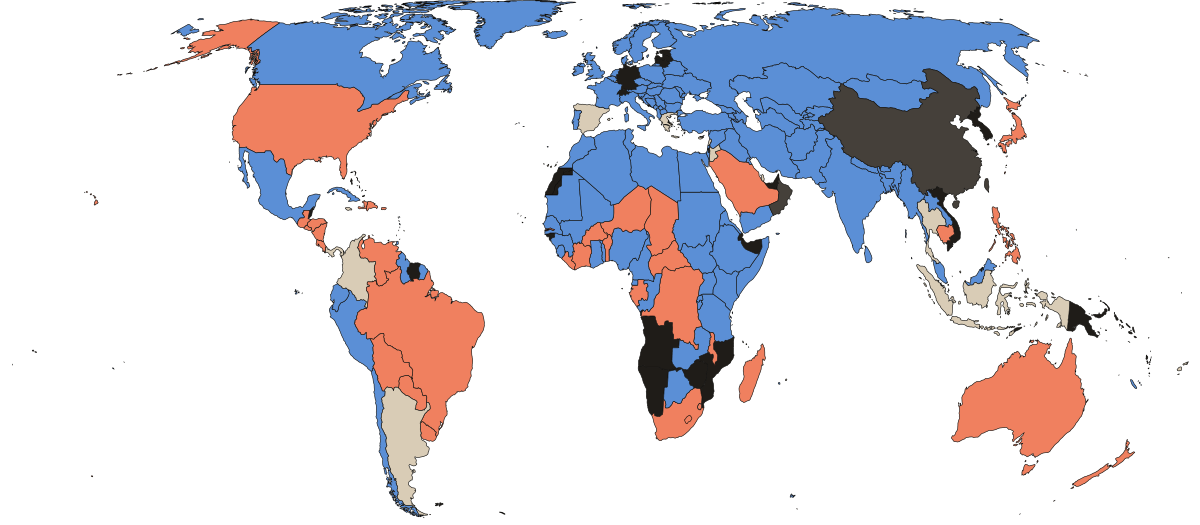
- Yes
- No
- Abstained
- Didn't vote
- Not a UN member
Which countries voted against?
The United States and Japan led the 35 no votes. They were joined by Australia, New Zealand, Saudi Arabia, Brazil, the Philippines and many Latin American and African governments that recognized the Republic of China at the time.
- United States
- Australia
- Bolivia
- Brazil
- Central African Republic
- Chad
- Costa Rica
- Dahomey
- Dominican Republic
- DR Congo
- El Salvador
- Gabon
- Gambia
- Guatemala
- Haiti
- Honduras
- Ivory Coast
- Japan
- Khmer Republic
- Lesotho
- Liberia
- Madagascar
- Malawi
- Malta
- New Zealand
- Nicaragua
- Niger
- Paraguay
- Philippines
- Saudi Arabia
- South Africa
- Swaziland
- Upper Volta
- Uruguay
- Venezuela
How did the big powers vote?
What happened in the Assembly that night?
China was a founding UN member. The Republic of China government held its seat after it lost the civil war on the mainland and moved to Taiwan in 1949. From 1963, Albania and other co-sponsoring governments put forward a draft resolution almost every year to seat the People's Republic. In November 1970 the Albanian draft got more yes than no votes for the first time (51-49) but failed because the Assembly had voted to treat it as an important question needing two-thirds.
On October 25, 1971, the United States tried the same approach. Its "important question" draft was rejected by 59 votes to 55, with 15 abstentions. Supporters of the resolution said this was a credentials question needing only a simple majority. A United States motion to vote separately on the expulsion clause was then rejected 61 to 51. The Republic of China's foreign minister Chow Shu-kai said his delegation "has now decided not to take part in any further proceedings of this General Assembly." He led his delegation out before the final vote. UPI reported that his exit "was so dignified that the assembly gave him a spontaneous ovation."
Henry Kissinger, the United States national security adviser, was in Beijing that week on his second China trip, preparing President Nixon's February 1972 visit. Mongolia's delegate cited the trip in the debate.
When the resolution passed, by 76 votes to 35 with 17 abstentions, delegates cheered. Contemporary reports said Tanzania's ambassador Salim Ahmed Salim danced, which he later denied.
Why did countries vote yes or no?
Supporters argued that the question was which government represented China, not whether to expel a member. In their view, China was a founding UN member and only its representatives were changing. Malaysia called Taiwan "a separate issue" to be settled with "the wishes of the people of Taiwan" taken into account. Many governments that voted yes had already recognized the People's Republic, among them the United Kingdom and Israel in 1950, France in 1964, Canada and Italy in 1970.
By 1971 the United States, which had long led the effort to keep the People's Republic out, no longer opposed seating it. It backed a "dual representation" plan that would have seated the People's Republic in both the General Assembly and the Security Council while keeping the Republic of China in the Assembly. United States ambassador George H. W. Bush warned before the vote that it would be "the first expulsion of a Member State in the 26-year history of the United Nations." After the vote he told reporters, "It's not a good thing to kick somebody out."
Japan's delegate said it was wrong "to expel the smaller Government because the larger Government wishes it." Japan switched recognition to the People's Republic in 1972, and the United States did so in 1979.
Why is Resolution 2758 argued over today?
China says the resolution "resolved once and for all the question of the representation of the whole of China, including Taiwan" and that Taiwan has no right to send representatives to the UN. Its foreign ministry published this position on September 30, 2025, citing UN legal opinions that treat Taiwan "as a province of China with no separate status." In the 1971 debate, the Republic of China's own representative Liu Chieh, whose government then claimed to be the government of all China, told the Assembly, "Taiwan is indeed Chinese territory."
In April 2024 United States deputy assistant secretary of state Mark Lambert said the resolution does not endorse the "one China" principle, does not decide Taiwan's status and does not bar Taiwan's meaningful participation in the UN system. In March 2025 a State Department spokesperson called China's reading an "intentional misuse and mischaracterization." Taiwan's foreign ministry says the resolution "does not mention Taiwan" and should not be used to exclude Taiwan from the UN system. It repeated this position in September 2026. The European Parliament (October 24, 2024), the Dutch House of Representatives and the Australian Senate (both 2024) passed non-binding motions saying the resolution does not decide Taiwan's status.
Taiwan remains outside the UN. In May 2026 the World Health Assembly again declined to invite it as an observer, for the 10th year in a row. Twelve states, eleven UN members plus the Holy See, have diplomatic relations with Taiwan, according to a Reuters count (May 2026).
How did each region vote?
Europe voted yes almost as one, with 23 in favor, one against and four abstentions. The Americas were the only large region where no votes outnumbered yes votes, 13 to eight. Africa split 26 yes to 15 no.
- Europe28 countries 23 yes1 no4 abstained
- Americas26 countries 8 yes13 no5 abstained
- Asia18 countries 11 yes3 no2 abstained
- Oceania3 countries 0 yes2 no1 abstained
- Middle East14 countries 8 yes1 no4 abstained
- Africa42 countries 26 yes15 no1 abstained
What did the resolution say?
- The preamble says that restoring the "lawful rights" of the People's Republic of China is essential for the protection of the Charter and for the cause that the United Nations must serve.
- The preamble also says the People's Republic of China's representatives "are the only lawful representatives of China to the United Nations" and that the People's Republic is one of the five permanent members of the Security Council.
- The single operative paragraph (the part that makes the decision) "Decides to restore all its rights to the People's Republic of China".
- It recognizes "the representatives of its Government as the only legitimate representatives of China to the United Nations".
- It expels "forthwith the representatives of Chiang Kai-shek from the place which they unlawfully occupy at the United Nations and in all the organizations related to it".
- The text names no one except the People's Republic of China and Chiang Kai-shek. It does not mention Taiwan.
How did every country vote?
| Country | Region | Vote |
|---|---|---|
| Afghanistan | Asia | Yes |
| Albania | Europe | Yes |
| Algeria | Africa | Yes |
| Argentina | Americas | Abstained |
| Australia | Oceania | No |
| Austria | Europe | Yes |
| Bahrain | Middle East | Abstained |
| Barbados | Americas | Abstained |
| Belgium | Europe | Yes |
| Bhutan | Asia | Yes |
| Bolivia | Americas | No |
| Botswana | Africa | Yes |
| Brazil | Americas | No |
| Bulgaria | Europe | Yes |
| Burma | Asia | Yes |
| Burundi | Africa | Yes |
| Byelorussian SSR | Europe | Yes |
| Cameroon | Africa | Yes |
| Canada | Americas | Yes |
| Central African Republic | Africa | No |
| Ceylon | Asia | Yes |
| Chad | Africa | No |
| Chile | Americas | Yes |
| China (Republic of China delegation) | Asia | Didn't vote |
| Colombia | Americas | Abstained |
| Costa Rica | Americas | No |
| Cuba | Americas | Yes |
| Cyprus | Europe | Abstained |
| Czechoslovakia | Europe | Yes |
| Dahomey | Africa | No |
| Denmark | Europe | Yes |
| Dominican Republic | Americas | No |
| DR Congo | Africa | No |
| Ecuador | Americas | Yes |
| Egypt | Africa | Yes |
| El Salvador | Americas | No |
| Equatorial Guinea | Africa | Yes |
| Ethiopia | Africa | Yes |
| Fiji | Oceania | Abstained |
| Finland | Europe | Yes |
| France | Europe | Yes |
| Gabon | Africa | No |
| Gambia | Africa | No |
| Ghana | Africa | Yes |
| Greece | Europe | Abstained |
| Guatemala | Americas | No |
| Guinea | Africa | Yes |
| Guyana | Americas | Yes |
| Haiti | Americas | No |
| Honduras | Americas | No |
| Hungary | Europe | Yes |
| Iceland | Europe | Yes |
| India | Asia | Yes |
| Indonesia | Asia | Abstained |
| Iran | Middle East | Yes |
| Iraq | Middle East | Yes |
| Ireland | Europe | Yes |
| Israel | Middle East | Yes |
| Italy | Europe | Yes |
| Ivory Coast | Africa | No |
| Jamaica | Americas | Abstained |
| Japan | Asia | No |
| Jordan | Middle East | Abstained |
| Kenya | Africa | Yes |
| Khmer Republic | Asia | No |
| Kuwait | Middle East | Yes |
| Laos | Asia | Yes |
| Lebanon | Middle East | Abstained |
| Lesotho | Africa | No |
| Liberia | Africa | No |
| Libya | Africa | Yes |
| Luxembourg | Europe | Abstained |
| Madagascar | Africa | No |
| Malawi | Africa | No |
| Malaysia | Asia | Yes |
| Maldives | Asia | Didn't vote |
| Mali | Africa | Yes |
| Malta | Europe | No |
| Mauritania | Africa | Yes |
| Mauritius | Africa | Abstained |
| Mexico | Americas | Yes |
| Mongolia | Asia | Yes |
| Morocco | Africa | Yes |
| Nepal | Asia | Yes |
| Netherlands | Europe | Yes |
| New Zealand | Oceania | No |
| Nicaragua | Americas | No |
| Niger | Africa | No |
| Nigeria | Africa | Yes |
| North Yemen | Middle East | Yes |
| Norway | Europe | Yes |
| Oman | Middle East | Didn't vote |
| Pakistan | Asia | Yes |
| Panama | Americas | Abstained |
| Paraguay | Americas | No |
| Peru | Americas | Yes |
| Philippines | Asia | No |
| Poland | Europe | Yes |
| Portugal | Europe | Yes |
| Qatar | Middle East | Abstained |
| Republic of the Congo | Africa | Yes |
| Romania | Europe | Yes |
| Rwanda | Africa | Yes |
| Saudi Arabia | Middle East | No |
| Senegal | Africa | Yes |
| Sierra Leone | Africa | Yes |
| Singapore | Asia | Yes |
| Somalia | Africa | Yes |
| South Africa | Africa | No |
| South Yemen | Middle East | Yes |
| Soviet Union | Europe | Yes |
| Spain | Europe | Abstained |
| Sudan | Africa | Yes |
| Swaziland | Africa | No |
| Sweden | Europe | Yes |
| Syria | Middle East | Yes |
| Tanzania | Africa | Yes |
| Thailand | Asia | Abstained |
| Togo | Africa | Yes |
| Trinidad and Tobago | Americas | Yes |
| Tunisia | Africa | Yes |
| Turkey | Middle East | Yes |
| Uganda | Africa | Yes |
| Ukrainian SSR | Europe | Yes |
| United Kingdom | Europe | Yes |
| United States | Americas | No |
| Upper Volta | Africa | No |
| Uruguay | Americas | No |
| Venezuela | Americas | No |
| Yugoslavia | Europe | Yes |
| Zambia | Africa | Yes |