
General Assembly vote · October 29, 2025
How countries vote on the US embargo on Cuba at the UN
Almost every year since 1992 (the 2020 vote was delayed to June 2021 by COVID-19), the General Assembly has called for an end to the US embargo on Cuba. On October 29, 2025, it did so for the 33rd time, by 165 to 7 with 12 abstentions. The seven no votes were a record (the previous high was four, in 1993 and 2004 to 2007), after the United States asked governments to vote against.
- Yes
- 165
- No
- 7
- Abstained
- 12
- Didn't vote
- 9
Adopted: it needed more yes votes than no votes, and abstentions count for neither side.
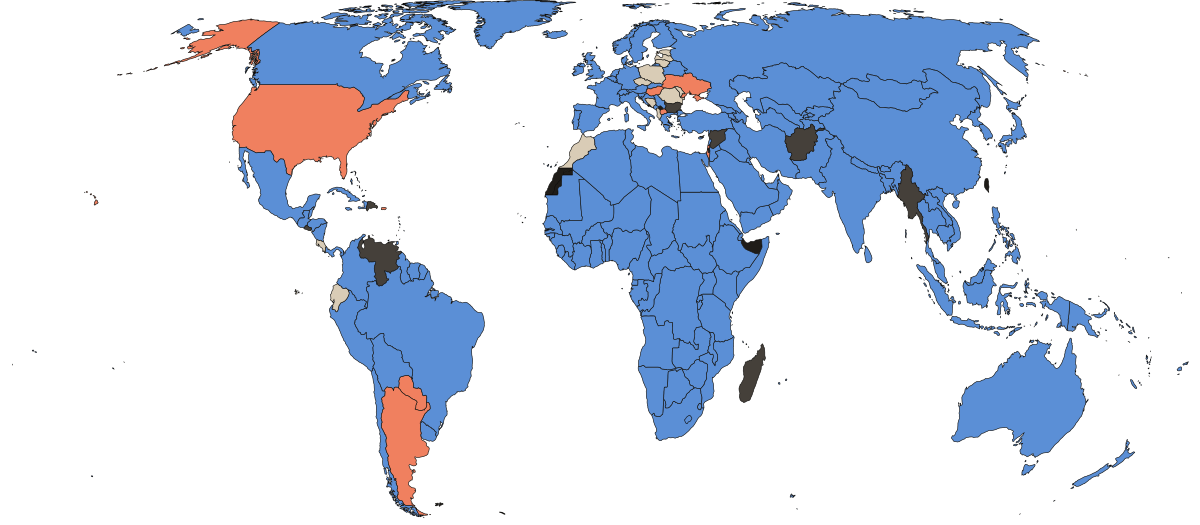
- Yes
- No
- Abstained
- Didn't vote
- Not a UN member
Which countries voted against?
The United States and Israel have voted no every year except 2016, when both abstained. Argentina, Hungary, North Macedonia and Ukraine voted no for the first time, and Paraguay for the first time since 1993. Hungary was the only EU member to vote no.
 United States
 Argentina
 Hungary
 Israel
 North Macedonia
 Paraguay
 Ukraine
How did the big powers vote?
Why did more countries vote no in 2025?
In an unclassified cable dated October 2, 2025, reported by Reuters, the State Department told US missions to lobby governments to vote no, or at least abstain or stay away. Its main argument was that Cuba supports Russia's war in Ukraine. The United States estimates that 1,000 to 5,000 Cubans are fighting for Russia. Cuba denies this.
Several governments explained their votes. Ukraine's ambassador Andrii Melnyk said the vote was "not directed against the Cuban people but against the inaction of the Cuban government." Paraguay's deputy foreign minister Victor Verdun said "the problem is the Cuban regime, not the blockade" (translated from Spanish). Poland, speaking also for Czechia and the three Baltic states, abstained and cited Cuba's support for Russia's invasion. Costa Rica abstained, saying neither the embargo nor the resolution had brought reform.
No formal explanation from Argentina has been reported. Argentine media described the vote as alignment with the United States, in the first vote under its new foreign minister, Pablo Quirno. No public reason from Hungary or North Macedonia has been reported.
- Yes
- No
- Abstained
- Didn't vote
What is the embargo, and can a UN vote end it?
The United States banned most exports to Cuba in October 1960. President Kennedy proclaimed a full embargo on February 3, 1962. The Helms-Burton Act of March 12, 1996 wrote the embargo into US law. No president can lift it alone. It ends only if Congress changes the law, or if a president certifies that a transition government, as the Act defines it, is in power in Cuba.
General Assembly resolutions are not binding, and 33 of them have not ended the embargo. US policy did ease under President Obama: the two countries restored relations in 2015, and in 2016 the United States abstained for the first time, along with Israel, with the vote passing 191-0. US ambassador Samantha Power said the policy had isolated the United States rather than Cuba. Since 2017, apart from limited easing under President Biden, the United States has tightened the embargo. On January 20, 2025, President Trump put Cuba back on the US list of state sponsors of terrorism, reversing President Biden's decision a week earlier to remove it. In January 2026 an executive order authorized tariffs on countries that supply Cuba with oil, and more sanctions followed during 2026.
What do Cuba and the United States say?
Cuba's foreign minister Bruno Rodriguez called the embargo "a policy of collective punishment" and said "Cuba will not surrender." He spoke on October 29, 2025, as Hurricane Melissa hit Cuba. Before the 2025 vote, Cuba's government estimated the embargo cost $7.556 billion from March 2024 to February 2025. Its latest report, released September 7, 2026, puts the cost at about $8.08 billion from March 2025 to February 2026, its highest yearly figure, and Cuban state media give about $178.7 billion since the embargo began.
US ambassador Mike Waltz said "There is no blockade" and that food, medicine and humanitarian goods are allowed. He cited about $585 million in US food and medicine exports to Cuba in 2024 and called Cuba's campaign "political theatre."
When Waltz spoke, Cuba's delegation interrupted with a point of order (a formal procedural objection), telling him the General Assembly "is not a signal chat," a reference to the Signal group chat that ended his time as national security adviser. Waltz replied that he was well aware of where he was speaking. The Assembly is due to take up the resolution again on October 27-28, 2026.
How did each region vote?
Africa and Asia voted yes almost unanimously, with 52 of 54 African members and 27 of 29 Asian members voting in favor and none against. Europe was the most divided region, with 34 yes, 3 no and 9 abstentions.
- Europe47 countries 34 yes3 no9 abstained
- Americas35 countries 27 yes3 no2 abstained
- Asia29 countries 27 yes0 no0 abstained
- Oceania14 countries 13 yes0 no0 abstained
- Middle East14 countries 12 yes1 no0 abstained
- Africa54 countries 52 yes0 no1 abstained
What did the resolution say?
- It expressed concern about laws such as the Helms-Burton Act of March 12, 1996, whose extraterritorial effects affect the sovereignty of other states.
- It recalled the easing of the embargo in 2015-2016 and contrasted it with the measures applied since 2017 to reinforce the embargo.
- It called on all states to refrain from passing or applying such laws and measures.
- It urged states that apply such laws to take the steps necessary to repeal or invalidate them as soon as possible.
- The operative demands address "States" and do not name the United States, which appears only in the title (repeated in the final paragraph) and the preamble. The text says "embargo." "Blockade" is Cuba's word for it and does not appear in the resolution.
How did every country vote?
| Country | Region | Vote |
|---|---|---|
 Afghanistan Afghanistan | Asia | Didn't vote |
 Albania Albania | Europe | Abstained |
 Algeria Algeria | Africa | Yes |
 Andorra Andorra | Europe | Yes |
 Angola Angola | Africa | Yes |
 Antigua and Barbuda Antigua and Barbuda | Americas | Yes |
| Argentina | Americas | No |
 Armenia Armenia | Europe | Yes |
 Australia Australia | Oceania | Yes |
 Austria Austria | Europe | Yes |
 Azerbaijan Azerbaijan | Europe | Yes |
 Bahamas Bahamas | Americas | Yes |
 Bahrain Bahrain | Middle East | Yes |
 Bangladesh Bangladesh | Asia | Yes |
 Barbados Barbados | Americas | Yes |
 Belarus Belarus | Europe | Yes |
 Belgium Belgium | Europe | Yes |
 Belize Belize | Americas | Yes |
 Benin Benin | Africa | Yes |
 Bhutan Bhutan | Asia | Yes |
 Bolivia Bolivia | Americas | Yes |
 Bosnia and Herzegovina Bosnia and Herzegovina | Europe | Abstained |
 Botswana Botswana | Africa | Yes |
 Brazil Brazil | Americas | Yes |
 Brunei Brunei | Asia | Yes |
 Bulgaria Bulgaria | Europe | Didn't vote |
 Burkina Faso Burkina Faso | Africa | Yes |
 Burundi Burundi | Africa | Yes |
 Cambodia Cambodia | Asia | Yes |
 Cameroon Cameroon | Africa | Yes |
 Canada Canada | Americas | Yes |
 Cape Verde Cape Verde | Africa | Yes |
 Central African Republic Central African Republic | Africa | Yes |
 Chad Chad | Africa | Yes |
 Chile Chile | Americas | Yes |
 China China | Asia | Yes |
 Colombia Colombia | Americas | Yes |
 Comoros Comoros | Africa | Yes |
 Costa Rica Costa Rica | Americas | Abstained |
 Côte d'Ivoire Côte d'Ivoire | Africa | Yes |
 Croatia Croatia | Europe | Yes |
 Cuba Cuba | Americas | Yes |
 Cyprus Cyprus | Europe | Yes |
 Czechia Czechia | Europe | Abstained |
 Denmark Denmark | Europe | Yes |
 Djibouti Djibouti | Africa | Yes |
 Dominica Dominica | Americas | Yes |
 Dominican Republic Dominican Republic | Americas | Didn't vote |
 DR Congo DR Congo | Africa | Yes |
 Ecuador Ecuador | Americas | Abstained |
 Egypt Egypt | Africa | Yes |
 El Salvador El Salvador | Americas | Didn't vote |
 Equatorial Guinea Equatorial Guinea | Africa | Yes |
 Eritrea Eritrea | Africa | Yes |
 Estonia Estonia | Europe | Abstained |
 Eswatini Eswatini | Africa | Yes |
 Ethiopia Ethiopia | Africa | Yes |
 Fiji Fiji | Oceania | Yes |
 Finland Finland | Europe | Yes |
 France France | Europe | Yes |
 Gabon Gabon | Africa | Yes |
 Gambia Gambia | Africa | Yes |
 Georgia Georgia | Europe | Yes |
 Germany Germany | Europe | Yes |
 Ghana Ghana | Africa | Yes |
 Greece Greece | Europe | Yes |
 Grenada Grenada | Americas | Yes |
 Guatemala Guatemala | Americas | Yes |
 Guinea Guinea | Africa | Yes |
 Guinea-Bissau Guinea-Bissau | Africa | Yes |
 Guyana Guyana | Americas | Yes |
 Haiti Haiti | Americas | Yes |
 Honduras Honduras | Americas | Yes |
| Hungary | Europe | No |
 Iceland Iceland | Europe | Yes |
 India India | Asia | Yes |
 Indonesia Indonesia | Asia | Yes |
 Iran Iran | Middle East | Yes |
 Iraq Iraq | Middle East | Yes |
 Ireland Ireland | Europe | Yes |
| Israel | Middle East | No |
 Italy Italy | Europe | Yes |
 Jamaica Jamaica | Americas | Yes |
 Japan Japan | Asia | Yes |
 Jordan Jordan | Middle East | Yes |
 Kazakhstan Kazakhstan | Asia | Yes |
 Kenya Kenya | Africa | Yes |
 Kiribati Kiribati | Oceania | Yes |
 Kuwait Kuwait | Middle East | Yes |
 Kyrgyzstan Kyrgyzstan | Asia | Yes |
 Laos Laos | Asia | Yes |
 Latvia Latvia | Europe | Abstained |
 Lebanon Lebanon | Middle East | Yes |
 Lesotho Lesotho | Africa | Yes |
 Liberia Liberia | Africa | Yes |
 Libya Libya | Africa | Yes |
 Liechtenstein Liechtenstein | Europe | Yes |
 Lithuania Lithuania | Europe | Abstained |
 Luxembourg Luxembourg | Europe | Yes |
 Madagascar Madagascar | Africa | Didn't vote |
 Malawi Malawi | Africa | Yes |
 Malaysia Malaysia | Asia | Yes |
 Maldives Maldives | Asia | Yes |
 Mali Mali | Africa | Yes |
 Malta Malta | Europe | Yes |
 Marshall Islands Marshall Islands | Oceania | Yes |
 Mauritania Mauritania | Africa | Yes |
 Mauritius Mauritius | Africa | Yes |
 Mexico Mexico | Americas | Yes |
 Micronesia Micronesia | Oceania | Yes |
 Moldova Moldova | Europe | Abstained |
 Monaco Monaco | Europe | Yes |
 Mongolia Mongolia | Asia | Yes |
 Montenegro Montenegro | Europe | Yes |
 Morocco Morocco | Africa | Abstained |
 Mozambique Mozambique | Africa | Yes |
 Myanmar Myanmar | Asia | Didn't vote |
 Namibia Namibia | Africa | Yes |
 Nauru Nauru | Oceania | Didn't vote |
 Nepal Nepal | Asia | Yes |
 Netherlands Netherlands | Europe | Yes |
 New Zealand New Zealand | Oceania | Yes |
 Nicaragua Nicaragua | Americas | Yes |
 Niger Niger | Africa | Yes |
 Nigeria Nigeria | Africa | Yes |
 North Korea North Korea | Asia | Yes |
| North Macedonia | Europe | No |
 Norway Norway | Europe | Yes |
 Oman Oman | Middle East | Yes |
 Pakistan Pakistan | Asia | Yes |
 Palau Palau | Oceania | Yes |
 Panama Panama | Americas | Yes |
 Papua New Guinea Papua New Guinea | Oceania | Yes |
| Paraguay | Americas | No |
 Peru Peru | Americas | Yes |
 Philippines Philippines | Asia | Yes |
 Poland Poland | Europe | Abstained |
 Portugal Portugal | Europe | Yes |
 Qatar Qatar | Middle East | Yes |
 Republic of the Congo Republic of the Congo | Africa | Yes |
 Romania Romania | Europe | Abstained |
 Russia Russia | Europe | Yes |
 Rwanda Rwanda | Africa | Yes |
 Saint Kitts and Nevis Saint Kitts and Nevis | Americas | Yes |
 Saint Lucia Saint Lucia | Americas | Yes |
 Saint Vincent and the Grenadines Saint Vincent and the Grenadines | Americas | Yes |
 Samoa Samoa | Oceania | Yes |
 San Marino San Marino | Europe | Yes |
 São Tomé and Príncipe São Tomé and Príncipe | Africa | Yes |
 Saudi Arabia Saudi Arabia | Middle East | Yes |
 Senegal Senegal | Africa | Yes |
 Serbia Serbia | Europe | Yes |
 Seychelles Seychelles | Africa | Yes |
 Sierra Leone Sierra Leone | Africa | Yes |
 Singapore Singapore | Asia | Yes |
 Slovakia Slovakia | Europe | Yes |
 Slovenia Slovenia | Europe | Yes |
 Solomon Islands Solomon Islands | Oceania | Yes |
 Somalia Somalia | Africa | Yes |
 South Africa South Africa | Africa | Yes |
 South Korea South Korea | Asia | Yes |
 South Sudan South Sudan | Africa | Yes |
 Spain Spain | Europe | Yes |
 Sri Lanka Sri Lanka | Asia | Yes |
 Sudan Sudan | Africa | Yes |
 Suriname Suriname | Americas | Yes |
 Sweden Sweden | Europe | Yes |
 Switzerland Switzerland | Europe | Yes |
 Syria Syria | Middle East | Didn't vote |
 Tajikistan Tajikistan | Asia | Yes |
 Tanzania Tanzania | Africa | Yes |
 Thailand Thailand | Asia | Yes |
 Timor-Leste Timor-Leste | Asia | Yes |
 Togo Togo | Africa | Yes |
 Tonga Tonga | Oceania | Yes |
 Trinidad and Tobago Trinidad and Tobago | Americas | Yes |
 Tunisia Tunisia | Africa | Yes |
 Turkey Turkey | Middle East | Yes |
 Turkmenistan Turkmenistan | Asia | Yes |
 Tuvalu Tuvalu | Oceania | Yes |
 Uganda Uganda | Africa | Yes |
| Ukraine | Europe | No |
 United Arab Emirates United Arab Emirates | Middle East | Yes |
 United Kingdom United Kingdom | Europe | Yes |
| United States | Americas | No |
 Uruguay Uruguay | Americas | Yes |
 Uzbekistan Uzbekistan | Asia | Yes |
 Vanuatu Vanuatu | Oceania | Yes |
 Venezuela Venezuela | Americas | Didn't vote |
 Vietnam Vietnam | Asia | Yes |
 Yemen Yemen | Middle East | Yes |
 Zambia Zambia | Africa | Yes |
 Zimbabwe Zimbabwe | Africa | Yes |