How did the Persian Empire fall?
The largest empire the world had ever seen fell in three years. It was not rotten. It was built so that one man's failure could bring the whole thing down.
At its peak, around 480 BC, the Achaemenid Persian Empire held roughly 44 percent of all the people alive on earth, a share no empire has matched since. It stretched from the Aegean coast of Turkey to the Indus River in modern Pakistan. Cyrus the Great had built it, Darius I had organized it, and its system of roads, governors, and carefully managed tolerance had kept it running for two centuries, surviving even the failed invasions of Greece. Then a twenty-two-year-old king from Macedon crossed into Asia with about 37,000 men, and within three years the whole thing was gone.
An empire of governors, not citizens
The Persian system worked because it did not try to make Persians out of its subjects. Conquered peoples kept their gods, their customs, and their local rulers. They paid tribute and supplied soldiers when asked. In return the empire left them alone. Darius I divided the territory into more than 20 provinces called satrapies, each run by a governor, a satrap, who answered to the Great King. A Royal Road ran from Susa in modern Iran to Sardis in western Turkey, roughly 2,700 kilometers, and relay riders could carry a message from one end to the other in about a week.
The efficiency had a cost. The empire's loyalty ran upward, to the king personally, not outward to an idea of Persia. No one fought for a flag or a constitution. Satraps were administrators, not patriots. They served whoever credibly held the throne, and if the throne changed hands, they adjusted. The system was stable as long as the king's authority was beyond question. The moment it was not, every governor in every province faced the same simple calculation: resist alone and be destroyed, or surrender and keep your position.
Three battles in three years
In the spring of 334 BC, Alexander crossed the Hellespont into Asia with roughly 37,000 soldiers. The Persian Empire had millions of subjects and vastly more wealth. But Alexander had an army his father Philip II had spent twenty years building: a Macedonian phalanx armed with six-meter pikes and a Companion cavalry that was the best shock force in the ancient world.
The first battle came at the Granicus River in western Turkey. The local Persian satraps lined the far bank with cavalry and fought Alexander personally in the crossing. Alexander nearly died: a Persian nobleman split his helmet with a sword, and a Companion officer cut the man's arm off before the second blow landed. The Macedonians forced the crossing, killed several satraps on the field, and massacred the Greek mercenaries who had fought for Persia. The western provinces began to open their gates.
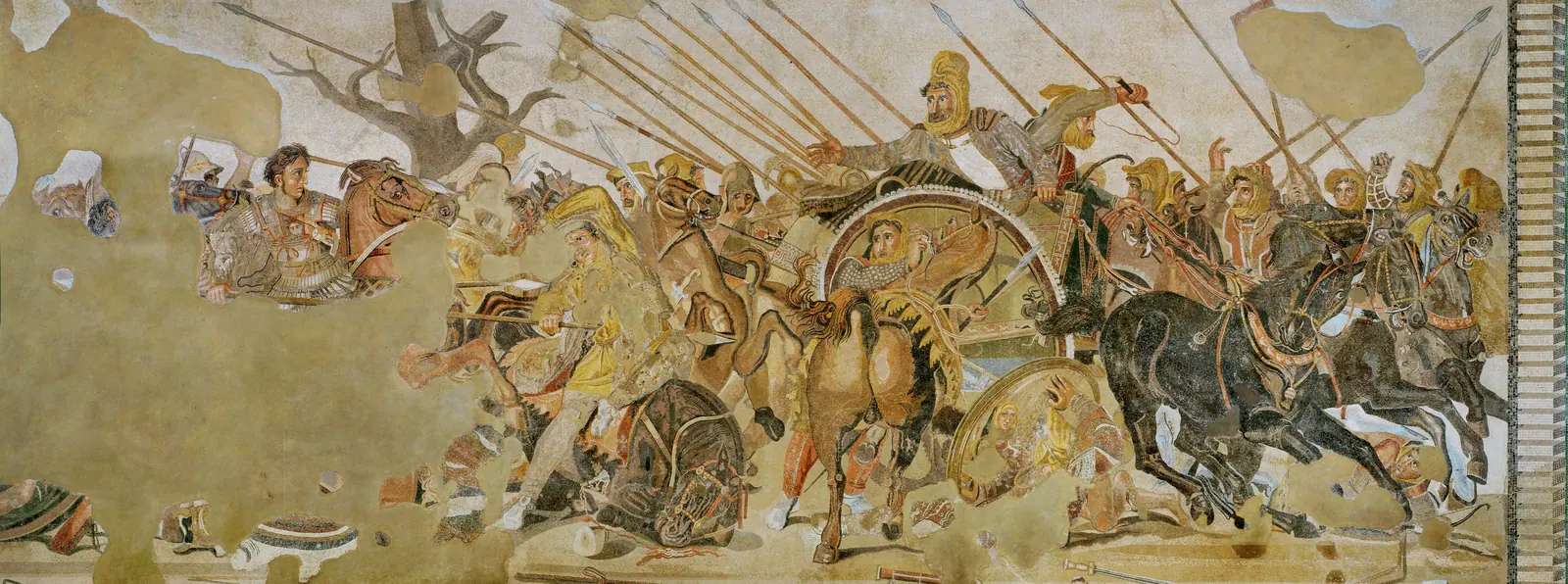
At Issus in November 333 BC, Alexander met Darius III himself for the first time. Darius had marched his army into the narrow coastal plain between the mountains and the sea in what is now southern Turkey. The tight ground canceled his numerical advantage. Alexander led his cavalry straight at the Persian center, charging directly at the spot where Darius stood on his chariot. Darius turned and fled. His army collapsed behind him. Alexander captured the Persian camp, including Darius's mother, wife, and children.
The pattern held at Gaugamela in October 331 BC, the battle that ended the empire. Darius chose a wide, flat plain in northern Mesopotamia, near modern Erbil in Iraqi Kurdistan, and had the ground leveled for his scythed chariots. He assembled the largest army Alexander would ever face. Alexander led his right wing on a long diagonal march that pulled the Persian left out of position and opened a gap near the center. He drove a cavalry wedge through the gap straight at Darius. Darius fled again. The Persian army broke, and this time there was no recovering.
What Alexander found in the vaults
After Gaugamela, the empire's great cities fell one after another. Babylon surrendered without a fight. The Persian commander who had led the right wing at Gaugamela rode out and handed the city over rather than see it destroyed. Susa surrendered next, and Alexander's men found roughly 50,000 talents of gold and silver in its treasury, about fifty times the total annual revenue of Athens at the height of its power.
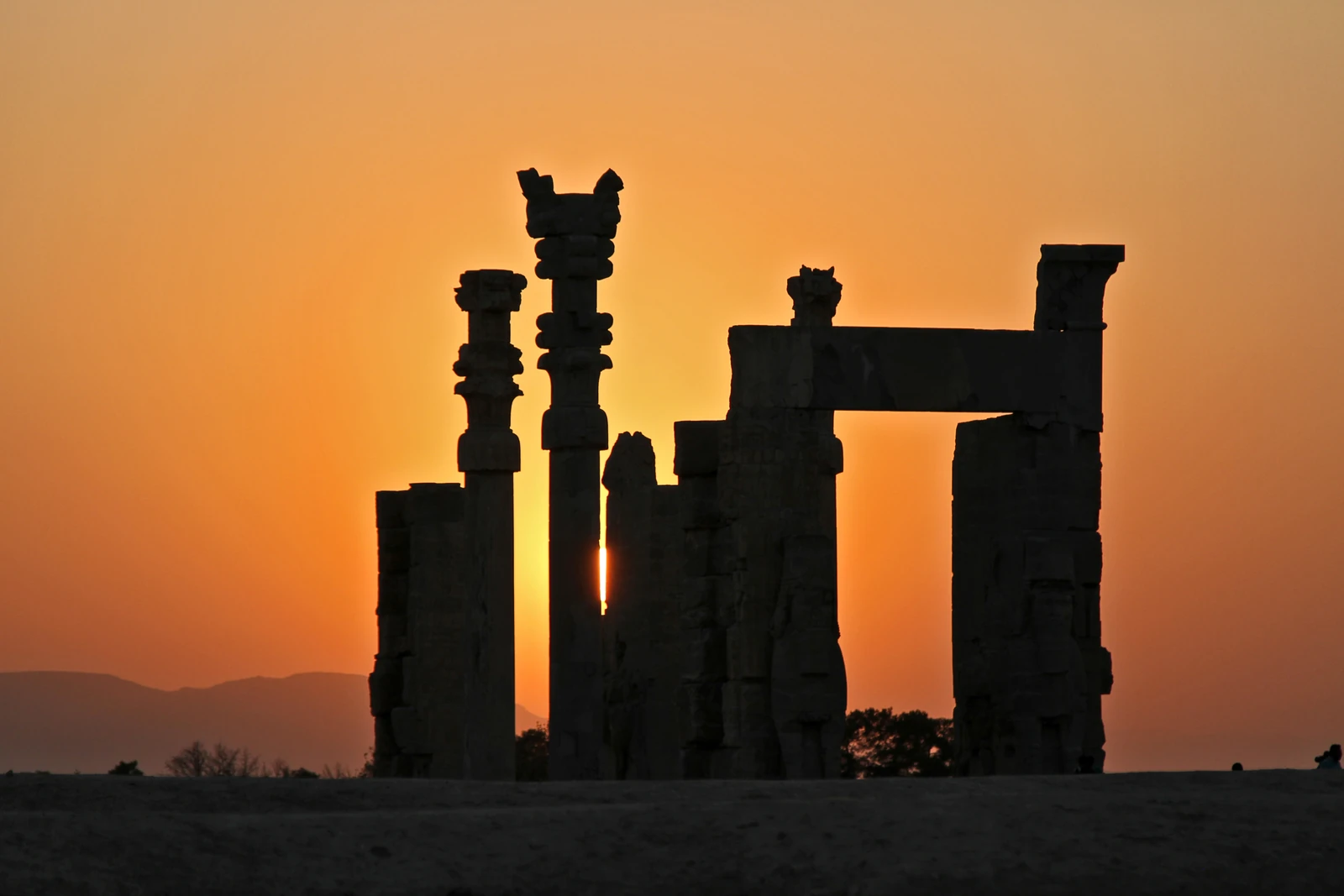
Then came Persepolis, the ceremonial capital Darius I had built to display the empire's grandeur. Alexander looted its treasury, which ancient sources say held even more than Susa's. He needed 3,000 pack camels and a long train of mules to carry it all away. Then, in the spring of 330 BC, he burned the palace complex to the ground.
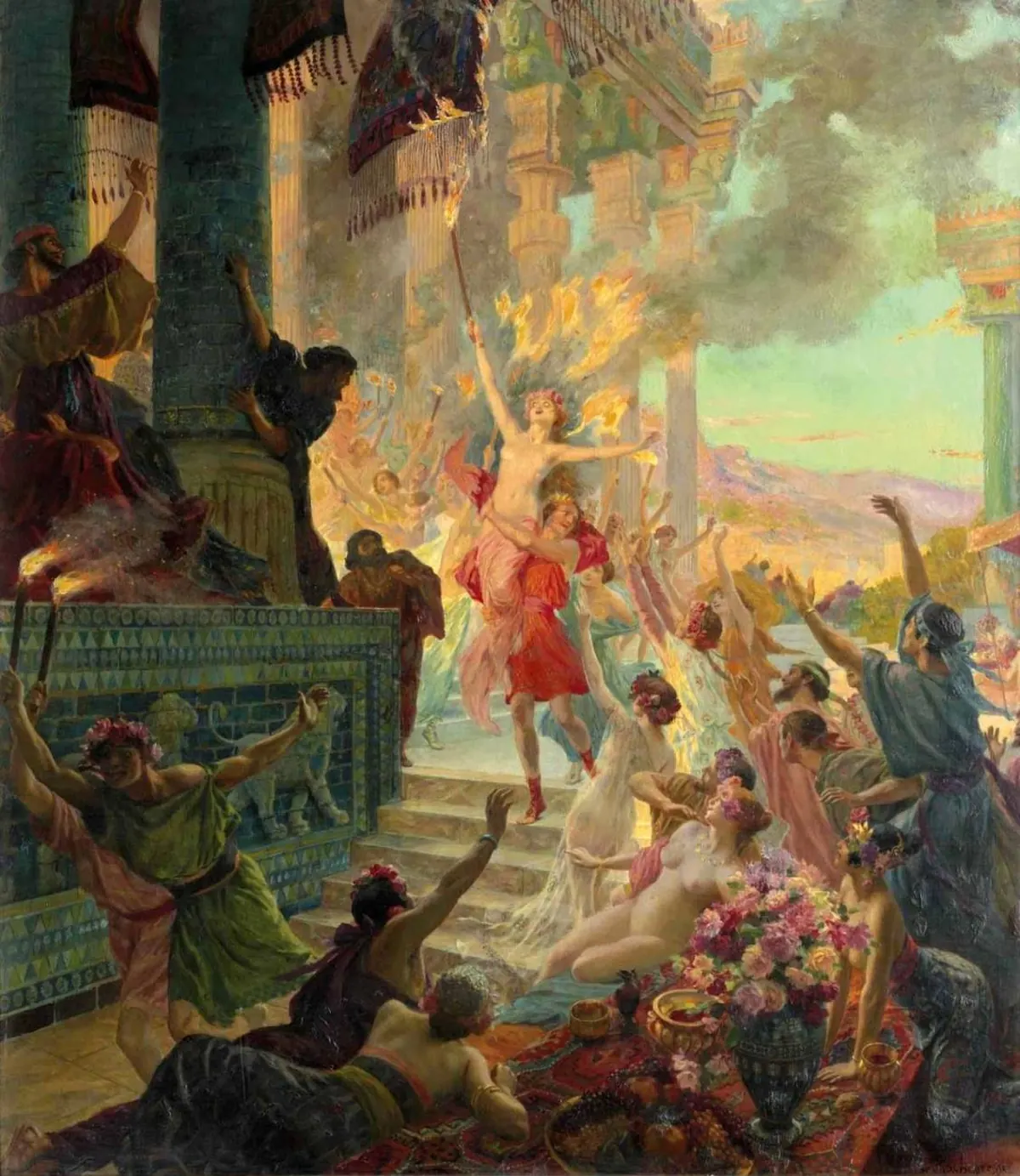
The ancient sources disagree on why. Diodorus and Curtius Rufus tell a story: at a drunken banquet, an Athenian woman named Thais urged Alexander to set the fire as revenge for Xerxes' burning of Athens 150 years earlier. She threw the first torch, and Alexander and his companions followed. Arrian, a more sober historian, says Alexander burned Persepolis deliberately, against the advice of his general Parmenion, who argued that destroying his own property was foolish. Whether the fire was drunken impulse or cold calculation, the message was the same: the old empire was finished.
A king killed by his own generals
Darius III was still alive, somewhere east of the Iranian plateau, trying to raise another army. He had been a competent enough ruler in peacetime, but he had now fled the decisive moment of two major battles, and the men around him had noticed. In the summer of 330 BC, a group of his own commanders, led by Bessus, the satrap of Bactria, and Nabarzanes, the commander of the royal guard, arrested Darius and took control of what remained of the army.
When Alexander's cavalry closed in during a forced pursuit through the desert east of modern Tehran, Bessus and Nabarzanes stabbed Darius and left him dying by the road. A Macedonian patrol found the body. According to Plutarch, Alexander covered Darius with his own cloak and declared that he would avenge the murdered king. It was a political move as much as a gesture: by presenting himself as Darius's avenger, Alexander claimed the Achaemenid throne not as a foreign conqueror but as the legitimate successor.
Bessus fled to Central Asia and proclaimed himself the new Great King. His own men eventually arrested him and handed him over to Alexander, who had him executed.
Why empires built on personal rule break fast
The Persian Empire did not fall because it was decadent or weak. It had run an effective system of roads, taxation, and governance across a territory stretching from Egypt to Pakistan for more than two hundred years. It fell because that system was held together by the king's authority, and Alexander destroyed that authority on three battlefields in three years.
Once the royal army was gone, the empire's structure worked in Alexander's favor. Each satrap made a rational choice. Most surrendered, kept their positions, and started governing on behalf of the new king. Alexander walked into the administrative machinery Cyrus had built and kept it running. He did not dismantle the empire. He took it over. (It would fall apart within a generation of his death, for related reasons.)
The same pattern has repeated wherever empires depend on one person or one center rather than on institutions that outlast any individual. The Mughal Empire in India fragmented province by province once central authority weakened. The Soviet Union dissolved in months once the center could no longer compel obedience. In each case, the structure looked solid from outside but had no mechanism to survive a shock at the top. The Persian Empire was the first and clearest example. It did not crumble. It changed owners.
Test what you learned
6 questions on this article. About two minutes, no signup.
Orbis has a full course on this
World History: 12,000 Years of Civilization. 41 lessons, each ending with a quiz like this one.