Who won the Crusades?
The Crusaders took Jerusalem in 1099 and held nothing by 1291. The Muslim side won the war, but the biggest loser was the empire that asked for help.
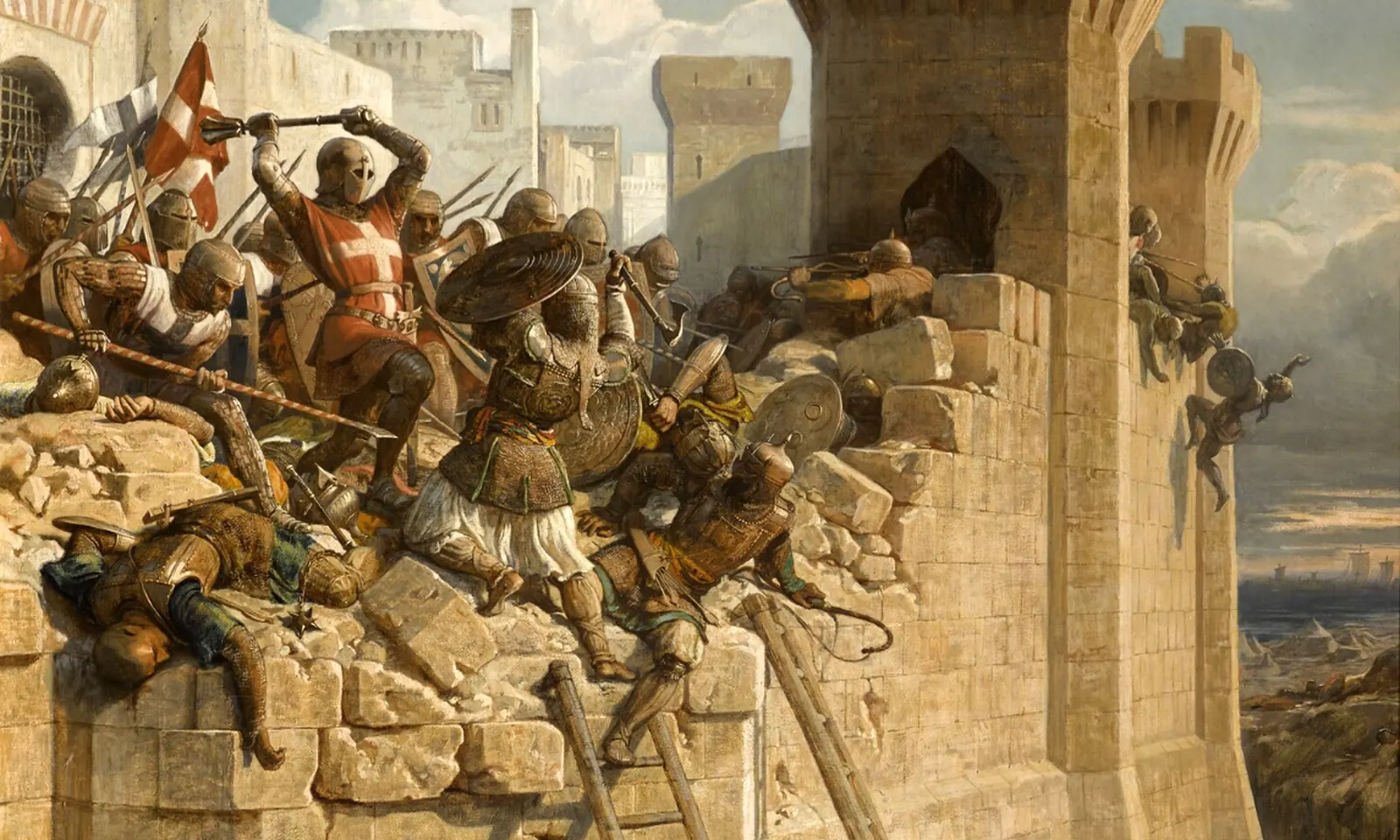
The short answer is that the Muslim side won. European Crusaders captured Jerusalem in 1099, held it for 88 years, and lost it in 1187. They spent the next century trying to take it back and failed. By 1291, every Crusader state in the Middle East was gone. Two hundred years of warfare, an estimated one to three million dead, and the net territorial result for the Crusaders was zero.
But the full answer is stranger. The Muslim world took nearly half a century to even mount a serious response. The Crusade that did the most lasting damage never fought a Muslim army at all. And the biggest loser of the entire era was the Christian empire that asked for the Crusades in the first place.
The Crusaders won the first round
In 1099, after three years of marching, starving, and fighting, a Crusader army of roughly 50,000 broke through the walls of Jerusalem and massacred thousands of Muslim and Jewish inhabitants. They established four states along the eastern Mediterranean coast: the Kingdom of Jerusalem, the County of Tripoli, the Principality of Antioch, and the County of Edessa. It was a shocking military achievement against long odds. (The full story of why the Crusades happened and how the First Crusade succeeded is covered in a companion article.)
The Crusader states looked impressive on a map, but they were thin strips of coastline ruled by a European minority over a mostly Muslim population. The Kingdom of Jerusalem at its peak held perhaps 120,000 Franks governing several hundred thousand Muslims. Every castle, every garrison, every harvest depended on reinforcements from 3,000 miles away and on the continuing inability of the Muslim world to mount a united response. As long as that held, the states survived. It did not hold.
The Muslim world took 45 years to notice
This is the part that surprises most people. The fall of Jerusalem in 1099 barely registered as a crisis in the wider Muslim world. Contemporary Arabic chronicles mentioned it briefly, if at all. No caliph declared a counter-crusade. No sultan rallied an army to take Jerusalem back.
The reason was political fragmentation. The Muslim Middle East in 1100 was split between the Shia Fatimid caliphate in Egypt and Sunni Seljuk Turks in Syria and Iraq, and both were fractured internally. Local emirs cut deals with the Crusaders the same way they cut deals with each other: as one more military faction in a crowded neighborhood. A Muslim nobleman named Usama ibn Munqidh spent decades interacting with the Crusaders and treated them as a familiar nuisance, not an existential threat.
The first real counter-attack came in 1144, when a Turkish general named Zengi captured the County of Edessa, the weakest and most exposed Crusader state. That triggered the Second Crusade from Europe, which accomplished nothing. It was Zengi's successor, Nur al-Din, who built the religious and military framework for a sustained campaign against the Crusaders. But the man who finished the job was Nur al-Din's most famous subordinate.
Saladin retook Jerusalem without a massacre
Saladin was Kurdish, born around 1137 in Tikrit (the same Iraqi town where Saddam Hussein was born eight centuries later). His father was a mid-ranking military officer, and the young Saladin was reportedly more bookish and prayerful than his rougher peers. He spent most of his career fighting other Muslims, not Crusaders. He took control of Egypt in 1169, ended the Fatimid caliphate in 1171, and spent the next twelve years absorbing Damascus, Aleppo, and Mosul into his own empire. Only then did he turn on the Crusader states.
On July 4, 1187, Saladin lured the entire Crusader field army onto a waterless plateau near the village of Hattin in northern Palestine. It was the height of summer. He set the dry grass on fire. Over two days, he destroyed the army completely: roughly 15,000 to 20,000 men killed or captured, including the king, Guy of Lusignan. Saladin personally executed Raynald of Chatillon, a Crusader lord who had attacked Muslim pilgrim caravans, and ordered the mass execution of captured Templar and Hospitaller knights.
Three months later, on October 2, 1187, Saladin took Jerusalem. What he did next defined his reputation: he let the Christian inhabitants ransom themselves and leave. Those who could not pay were supposed to be enslaved, but Saladin and his brother released thousands of them anyway. The contrast with the Crusaders' massacre in 1099 was deliberate.
Europe responded with the Third Crusade, led by Richard I of England. Richard won battles, including a decisive victory at Arsuf, and retook the coastal city of Acre. But he never retook Jerusalem. The two generals agreed to the Treaty of Jaffa in September 1192: the Crusaders kept a strip of coast from Tyre to Jaffa, and Christian pilgrims could visit Jerusalem, but the city stayed under Muslim control. Saladin died six months later, in March 1193. When his treasury was opened, it held one gold coin and 47 dirhams. His funeral expenses had to be borrowed from a friend.
The Fourth Crusade attacked the wrong city
The most destructive Crusade never reached the Holy Land. In 1204, a Crusader army that owed Venice 85,000 silver marks for ships it could not fill was redirected to Constantinople, the capital of the Byzantine Empire and the largest Christian city in the world. The army had been unable to pay because only about a third of the expected Crusaders had shown up. Venice's doge, Enrico Dandolo, over 80 years old and blind, offered to defer the debt if the army helped Venice settle scores along the way. That path led to Constantinople.
The Crusaders sacked it for three days. Nine centuries of accumulated wealth were looted or destroyed. Churches were stripped of their gold. The bronze horses of the Hippodrome were shipped to Venice, where they still stand on St. Mark's Basilica. Venice claimed three-eighths of the former Byzantine Empire, and Dandolo took the title "Lord of a quarter and a half-quarter of the Roman Empire."
Not a single blow was struck against a Muslim army. The Crusade that was supposed to recover Jerusalem instead gutted the Christian empire the Crusades were originally called to save.
The Mamluks finished the job
After Saladin's death, his empire fragmented among his descendants. The final expulsion of the Crusaders fell to the Mamluks, slave soldiers recruited as boys from the steppes of Central Asia, converted to Islam, and trained as elite cavalry. They had seized power in Egypt in 1250 by overthrowing Saladin's Ayyubid dynasty, and in 1260 they stopped the Mongol advance at the Battle of Ain Jalut, one of the most important battles in Middle Eastern history.
Their sultan Baybars then turned on the Crusader states with methodical brutality. Between 1265 and 1271, he took Caesarea, Arsuf, Jaffa, and Antioch. When Antioch fell in 1268 after a siege of only a few days, the entire Christian population was killed or enslaved. His successors continued the campaign. Tripoli fell in 1289. On May 18, 1291, the Mamluk sultan al-Ashraf Khalil took Acre, the last major Crusader stronghold, with an army that vastly outnumbered its defenders. The surviving Crusaders fled by sea to Cyprus. Two hundred years of European military presence in the Middle East were over.
Who actually won?
The military scoreboard is clear: the Crusaders held nothing at the end. The Muslim side held everything it held before plus everything the Crusaders had built. But the question of who won depends on who you count as a side.
The biggest loser was arguably the Byzantine Empire. Emperor Alexios I had asked Pope Urban II for a few thousand mercenaries in 1095 to help fight the Seljuk Turks. Instead he got the Crusades, and in 1204 the Crusaders sacked his successor's capital. The Byzantine Empire never recovered. When the Ottoman Turks finally took Constantinople in 1453, a senior Byzantine official reportedly said he would rather see the sultan's turban in the city than the pope's hat. The Crusades were supposed to save Christian Byzantium. They helped destroy it.
The biggest winner, oddly, may have been Venice, which turned the Fourth Crusade into a commercial empire, and the Ottoman Turks, who inherited a fatally weakened Byzantium two centuries later.
And here is the most counter-intuitive part: from roughly 1300 to 1850, the Crusades were barely remembered in the Muslim world. The Mongol destruction of Baghdad in 1258 was the far greater trauma. It was only in the nineteenth and twentieth centuries, when European powers colonized the Middle East, that the word "Crusader" was revived as a political weapon on both sides. The Crusades matter today not because of what they settled nine hundred years ago, but because hawks and recruiters keep reaching for the word to describe conflicts with entirely modern causes.
Test what you learned
5 questions on this article. About two minutes, no signup.
Orbis has a full course on this
Islam: 1,400 Years of Faith and Power. 42 lessons, each ending with a quiz like this one.