Why did the Crusades happen?
In 1095, a pope told Europe's knights to march 3,000 miles and take Jerusalem. Tens of thousands went. The causes were religious, political, and personal.
On November 27, 1095, Pope Urban II stood before a crowd of bishops and nobles in a field outside the French town of Clermont and made one of the most consequential speeches in history. He called on the warriors of western Europe to march east, rescue their fellow Christians from Muslim conquest, and take back Jerusalem. He promised full forgiveness of sins to anyone who went. The crowd, by several accounts, answered with a shout: "God wills it." Within four years, a Crusader army had fought its way across 3,000 miles and captured Jerusalem. The massacre that followed killed thousands.
The Crusades lasted two hundred years and cost an estimated one to three million lives. But the first question is also the most interesting: how did a pope convince tens of thousands of people to march across a continent to fight for a city most of them had never seen?
A Christian empire was losing its war
The answer starts not in Rome but in Constantinople, the capital of the Byzantine Empire. For centuries, Byzantium had been the most powerful Christian state in the world, controlling Asia Minor (modern Turkey), the Balkans, and much of the eastern Mediterranean. Constantinople had over 400,000 people, far larger than any city in western Europe.
In 1071, that strength collapsed. At the Battle of Manzikert in eastern Turkey, the Seljuk Turks destroyed the main Byzantine army and captured the emperor, Romanos IV Diogenes. He was the first Byzantine emperor ever taken prisoner by a Muslim force. The civil war that followed did even more damage than the battle. Within a decade, the Seljuks had overrun most of Asia Minor, the empire's heartland and its main source of soldiers and tax revenue.
By 1095, the emperor Alexios I Komnenos was desperate. He had stabilized the empire but could not take back what was lost, not without western knights and their heavy cavalry. So he sent envoys to Pope Urban II asking for military help. What he wanted was a few thousand mercenaries. What he got was the Crusades.
The pope saw an opportunity
Urban II understood Alexios's request, but he had his own reasons for answering it with something much bigger.
The papacy in 1095 was still fighting for authority over the kings and emperors of Europe. For decades, popes and Holy Roman emperors had been locked in a struggle over who had the right to appoint bishops. A successful holy war would prove that the pope could command armies and direct the energy of an entire continent. It would also give Urban leverage over the Orthodox Church in Constantinople, which had broken with Rome in 1054. If Catholic knights saved the Byzantine Empire, the pope could press for reunification on his terms.
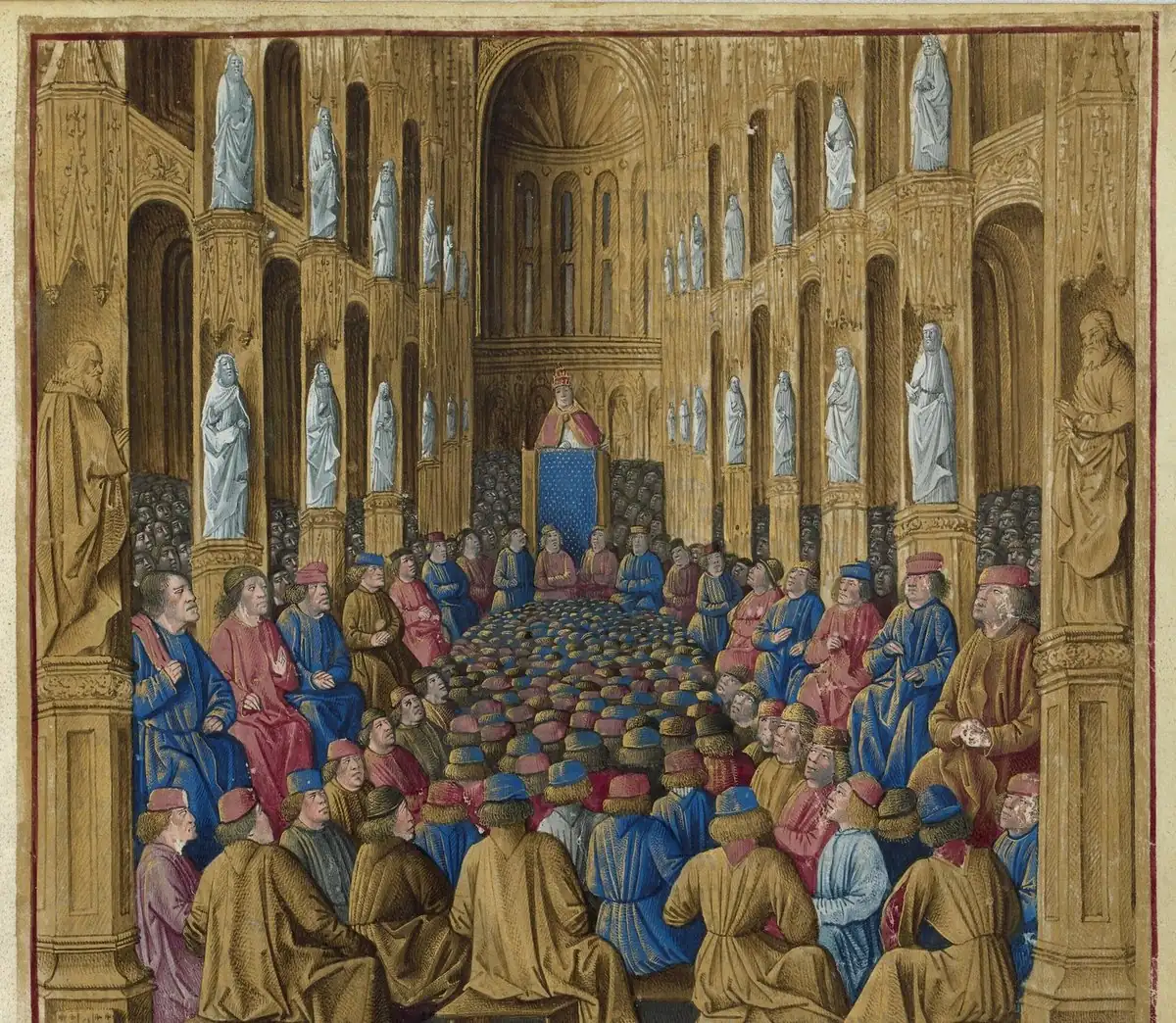
Urban was a Frenchman, born Odo of Lagery, and he knew his audience. He did not pitch the Crusade as a favor to the Byzantine emperor. He pitched it as a rescue mission for Christian pilgrims and, above all, as a chance to liberate Jerusalem. Jerusalem had been under Muslim control since 638, but the timing mattered more than the history. The Seljuk conquests had disrupted pilgrimage routes that had been safe for centuries, and reports of mistreatment of Christian pilgrims were circulating across Europe. Urban gave his audience an enemy, a mission, and a guarantee: go, and your sins are forgiven.
No transcript of the speech survives. Several chroniclers wrote versions years later, and they disagree on the details. But they agree on the effect.
Europe's knights had reasons to go
The religious appeal was real, but it landed in a society that had its own reasons for sending men east.
Western Europe in 1095 was violent, crowded with armed men, and short on land. Feudalism concentrated wealth in the hands of eldest sons who inherited estates. Younger sons trained for war but often had no land and no clear path to getting any. A Crusade offered what the feudal system denied them: land, titles, and purpose.
But the material motive is easy to overstate. Crusading was ruinously expensive. Knights had to fund their own equipment, travel, and supplies for a journey that could take years. Many mortgaged or sold their estates to pay for it. Robert, Duke of Normandy, pawned his entire duchy to his brother, King William II of England, for 10,000 marks of silver. People who expected to get rich mostly did not. Many never came home.
What the evidence suggests is that spiritual and material motives coexisted. A knight could genuinely believe he was saving his soul while also hoping to win a fief in the Levant. Urban's genius was offering both in the same package: salvation and a sword.
The People's Crusade showed what was coming
Urban intended a military expedition led by trained nobles. What happened first was something he did not plan.
A charismatic preacher named Peter the Hermit traveled through France and Germany, telling crowds that Christians in the East were suffering and that God demanded action. He was a monk, probably in his fifties, who reportedly rode a donkey and wore a simple wool tunic. Tens of thousands of ordinary people followed him: peasants, laborers, entire families with children. Roughly 40,000 set out in the spring of 1096, months before the main Crusader armies.
The People's Crusade was a disaster. On the way east, mobs attacked Jewish communities in the Rhineland, killing an estimated 5,000 to 8,000 people in some of the worst anti-Jewish violence Europe had seen. When Peter's followers reached Asia Minor, the Seljuk Turks destroyed them at the Battle of Civetot in October 1096. Fewer than 3,000 survived. Urban had tapped into a force much larger than a military campaign, and without military discipline it got people killed by the thousands.
The First Crusade succeeded against the odds
The main Crusade left in the summer of 1096. It was led by French, Norman, and Flemish nobles, not kings. Roughly 7,000 knights and perhaps 50,000 total fighters marched overland to Constantinople, crossed into Asia Minor, and fought their way south through Seljuk and Fatimid territory. They besieged Antioch for eight months, nearly starved, and at one point ate their horses.
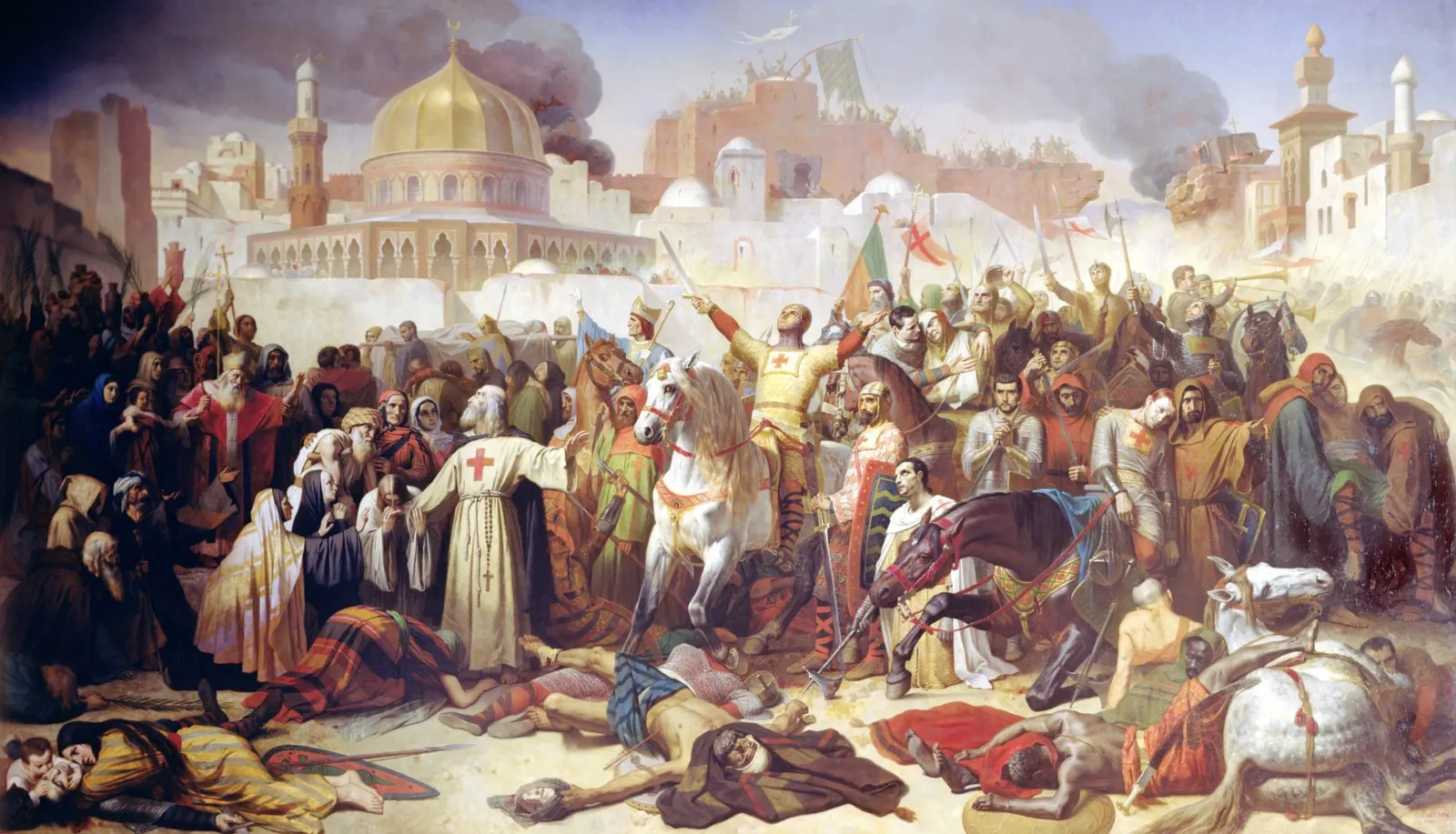
On July 15, 1099, they broke through the walls of Jerusalem. Crusaders killed thousands of Muslim and Jewish inhabitants in the massacre that followed. They established four states along the coast: the Kingdom of Jerusalem, the County of Tripoli, the Principality of Antioch, and the County of Edessa. Against almost every reasonable expectation, a pope's speech in a French field had produced a new Christian kingdom in the heart of the Muslim world.
It did not end there
The Crusader states were thin strips of coastline governed by a European minority over a mostly Muslim population. They depended on reinforcements from 3,000 miles away and on divisions among their Muslim neighbors. When those divisions ended, the states began to fall.
In 1187, Saladin, a Kurdish general who had united Egypt and Syria, destroyed the main Crusader army at Hattin and retook Jerusalem. Unlike the Crusaders in 1099, Saladin allowed most of the city's Christians to leave after paying a ransom.
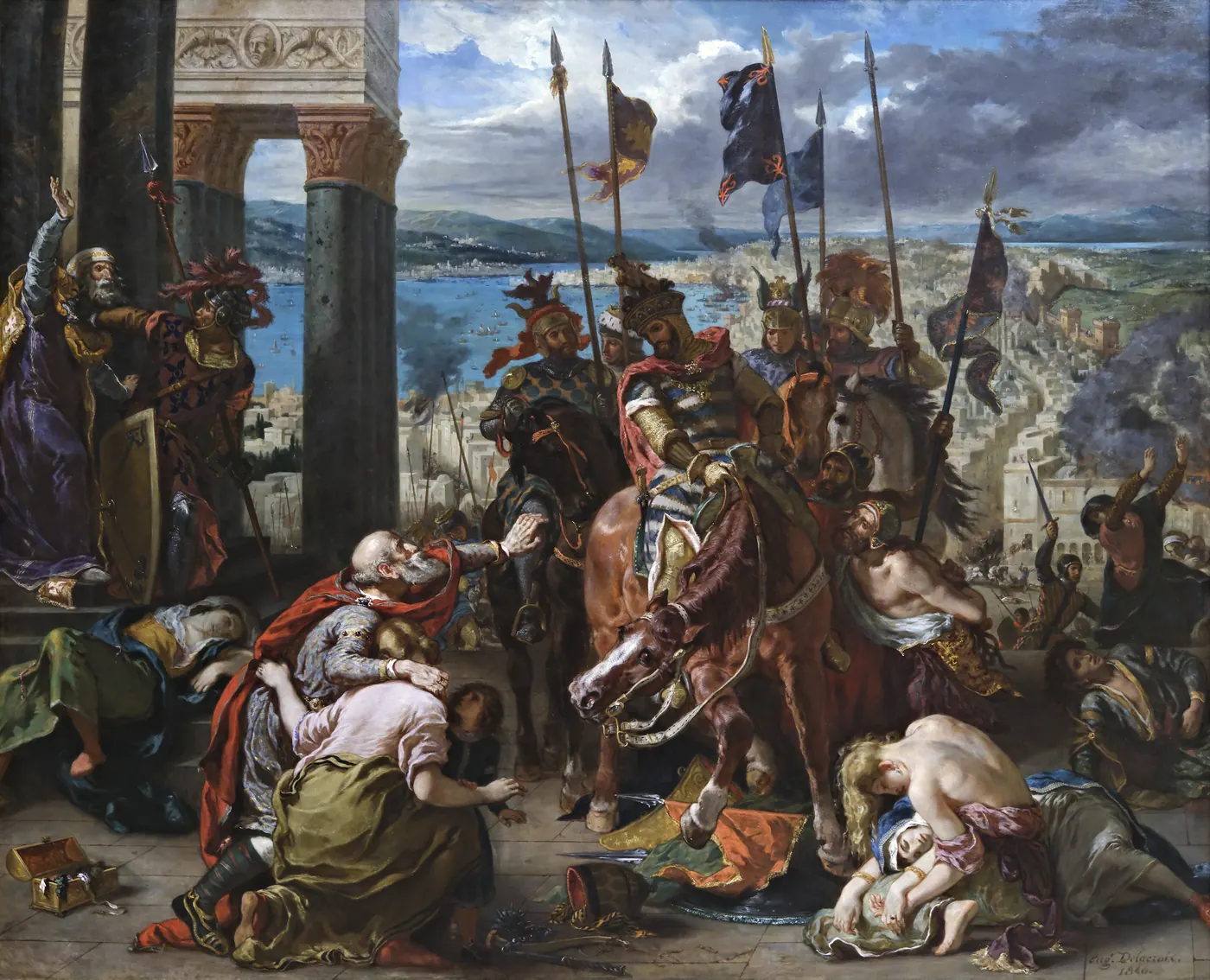
Europe launched more Crusades, but none recaptured Jerusalem. The Fourth Crusade, in 1204, never reached the Holy Land at all. The Crusaders owed Venice a massive debt for sea transport and Venice redirected the army to Constantinople. They sacked the largest and richest city in Christendom, the very empire the Crusades were supposed to save.
In 1291, Mamluk armies besieged Acre, the last major Crusader stronghold, and took it on May 18. The surviving defenders fled by sea to Cyprus. Two centuries of Crusader presence in the Holy Land were over.
Why the Crusades still get invoked
For most of the centuries since 1291, the Crusades held a larger place in European memory than in the Muslim world, where they were one wave of invaders among many. That changed in the nineteenth and twentieth centuries, as European powers colonized the Middle East and the word "Crusade" was revived as a symbol on both sides.
On September 16, 2001, five days after the attacks, President George W. Bush said, "This crusade, this war on terrorism, is going to take a while." The White House walked it back within days, but the damage was done. Osama bin Laden had already framed his war as a fight against "Jews and Crusaders," and Bush had handed him a talking point. The Crusades matter today not because anyone is fighting over Jerusalem with swords, but because hawks and recruiters on both sides keep reaching for the same nine-hundred-year-old word to describe conflicts that have entirely modern causes.
Test what you learned
5 questions on this article. About two minutes, no signup.
Orbis teaches the history behind the news
Orbis covers the Crusades, Saladin, the fall of the Byzantine Empire, and the forces that shaped the medieval world in five-minute lessons.