Why are there so many countries that end in -stan?
Seven countries share the suffix. The answer involves an ancient Persian word, Soviet mapmakers, and a student in 1930s Cambridge who needed a name.
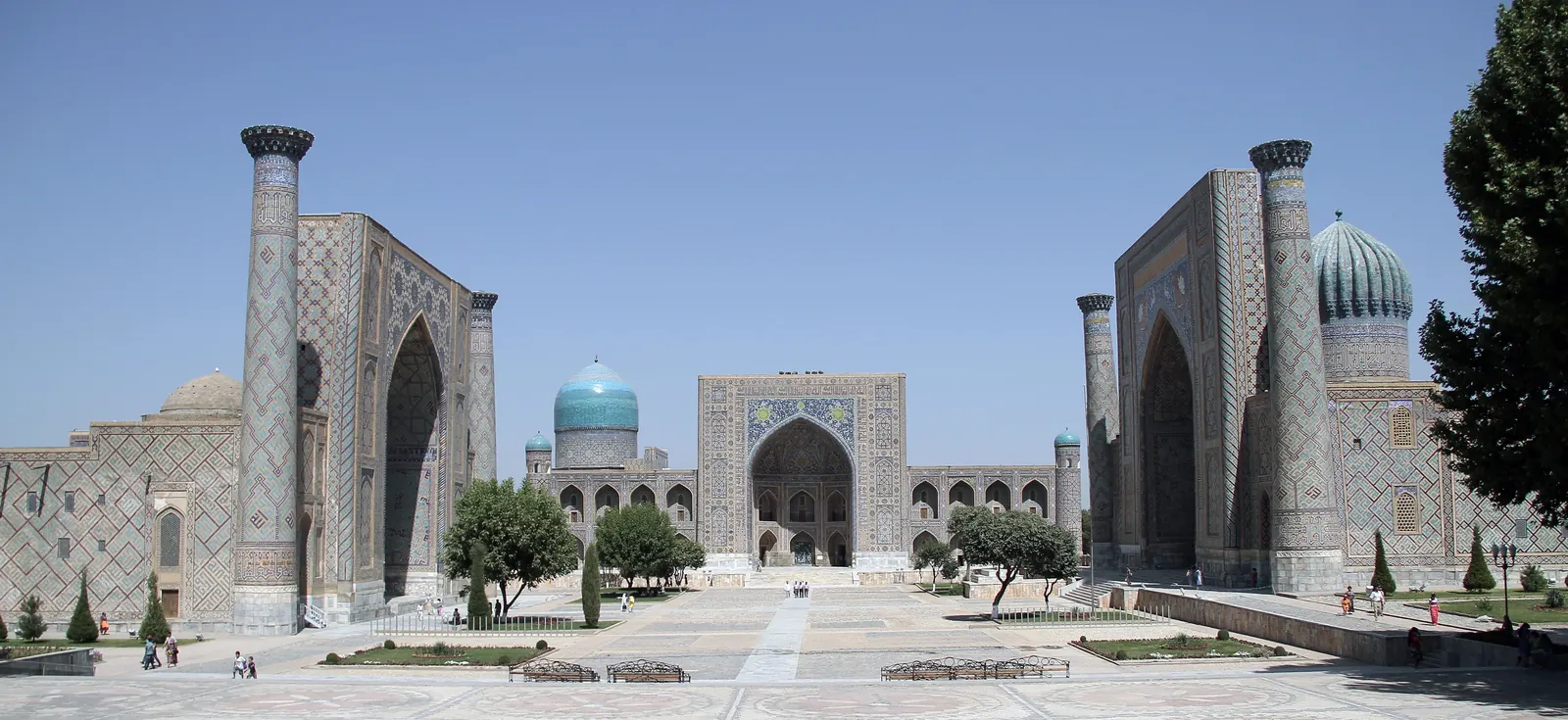
Seven countries on Earth end in "-stan": Afghanistan, Kazakhstan, Kyrgyzstan, Pakistan, Tajikistan, Turkmenistan, and Uzbekistan. Five sit next to each other in Central Asia. The suffix shows up so often on the map that most people assume these countries were always there. They were not. Six of the seven got their current borders in the 20th century, and the reason they all share a suffix comes down to three things: a very old word, a deliberate act of Soviet mapmaking, and one student in England who needed a name for a country that did not yet exist.
What "-stan" actually means
The suffix comes from Old Persian. It means "land" or "place," from the Proto-Indo-Iranian root stāna, "the place where one stands." The same root, through a different branch of the same language family, gave English the words "stand," "state," and "station." English and Persian have been using versions of the same word for roughly five thousand years without knowing it.
Persian was the dominant written language of Central Asia for close to a millennium. From the Samanid dynasty in the 9th century through the Timurid and Mughal empires, Turkic rulers across the region used Persian at court, in poetry, and in administration. The suffix stuck to the land the way Latin stuck to European geography: not because everyone spoke Persian, but because the people who named places did.
That is why the Central Asian -stans speak Turkic languages today (Kazakh, Kyrgyz, Turkmen, and Uzbek are all Turkic) but carry a Persian suffix. Tajikistan is the exception: Tajik is a form of Persian, close enough to the Farsi spoken in Iran that speakers can mostly understand each other.
The suffix shows up far beyond those seven countries. Hindustan is an old name for India. Rajasthan is an Indian state ("land of kings"). Kurdistan names the Kurdish homeland across four countries but has never been a country itself. The word always means the same thing: the land of whoever the first part names.
The borders that were drawn in a single year
Before the Russian Empire conquered Central Asia in the 1860s and 1870s, the region was not organized by ethnicity. Power was built around cities. The Emirate of Bukhara, the Khanate of Khiva, and the Khanate of Kokand were multiethnic states where Uzbeks, Tajiks, Turkmen, Kazakhs, and Kyrgyz lived side by side. A resident of Bukhara in 1850 would have called himself Bukharan, not Uzbek or Tajik.
The Soviets changed that. In October 1924, Moscow dissolved the old structures and redrew the entire map of Central Asia along ethnic lines, a policy called "national-territorial delimitation." Every major ethnic group was assigned its own republic, with its own borders, capital, and name. The Uzbek SSR and the Turkmen SSR were created that year. The Tajik republic, initially placed inside Uzbekistan, became a full Soviet republic in 1929. Kazakhstan and Kyrgyzstan followed by 1936.
Drawing ethnic borders where none had existed also kept the new republics divided and dependent on Moscow. None of the borders matched any previous state. Bukhara and Samarkand, major stops on the Silk Road for more than two thousand years, had large Tajik-speaking populations when the lines were drawn. Both ended up in Uzbekistan. Tajik nationalists have considered this a theft ever since.
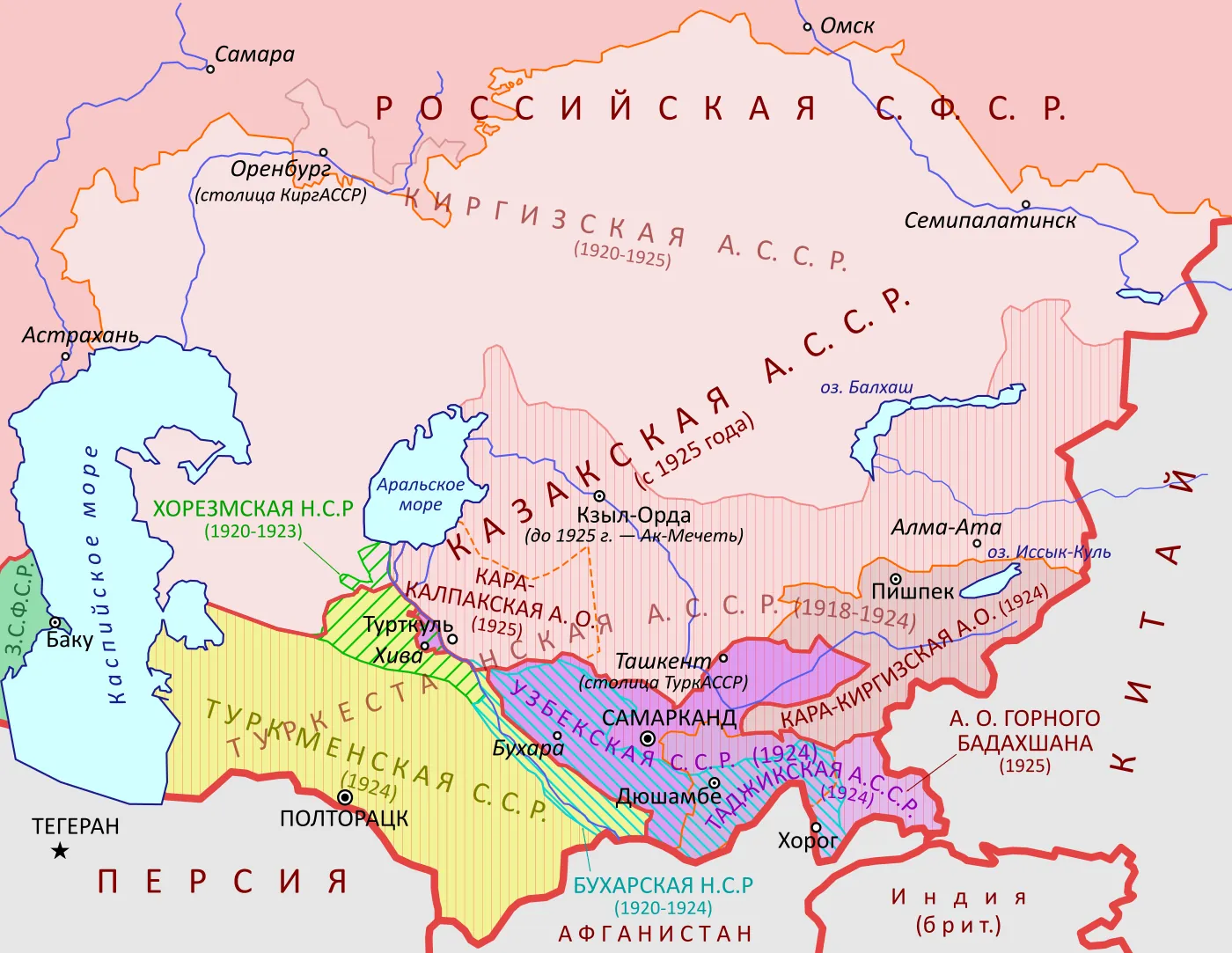
When the Soviet Union collapsed in 1991, all five Central Asian republics became independent countries practically overnight. None of them had asked for independence. But the borders held, the names held, and five new -stans appeared on the world map. They had existed as Soviet administrative units for roughly 65 years. Now they were countries.
The -stan that was invented on paper
Pakistan is the outlier. Its name is not an ancient place name. It was coined by Choudhry Rahmat Ali, a law student from Punjab studying at Cambridge, who published a four-page pamphlet on January 28, 1933, titled "Now or Never; Are We to Live or Perish Forever?" Ali argued that the Muslims of northwestern British India needed their own state, and he built the name from the initials of its would-be provinces: P for Punjab, A for Afghania (the North-West Frontier Province), K for Kashmir, S for Sindh, and the ending from Baluchistan. His original spelling was "Pakstan," without the "i," which was added later to make the word easier to say. The name also happened to mean "land of the pure" in Urdu and Persian, since pāk means clean or holy.
The partition of British India in 1947 created exactly the kind of state Ali had imagined, though its borders did not match his map. Muhammad Ali Jinnah, who led the actual campaign for Pakistan, barely acknowledged the name's inventor. Ali never moved to the country he named. He returned to Cambridge after partition, lived in poor health and near-poverty, and died in 1951 at 54. He is buried in a Cambridge cemetery.
Afghanistan: the -stan that named itself
Afghanistan is the opposite case. It is the only -stan that was never part of the Russian Empire or the Soviet Union, and its name is the oldest by far. The word "Afghan," referring to the Pashtun tribes of the region, appears in a Persian geography text called the Hudud al-Alam from the year 982, more than a thousand years ago. "Afghanistan," land of the Afghans, was in common use by the 14th century.
While Britain and Russia spent the 19th century competing for influence over the country in what became known as the Great Game, neither conquered it. The five -stans to Afghanistan's north were drawn into Soviet republics and named by bureaucrats in Moscow. Afghanistan kept its name and its independence, the one -stan whose name grew from the ground up over centuries rather than being assigned in a decree.
Seven countries, one suffix
The seven -stans hold roughly 360 million people across a territory larger than Western Europe. They share a two-syllable suffix and almost nothing else. Kazakhstan exports enough oil to matter on global markets. Tajikistan is one of the poorest countries in Asia. Pakistan has nuclear weapons and 240 million people. Kyrgyzstan has seven million. Afghanistan has been at war, on and off, for nearly fifty years.
What connects them is a history of being named, and often bordered, by forces larger than themselves. The Persian suffix came from a language that dominated the region for a millennium. The five Central Asian borders were drawn by Soviet officials who sorted multiethnic khanates into ethnic republics that had never existed before. Pakistan's name was coined in a pamphlet at Cambridge, fourteen years before the country existed. Only Afghanistan named itself, over centuries, from the ground up, and it is also the only one that has never been successfully governed by an outside power.
Test what you learned
5 questions on this article. About two minutes, no signup.
Orbis teaches the history behind the news
Orbis covers Central Asia, the Silk Road, and how empires drew the borders on today's map.