
Country profile · Levant
 Jordan
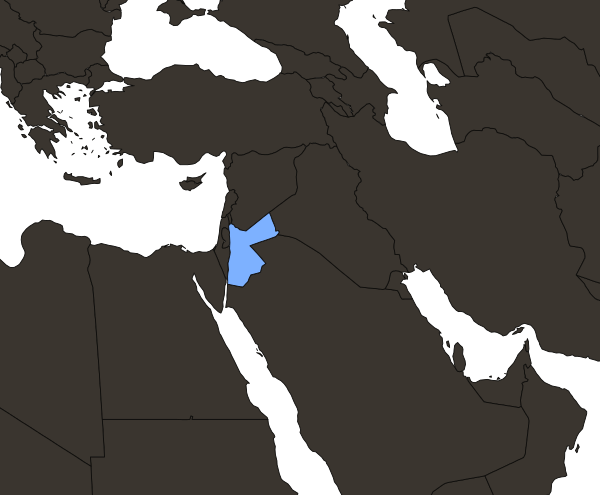
Jordan has about 11.5 million people (UN, 2025). King Abdullah II has ruled since 1999. Jordan has almost no oil and very little water, and it relies on aid from the United States and the Gulf. It has a peace treaty with Israel and hosts US troops. Since February 2026 it has shot down Iranian missiles aimed at US bases.
Where Jordan ranks
All rankings →Who runs Jordan?
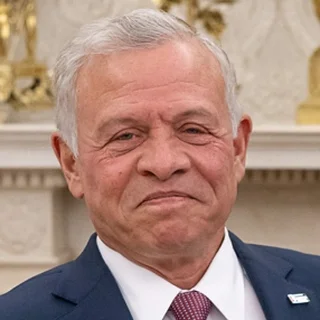
King Abdullah II was born on January 30, 1962, in Amman. He is the eldest son of King Hussein and his British-born wife, Princess Muna. He trained at Sandhurst in Britain and commanded Jordan's special forces. King Hussein named him crown prince on January 24, 1999, two weeks before he died. Abdullah became king on February 7, 1999. Queen Rania was born in Kuwait to Palestinian parents. In 2021 the king's half-brother, Prince Hamzah, was put under house arrest over an alleged plot. The constitution gives executive power to the king. He appoints the prime minister and the Senate and can dissolve parliament. Prime Minister Jafar Hassan has served since September 2024. In the election of September 10, 2024, the Islamic Action Front won the most seats, 31 of 138 (chart). Jordan banned the Muslim Brotherhood in April 2025, and the party renamed itself the Umma Party in April 2026. In 2026 Jordan brought back military service for the first time since 1991.
- Islamic Action Front (since 2026 the Umma Party) 31
- Mithaq (21), Irada (19) and other parties 73
- Local lists, mostly independent and tribal candidates 34
Photo (February 2025): The White House, Wikimedia Commons, public domain (cropped)
Who are Jordan's allies and rivals?
The United States is Jordan's main ally. It gives Jordan about $1.65 billion of aid a year, and nearly 4,000 US troops are based there. Saudi Arabia and the United Arab Emirates also give aid and invest. Jordan signed a peace treaty with Israel on October 26, 1994, the second Arab state to do so after Egypt. Relations are now at their lowest point since then. Jordan recalled its ambassador over the Gaza war in November 2023. King Abdullah II calls any Israeli annexation of the West Bank a red line. Israeli gas still flows to Jordan. The United States and Israel attacked Iran on February 28, 2026. Since then Iran has fired missiles and drones at US bases in Jordan. In the first five weeks, Jordan shot down 261 of 281. On July 17, 2026, an Iranian missile killed three US soldiers at Muwaffaq Salti air base. Since Bashar al-Assad fell in December 2024, Jordan has worked closely with Syria's new government.
Allies and partners
 United StatesAbout $1.65 billion of aid a year; nearly 4,000 troops
 Saudi ArabiaAid, and Jordan's second-biggest export market
 United Arab EmiratesBudget support; financing a railway to Aqaba
 EgyptNeighbor across the Gulf of Aqaba; gas partner
 United KingdomRuled Transjordan until 1946; RAF defended Jordan in 2026


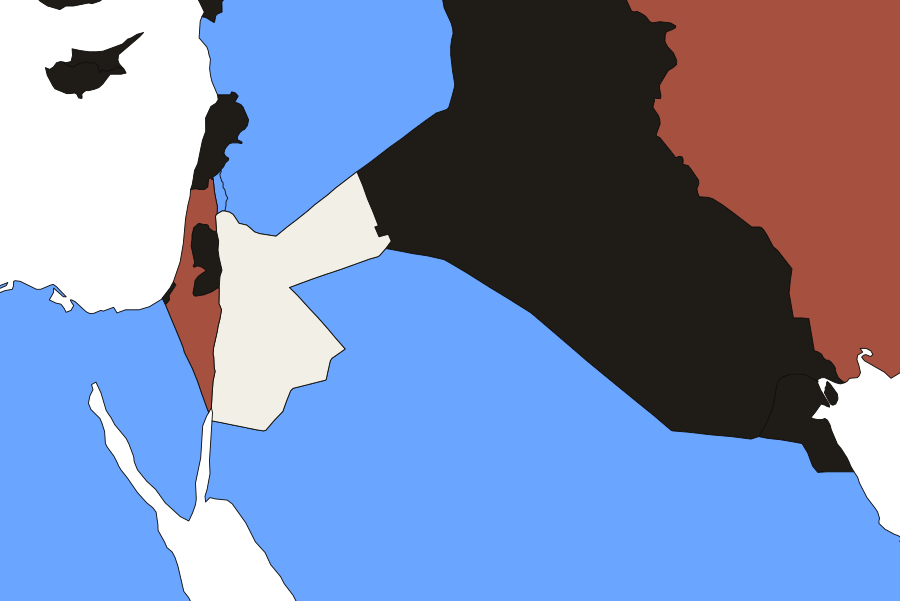
- Muwaffaq Salti air base Jordanian air base used by US forces. An Iranian missile killed three US soldiers here on July 17, 2026.
- Zaatari camp Largest camp for Syrian refugees, opened in July 2012. About 200,000 people lived here in 2013, about 48,000 in 2026.
- Allenby Bridge Main crossing between Jordan and the West Bank. Jordanian attackers killed Israelis here in 2024 and 2025.
- Aqaba Jordan's only port, on 26 km of coast. A desalination plant here is to pump water to Amman from 2030.
- Jordan
- Partner
- Tensions
Who does Jordan trade with?
Jordan imports about twice as much as it exports. In 2025 it sold $14.9 billion of goods abroad and bought $29.0 billion (Department of Statistics). The United States is the biggest buyer, with about a quarter of exports, followed by Saudi Arabia, India and Iraq (chart). The United States buys more than 80% of Jordan's clothing exports, under a free trade agreement in force since 2001. China is the biggest supplier, with about a fifth of imports. Jordan is the world's fifth-largest producer of phosphate rock and the eighth-largest of potash, both mined near the Dead Sea (USGS). It imports about 96% of its energy, including gas from Israel. Tourism brought in $7.8 billion in 2025, and Jordanians working abroad sent home $4.5 billion. Government debt is about 84% of GDP. Since January 2024 an IMF program has aimed to cut it to 80% by 2028. In mid-2026, 21% of Jordanians in the labor force had no job.
Sells to
Share of Jordan's exports
- United States24.7%
- Saudi Arabia12.3%
 India10.5%
 Iraq10.2%
- United Arab Emirates4.3%
Buys from
Share of Jordan's imports
 China19.2%
- Saudi Arabia15.3%
- United States6.9%
- United Arab Emirates4.6%
 Germany3.6%
Goods, 2024. UN Comtrade, as reported by Jordan.
Why does Jordan host so many refugees?
Jordan has taken in people from the wars around it. Palestinians came after the wars of 1948 and 1967. About 2.4 million registered Palestine refugees live in Jordan, the largest group served by the UN agency UNRWA. Iraqis came after the US invasion of 2003. Syria's civil war then brought the biggest wave. At the end of 2018 the UN refugee agency, UNHCR, counted 676,000 registered Syrians in Jordan. Zaatari camp opened in July 2012 and held about 200,000 people the next year. At the end of 2025 Jordan hosted 436,000 refugees registered with UNHCR, 37.9 for every 1,000 people (chart). Counting Palestine refugees, about one in four people in Jordan is a refugee (UNHCR). Since Bashar al-Assad fell in December 2024, more than 232,000 Syrians have gone home from Jordan. On September 30, 2026, UNHCR counted 352,553 refugees in Jordan, the fewest since 2012. Jordan has never signed the 1951 Refugee Convention.


Why is Jordan running out of water?
Jordan has about 61 cubic meters of renewable fresh water per person a year (Ministry of Water and Irrigation). That is an eighth of the UN's line for absolute water scarcity. UNICEF calls Jordan the world's second most water-scarce country. Jordan pumps about 699 million cubic meters of groundwater a year, about 280 million more than the safe limit. Since 2013 a pipeline has brought water to Amman from the Disi aquifer, which does not refill. About half of all water is lost to leaks or theft or is never billed. Many homes in Amman get piped water for only 12 to 24 hours a week. Israel supplies about 50 million cubic meters a year under the 1994 peace treaty. An extra 50 million, agreed in 2021, lapsed in November 2025. Jordan's plan is a desalination plant at Aqaba and a 450 km pipeline to Amman. From 2030 it is to supply 300 million cubic meters a year, about 40% of Jordan's needs.