
Country profile · Middle East
 Iraq
Iraq
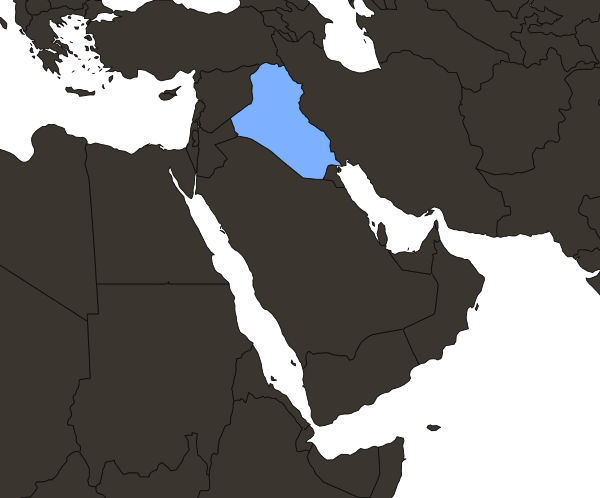
Iraq produced 4.39 million barrels of oil a day in 2025, the fifth most in the world, and oil paid for about 88% of federal revenue. Prime Minister Ali al-Zaidi, a businessman, took office in May 2026. On September 30, 2026, the US-led coalition against the Islamic State ended its mission in Iraq after 12 years.
Where Iraq ranks
All rankings →Who runs Iraq?
Prime Minister Ali al-Zaidi runs Iraq's government. By an unwritten rule, the prime minister is a Shia Arab, the president a Kurd and the speaker of parliament a Sunni Arab. Al-Zaidi is a Baghdad businessman who had never held political office. Born in 1985 or 1986, he is the youngest prime minister since 2003. His Al-Awees food group supplies the food basket that the state hands out on ration cards. The Coordination Framework, the bloc of Iran-aligned Shia parties, first nominated a former prime minister, Nouri al-Maliki, in January 2026. On January 27, President Trump wrote that if Maliki returned, "the United States of America will no longer help Iraq." The Framework named al-Zaidi instead on April 27. Parliament approved only 14 of his 23 ministers on May 14, and the defense and interior posts were still empty in late September.

Photo (July 2026): US Department of War, Wikimedia Commons, public domain
Who are Iraq's allies and rivals?
Iraq has no treaty allies. It balances between the United States and Iran, which went to war on February 28, 2026. The US-led coalition against the Islamic State ended its mission on September 30, 2026, when the last US troops left Erbil air base. Iraq's oil revenue is held at the Federal Reserve Bank of New York, which gives Washington leverage. Iran shares a 1,599 km border with Iraq and fought it from 1980 to 1988. Today it backs the main Shia parties and supplies gas for a third to two fifths of Iraq's electricity. Iran-backed armed groups in Iraq attacked US sites after the war began. After drone attacks on Saudi oil sites, US and Saudi jets struck militia sites in eight Iraqi provinces on July 29, killing at least 20.
Allies and partners
 United StatesCoalition mission ended September 30, 2026
 IranGas for a third of Iraq's electricity
 TurkeyOil pipeline deal renewed August 2026
 ChinaLargest buyer of Iraqi crude
 JordanPlanned oil pipeline to Aqaba
Tensions
 KuwaitDisputed sea border at Khor Abdullah
 Saudi ArabiaStruck militia sites in Iraq, July 2026
 IsraelIraq does not recognize it
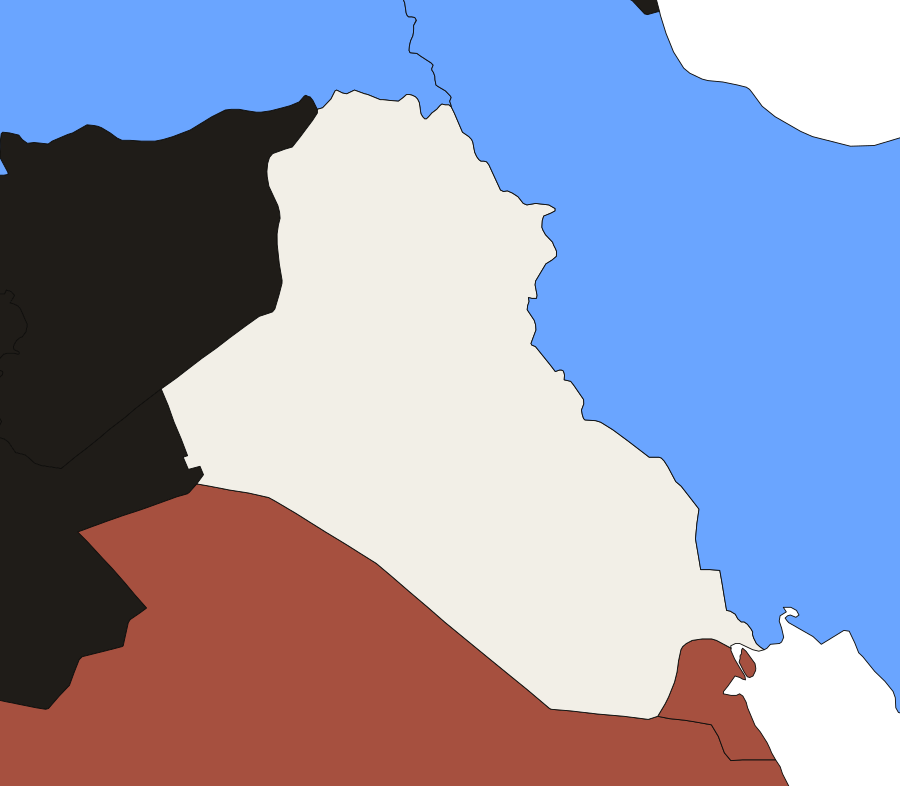
- Kirkuk Oil city claimed by Baghdad and the Kurds, where the pipeline to Turkey starts
- Erbil Capital of the Kurdistan Region; the last US troops left on September 30, 2026
- Basra oil terminals Where most of Iraq's oil is loaded, before it passes Hormuz
- Ain al-Asad Air base US forces handed to Iraq in January 2026
- Iraq
- Partner
- Tensions
Who does Iraq trade with?
Iraq sells oil to Asia and buys most other goods from China and Turkey. The Central Bank of Iraq reported goods exports of $90.43 billion and imports of $65.74 billion in 2025, and crude oil was about 97% of exports. China and India together bought more than 60% of Iraq's exports. Iraq's large trade with Iran and the UAE is missing from the chart, because neither reported 2025 figures to the UN. The state pays about 4.2 million employees, more than 3 million pensioners and about 3 million welfare recipients, about $6 billion a month in all. When the war cut oil sales in 2026, July salaries were paid late. The government borrowed heavily from the central bank, and foreign reserves fell from $102 billion in February to $81 billion in July.


 Greece
Goods, 2025. Iraq publishes no trade by country. Exports: shares of what buyers reported importing from Iraq (UN Comtrade). Imports: China's and Turkey's reported sales to Iraq, against the Central Bank of Iraq's total. Iran and the UAE, both large suppliers, did not report 2025 figures to the UN.
How strong is Iraq's military?
SIPRI estimates that Iraq spent $6.4 billion on its military in 2025, 2.4% of GDP, and the IISS counts 193,000 active troops. On top of the army are the Popular Mobilization Forces (PMF), formed after Grand Ayatollah Sistani's call to arms in June 2014, when the Islamic State took Mosul. The PMF helped defeat it, and Iraq declared victory in December 2017. The PMF now has more than 238,000 members on the state budget, and it cost about $3.5 billion in 2024. Some of its groups are loyal to Iran. The government's deadline for disarming armed groups is now June 30, 2027, but Kataib Hezbollah and Harakat al-Nujaba refuse to hand over their weapons. Iraq bought 36 US F-16 fighters. About 34 remain, with low readiness since US contractors left in 2026.
Active troops in the Middle East, 2026
Full ranking →- Iran610,000
 Egypt438,500
- Turkey355,200
- Saudi Arabia257,000
- Iraq193,000
- Israel169,500
IISS, The Military Balance, 2024 to 2026 editions
How much oil does Iraq produce?
Iraq produced 4.39 million barrels of oil a day in 2025, the fifth most in the world, and exported about 3.43 million. Its proven reserves of 145 billion barrels are the fifth largest by the EIA's count. Before the war, about 95% of exports left from terminals near Basra and passed through the Strait of Hormuz. After Iran closed the strait on February 28, 2026, exports fell 81% in March, and to about 330,000 barrels a day in April. They recovered to about 2.34 million in August, helped by deep discounts and Iran's permission for some Iraqi tankers, and averaged about 2.6 million in September. About 90% still goes through Hormuz. The only other route, a pipeline from Kirkuk to Ceyhan in Turkey, carried about 250,000 barrels a day in late September.
The largest oil producers, 2025 (barrels a day)
Full ranking →- United States13,586,000
 Russia9,885,000
- Saudi Arabia9,556,000
 Canada4,964,000
- Iraq4,388,000
- China4,325,000
- Iran4,051,000
 United Arab Emirates3,771,000
 Brazil3,769,000
- Kuwait2,584,000
US Energy Information Administration, International Energy Statistics