
Country profile · South America
 Suriname
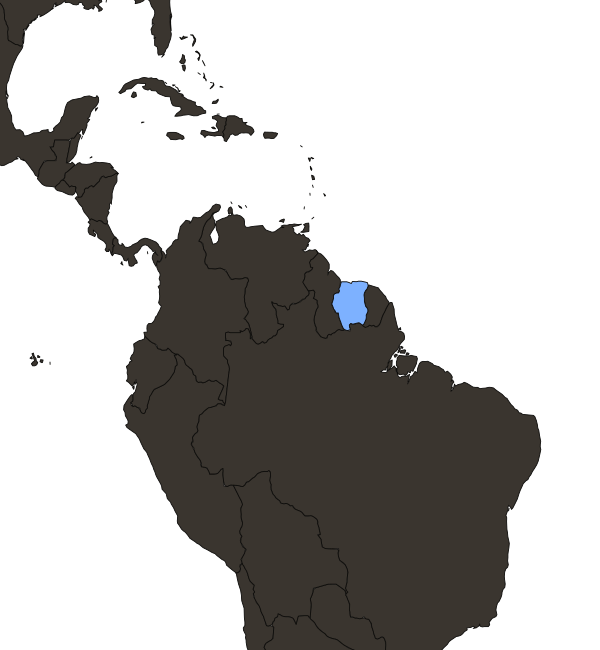
, on the northern coast of South America, is the continent's smallest independent country, with about 640,000 people. It was a Dutch colony until 1975. President Jennifer Geerlings-Simons took office in July 2025. Gold earns most of its export revenue, and an offshore oil field due to start in 2028 could transform the economy.
Where Suriname ranks
All rankings →Who runs Suriname?
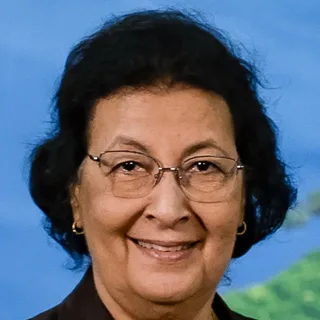
President Jennifer Geerlings-Simons was born in Paramaribo in 1953. She trained as a doctor in Suriname and graduated in 1979. She served in parliament from 1996 and was speaker of the National Assembly from 2010 to 2020. In July 2024 she became leader of the NDP, the party founded by the former military ruler Desi Bouterse. Bouterse died in December 2024 while hiding from a 20-year prison sentence for the murder of 15 opponents in 1982. In the election of May 25, 2025, the NDP won 18 of 51 seats (chart). It formed a coalition with five smaller parties, holding 34 seats in total. The assembly elected Geerlings-Simons unopposed with the two-thirds a president needs on July 6, 2025, and she took office on July 16 as Suriname's first woman president. On September 24, 2026, Ronnie Brunswijk, leader of the coalition party ABOP, warned that it could leave the government. The former president Chan Santokhi died on March 30, 2026.
- NDP (Geerlings-Simons) 18
- ABOP 6
- NPS 6
- PL 2
- A20 1
- BEP 1
- VHP 17
Photo (November 2025): Ricardo Stuckert, Presidency of Brazil, Wikimedia Commons, CC BY-SA 4.0 (cropped)
Who are Suriname's allies and rivals?
The Netherlands ruled Suriname until independence on November 25, 1975. About 370,000 people of Surinamese origin live in the Netherlands more than half as many as live in Suriname. King Willem-Alexander, who apologized for slavery in 2023, made a state visit from December 1 to 3, 2025, the first Dutch state visit in 47 years. The United States is the largest supplier of imports. In October 2025 President Jennifer Geerlings-Simons rejected US military action against Venezuela. After US forces captured Nicolás Maduro on January 3, 2026, Suriname backed a CARICOM statement that international law must be respected. Venezuela's acting president, Delcy Rodríguez, visited Paramaribo on September 10 and 11, 2026. Suriname signed a Belt and Road memorandum with China in 2018, and in 2024 it restructured about $476 million it owed to China's Exim Bank. A tribunal under the UN Law of the Sea settled the sea border with Guyana in 2007. The two countries still both claim the Tigri area.
Allies and partners
 NetherlandsFormer ruler; 370,000 people of Surinamese origin
 United StatesLargest supplier of imports
 ChinaBelt and Road partner; debt restructured in 2024
 SwitzerlandLargest buyer of exports, mostly gold
 BrazilState visit in May 2026; 13 agreements
Tensions
 GuyanaBoth claim the Tigri area
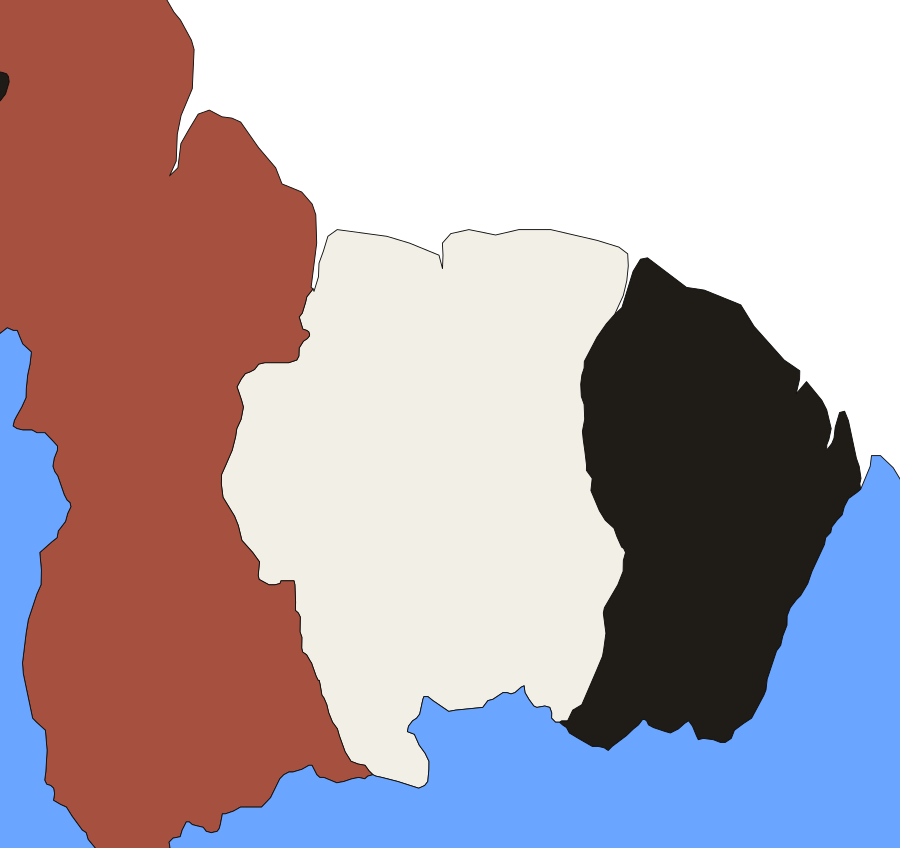
- GranMorgu Offshore oil project led by TotalEnergies, about 150 km from the coast. First oil planned for 2028.
- Tigri area Forest area held by Guyana, claimed by Suriname. A Surinamese map shown in June 2026 led Guyana to protest.
- Marouini area France and Suriname disagree on which river forms the border with French Guiana here.
- Merian Gold mine owned by Newmont (75%) and the state oil company Staatsolie (25%).
- Suriname
- Partner
- Tensions
Who does Suriname trade with?
Suriname exported $3.35 billion of goods in 2025 and imported $2.13 billion (World Bank). Gold made up about 79% of exports in 2024. Suriname itself reports most of its gold exports without a destination, so the chart uses the buyers' own figures. They show Switzerland taking 38.9% of exports in 2025 (chart), Australia 23.2% and Singapore 20.8%, almost all of it gold. Official gold figures do not agree: the central bank counted about 22 tonnes exported in 2025, while buying countries reported 32 to 33 tonnes. Since August 17, 2026, gold exporters must sell 35% of their foreign earnings to the central bank. The United States supplied 23.3% of imports, China 16.6% and the Netherlands 11.6%. The state oil company Staatsolie pumped about 17,400 barrels a day on land in 2025 and paid the state $387 million, 32% of government revenue. Inflation fell from 59.1% in 2021 to 8.0% in August 2026.
Sells to
Share of Suriname's exports
- Switzerland38.9%
 Australia23.2%
 Singapore20.8%
- Guyana5.9%
- United States2.6%
Buys from
Share of Suriname's imports
- United States23.3%
- China16.6%
- Netherlands11.6%
 Trinidad and Tobago4.8%
 Japan4.5%
Goods, 2025. UN Comtrade (exports as reported by the buying countries, imports as reported by Suriname).
Will oil make Suriname rich?
On October 1, 2024, TotalEnergies decided to develop the GranMorgu oil project in Block 58, about 150 km off the coast. The project cost about $10.5 billion at the time of the decision. TotalEnergies and the US company APA each own 40%, and the state oil company Staatsolie owns 20%. It can produce 220,000 barrels a day. It was about half complete in September 2026, and first oil is still planned for 2028. The IMF expects the economy to grow about 30% that year. Next door, Guyana began pumping offshore oil in 2019 and now has the highest GDP per person in South America (chart). Suriname defaulted on its debt in November 2020, and the IMF puts government debt at about 106% of GDP in 2025. From 2026 all mineral revenue must go into a savings fund, which held no money yet in September 2026. The new government stopped its predecessor's plan to pay every citizen $750 from future oil royalties.


Why are Suriname's people so diverse?
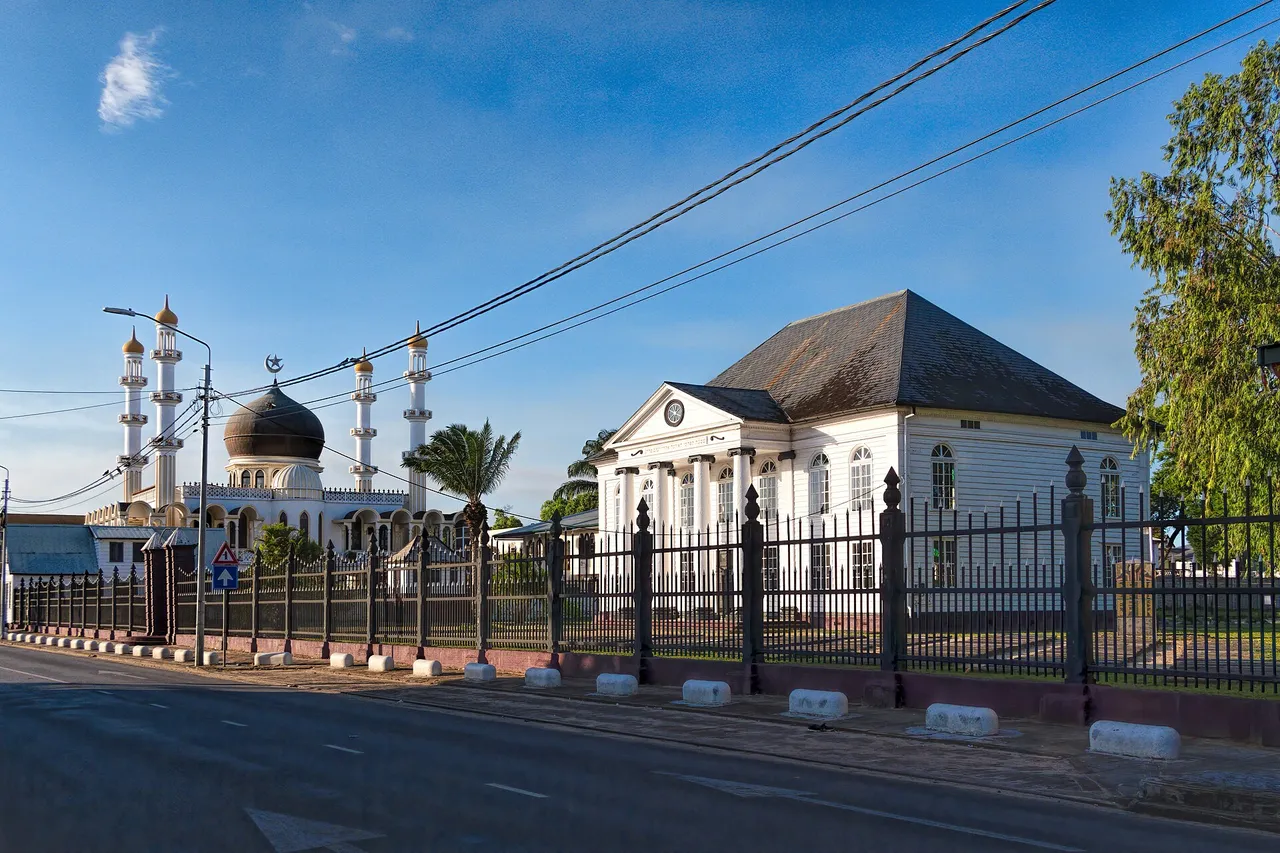
A Dutch fleet took the English colony of Suriname in 1667. Under the Treaty of Breda that year, each side kept what it held: the Dutch kept Suriname and England kept New Netherland, already renamed New York. Plantation owners brought an estimated 200,000 to 300,000 enslaved Africans. Many escaped into the forest and formed Maroon communities, which made peace treaties with the colony in the 1760s. Slavery ended on July 1, 1863, but freed people had to keep working on plantations for 10 more years. Planters then brought contract workers: Chinese from 1853, about 34,000 Indians from 1873 and almost 33,000 Javanese from 1890. In the 2012 census, 27.4% of people were Hindustani, 21.7% Maroon, 15.7% Creole and 13.7% Javanese. About 48% were Christian, 22.3% Hindu and 13.8% Muslim. In Paramaribo a synagogue and a mosque stand side by side, as the photo at the top of this page shows. Dutch is the only official language, and most people also speak Sranan Tongo.