
Country profile · Central Asia
 Turkmenistan
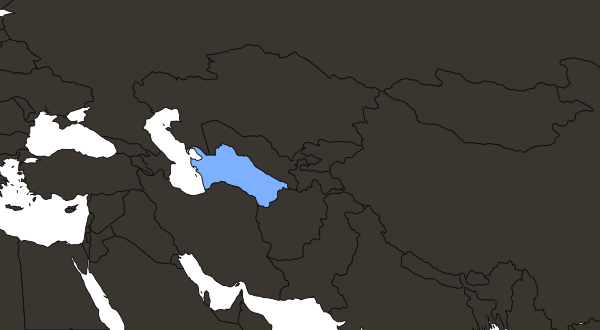
 is a desert country in Central Asia on the Caspian Sea. It has some of the largest gas reserves in the world and sends about 90% of its gas exports to China. President Serdar Berdimuhamedov took over from his father, Gurbanguly, in 2022. His father still chairs the People's Council. Freedom House gives Turkmenistan 1 out of 100.
Where Turkmenistan ranks
All rankings →Who runs Turkmenistan?
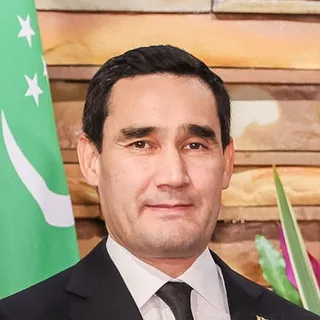
President Serdar Berdimuhamedov was born in Ashgabat on September 22, 1981. He studied at the Diplomatic Academy in Moscow and the Geneva Centre for Security Policy. He served as deputy foreign minister, governor of the Ahal region and deputy prime minister. He won an early presidential election on March 12, 2022, with 72.97% of the vote and took office on March 19, 2022. His father, Gurbanguly Berdimuhamedov, a dentist born in 1957, was president from 2006 to 2022. Since January 2023 the father has chaired the Halk Maslahaty, or People's Council, which is now the highest body of the state. He also holds the title "National Leader of the Turkmen People". In the 2023 parliamentary election the Democratic Party won 65 of 125 seats in the Mejlis (chart), but all parties support the government. Observers from the OSCE said voters had no genuine choice. In October 2026 analysts at the Carnegie Endowment wrote that Serdar Berdimuhamedov has been replacing his father's appointees.
- Democratic Party 65
- Agrarian Party 24
- Industrialists and Entrepreneurs 18
- Independents 18
Photo (December 2025): Cabinet Public Relations Office, Government of Japan, Wikimedia Commons, CC BY 4.0 (cropped)
Who are Turkmenistan's allies and rivals?
On December 12, 1995, the UN General Assembly recognized Turkmenistan's "permanent neutrality" and reaffirmed it in 2015 and 2025. Turkmenistan stays out of military alliances. It is not a member of the CSTO, the Eurasian Economic Union or the Shanghai Cooperation Organisation. It is only an associate member of the Commonwealth of Independent States, which it chairs in 2026. President Vladimir Putin met President Serdar Berdimuhamedov at the Caspian resort of Avaza on October 8, 2026, during a CIS summit there. China is the largest customer for Turkmen gas through a pipeline that has run since December 2009. Gazprom of Russia stopped buying Turkmen gas in mid-2024. In March 2022 Turkmenistan became the first Central Asian country to let the Taliban take over Afghanistan's embassy, but it has not formally recognized them. On October 8, 2026, he and Uzbekistan's President Shavkat Mirziyoyev signed a treaty setting up a council for their strategic partnership.
Allies and partners
 ChinaBuys most of its gas
 TurkeyLargest supplier of imports
 UzbekistanStrategic partnership council since October 2026
 RussiaPutin visited Avaza in October 2026
 AzerbaijanEnergy agreement signed in Baku, June 2026
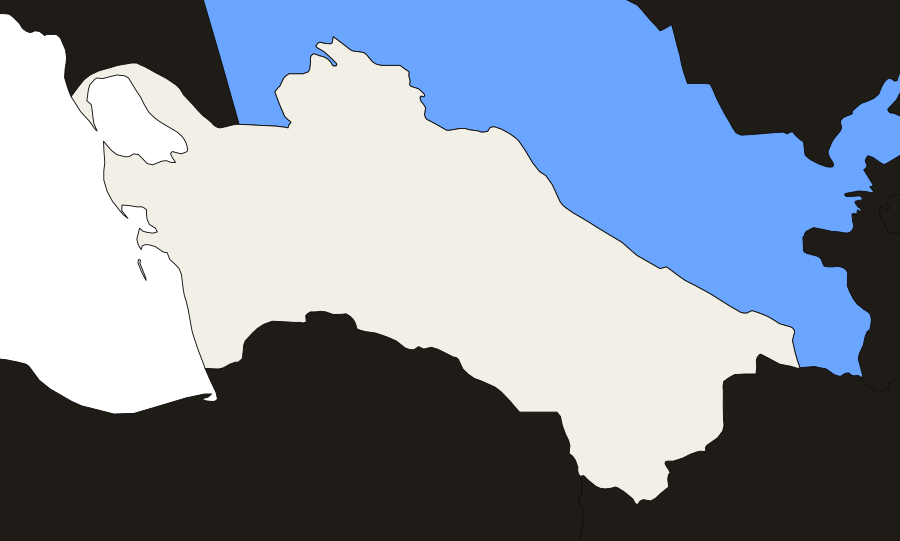
- Galkynysh One of the two largest gas fields in the world. CNPC of China is building its fourth phase.
- Serhetabat Starting point of the TAPI gas pipeline across Afghanistan toward Pakistan and India.
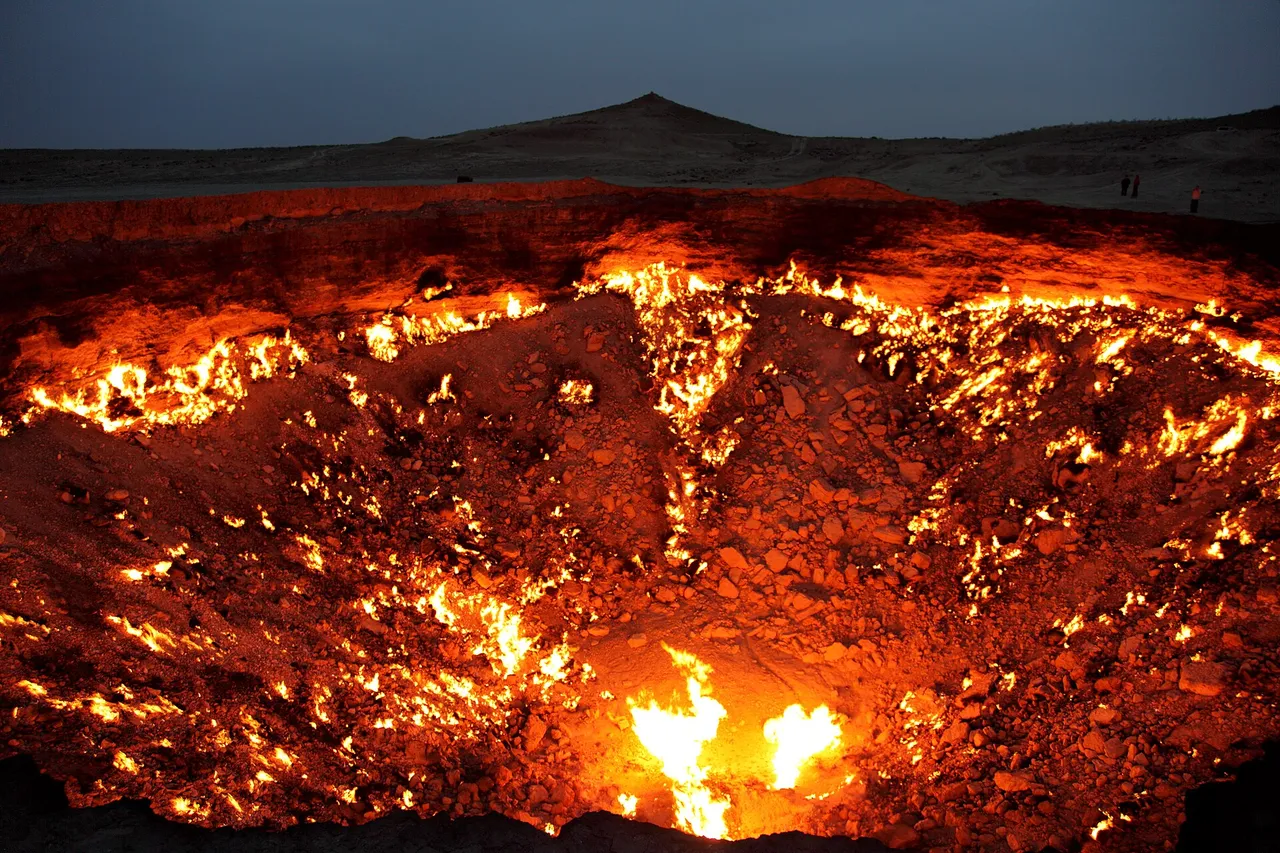
- Darvaza crater Burning gas crater in the Karakum desert, known as the Door to Hell. Its flames have been shrinking.
- Avaza Caspian resort where Turkmenistan hosted the CIS summit in October 2026.
- Turkmenistan
- Partner
Who does Turkmenistan trade with?
Turkmenistan publishes almost no trade figures. The chart uses what its partners reported for 2024. China bought 71.1% of Turkmenistan's exports (chart). Turkey bought 7.9% and Uzbekistan 7.5%. Turkey supplied 27.8% of imports and China 26.1%. Russia and Iran publish no trade figures, so they are missing from the chart. IMF data for 2025 show China with 57.5% of Turkmenistan's trade in goods. Chinese customs reported $8.4 billion of imports from Turkmenistan in 2025, almost all of it gas, and $1.6 billion of exports to it. The official exchange rate has been 3.5 manat to the dollar since 2015. On the street a dollar cost about 17 to 18 manat in September 2026. The government says the economy grew 6.3% in 2025, while the IMF estimates 3.6%. On September 11, 2026, the IMF found that Turkmenistan was breaking its duty to provide economic data. The United States has banned Turkmen cotton since 2018 because of forced labor in the harvest.
Sells to
Share of Turkmenistan's exports
- China71.1%
- Turkey7.9%
- Uzbekistan7.5%
 Greece2.3%
- Azerbaijan2.2%
Buys from
Share of Turkmenistan's imports
- Turkey27.8%
- China26.1%
 Kazakhstan8.5%
 Germany6.6%
 Italy3.0%
Goods, 2024. UN Comtrade (as reported by Turkmenistan's trade partners; Russia and Iran publish no figures).
Who buys Turkmenistan's gas?
Turkmenistan's gas reserves are often ranked fourth in the world, after Russia, Iran and Qatar. The government says the country produced 76.5 billion cubic meters of gas in 2025. It sold 34.2 billion cubic meters more than it bought in 2024 (chart). About 90% of its gas exports go to China through three pipelines. China says it bought about 30 billion cubic meters in 2025. Turkmen leaders say about 40 billion. In 2025 Russia overtook Turkmenistan as China's largest supplier of pipeline gas. Gas sent to Turkey through Iran stopped in 2025, and the war involving Iran since February 2026 has frozen deals that route gas through it. The TAPI pipeline is meant to carry gas across Afghanistan to Pakistan and India. Work began in Afghanistan in September 2024. About 80% of the first 153 km had been laid by September 2026. Satellites found 15 of the world's 25 worst oil and gas methane leaks of 2025 in Turkmenistan.
Net gas exports, 2024
Full ranking →- Russia145.1
 United States129.2
 Norway126.0
 Qatar125.7
 Australia105.9
 Canada59.9
 Algeria48.9
- Turkmenistan34.2
 Malaysia33.7
- Azerbaijan24.5
US Energy Information Administration, International Energy Statistics
Why is Turkmenistan so closed?
Saparmurat Niyazov led Soviet Turkmenistan from 1985 and ruled the independent country from 1991 until his death on December 21, 2006. He called himself Turkmenbashi, or "Head of all Turkmen", and parliament made him president for life in 1999. His book, the Ruhnama, was compulsory in schools and even in the driving test. In 2002 he renamed all 12 months, including January after himself and April after his mother. His successor, Gurbanguly Berdimuhamedov, put up a golden statue of himself on horseback in 2015 and a golden statue of an Alabai dog in 2020. A new city named Arkadag after him opened in June 2023. The government says Turkmenistan never had a case of COVID-19. The WHO and independent journalists have cast doubt on this. Human Rights Watch reports that the authorities block VPNs. In April 2026 police seized Starlink satellite internet dishes. Few foreigners visit, but an online visa system opened on October 1, 2026.