
Country profile · Central Asia
 Uzbekistan
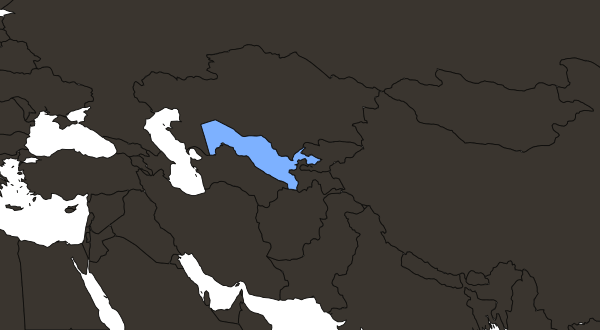
 is the most populous country in former Soviet Central Asia, with about 39 million people, and one of only two doubly landlocked countries in the world. President Shavkat Mirziyoyev has ruled since 2016. He opened the economy but keeps tight political control. Uzbekistan belongs to no military bloc and deals with Russia, China, the United States and the Taliban.
Where Uzbekistan ranks
All rankings →Which alliances is Uzbekistan in?
All alliances →Who runs Uzbekistan?
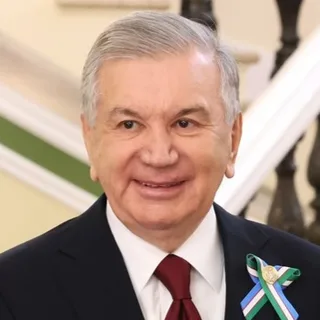
President Shavkat Mirziyoyev was born on July 24, 1957, in Jizzakh Region. He served as prime minister from 2003 to 2016 under Islam Karimov, who ruled from 1989 until his death in September 2016. Mirziyoyev became acting president and won elections in 2016 and 2021. A new constitution, approved in a referendum in April 2023, extended presidential terms from five years to seven and reset his count. He won a snap election in July 2023 with 87% and could rule until 2037 if re-elected in 2030. He floated the currency in 2017, opened the country to tourists and ended forced labor in the cotton harvest. But no genuine opposition party has been registered since independence in 1991, and bloggers are jailed. In July 2022, 21 people died when protests in Karakalpakstan were put down, by the official count. His daughter Saida Mirziyoyeva has run the Presidential Administration since June 2025. A law in August 2026 made her deputy chair of the Security Council, and she is widely seen as a possible successor. All five parties in parliament back the president (chart).
- Liberal Democratic Party, the president's party 64
- Milliy Tiklanish 29
- Adolat (21), People's Democratic (20) and Ecological (16) 57
Photo (May 2025): Kremlin.ru, Wikimedia Commons, CC BY 4.0 (cropped)
Who are Uzbekistan's allies and rivals?
Uzbekistan belongs to no military bloc. It left the Russian-led CSTO in 2012 and is only an observer in Russia's Eurasian Economic Union. Russia is its biggest export market, and Russia's Rosatom began building Central Asia's first nuclear power plant in Jizzakh region in June 2026. China is its biggest trade partner, and a railway from China through Kyrgyzstan to Uzbekistan is under construction. President Shavkat Mirziyoyev met President Trump with the other Central Asian leaders at the White House in November 2025. US Secretary of State Marco Rubio visited Samarkand on October 18 and 19, 2026. Uzbekistan signed an alliance treaty with Tajikistan that took effect in March 2025. It works with the Taliban without recognizing them: it accepted a Taliban envoy in 2024 and is studying a railway across Afghanistan to Pakistan. But a Taliban canal on the Amu Darya could cut the river's flow by up to a fifth, by some estimates.
Allies and partners
 RussiaBiggest export market; building a nuclear plant
 ChinaBiggest trade partner; railway under construction
 KazakhstanBiggest trade partner in Central Asia
 TajikistanAlliance treaty in force since 2025
 United StatesRubio visited Samarkand in October 2026
 TurkeyFellow member of the Organization of Turkic States
Tensions
 AfghanistanTaliban canal may take Amu Darya water; no water deal
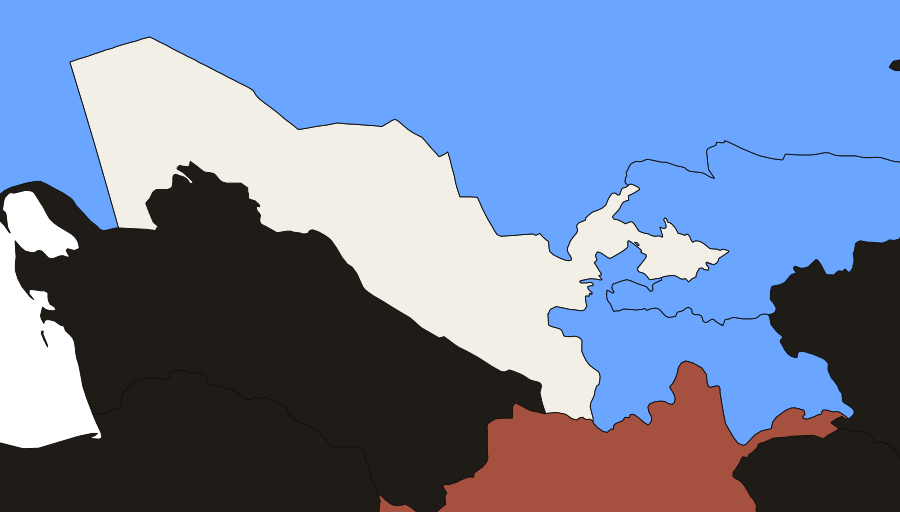
- Muruntau One of the world's largest open-pit gold mines, run by the state firm NMMC.
- Jizzakh Russia's Rosatom began building Central Asia's first nuclear power plant here in June 2026.
- Termez Border city with the only bridge to Afghanistan and a trade center for Afghan buyers.
- Qosh Tepa canal A 285 km Taliban canal taking water from the Amu Darya to irrigate northern Afghanistan.
- Moynaq Former fishing port on the Aral Sea, which has lost about 90% of its water since the 1960s.
- Uzbekistan
- Partner
- Tensions
Who does Uzbekistan trade with?
Uzbekistan's trade reached a record $81.2 billion in 2025, including services: exports of $33.8 billion and imports of $47.4 billion (statistics agency). China supplied 31% of imports, and Russia bought the largest share of exports (chart). Gold was the biggest export in 2025: a record $9.9 billion, 29% of all exports. Then gold sales stopped from October 2025 to March 2026, and gold fell to 12% of exports in the first eight months of 2026. Uzbekistan used to sell natural gas abroad. Output fell to about 42 billion cubic meters in 2025, and since 2023 the country has imported more gas than it sells, mostly from Russia. The economy grew 7.7% in 2025, and the IMF expects 7.8% in 2026. Uzbekistan hopes to join the World Trade Organization by the end of 2026, after missing a March 2026 target. The US still applies a Cold War trade law, the Jackson-Vanik amendment, to Uzbekistan.
Sells to
Share of Uzbekistan's exports
- Russia12.8%
- China7.3%
- Kazakhstan4.6%
- Afghanistan4.5%
- Turkey3.4%
Buys from
Share of Uzbekistan's imports
- China31.2%
- Russia18.3%
- Kazakhstan7.2%
- Turkey4.0%
 South Korea3.5%
Goods and services, 2025. Statistics Agency of Uzbekistan. Gold, 29% of exports, is not listed by buyer.
Why does Uzbekistan hold so much gold?
Uzbekistan mined about 130 tonnes of gold in 2025. Most of it comes from the Muruntau mine in the Kyzylkum desert, run by the state firm NMMC. NMMC sells nearly all its gold to the central bank, which pays in local currency and then holds the gold or sells it abroad. As a result, gold makes up a larger share of reserves in Uzbekistan than almost anywhere else (chart). On October 1, 2026, the central bank held about 446 tonnes worth $60 billion, about 90% of its reserves. It bought close to 50 tonnes in 2026, among the most of any central bank. The heavy bet on gold swings the reserves with the gold price: they peaked at $77.1 billion in March 2026 and fell $5.5 billion in September alone. NMMC planned to list shares in London, but the sale was paused in May 2026.
Gold's share of reserves, 2026
Full ranking →- Uzbekistan87.1%
- United States81.3%
 Germany80.8%
 Kyrgyzstan79.5%
 France78.6%
- Kazakhstan76.0%
IMF International Liquidity, September 2026
Why do so many Uzbeks work in Russia?
About 2.1 million people born in Uzbekistan lived abroad in 2024 (UN). Uzbekistan's population of about 39 million is young and growing fast. Wages in Russia are much higher than at home. Uzbeks abroad sent home $21.1 billion in 2025 (World Bank), the 12th most in the world and equal to about a seventh of GDP (chart). About three quarters of it came from Russia, 72% in early 2026. Russia tightened its rules after Islamic State gunmen attacked the Crocus City Hall concert venue near Moscow in March 2024. Migrants now face a register of people to be expelled, Russian-language tests for their children and higher work-permit costs. Russia expelled 43,700 foreigners in the first half of 2026, 65% more than a year earlier. Uzbekistan now sends more workers to Kazakhstan, Turkey, South Korea, the UK and the EU, and signed labor deals with France, Sweden, the United States and Qatar in 2026. Some Uzbeks have been recruited to fight for Russia in Ukraine.
Money sent home, share of GDP, 2025
Full ranking →- Tajikistan57.7%
 Nepal32.3%
 El Salvador27.5%
 Guatemala20.8%
- Uzbekistan14.4%
 Philippines8.5%
World Bank World Development Indicators, from KNOMAD and IMF balance of payments data, October 2026