
General Assembly vote · November 10, 1975
How countries voted on Resolution 3379, which called Zionism a form of racism
On November 10, 1975, the General Assembly adopted Resolution 3379 by 72 in favor, 35 against, with 32 abstentions. Its single operative paragraph determined that "zionism is a form of racism and racial discrimination." On December 16, 1991, the Assembly revoked that determination by adopting Resolution 46/86 by 111 to 25, with 13 abstentions.
- Yes
- 72
- No
- 35
- Abstained
- 32
- Didn't vote
- 3
Adopted: it needed more yes votes than no votes, and abstentions count for neither side.
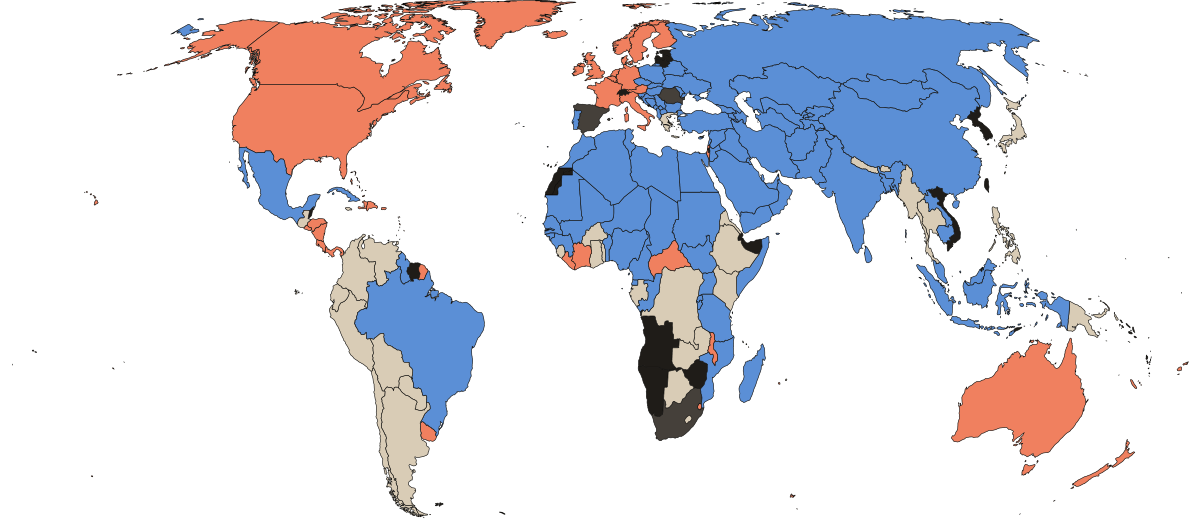
- Yes
- No
- Abstained
- Didn't vote
- Not a UN member
Which countries voted against?
The 35 no votes came from Western Europe (France, the United Kingdom, West Germany, and 11 other states), the United States, Canada, Australia, New Zealand, Fiji, Israel, and 10 states in Latin America and the Caribbean: the Bahamas, Barbados, Costa Rica, the Dominican Republic, El Salvador, Haiti, Honduras, Nicaragua, Panama, and Uruguay. Five African states also voted no: the Central African Republic, Ivory Coast, Liberia, Malawi, and Swaziland.
- United States
- Australia
- Austria
- Bahamas
- Barbados
- Belgium
- Canada
- Central African Republic
- Costa Rica
- Denmark
- Dominican Republic
- El Salvador
- Fiji
- Finland
- France
- Haiti
- Honduras
- Iceland
- Ireland
- Israel
- Italy
- Ivory Coast
- Liberia
- Luxembourg
- Malawi
- Netherlands
- New Zealand
- Nicaragua
- Norway
- Panama
- Swaziland
- Sweden
- United Kingdom
- Uruguay
- West Germany
How did the big powers vote?
Why did the Assembly pass it in 1975?
Through 1975, three international meetings adopted texts linking Zionism to racism. The Declaration of Mexico, adopted at the World Conference of the International Women's Year (June 19 to July 2), listed zionism with colonialism, apartheid and racial discrimination as things to be eliminated. A resolution of the Organization of African Unity, adopted in Kampala (July 28 to August 1), said the regimes in "occupied Palestine", Zimbabwe and South Africa had "a common imperialist origin." A declaration of Non-Aligned foreign ministers in Lima (August 25 to 30) condemned zionism "as a threat to world peace and security."
Somalia introduced the draft on October 16, 1975 in the Third Committee. It ended with 26 sponsors: 20 Arab League members, plus Afghanistan, Cuba, Dahomey, Guinea, Mali, and the Ukrainian SSR. On October 17, 1975, the Committee adopted it 70 to 29, with 27 abstentions.
At the plenary on November 10, Belgium moved to defer the text to the next session. That motion failed 67 to 55, with 15 abstentions. The Assembly then adopted Resolution 3379 by 72 to 35, with 32 abstentions.
- Resolution 3379: Zionism called racismNov 1975 72 yes35 no32 abstained
- Resolution 46/86: the revocationDec 1991 111 yes25 no13 abstained
What did Israel and the United States say?
Chaim Herzog, Israel's Permanent Representative, spoke before the vote on November 10, 1975. He called the resolution "based on hatred, falsehood and arrogance" and said: "For us, the Jewish people, this is no more than a piece of paper, and we shall treat it as such." He then tore the text of the resolution in half at the podium.
Daniel Patrick Moynihan, the United States Permanent Representative, spoke after the vote. "The United States rises to declare before the General Assembly ... that it does not acknowledge, it will not abide by, it will never acquiesce in this infamous act," he said. He said: "The lie is that zionism is a form of racism. The overwhelmingly clear truth is that it is not."
What did the resolution's supporters say?
Fayez Sayegh, Kuwait's representative, argued that the label fit Israel's laws. "A country in which there is a law called the Law of Return, permitting a Jew who has never been to Palestine to 'return', and a policy prohibiting a Palestinian from actually returning to his home... how can the label of racism and racial discrimination be questioned...?" he said on November 10, 1975. He added: "We revere the Jewish faith."
Jamil Baroody, Saudi Arabia's representative, replied to Moynihan after the vote, asking: "But we are liars, 72 liars? Do you have a monopoly of the truth?" He said: "We have no quarrel with Judaism. But it was European Jews who started this movement... They used Judaism, a noble religion, for a political and economic end."
Why was it revoked in 1991?
On September 23, 1991, President George H.W. Bush called for repeal in his address to the General Assembly. He cited the Charter's pledge "to practice tolerance and live together in peace with one another as good neighbors" and said: "UNGA Resolution 3379, the so-called 'Zionism is racism' resolution, mocks this pledge and the principles upon which the United Nations was founded. And I call now for its repeal."
The end of the Cold War changed many governments' votes. The Soviet Union, which had voted yes in 1975, co-sponsored the revocation. East European states that had supported the original resolution under communist governments now backed repeal. The draft had 86 co-sponsors.
Yemen moved to require a two-thirds majority for passage. That motion was rejected 96 to 34. The Assembly then adopted Resolution 46/86 by 111 to 25, with 13 abstentions. Revocations by the Assembly are rare. In 1950, Resolution 386 (V) revoked two recommendations on Spain contained in a 1946 resolution.
Khalil Makkawi of Lebanon, speaking for the Arab Group, warned that revocation "would set a dangerous precedent which could render other United Nations resolutions no longer morally and politically binding." Cuba's representative, Ricardo Alarcón de Quesada, said the United States had acted "for petty domestic reasons... using a level of pressure and disinformation that is quite extraordinary."
The 25 no votes came from 13 Arab states, seven Muslim-majority states in Asia (Afghanistan, Bangladesh, Brunei, Indonesia, Iran, Malaysia, and Pakistan), Mali, and four other states: Cuba, North Korea, Sri Lanka, and Viet Nam.
No→Yes35
- Australia
- Austria
- Bahamas
- Barbados
- Belgium
- Canada
- Central African Republic
- Costa Rica
- Côte d'Ivoire
- Denmark
- Dominican Republic
- El Salvador
- Fiji
- Finland
- France
- Germany
- Haiti
- Honduras
- Iceland
- Ireland
- Israel
- Italy
- Liberia
- Luxembourg
- Malawi
- Netherlands
- New Zealand
- Nicaragua
- Norway
- Panama
- Swaziland
- Sweden
- United Kingdom
- United States
- Uruguay
Abstained→Yes26
- Argentina
- Bhutan
- Bolivia
- Botswana
- Chile
- Colombia
- Ecuador
- Gabon
- Greece
- Guatemala
- Jamaica
- Japan
- Kenya
- Lesotho
- Nepal
- Papua New Guinea
- Paraguay
- Peru
- Philippines
- Sierra Leone
- Singapore
- Thailand
- Togo
- Venezuela
- Zaire
- Zambia
Yes→No22
- Afghanistan
- Algeria
- Bangladesh
- Cuba
- Indonesia
- Iran
- Iraq
- Jordan
- Lebanon
- Libya
- Malaysia
- Mali
- Mauritania
- Pakistan
- Qatar
- Saudi Arabia
- Somalia
- Sri Lanka
- Sudan
- Syria
- United Arab Emirates
- Yemen
Yes→Abstained5
- Laos
- Maldives
- Tanzania
- Turkey
- Uganda
Unchanged: 30 yes both times, 6 abstained both times. Countries that didn't vote on one of the two, or weren't members yet, are left out.
How did each region vote?
Africa provided the largest bloc of yes votes at 28, followed by the Middle East at 14 and Europe at 13. In the Americas, 12 voted no, 11 abstained and 5 voted yes. All 3 no votes in Oceania came from Australia, New Zealand, and Fiji.
- Europe30 countries 13 yes14 no1 abstained
- Americas28 countries 5 yes12 no11 abstained
- Asia19 countries 12 yes0 no7 abstained
- Oceania4 countries 0 yes3 no1 abstained
- Middle East15 countries 14 yes1 no0 abstained
- Africa46 countries 28 yes5 no12 abstained
What did the resolution say?
- The preamble recalled the 1963 Declaration on the Elimination of All Forms of Racial Discrimination, which stated that "any doctrine of racial differentiation or superiority is scientifically false, morally condemnable, socially unjust and dangerous."
- It recalled a 1973 resolution that "condemned, inter alia, the unholy alliance between South African racism and zionism."
- It took note of the Declaration of Mexico, adopted in 1975 by the World Conference of the International Women's Year, which said international co-operation and peace require "the elimination of colonialism and neo-colonialism, foreign occupation, zionism, apartheid and racial discrimination in all its forms."
- It took note of an Organization of African Unity resolution from Kampala (1975), which found "that the racist regime in occupied Palestine and the racist regimes in Zimbabwe and South Africa have a common imperialist origin..."
- It took note of the political declaration of the Non-Aligned foreign ministers' conference in Lima (1975), which "most severely condemned zionism as a threat to world peace and security and called upon all countries to oppose this racist and imperialist ideology."
- The single operative paragraph stated: "Determines that zionism is a form of racism and racial discrimination."
How did every country vote?
| Country | Region | Vote |
|---|---|---|
| Afghanistan | Asia | Yes |
| Albania | Europe | Yes |
| Algeria | Africa | Yes |
| Argentina | Americas | Abstained |
| Australia | Oceania | No |
| Austria | Europe | No |
| Bahamas | Americas | No |
| Bahrain | Middle East | Yes |
| Bangladesh | Asia | Yes |
| Barbados | Americas | No |
| Belgium | Europe | No |
| Bhutan | Asia | Abstained |
| Bolivia | Americas | Abstained |
| Botswana | Africa | Abstained |
| Brazil | Americas | Yes |
| Bulgaria | Europe | Yes |
| Burma | Asia | Abstained |
| Burundi | Africa | Yes |
| Byelorussian SSR | Europe | Yes |
| Cambodia | Asia | Yes |
| Cameroon | Africa | Yes |
| Canada | Americas | No |
| Cape Verde | Africa | Yes |
| Central African Republic | Africa | No |
| Chad | Africa | Yes |
| Chile | Americas | Abstained |
| China | Asia | Yes |
| Colombia | Americas | Abstained |
| Costa Rica | Americas | No |
| Cuba | Americas | Yes |
| Cyprus | Europe | Yes |
| Czechoslovakia | Europe | Yes |
| Dahomey | Africa | Yes |
| Denmark | Europe | No |
| Dominican Republic | Americas | No |
| East Germany | Europe | Yes |
| Ecuador | Americas | Abstained |
| Egypt | Africa | Yes |
| El Salvador | Americas | No |
| Equatorial Guinea | Africa | Yes |
| Ethiopia | Africa | Abstained |
| Fiji | Oceania | No |
| Finland | Europe | No |
| France | Europe | No |
| Gabon | Africa | Abstained |
| Gambia | Africa | Yes |
| Ghana | Africa | Abstained |
| Greece | Europe | Abstained |
| Grenada | Americas | Yes |
| Guatemala | Americas | Abstained |
| Guinea | Africa | Yes |
| Guinea-Bissau | Africa | Yes |
| Guyana | Americas | Yes |
| Haiti | Americas | No |
| Honduras | Americas | No |
| Hungary | Europe | Yes |
| Iceland | Europe | No |
| India | Asia | Yes |
| Indonesia | Asia | Yes |
| Iran | Middle East | Yes |
| Iraq | Middle East | Yes |
| Ireland | Europe | No |
| Israel | Middle East | No |
| Italy | Europe | No |
| Ivory Coast | Africa | No |
| Jamaica | Americas | Abstained |
| Japan | Asia | Abstained |
| Jordan | Middle East | Yes |
| Kenya | Africa | Abstained |
| Kuwait | Middle East | Yes |
| Laos | Asia | Yes |
| Lebanon | Middle East | Yes |
| Lesotho | Africa | Abstained |
| Liberia | Africa | No |
| Libya | Africa | Yes |
| Luxembourg | Europe | No |
| Madagascar | Africa | Yes |
| Malawi | Africa | No |
| Malaysia | Asia | Yes |
| Maldives | Asia | Yes |
| Mali | Africa | Yes |
| Malta | Europe | Yes |
| Mauritania | Africa | Yes |
| Mauritius | Africa | Abstained |
| Mexico | Americas | Yes |
| Mongolia | Asia | Yes |
| Morocco | Africa | Yes |
| Mozambique | Africa | Yes |
| Nepal | Asia | Abstained |
| Netherlands | Europe | No |
| New Zealand | Oceania | No |
| Nicaragua | Americas | No |
| Niger | Africa | Yes |
| Nigeria | Africa | Yes |
| North Yemen | Middle East | Yes |
| Norway | Europe | No |
| Oman | Middle East | Yes |
| Pakistan | Asia | Yes |
| Panama | Americas | No |
| Papua New Guinea | Oceania | Abstained |
| Paraguay | Americas | Abstained |
| Peru | Americas | Abstained |
| Philippines | Asia | Abstained |
| Poland | Europe | Yes |
| Portugal | Europe | Yes |
| Qatar | Middle East | Yes |
| Republic of the Congo | Africa | Yes |
| Romania | Europe | Didn't vote |
| Rwanda | Africa | Yes |
| São Tomé and Príncipe | Africa | Yes |
| Saudi Arabia | Middle East | Yes |
| Senegal | Africa | Yes |
| Sierra Leone | Africa | Abstained |
| Singapore | Asia | Abstained |
| Somalia | Africa | Yes |
| South Africa | Africa | Didn't vote |
| South Yemen | Middle East | Yes |
| Soviet Union | Europe | Yes |
| Spain | Europe | Didn't vote |
| Sri Lanka | Asia | Yes |
| Sudan | Africa | Yes |
| Swaziland | Africa | No |
| Sweden | Europe | No |
| Syria | Middle East | Yes |
| Tanzania | Africa | Yes |
| Thailand | Asia | Abstained |
| Togo | Africa | Abstained |
| Trinidad and Tobago | Americas | Abstained |
| Tunisia | Africa | Yes |
| Turkey | Middle East | Yes |
| Uganda | Africa | Yes |
| Ukrainian SSR | Europe | Yes |
| United Arab Emirates | Middle East | Yes |
| United Kingdom | Europe | No |
| United States | Americas | No |
| Upper Volta | Africa | Abstained |
| Uruguay | Americas | No |
| Venezuela | Americas | Abstained |
| West Germany | Europe | No |
| Yugoslavia | Europe | Yes |
| Zaire | Africa | Abstained |
| Zambia | Africa | Abstained |