
General Assembly vote · December 10, 1948
How countries voted on the Universal Declaration of Human Rights in 1948
The UN General Assembly adopted the Universal Declaration of Human Rights on December 10, 1948, at the Palais de Chaillot in Paris. The vote was 48 to 0, with 8 abstentions. The 8 abstainers were the 5 Soviet bloc states, Yugoslavia, Saudi Arabia and South Africa. Honduras and Yemen were absent. No country voted against the declaration.
- Yes
- 48
- Abstained
- 8
- Didn't vote
- 2
Adopted: it needed more yes votes than no votes, and abstentions count for neither side.
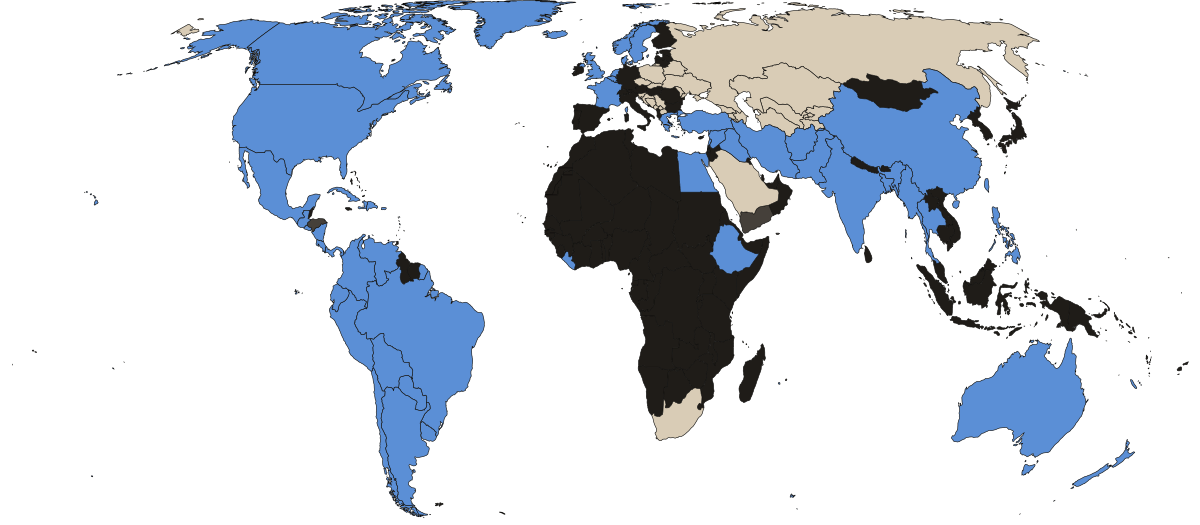
- Yes
- No
- Abstained
- Didn't vote
- Not a UN member
Which countries voted against?
No country voted against the declaration. The 8 abstainers were the Soviet Union, the Byelorussian SSR, the Ukrainian SSR, Poland, Czechoslovakia, Yugoslavia, Saudi Arabia and South Africa. The Soviet bloc states said the text ignored state sovereignty and did not require states to guarantee the rights. Yugoslavia said the text was too individualistic. Saudi Arabia objected to provisions on marriage and the freedom to change religion. South Africa feared the declaration would be treated as a binding definition of the rights in the UN Charter.
How did the big powers vote?
Why did 8 countries abstain?
The 5 Soviet bloc states and Yugoslavia abstained. The UN record has the Soviet Union's Andrei Vyshinsky say several articles "completely ignored the sovereign rights of democratic Governments." It adds: "Human rights meant nothing unless they were guaranteed and protected by the State; otherwise they became a mere abstraction." The record has Poland's Juliusz Katz-Suchy say the declaration "only went so far as to state traditional freedoms and rights of the old liberal school" and omitted the duties of the individual. The record has Yugoslavia's Radovanović say the text was "based on individualistic concepts which considered man as an isolated individual."
In the Third Committee, the record has Saudi Arabia's Jamil Baroody say the declaration "was based largely on Western patterns of culture." The record adds that this did not mean it "went counter to" Eastern patterns. The record says Saudi Arabia did not vote for the marriage article (final Article 16) because it could not agree to "any provisions of that article which might possibly conflict with Islamic law." On changing religion (final Article 18), the record has Baroody argue that "throughout history missionaries had often abused their rights by becoming the forerunners of a political intervention." His amendment to remove that clause was rejected 22 to 12, with 8 abstentions.
The record has South Africa's Mr. Andrews say the declaration "would probably be interpreted as an authoritative definition of fundamental rights and freedoms which had been left undefined in the Charter," and that matters of "domestic jurisdiction" could become subject to "discussion, and even condemnation," by the Assembly.
Who wrote and defended the declaration?
Eleanor Roosevelt of the United States chaired the Commission on Human Rights and its drafting committee. John Humphrey, a Canadian who directed the UN Human Rights Division, prepared the initial blueprint of 48 rights. René Cassin of France composed the first draft from Humphrey's outline. P.C. Chang of China served as vice-chairman, and Charles Malik of Lebanon served as rapporteur. Malik also chaired the Third Committee, which adopted the text 29 to 0, with 7 abstentions.
Chang argued that the declaration should reflect more than Western ideas. According to Roosevelt's memoirs, Chang suggested the Secretariat study Confucianism. The word "conscience" in Article 1 is often attributed to his influence. Hansa Mehta of India is often credited with changing the opening of Article 1 from "All men are born free and equal" to "All human beings are born free and equal." Denmark's Bodil Begtrup pressed for "everyone" instead of "all men."
Pakistan's Sir Mohammed Zafrulla Khan spoke for the freedom to change religion. Pakistan had voted against that clause in the Third Committee. In the plenary on December 10, Zafrulla Khan reversed that position. The UN record summarises him as saying the Koran stated: "Let he who chooses to believe, believe, and he who chooses to disbelieve, disbelieve." On December 9, Roosevelt told the Assembly the declaration "may well become the international Magna Carta of all men everywhere." After the vote, the record has Assembly President Herbert Evatt of Australia praise Roosevelt as "the person who had raised to even greater heights even so great a name."
Is the declaration binding?
No. The declaration is a General Assembly resolution, not a treaty. Roosevelt said on December 9, 1948: "It is not a treaty; it is not an international agreement. It is not and does not purport to be a statement of law or of legal obligation." The record has Assembly President Herbert Evatt say after the vote that it "was not a convention by which States would be bound."
On December 16, 1966, the General Assembly adopted 2 covenants: the International Covenant on Economic, Social and Cultural Rights, by 105 to 0, and the International Covenant on Civil and Political Rights, by 106 to 0. The resolution containing both covenants and an optional protocol passed 104 to 0, with 18 absent. The economic and social covenant came into force on January 3, 1976, and the civil and political covenant on March 23, 1976. As of November 2026, the civil and political covenant has 175 parties and the economic and social covenant has 174. China has signed but not ratified the civil and political covenant. The United States has signed but not ratified the economic and social covenant. Saudi Arabia is party to neither.
The 1968 Proclamation of Tehran called the declaration "an obligation for the members of the international community," though that statement did not settle the legal debate. The 1993 Vienna Declaration, adopted by a conference of 171 states, called the universal nature of all human rights "beyond question." Many scholars argue that some of the declaration's provisions have become customary international law. The declaration itself remains a non-binding resolution.
- Universal Declaration, 1948Dec 1948 48 yes0 no8 abstained
- The 2 human rights covenants, 1966Dec 1966 104 yes0 no0 abstained
How did each region vote?
In Europe, 10 of 16 members voted yes and 6 abstained: the Soviet Union, the Byelorussian SSR, the Ukrainian SSR, Poland, Czechoslovakia and Yugoslavia. In the Americas, 21 of 22 voted yes and Honduras was absent. In Asia, all 7 voted yes. In the Middle East, 5 of 7 voted yes, Saudi Arabia abstained and Yemen was absent. In Oceania, both members voted yes. In Africa, 3 of 4 voted yes and South Africa abstained.
- Europe16 countries 10 yes0 no6 abstained
- Americas22 countries 21 yes0 no0 abstained
- Asia7 countries 7 yes0 no0 abstained
- Oceania2 countries 2 yes0 no0 abstained
- Middle East7 countries 5 yes0 no1 abstained
- Africa4 countries 3 yes0 no1 abstained
What does the declaration say?
- Article 1: "All human beings are born free and equal in dignity and rights. They are endowed with reason and conscience and should act towards one another in a spirit of brotherhood."
- Article 3: "Everyone has the right to life, liberty and security of person."
- Article 18: "Everyone has the right to freedom of thought, conscience and religion; this right includes freedom to change his religion or belief, and freedom, either alone or in community with others and in public or private, to manifest his religion or belief in teaching, practice, worship and observance."
- Article 19: "Everyone has the right to freedom of opinion and expression; this right includes freedom to hold opinions without interference and to seek, receive and impart information and ideas through any media and regardless of frontiers."
- The preamble says that "recognition of the inherent dignity and of the equal and inalienable rights of all members of the human family is the foundation of freedom, justice and peace in the world."
How did every country vote?
| Country | Region | Vote |
|---|---|---|
| Afghanistan | Asia | Yes |
| Argentina | Americas | Yes |
| Australia | Oceania | Yes |
| Belgium | Europe | Yes |
| Bolivia | Americas | Yes |
| Brazil | Americas | Yes |
| Burma | Asia | Yes |
| Byelorussian SSR | Europe | Abstained |
| Canada | Americas | Yes |
| Chile | Americas | Yes |
| China | Asia | Yes |
| Colombia | Americas | Yes |
| Costa Rica | Americas | Yes |
| Cuba | Americas | Yes |
| Czechoslovakia | Europe | Abstained |
| Denmark | Europe | Yes |
| Dominican Republic | Americas | Yes |
| Ecuador | Americas | Yes |
| Egypt | Africa | Yes |
| El Salvador | Americas | Yes |
| Ethiopia | Africa | Yes |
| France | Europe | Yes |
| Greece | Europe | Yes |
| Guatemala | Americas | Yes |
| Haiti | Americas | Yes |
| Honduras | Americas | Didn't vote |
| Iceland | Europe | Yes |
| India | Asia | Yes |
| Iran | Middle East | Yes |
| Iraq | Middle East | Yes |
| Lebanon | Middle East | Yes |
| Liberia | Africa | Yes |
| Luxembourg | Europe | Yes |
| Mexico | Americas | Yes |
| Netherlands | Europe | Yes |
| New Zealand | Oceania | Yes |
| Nicaragua | Americas | Yes |
| Norway | Europe | Yes |
| Pakistan | Asia | Yes |
| Panama | Americas | Yes |
| Paraguay | Americas | Yes |
| Peru | Americas | Yes |
| Philippines | Asia | Yes |
| Poland | Europe | Abstained |
| Saudi Arabia | Middle East | Abstained |
| Siam | Asia | Yes |
| Soviet Union | Europe | Abstained |
| Sweden | Europe | Yes |
| Syria | Middle East | Yes |
| Turkey | Middle East | Yes |
| Ukrainian SSR | Europe | Abstained |
| Union of South Africa | Africa | Abstained |
| United Kingdom | Europe | Yes |
| United States | Americas | Yes |
| Uruguay | Americas | Yes |
| Venezuela | Americas | Yes |
| Yemen | Middle East | Didn't vote |
| Yugoslavia | Europe | Abstained |