
General Assembly vote · September 13, 2007
How countries voted on the Declaration on the Rights of Indigenous Peoples in 2007
The General Assembly adopted the Declaration on the Rights of Indigenous Peoples on September 13, 2007, by 143 to 4, with 11 abstentions. Australia, Canada, New Zealand and the United States voted no. All four later reversed their positions, with the United States the last to do so in December 2010. The declaration is not a treaty and is not legally binding, though Bolivia wrote it into national law in November 2007.
- Yes
- 143
- No
- 4
- Abstained
- 11
- Didn't vote
- 34
Adopted: it needed more yes votes than no votes, and abstentions count for neither side.
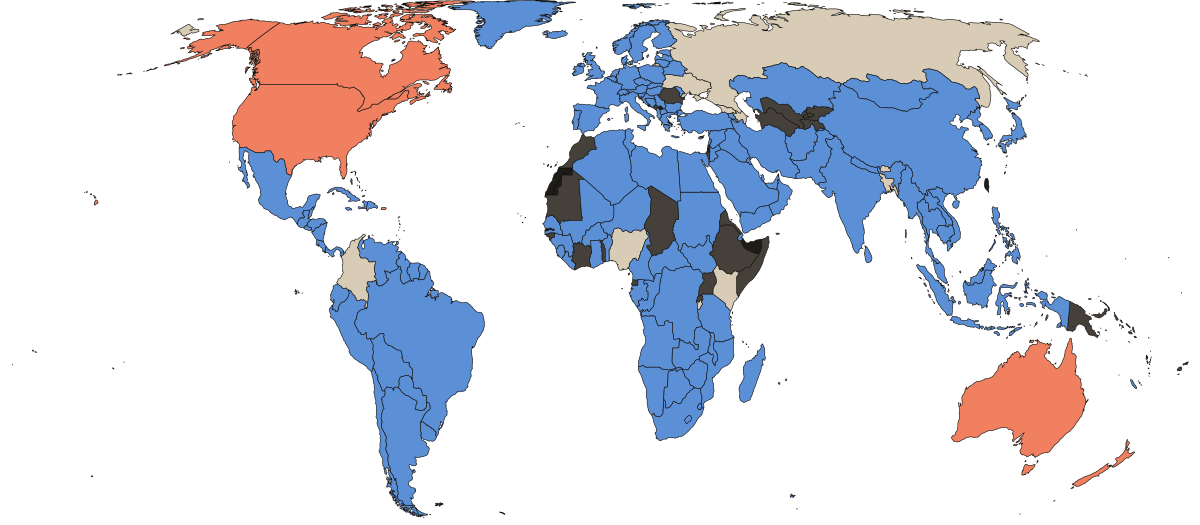
- Yes
- No
- Abstained
- Didn't vote
- Not a UN member
Which countries voted against?
Australia, Canada, New Zealand and the United States were the only four countries to vote no. Australia, Canada and New Zealand objected to the provisions on land. They said the provisions on free, prior and informed consent could give indigenous peoples a veto over government decisions. New Zealand said four articles were "fundamentally incompatible" with its constitutional arrangements. Canada said the land provisions were "overly broad" and could put settled treaties into question. The United States said the text was prepared after negotiations had ended and "risks endless conflicting interpretations." Australia, New Zealand and the United States requested the recorded vote. Peru had asked for adoption without a vote.
 United States
 Australia
 Canada
 New Zealand
How did the big powers vote?
- United StatesNo
- CanadaNo
- AustraliaNo
- New ZealandNo
 RussiaAbstained
 ChinaYes
 BrazilYes
 MexicoYes
 BoliviaYes
 IndiaYes
 ColombiaAbstained
 KenyaAbstained
Why did four countries vote no?
Australia's representative Robert Hill said "Australia cannot accept a right that allows a particular subgroup of the population to be able to veto legitimate decisions of a democratic and representative Government." Canada's ambassador John McNee said the land provisions were "overly broad and unclear" and were "possibly putting into question matters that have already been settled by treaty in Canada."
New Zealand's ambassador Rosemary Banks said "four provisions in the Declaration are fundamentally incompatible with New Zealand's constitutional and legal arrangements." On Article 26, she said "the entire country is potentially caught within the scope of the article." The United States representative Robert Hagen said the text "was prepared and submitted after the negotiations had concluded" and that it "risks endless conflicting interpretations."
Peru, which introduced the text, said the 2007 changes "do not undermine the substantive aspects of the protection of indigenous peoples." Sweden, which voted yes, said Article 19 "does not entail a collective right to veto." It said Article 32(2) "shall be interpreted as a guarantee that indigenous peoples must be consulted, not as giving them a right of veto." Guatemala, which voted yes, said "The Declaration does not create new rights" and that "Great care was taken at every step to ensure the Declaration's consistency with the general principles of human rights and international law."
Australia, New Zealand and the United States requested the recorded vote. The result was 143 to 4, with 11 abstentions.
How did Australia, Canada, New Zealand and the United States reverse their positions?
Australia was the first to reverse. On April 3, 2009, Indigenous Affairs Minister Jenny Macklin announced support at Parliament House in Canberra. She said "today, Australia changes its position" and cited Article 10's ban on forced removal. She also said the declaration "is non-binding and does not affect existing Australian law."
New Zealand followed on April 19, 2010, when Maori Affairs Minister Pita Sharples announced support at the UN Permanent Forum on Indigenous Issues. He called the document "aspirational." The government said New Zealand's existing legal and constitutional frameworks would set the limits of its engagement with the declaration. On April 21, 2010, Maori Party MP Hone Harawira told Parliament that New Zealand was supporting it "without caveat."
Canada endorsed the declaration on November 12, 2010, calling it an "aspirational document" that "does not reflect customary international law nor change Canadian laws." On May 10, 2016, Indigenous Affairs Minister Carolyn Bennett said Canada was "now a full supporter of the Declaration without qualification."
The United States was the last to reverse. President Obama announced support on December 16, 2010, at the White House Tribal Nations Conference.
Is the declaration binding?
No. A General Assembly declaration is not a treaty and does not create legal obligations. Australia and Canada stressed this point when they voted no and again when they reversed their positions. New Zealand said supporters described the declaration as "an aspirational document intended to inspire rather than to have legal effect." It said it did not accept "that a State can responsibly take such a stance towards a document that purports to declare the contents of the rights of indigenous people."
Some governments have written it into law. Bolivia's Law No. 3760 of November 7, 2007, raised all 46 articles to the rank of national law. In Canada, the United Nations Declaration on the Rights of Indigenous Peoples Act became law on June 21, 2021. British Columbia passed its own Declaration on the Rights of Indigenous Peoples Act in 2019. In December 2025, the BC Court of Appeal ruled in Gitxaala v. British Columbia that the provincial act incorporates the declaration into BC law. BC appealed, and the Supreme Court of Canada granted leave to appeal on May 21, 2026. As of November 12, 2026, the appeal is pending.
Namibia, which voted yes, told the Assembly that "the argument that the Declaration is not binding did not appeal to us. We take our obligations seriously." In Belize, the Supreme Court cited the declaration in October 2007 when it upheld Maya customary land rights in Aurelio Cal et al. v. Attorney General, five weeks after the vote.
How did each region vote?
In Europe, 41 of 47 members voted yes and 4 abstained. In the Americas, 30 of 35 voted yes, 2 voted no and 1 abstained. In Africa, 35 of 53 voted yes and 3 abstained. In Asia, 23 of 29 voted yes and 2 abstained. In the Middle East, 13 of 14 voted yes. In Oceania, 1 of 14 voted yes, 2 voted no and 1 abstained.
- Europe47 countries 41 yes0 no4 abstained
- Americas35 countries 30 yes2 no1 abstained
- Asia29 countries 23 yes0 no2 abstained
- Oceania14 countries 1 yes2 no1 abstained
- Middle East14 countries 13 yes0 no0 abstained
- Africa53 countries 35 yes0 no3 abstained
What does the declaration say?
- Article 3 states that "indigenous peoples have the right to self-determination" and that "they freely determine their political status and freely pursue their economic, social and cultural development."
- Article 4 says self-determination includes "the right to autonomy or self-government in matters relating to their internal and local affairs."
- Article 10 says "indigenous peoples shall not be forcibly removed from their lands or territories" and that "no relocation shall take place without the free, prior and informed consent of the indigenous peoples concerned."
- Article 19 requires states to consult indigenous peoples "in order to obtain their free, prior and informed consent before adopting and implementing legislative or administrative measures that may affect them."
- Article 26(2) says indigenous peoples "have the right to own, use, develop and control the lands, territories and resources that they possess by reason of traditional ownership or other traditional occupation or use, as well as those which they have otherwise acquired."
- Article 46(1) says nothing in the declaration may be "construed as authorizing or encouraging any action which would dismember or impair, totally or in part, the territorial integrity or political unity of sovereign and independent States."
How did every country vote?
| Country | Region | Vote |
|---|---|---|
 Afghanistan | Asia | Yes |
 Albania | Europe | Yes |
 Algeria | Africa | Yes |
 Andorra | Europe | Yes |
 Angola | Africa | Yes |
 Antigua and Barbuda | Americas | Yes |
 Argentina | Americas | Yes |
 Armenia | Europe | Yes |
| Australia | Oceania | No |
 Austria | Europe | Yes |
 Azerbaijan | Europe | Abstained |
 Bahamas | Americas | Yes |
 Bahrain | Middle East | Yes |
 Bangladesh | Asia | Abstained |
 Barbados | Americas | Yes |
 Belarus | Europe | Yes |
 Belgium | Europe | Yes |
 Belize | Americas | Yes |
 Benin | Africa | Yes |
 Bhutan | Asia | Abstained |
| Bolivia | Americas | Yes |
 Bosnia and Herzegovina | Europe | Yes |
 Botswana | Africa | Yes |
| Brazil | Americas | Yes |
 Brunei | Asia | Yes |
 Bulgaria | Europe | Yes |
 Burkina Faso | Africa | Yes |
 Burundi | Africa | Abstained |
 Cambodia | Asia | Yes |
 Cameroon | Africa | Yes |
| Canada | Americas | No |
 Cape Verde | Africa | Yes |
 Central African Republic | Africa | Yes |
 Chad | Africa | Didn't vote |
 Chile | Americas | Yes |
| China | Asia | Yes |
| Colombia | Americas | Abstained |
 Comoros | Africa | Yes |
 Costa Rica | Americas | Yes |
 Côte d'Ivoire | Africa | Didn't vote |
 Croatia | Europe | Yes |
 Cuba | Americas | Yes |
 Cyprus | Europe | Yes |
 Czechia | Europe | Yes |
 Denmark | Europe | Yes |
 Djibouti | Africa | Yes |
 Dominica | Americas | Yes |
 Dominican Republic | Americas | Yes |
 DR Congo | Africa | Yes |
 Ecuador | Americas | Yes |
 Egypt | Africa | Yes |
 El Salvador | Americas | Yes |
 Equatorial Guinea | Africa | Didn't vote |
 Eritrea | Africa | Didn't vote |
 Estonia | Europe | Yes |
 Ethiopia | Africa | Didn't vote |
 Fiji | Oceania | Didn't vote |
 Finland | Europe | Yes |
 France | Europe | Yes |
 Gabon | Africa | Yes |
 Gambia | Africa | Didn't vote |
 Georgia | Europe | Abstained |
 Germany | Europe | Yes |
 Ghana | Africa | Yes |
 Greece | Europe | Yes |
 Grenada | Americas | Didn't vote |
 Guatemala | Americas | Yes |
 Guinea | Africa | Yes |
 Guinea-Bissau | Africa | Didn't vote |
 Guyana | Americas | Yes |
 Haiti | Americas | Yes |
 Honduras | Americas | Yes |
 Hungary | Europe | Yes |
 Iceland | Europe | Yes |
| India | Asia | Yes |
 Indonesia | Asia | Yes |
 Iran | Middle East | Yes |
 Iraq | Middle East | Yes |
 Ireland | Europe | Yes |
 Israel | Middle East | Didn't vote |
 Italy | Europe | Yes |
 Jamaica | Americas | Yes |
 Japan | Asia | Yes |
 Jordan | Middle East | Yes |
 Kazakhstan | Asia | Yes |
| Kenya | Africa | Abstained |
 Kiribati | Oceania | Didn't vote |
 Kuwait | Middle East | Yes |
 Kyrgyzstan | Asia | Didn't vote |
 Laos | Asia | Yes |
 Latvia | Europe | Yes |
 Lebanon | Middle East | Yes |
 Lesotho | Africa | Yes |
 Liberia | Africa | Yes |
 Libya | Africa | Yes |
 Liechtenstein | Europe | Yes |
 Lithuania | Europe | Yes |
 Luxembourg | Europe | Yes |
 Madagascar | Africa | Yes |
 Malawi | Africa | Yes |
 Malaysia | Asia | Yes |
 Maldives | Asia | Yes |
 Mali | Africa | Yes |
 Malta | Europe | Yes |
 Marshall Islands | Oceania | Didn't vote |
 Mauritania | Africa | Didn't vote |
 Mauritius | Africa | Yes |
| Mexico | Americas | Yes |
 Micronesia | Oceania | Yes |
 Moldova | Europe | Yes |
 Monaco | Europe | Yes |
 Mongolia | Asia | Yes |
 Montenegro | Europe | Didn't vote |
 Morocco | Africa | Didn't vote |
 Mozambique | Africa | Yes |
 Myanmar | Asia | Yes |
 Namibia | Africa | Yes |
 Nauru | Oceania | Didn't vote |
 Nepal | Asia | Yes |
 Netherlands | Europe | Yes |
| New Zealand | Oceania | No |
 Nicaragua | Americas | Yes |
 Niger | Africa | Yes |
 Nigeria | Africa | Abstained |
 North Korea | Asia | Yes |
 North Macedonia | Europe | Yes |
 Norway | Europe | Yes |
 Oman | Middle East | Yes |
 Pakistan | Asia | Yes |
 Palau | Oceania | Didn't vote |
 Panama | Americas | Yes |
 Papua New Guinea | Oceania | Didn't vote |
 Paraguay | Americas | Yes |
 Peru | Americas | Yes |
 Philippines | Asia | Yes |
 Poland | Europe | Yes |
 Portugal | Europe | Yes |
 Qatar | Middle East | Yes |
 Republic of the Congo | Africa | Yes |
 Romania | Europe | Didn't vote |
| Russia | Europe | Abstained |
 Rwanda | Africa | Didn't vote |
 Saint Kitts and Nevis | Americas | Didn't vote |
 Saint Lucia | Americas | Yes |
 Saint Vincent and the Grenadines | Americas | Yes |
 Samoa | Oceania | Abstained |
 San Marino | Europe | Yes |
 São Tomé and Príncipe | Africa | Didn't vote |
 Saudi Arabia | Middle East | Yes |
 Senegal | Africa | Yes |
 Serbia | Europe | Yes |
 Seychelles | Africa | Didn't vote |
 Sierra Leone | Africa | Yes |
 Singapore | Asia | Yes |
 Slovakia | Europe | Yes |
 Slovenia | Europe | Yes |
 Solomon Islands | Oceania | Didn't vote |
 Somalia | Africa | Didn't vote |
 South Africa | Africa | Yes |
 South Korea | Asia | Yes |
 Spain | Europe | Yes |
 Sri Lanka | Asia | Yes |
 Sudan | Africa | Yes |
 Suriname | Americas | Yes |
| Swaziland | Africa | Yes |
 Sweden | Europe | Yes |
 Switzerland | Europe | Yes |
 Syria | Middle East | Yes |
 Tajikistan | Asia | Didn't vote |
 Tanzania | Africa | Yes |
 Thailand | Asia | Yes |
 Timor-Leste | Asia | Yes |
 Togo | Africa | Didn't vote |
 Tonga | Oceania | Didn't vote |
 Trinidad and Tobago | Americas | Yes |
 Tunisia | Africa | Yes |
 Turkey | Middle East | Yes |
 Turkmenistan | Asia | Didn't vote |
 Tuvalu | Oceania | Didn't vote |
 Uganda | Africa | Didn't vote |
 Ukraine | Europe | Abstained |
 United Arab Emirates | Middle East | Yes |
 United Kingdom | Europe | Yes |
| United States | Americas | No |
 Uruguay | Americas | Yes |
 Uzbekistan | Asia | Didn't vote |
 Vanuatu | Oceania | Didn't vote |
 Venezuela | Americas | Yes |
 Vietnam | Asia | Yes |
 Yemen | Middle East | Yes |
 Zambia | Africa | Yes |
 Zimbabwe | Africa | Yes |