
General Assembly vote · December 17, 2024
How countries vote on the UN's call to halt executions
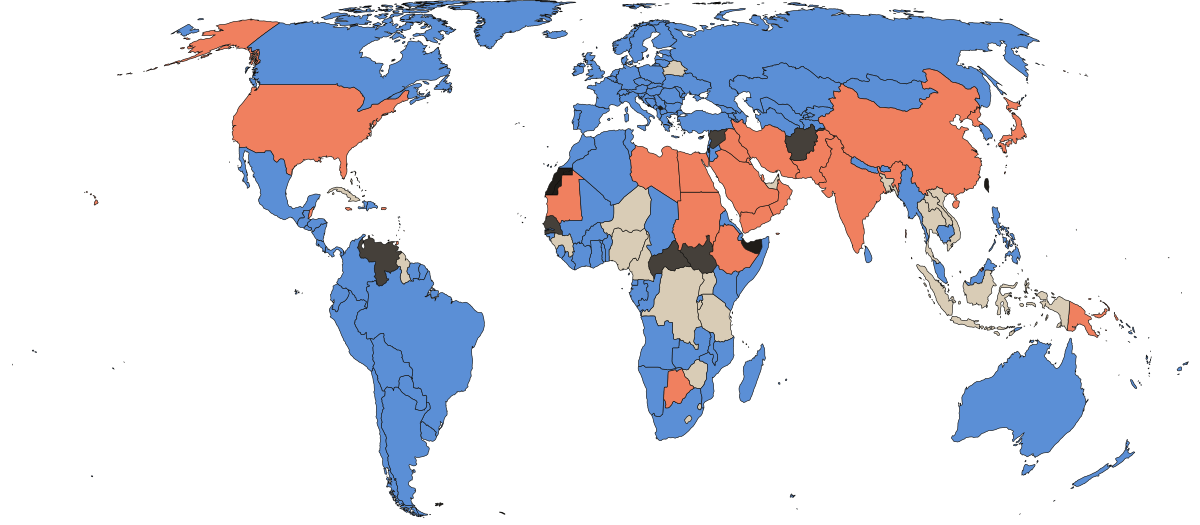
The UN General Assembly has voted ten times on a resolution calling on all states to establish a moratorium on executions. The most recent vote took place on December 17, 2024. It passed 130 to 32, with 22 abstentions, up from 104 to 54 in 2007. The resolution is non-binding. The next vote is expected in December 2026.
- Yes
- 130
- No
- 32
- Abstained
- 22
- Didn't vote
- 9
Adopted: it needed more yes votes than no votes, and abstentions count for neither side.
- Yes
- No
- Abstained
- Didn't vote
- Not a UN member
Which countries voted against?
The 32 countries that voted no in December 2024 included the United States, China, India, Japan, Iran, Saudi Arabia, Egypt, Singapore, Pakistan and North Korea. All 32 also voted no in 2007. No country that supported the resolution in 2007 opposed it in 2024.
 United States
 Bahrain
 Barbados
 Belize
 Botswana
 Brunei
 China
 Egypt
 Ethiopia
 India
 Iran
 Iraq
 Jamaica
 Japan
 Kuwait
 Libya
 Maldives
 Mauritania
 North Korea
 Oman
 Pakistan
 Papua New Guinea
 Qatar
 Saint Kitts and Nevis
 Saint Lucia
 Saint Vincent and the Grenadines
 Saudi Arabia
 Singapore
 Sudan
 Tonga
 Trinidad and Tobago
 Yemen
How did the big powers vote?
How has the vote changed since 2007?
The Assembly first adopted the resolution on December 18, 2007, by 104 to 54, with 29 abstentions. Support has risen at every vote except 2016, when it stayed at 117. The ten results: 104 yes in 2007, 106 in 2008, 109 in 2010, 111 in 2012, 117 in 2014, 117 in 2016, 121 in 2018, 123 in 2020, 125 in 2022, and 130 in 2024. Opposition fell from 54 to 32 over the same period, though it rose in 2016 and 2020.
Since 2007, nine countries moved from no to yes, including Malaysia, Chad, Jordan and Mongolia. Another 16 moved from abstaining to yes, including South Korea, Kenya, Ghana, Morocco and Zambia. Nine countries moved from no to abstaining, among them Indonesia, Bangladesh, Thailand and Nigeria. No country that voted yes in 2007 voted no in 2024.
- Yes
- No
- Abstained
- Didn't vote
What do supporters and opponents say?
Italy's ambassador Maurizio Massari introduced the 2024 text in the Third Committee on November 18, 2024, on behalf of the 44 members of the Inter-Regional Task Force. He said "the abolition of the death penalty is not a matter of 'culture' or 'tradition'" and spoke of "a growing global momentum, with a universal character." Australia told the committee the resolution "simply calls upon member states to establish a moratorium."
Countries that vote no generally frame the death penalty as a matter of national sovereignty and criminal justice. Singapore's ambassador Burhan Gafoor told the General Assembly on December 17, 2024 that "every country has the sovereign right to determine its own criminal justice system." He said Article 6(2) of the International Covenant on Civil and Political Rights "allows for the use of the death penalty for 'the most serious crimes.'" In 2016, Qatar, speaking also for Kuwait, Oman and Saudi Arabia, said they voted no because the issue was first and foremost a criminal justice matter, according to the UN's meeting summary.
Singapore led an amendment, first tabled by 38 countries, adding a paragraph that "reaffirms the sovereign right of all countries to develop their own legal systems." Singapore said it was "an integral part of the resolution." The European Union, whose members voted against it, said "the Charter does not refer to any 'sovereign right' of States." The Third Committee adopted the amendment on November 18, 2024, by 105 to 65, with 13 abstentions.
Which countries changed their vote?
Malaysia voted no from 2007 to 2016, then switched to yes in 2018 after the Pakatan Harapan government decided in October 2018 to abolish the death penalty for all crimes. In 2023 Malaysia ended the mandatory death penalty but kept it as a discretionary option.
South Korea abstained from 2007 to 2018, then voted yes starting in 2020. The Justice Ministry cited South Korea's image as a country that has in practice abolished the penalty, with no executions since 1997.
Some countries moved the other way. The Philippines voted yes from 2007 to 2014, abstained in 2016 and 2018 while President Rodrigo Duterte sought to reinstate the death penalty, and returned to yes in 2020. In 2024, Mauritania and Papua New Guinea moved from abstaining to no, and Uganda and Guinea moved from yes to abstaining.
Abstained→Yes16
 Bhutan
 Djibouti
 Equatorial Guinea
 Eritrea
 Fiji
 Gambia
 Ghana
 Kenya
 Lebanon
 Liberia
 Malawi
 Morocco
 Sierra Leone
 South Korea
 Togo
 Zambia
No→Yes9
 Antigua and Barbuda
 Chad
 Jordan
 Malaysia
 Mongolia
 Myanmar
 Solomon Islands
 Somalia
 Suriname
Yes→Abstained1
 Burundi
Unchanged: 101 yes both times, 12 abstained both times, 32 no both times. Countries that didn't vote on one of the two, or weren't members yet, are left out.
Does the resolution stop executions?
No. General Assembly resolutions are non-binding. They express the position of the membership but do not create legal obligations.
According to Amnesty International, at least 1,518 people were executed in 15 countries in 2024, up 32% from 2023. In 2025 the figure rose to at least 2,707 in 17 countries, the highest Amnesty has recorded since 1981. Iran accounted for about 80% of the 2025 total. These figures exclude China, which Amnesty calls "the world's leading executioner" but whose numbers are a state secret.
According to Amnesty, 113 countries had fully abolished the death penalty by the end of 2024. As of October 22, 2026, the Third Committee had not voted on a 2026 draft. A plenary vote is expected in December 2026.
How did each region vote?
In Europe, 46 of 47 members voted yes and Belarus abstained. In Africa, 33 of 54 members voted yes and 6 voted no. In the Americas, 21 of 35 voted yes and 8 voted no. In Asia, 15 of 29 voted yes and 8 voted no. In the Middle East, 4 of 14 voted yes and 8 voted no. In Oceania, 11 of 14 voted yes and 2 voted no.
- Europe47 countries 46 yes0 no1 abstained
- Americas35 countries 21 yes8 no3 abstained
- Asia29 countries 15 yes8 no5 abstained
- Oceania14 countries 11 yes2 no0 abstained
- Middle East14 countries 4 yes8 no1 abstained
- Africa54 countries 33 yes6 no12 abstained
What did the resolution say?
- The resolution "calls upon all States to establish a moratorium on executions, with a view to abolishing the death penalty" (operative paragraph 2).
- It "reaffirms the sovereign right of all countries to develop their own legal systems, including determining appropriate legal penalties, in accordance with their international law obligations" (operative paragraph 1, added through a Singapore-led amendment).
- It asks states "to reduce the number of offences for which the death penalty may be imposed, including by considering removing the mandatory application of the death penalty" (operative paragraph 8(f)).
- It "calls upon States which have abolished the death penalty not to reintroduce it" (operative paragraph 9).
- The preamble states "there is no conclusive evidence of the deterrent value of the death penalty."
How did every country vote?
| Country | Region | Vote |
|---|---|---|
 Afghanistan | Asia | Didn't vote |
 Albania | Europe | Yes |
 Algeria | Africa | Yes |
 Andorra | Europe | Yes |
 Angola | Africa | Yes |
| Antigua and Barbuda | Americas | Yes |
 Argentina | Americas | Yes |
 Armenia | Europe | Yes |
 Australia | Oceania | Yes |
 Austria | Europe | Yes |
 Azerbaijan | Europe | Yes |
 Bahamas | Americas | Abstained |
| Bahrain | Middle East | No |
 Bangladesh | Asia | Abstained |
| Barbados | Americas | No |
 Belarus | Europe | Abstained |
 Belgium | Europe | Yes |
| Belize | Americas | No |
 Benin | Africa | Yes |
| Bhutan | Asia | Yes |
 Bolivia | Americas | Yes |
 Bosnia and Herzegovina | Europe | Yes |
| Botswana | Africa | No |
 Brazil | Americas | Yes |
| Brunei | Asia | No |
 Bulgaria | Europe | Yes |
 Burkina Faso | Africa | Yes |
| Burundi | Africa | Abstained |
 Cambodia | Asia | Yes |
 Cameroon | Africa | Abstained |
 Canada | Americas | Yes |
 Cape Verde | Africa | Yes |
 Central African Republic | Africa | Didn't vote |
| Chad | Africa | Yes |
 Chile | Americas | Yes |
| China | Asia | No |
 Colombia | Americas | Yes |
 Comoros | Africa | Abstained |
 Costa Rica | Americas | Yes |
 Côte d'Ivoire | Africa | Yes |
 Croatia | Europe | Yes |
 Cuba | Americas | Abstained |
 Cyprus | Europe | Yes |
 Czechia | Europe | Yes |
 Denmark | Europe | Yes |
| Djibouti | Africa | Yes |
 Dominica | Americas | Didn't vote |
 Dominican Republic | Americas | Yes |
 DR Congo | Africa | Abstained |
 Ecuador | Americas | Yes |
| Egypt | Africa | No |
 El Salvador | Americas | Yes |
| Equatorial Guinea | Africa | Yes |
| Eritrea | Africa | Yes |
 Estonia | Europe | Yes |
 Eswatini | Africa | Abstained |
| Ethiopia | Africa | No |
| Fiji | Oceania | Yes |
 Finland | Europe | Yes |
 France | Europe | Yes |
 Gabon | Africa | Yes |
| Gambia | Africa | Yes |
 Georgia | Europe | Yes |
 Germany | Europe | Yes |
| Ghana | Africa | Yes |
 Greece | Europe | Yes |
 Grenada | Americas | Didn't vote |
 Guatemala | Americas | Yes |
 Guinea | Africa | Abstained |
 Guinea-Bissau | Africa | Yes |
 Guyana | Americas | Abstained |
 Haiti | Americas | Yes |
 Honduras | Americas | Yes |
 Hungary | Europe | Yes |
 Iceland | Europe | Yes |
| India | Asia | No |
 Indonesia | Asia | Abstained |
| Iran | Middle East | No |
| Iraq | Middle East | No |
 Ireland | Europe | Yes |
 Israel | Middle East | Yes |
 Italy | Europe | Yes |
| Jamaica | Americas | No |
| Japan | Asia | No |
| Jordan | Middle East | Yes |
 Kazakhstan | Asia | Yes |
| Kenya | Africa | Yes |
 Kiribati | Oceania | Yes |
| Kuwait | Middle East | No |
 Kyrgyzstan | Asia | Yes |
 Laos | Asia | Abstained |
 Latvia | Europe | Yes |
| Lebanon | Middle East | Yes |
 Lesotho | Africa | Abstained |
| Liberia | Africa | Yes |
| Libya | Africa | No |
 Liechtenstein | Europe | Yes |
 Lithuania | Europe | Yes |
 Luxembourg | Europe | Yes |
 Madagascar | Africa | Yes |
| Malawi | Africa | Yes |
| Malaysia | Asia | Yes |
| Maldives | Asia | No |
 Mali | Africa | Yes |
 Malta | Europe | Yes |
 Marshall Islands | Oceania | Didn't vote |
| Mauritania | Africa | No |
 Mauritius | Africa | Yes |
 Mexico | Americas | Yes |
 Micronesia | Oceania | Yes |
 Moldova | Europe | Yes |
 Monaco | Europe | Yes |
| Mongolia | Asia | Yes |
 Montenegro | Europe | Yes |
| Morocco | Africa | Yes |
 Mozambique | Africa | Yes |
| Myanmar | Asia | Yes |
 Namibia | Africa | Yes |
 Nauru | Oceania | Yes |
 Nepal | Asia | Yes |
 Netherlands | Europe | Yes |
 New Zealand | Oceania | Yes |
 Nicaragua | Americas | Yes |
 Niger | Africa | Abstained |
 Nigeria | Africa | Abstained |
| North Korea | Asia | No |
 North Macedonia | Europe | Yes |
 Norway | Europe | Yes |
| Oman | Middle East | No |
| Pakistan | Asia | No |
 Palau | Oceania | Yes |
 Panama | Americas | Yes |
| Papua New Guinea | Oceania | No |
 Paraguay | Americas | Yes |
 Peru | Americas | Yes |
 Philippines | Asia | Yes |
 Poland | Europe | Yes |
 Portugal | Europe | Yes |
| Qatar | Middle East | No |
 Republic of the Congo | Africa | Yes |
 Romania | Europe | Yes |
 Russia | Europe | Yes |
 Rwanda | Africa | Yes |
| Saint Kitts and Nevis | Americas | No |
| Saint Lucia | Americas | No |
| Saint Vincent and the Grenadines | Americas | No |
 Samoa | Oceania | Yes |
 San Marino | Europe | Yes |
 São Tomé and Príncipe | Africa | Yes |
| Saudi Arabia | Middle East | No |
 Senegal | Africa | Didn't vote |
 Serbia | Europe | Yes |
 Seychelles | Africa | Yes |
| Sierra Leone | Africa | Yes |
| Singapore | Asia | No |
 Slovakia | Europe | Yes |
 Slovenia | Europe | Yes |
| Solomon Islands | Oceania | Yes |
| Somalia | Africa | Yes |
 South Africa | Africa | Yes |
| South Korea | Asia | Yes |
 South Sudan | Africa | Didn't vote |
 Spain | Europe | Yes |
 Sri Lanka | Asia | Yes |
| Sudan | Africa | No |
| Suriname | Americas | Yes |
 Sweden | Europe | Yes |
 Switzerland | Europe | Yes |
 Syria | Middle East | Didn't vote |
 Tajikistan | Asia | Yes |
 Tanzania | Africa | Abstained |
 Thailand | Asia | Abstained |
 Timor-Leste | Asia | Yes |
| Togo | Africa | Yes |
| Tonga | Oceania | No |
| Trinidad and Tobago | Americas | No |
 Tunisia | Africa | Yes |
 Turkey | Middle East | Yes |
 Turkmenistan | Asia | Yes |
 Tuvalu | Oceania | Yes |
 Uganda | Africa | Abstained |
 Ukraine | Europe | Yes |
 United Arab Emirates | Middle East | Abstained |
 United Kingdom | Europe | Yes |
| United States | Americas | No |
 Uruguay | Americas | Yes |
 Uzbekistan | Asia | Yes |
 Vanuatu | Oceania | Yes |
 Venezuela | Americas | Didn't vote |
 Vietnam | Asia | Abstained |
| Yemen | Middle East | No |
| Zambia | Africa | Yes |
 Zimbabwe | Africa | Abstained |