
General Assembly vote · May 11, 1949
How countries voted on Israel's admission to the United Nations in 1949
The General Assembly admitted Israel to the United Nations on May 11, 1949, by 37 to 12, with 9 abstentions. Admission needed a two-thirds majority of the members voting yes or no. The 37 yes votes were about 75.5% of the 49 yes and no votes. All 58 member states took part in the roll call. Israel became the 59th member. The Security Council had recommended admission on March 4, 1949, by 9 to 1, with 1 abstention. The United Kingdom abstained.
- Yes
- 37
- No
- 12
- Abstained
- 9
Adopted: it needed two-thirds of the countries voting yes or no, and got 76%. Abstentions count for neither side.
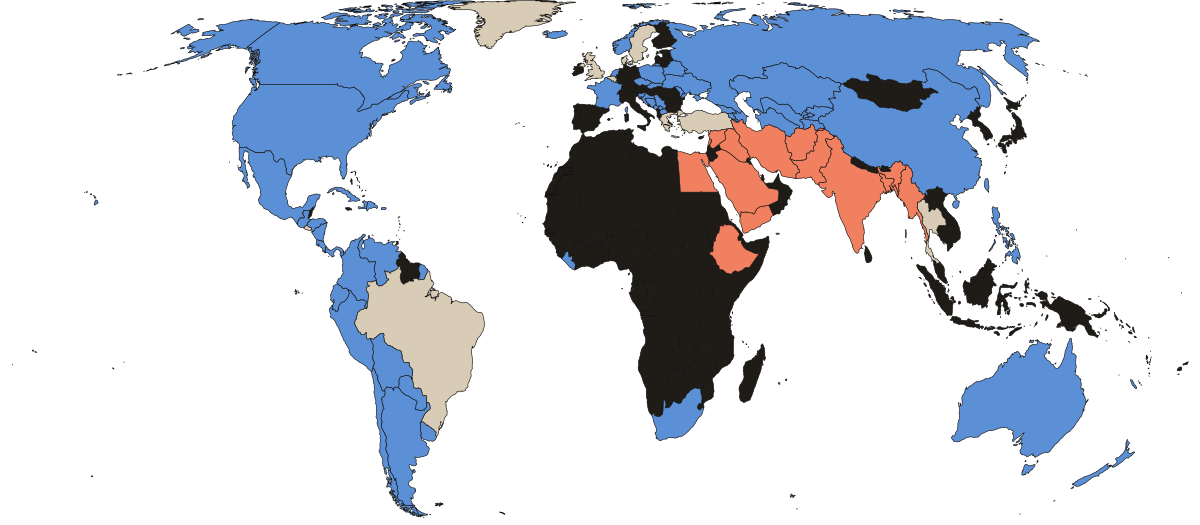
- Yes
- No
- Abstained
- Didn't vote
- Not a UN member
Which countries voted against?
The 12 countries that voted no were Afghanistan, Burma, Egypt, Ethiopia, India, Iran, Iraq, Lebanon, Pakistan, Saudi Arabia, Syria and Yemen. All 6 Arab states in the Assembly voted no. Arab delegates cited the displacement of Palestinian refugees and the lack of defined borders. According to the UN record, Egypt said the Jews had "systematically driven a whole nation out of their native land". Iraq said Palestine belonged to the people who inhabited it. Pakistan argued Israel had been created by the United Nations and therefore owed obligations to it.
How did the big powers vote?
How did Israel's admission come to a vote?
Israel declared independence on May 14, 1948. On November 29, 1948, exactly one year after the partition vote, Israel's foreign minister Moshe Shertok sent Israel's membership application to the UN Secretary-General. On December 17, 1948, the Security Council voted 5 to 1, with 5 abstentions. The application failed because it needed 7 yes votes. The United States, the Soviet Union, Argentina, Colombia and the Ukrainian SSR voted yes. Syria voted no. Belgium, Canada, China, France and the United Kingdom abstained.
On February 24, 1949, Israel asked the Security Council to consider the application again. On March 4, 1949, the Council recommended admission by 9 to 1, with 1 abstention. Egypt voted no and the United Kingdom abstained. Egypt's delegate Mahmoud Fawzi Bey called action on the application "an affront to humanity." The United Kingdom's Sir Terence Shone said his government needed clarification on Jerusalem and refugees, but would not use its veto to block admission.
The Ad Hoc Political Committee then held 10 meetings on Israel's positions on Jerusalem, refugees and the assassination of UN mediator Count Folke Bernadotte. Israel's representative Abba Eban answered questions on all three. On Jerusalem, Eban said: "My Government believes that the integration of the Jewish part of Jerusalem into the State of Israel is a healthy and natural process for which in due time we shall seek juridical confirmation." On refugees, he said Israel did not reject Resolution 194 but conditioned return on peaceful conditions. The committee approved the draft 33 to 11, with 13 abstentions, on May 9, 1949.
Which countries changed their vote after 1947?
Of the countries that abstained on the 1947 partition plan, 7 voted yes on admission: Argentina, Chile, China, Colombia, Honduras, Mexico and Yugoslavia. According to the UN record, Argentina's delegate Muñoz said Israel's government "exercised effective authority over a certain territory and its inhabitants". He said Argentina traditionally used that test for admission. Colombia's delegate Umaña Bernal said Israel's answers in committee had "cleared up a number of important points". Chile proposed the preamble clause that took note of Israel's statements in committee. Argentina and Colombia had already voted yes in the Security Council in December 1948.
In the other direction, 4 countries went from yes on partition to abstaining on admission: Belgium, Brazil, Denmark and Sweden. Belgium said Israel's statements had not offered adequate explanations on outstanding issues. According to the UN record, Sweden's delegate called Israel's report on the Bernadotte investigation "unsatisfactory, since it left too many questions unsettled and shed no light on the responsibility for the crime." Count Bernadotte was Swedish.
Cuba, which voted no on partition, voted yes on admission. According to the UN record, Cuba's delegate Zaydín said the Jerusalem, refugee and boundary questions could be discussed, but they "could not be allowed to determine a position" on admission. Greece and Turkey, which voted no on partition, abstained on admission. Ethiopia, which abstained on partition, voted no on admission. Burma, which was not yet a member in 1947, voted no. Siam, which was absent for the partition vote, abstained.
Abstained→Yes7
- Argentina
- Chile
- China
- Colombia
- Honduras
- Mexico
- Yugoslavia
Yes→Abstained4
- Belgium
- Brazil
- Denmark
- Sweden
No→Abstained2
- Greece
- Turkey
Abstained→No1
- Ethiopia
No→Yes1
- Cuba
Unchanged: 29 yes both times, 2 abstained both times, 10 no both times. Countries that didn't vote on one of the two, or weren't members yet, are left out.
Why did most countries vote yes, and what did Israel say?
The joint draft resolution was sponsored by Australia, Canada, Guatemala, Haiti, Panama, the United States and Uruguay. Supporters argued that Israel met the Charter's requirements and that outstanding disputes should not block admission.
According to the UN record, the Soviet delegate Soldatov said Israel should be admitted unconditionally. In committee, the Soviet delegate Jacob Malik said admission "should not be conditioned by any question arising from the discussion of the Palestine issue." The Soviet Union had recognised Israel on May 17, 1948, 3 days after independence.
According to the UN record, Poland's delegate Drohojowski said Israel should remember that Poland, the Soviet republics and the people's democracies "had been its true friends at the troubled time of its emergence." He hoped refugees would be treated "in a just and equitable manner."
In committee, Abba Eban answered questions on the refugees. According to the UN record, he said resettlement of refugees in neighbouring areas "should be considered as the main principle of solution" and that Israel "would be ready to make its own contribution." Asked whether Israel rejected paragraph 11 of Resolution 194, Eban answered: "No, my Government does not reject that or any other paragraph of the General Assembly resolution of 11 December."
Why did 12 countries vote no?
All 6 Arab members voted no: Egypt, Iraq, Lebanon, Saudi Arabia, Syria and Yemen. According to the UN record, Iraq's delegate said Palestine had been treated contrary to "the ancient principle whereby every country was allotted to the people who inhabited it." He called Israel's assurances on Jerusalem "vague and evasive" and said admission "would be the highest consummation of injustice". According to the UN record, Egypt's Mahmoud Fawzi Bey proposed an alternative preamble that began: "Considering that the applicant has invaded Palestine, driven its people from their homes, deprived them of their possessions, blocked their return, and refused even to pay compensation". Lebanon's Charles Malik said he could not conclude that refugees would be permitted to return or that Israel would not absorb the New City of Jerusalem.
Pakistan's Sir Mohammed Zafrulla Khan argued in committee that Israel had been created by the United Nations and therefore owed obligations to it. He said the Security Council recommendation had the concurring votes of only 4 permanent members, since the United Kingdom abstained. India, Iran, Afghanistan, Burma and Ethiopia voted no but gave no explanation in the records reviewed. India voted for Lebanon's motion to postpone admission to the next session.
How did each region vote?
In Europe, 11 of 16 members voted yes and 5 abstained. In the Americas, 20 of 22 voted yes and 2 abstained. In Asia, 2 of 7 voted yes, 4 voted no and 1 abstained. In the Middle East, 6 of 7 voted no and 1 abstained. In Oceania, both members voted yes. In Africa, 2 of 4 voted yes and 2 voted no.
- Europe16 countries 11 yes0 no5 abstained
- Americas22 countries 20 yes0 no2 abstained
- Asia7 countries 2 yes4 no1 abstained
- Oceania2 countries 2 yes0 no0 abstained
- Middle East7 countries 0 yes6 no1 abstained
- Africa4 countries 2 yes2 no0 abstained
What did the resolution say?
- The resolution noted Israel's declaration that it "unreservedly accepts the obligations of the United Nations Charter and undertakes to honour them from the day when it becomes a Member of the United Nations."
- The preamble recalled the partition resolution of November 29, 1947 (Resolution 181) and the resolution of December 11, 1948 (Resolution 194, on refugees and Jerusalem).
- The preamble took "note of the declarations and explanations made by the representative of the Government of Israel before the ad hoc Political Committee in respect of the implementation of the said resolutions."
- Acting under Article 4 of the Charter, the resolution decided that Israel "is a peace-loving State which accepts the obligations contained in the Charter and is able and willing to carry out those obligations" and decided "to admit Israel to membership in the United Nations."
How did every country vote?
| Country | Region | Vote |
|---|---|---|
| Afghanistan | Asia | No |
| Argentina | Americas | Yes |
| Australia | Oceania | Yes |
| Belgium | Europe | Abstained |
| Bolivia | Americas | Yes |
| Brazil | Americas | Abstained |
| Burma | Asia | No |
| Byelorussian SSR | Europe | Yes |
| Canada | Americas | Yes |
| Chile | Americas | Yes |
| China | Asia | Yes |
| Colombia | Americas | Yes |
| Costa Rica | Americas | Yes |
| Cuba | Americas | Yes |
| Czechoslovakia | Europe | Yes |
| Denmark | Europe | Abstained |
| Dominican Republic | Americas | Yes |
| Ecuador | Americas | Yes |
| Egypt | Africa | No |
| El Salvador | Americas | Abstained |
| Ethiopia | Africa | No |
| France | Europe | Yes |
| Greece | Europe | Abstained |
| Guatemala | Americas | Yes |
| Haiti | Americas | Yes |
| Honduras | Americas | Yes |
| Iceland | Europe | Yes |
| India | Asia | No |
| Iran | Middle East | No |
| Iraq | Middle East | No |
| Lebanon | Middle East | No |
| Liberia | Africa | Yes |
| Luxembourg | Europe | Yes |
| Mexico | Americas | Yes |
| Netherlands | Europe | Yes |
| New Zealand | Oceania | Yes |
| Nicaragua | Americas | Yes |
| Norway | Europe | Yes |
| Pakistan | Asia | No |
| Panama | Americas | Yes |
| Paraguay | Americas | Yes |
| Peru | Americas | Yes |
| Philippines | Asia | Yes |
| Poland | Europe | Yes |
| Saudi Arabia | Middle East | No |
| Soviet Union | Europe | Yes |
| Sweden | Europe | Abstained |
| Syria | Middle East | No |
| Thailand | Asia | Abstained |
| Turkey | Middle East | Abstained |
| Ukrainian SSR | Europe | Yes |
| Union of South Africa | Africa | Yes |
| United Kingdom | Europe | Abstained |
| United States | Americas | Yes |
| Uruguay | Americas | Yes |
| Venezuela | Americas | Yes |
| Yemen | Middle East | No |
| Yugoslavia | Europe | Yes |