
General Assembly vote · November 3, 1950
How countries voted on Uniting for Peace in 1950
On November 3, 1950, the General Assembly voted 52 to 5, with 2 abstentions, to adopt the Uniting for Peace resolutions, 377 A, B and C (V). Resolution 377 A lets the Assembly meet in emergency special session within 24 hours if a veto prevents the Security Council from acting on a threat to peace. The five Soviet bloc states voted no. India and Argentina abstained. As of November 2026, the Assembly has held 11 emergency special sessions, from Suez in 1956 to Ukraine in 2022.
- Yes
- 52
- No
- 5
- Abstained
- 2
- Didn't vote
- 1
Adopted: it needed more yes votes than no votes, and abstentions count for neither side.
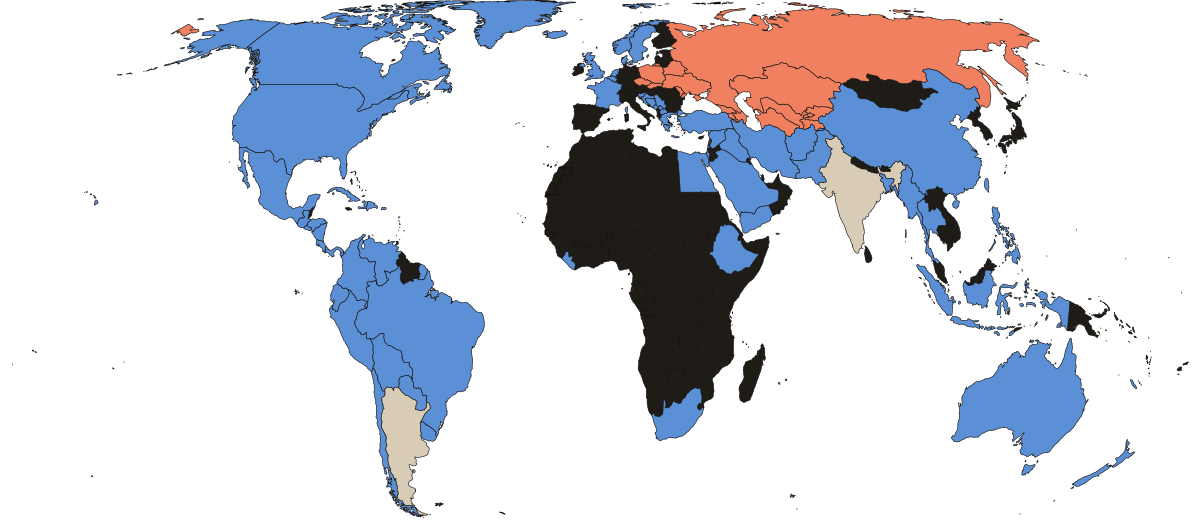
- Yes
- No
- Abstained
- Didn't vote
- Not a UN member
Which countries voted against?
The five countries that voted no were the Soviet Union, the Byelorussian SSR, the Ukrainian SSR, Czechoslovakia and Poland. Soviet Foreign Minister Andrei Vyshinsky argued that the resolution was a Charter amendment in disguise and that the veto was a lawful right under Article 27. He said the sponsors wanted a state of affairs "where a majority vote would suffice to legalize even measures which were illegal."
- Byelorussian SSR
- Czechoslovakia
- Poland
- Soviet Union
- Ukrainian SSR
How did the big powers vote?
Why did the Assembly pass Uniting for Peace?
In January 1950, the Soviet Union walked out of the Security Council after the Council refused to unseat the Nationalist Chinese representative. Soviet delegate Yakov Malik said the USSR "would not participate in the work of the Security Council until the representative of the Kuomintang group had been excluded." While the USSR was absent, the Council adopted its resolutions on the Korean War in June and July 1950.
Malik returned on August 1, 1950, when the USSR held the rotating presidency. The Soviet Union then vetoed two United States drafts. The first, on September 6, concerned Korea. The second, on September 12, proposed an investigation of alleged bombing of Chinese territory. US Secretary of State Dean Acheson responded on September 20 at the General Assembly. He said that "if the Security Council is not able to act because of the obstructive tactics of a permanent member, the Charter does not leave the United Nations impotent." He proposed emergency sessions on 24 hours' notice, a peace observation patrol, national units earmarked for UN service, and a committee on collective measures.
Seven states co-sponsored the draft: Canada, France, the Philippines, Turkey, the United Kingdom, the United States and Uruguay. The First Committee debated it from October 9 to 21. John Foster Dulles, a US delegate, told the plenary on November 1: "The First Committee has brought us a proposal which we can accept as a good policy of insurance against a third world war."
How has the resolution been used, and what are its limits?
The Assembly has convened 11 emergency special sessions under or alongside Uniting for Peace. The first two opened within days of each other in November 1956, one on the Suez crisis and one on Soviet troops in Hungary. The Suez session produced UNEF, the first armed UN peacekeeping force. Later sessions addressed crises in Lebanon (1958), the Congo (1960), the Middle East (1967), Afghanistan (1980), Palestine (1980), Namibia (1981), the Golan Heights (1982), occupied East Jerusalem (opened 1997), and Ukraine (opened 2022). The last two were still open as of November 19, 2026.
In April 2022, the Assembly adopted resolution 76/262, known as the veto initiative, without a vote. It requires the Assembly President to convene a debate within 10 working days of any Security Council veto, unless an emergency special session is meeting on the same situation. As of November 19, 2026, 16 stand-alone veto-initiative debates have been held. The latest, on November 10, 2026, concerned Western Sahara.
The Assembly can only recommend, not compel. The International Court of Justice held in its 1962 advisory opinion on Certain Expenses that "it is only the Security Council which can require enforcement by coercive action against an aggressor." Every Assembly-created force since 1950 has relied on the consent of the host state. In February 1951, resolution 498 (V) cited the Council's "lack of unanimity" and called on all states "to continue to lend every assistance to the United Nations action in Korea."
- Uniting for Peace, 1950Nov 1950 52 yes5 no2 abstained
- Suez ceasefire, 1956Nov 1956 64 yes5 no6 abstained
- Soviet troops in Hungary, 1956Nov 1956 50 yes8 no15 abstained
- Soviet troops in Afghanistan, 1980Jan 1980 104 yes18 no18 abstained
- Namibia, 1981Sep 1981 117 yes0 no25 abstained
- Golan Heights, 1982Feb 1982 86 yes21 no34 abstained
- Status of Jerusalem, 2017Dec 2017 128 yes9 no35 abstained
- Aggression against Ukraine, 2022Mar 2022 141 yes5 no35 abstained
- Ceasefire in Gaza, 2023Dec 2023 153 yes10 no23 abstained
Who voted no in 1950, and how have positions changed?
The Soviet bloc cast all 5 no votes. Soviet Foreign Minister Andrei Vyshinsky said the resolution bypassed the Charter's amendment procedure. He said: "There can be no two opinions regarding its illegality." US Secretary of State Dean Acheson cited the Assembly's powers under "Articles 10, 11 and 14" of the Charter.
The United Kingdom and France voted yes in 1950 but voted against sending Suez to the Assembly in 1956. The Soviet Union voted no in 1950 but requested the 1967 emergency special session on the Middle East. The United States voted against resolution ES-10/19 on Jerusalem in December 2017. It passed 128 to 9, with 35 abstentions. US Ambassador Nikki Haley said: "The United States will remember this day, in which it was singled out for attack in the General Assembly for the very act of exercising our right as a sovereign nation."
In February 2022, Russia voted against sending the Ukraine question to the Assembly. Russian Ambassador Vassily Nebenzia said Russia did so "because its authors proposed that it be placed on record that the Security Council is unable to uphold its primary responsibility for maintaining international peace and security." Assembly President Abdulla Shahid said the session was "rooted in the Charter and mandated in resolution 377 A (V)." In February 2025, the United States and Russia voted against resolution ES-11/7 on Ukraine. It passed 93 to 18, with 65 abstentions.
How did each region vote?
In Europe, 11 of 16 members voted yes and 5 voted no. All 5 no votes in Europe came from the Soviet bloc. In the Americas, 21 of 22 voted yes and Argentina abstained. In Asia, 7 of 8 voted yes and India abstained. In the Middle East, 7 of 8 voted yes and Lebanon was absent. In Africa, all 4 members voted yes. In Oceania, both members voted yes.
- Europe16 countries 11 yes5 no0 abstained
- Americas22 countries 21 yes0 no1 abstained
- Asia8 countries 7 yes0 no1 abstained
- Oceania2 countries 2 yes0 no0 abstained
- Middle East8 countries 7 yes0 no0 abstained
- Africa4 countries 4 yes0 no0 abstained
What did the resolution say?
- The resolution provides that "if the Security Council, because of lack of unanimity of the permanent members, fails to exercise its primary responsibility for the maintenance of international peace and security," the Assembly "shall consider the matter immediately with a view to making appropriate recommendations to Members for collective measures, including in the case of a breach of the peace or act of aggression the use of armed force when necessary" (section A, paragraph 1).
- It allows emergency special sessions "within twenty-four hours of the request therefor," called by the Security Council on the vote of any seven members or by a majority of UN members (section A, paragraph 1). Since the Security Council grew to 15 members in 1965, the Assembly's rules of procedure require the votes of any 9 Council members.
- Section B of resolution 377 A created a 14-member Peace Observation Commission to report on threats to peace in any area where international tension exists.
- Section C of resolution 377 A asked each member state to earmark national armed forces units trained and organized for prompt service as UN units.
- Section D of resolution 377 A created a 14-member Collective Measures Committee to study methods that could be used to maintain and strengthen international peace.
- Resolution 377 C recommended that the five permanent members "meet and discuss" their differences.
How did every country vote?
| Country | Region | Vote |
|---|---|---|
| Afghanistan | Asia | Yes |
| Argentina | Americas | Abstained |
| Australia | Oceania | Yes |
| Belgium | Europe | Yes |
| Bolivia | Americas | Yes |
| Brazil | Americas | Yes |
| Burma | Asia | Yes |
| Byelorussian SSR | Europe | No |
| Canada | Americas | Yes |
| Chile | Americas | Yes |
| China (Republic of China delegation) | Asia | Yes |
| Colombia | Americas | Yes |
| Costa Rica | Americas | Yes |
| Cuba | Americas | Yes |
| Czechoslovakia | Europe | No |
| Denmark | Europe | Yes |
| Dominican Republic | Americas | Yes |
| Ecuador | Americas | Yes |
| Egypt | Africa | Yes |
| El Salvador | Americas | Yes |
| Ethiopia | Africa | Yes |
| France | Europe | Yes |
| Greece | Europe | Yes |
| Guatemala | Americas | Yes |
| Haiti | Americas | Yes |
| Honduras | Americas | Yes |
| Iceland | Europe | Yes |
| India | Asia | Abstained |
| Indonesia | Asia | Yes |
| Iran | Middle East | Yes |
| Iraq | Middle East | Yes |
| Israel | Middle East | Yes |
| Lebanon | Middle East | Didn't vote |
| Liberia | Africa | Yes |
| Luxembourg | Europe | Yes |
| Mexico | Americas | Yes |
| Netherlands | Europe | Yes |
| New Zealand | Oceania | Yes |
| Nicaragua | Americas | Yes |
| Norway | Europe | Yes |
| Pakistan | Asia | Yes |
| Panama | Americas | Yes |
| Paraguay | Americas | Yes |
| Peru | Americas | Yes |
| Philippines | Asia | Yes |
| Poland | Europe | No |
| Saudi Arabia | Middle East | Yes |
| Soviet Union | Europe | No |
| Sweden | Europe | Yes |
| Syria | Middle East | Yes |
| Thailand | Asia | Yes |
| Turkey | Middle East | Yes |
| Ukrainian SSR | Europe | No |
| Union of South Africa | Africa | Yes |
| United Kingdom | Europe | Yes |
| United States | Americas | Yes |
| Uruguay | Americas | Yes |
| Venezuela | Americas | Yes |
| Yemen | Middle East | Yes |
| Yugoslavia | Europe | Yes |