
UN voting record · Europe
 How Austria votes at the UN
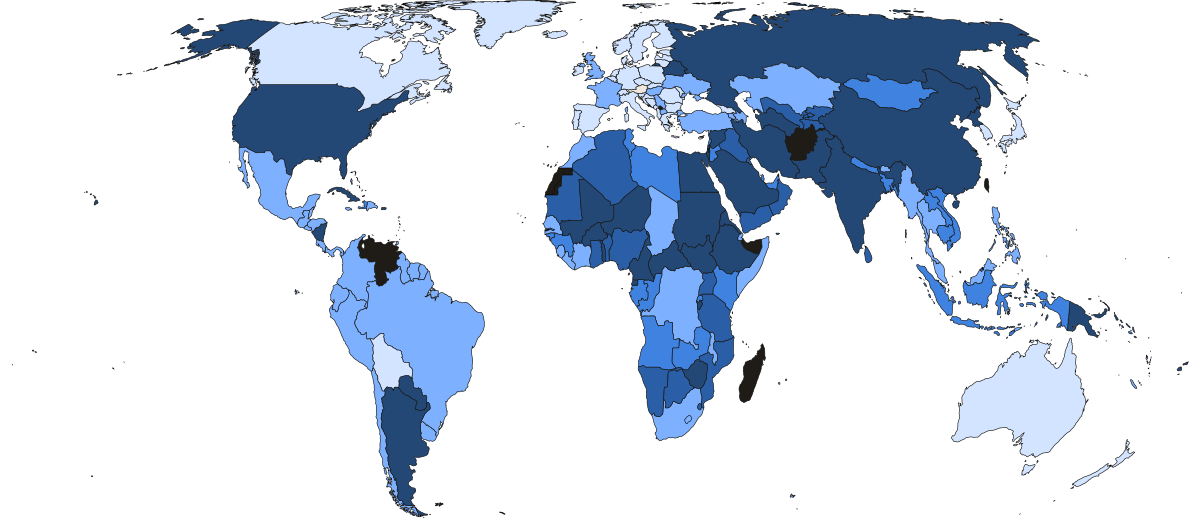
Austria votes with its EU partners on most issues but breaks from them on nuclear disarmament. In 2025 it agreed with Ireland on 99% of recorded votes (votes where each country's choice is listed) and with Germany on 95%. Agreement with the United States fell from 64% in 2024 to 20% in 2025 because the United States voted no on 174 of 192 recorded votes. Austria voted yes on the nuclear weapons ban treaty resolution and on the June 2025 Gaza ceasefire call. It won a 2027-28 Security Council seat.
 With Ireland
 With Germany
 With the US
 With Russia
- Under 83%
- 83–84%
- 84–85%
- 85–92%
- Over 92%
- Austria
- No vote or not a member
Share of recorded General Assembly votes on which Austria and each country voted the same way, 2025.
Why does Austria vote for the nuclear weapons ban?
Austria hosted the Vienna Conference on the Humanitarian Impact of Nuclear Weapons in December 2014, with 158 states attending. At the conference Austria presented the Austrian Pledge, later renamed the Humanitarian Pledge. It called on states parties to the Non-Proliferation Treaty to "identify and pursue effective measures to fill the legal gap for the prohibition and elimination of nuclear weapons." By December 2015, 120 states had backed it.
The Treaty on the Prohibition of Nuclear Weapons was adopted on 7 July 2017 by 122 to 1, with 1 abstention. Austria signed on 20 September 2017 and ratified on 8 May 2018. The treaty entered into force on 22 January 2021. Alexander Kmentt, who led Austria's disarmament department, was elected president of the first meeting of states parties, held at the Austria Center Vienna in June 2022.
In 2025, 12 of Austria's 17 breaks from the EU majority were on nuclear weapons or disarmament texts. Austria voted yes on the ban treaty resolution (119 to 45, with 12 abstentions), while 23 EU members voted no. Austria's 2025 coalition agreement states: "Austria remains a pioneer in disarmament, especially in advancing the global ban on nuclear weapons and the international regulation of autonomous weapons systems." NATO's North Atlantic Council said on 20 September 2017: "The ban treaty is at odds with the existing non-proliferation and disarmament architecture." NATO's North Atlantic Council said on 15 December 2020 that the treaty "will not result in the elimination of a single nuclear weapon". As of 14 November 2026, 75 states are parties to the treaty.
- Dec 2016Negotiations on a nuclear weapons ban, 2016113 yes, 35 no, 13 abstainedYes
- Dec 2025Treaty on the Prohibition of Nuclear Weapons, 2025119 yes, 45 no, 12 abstainedYes
- Dec 2025Humanitarian consequences of nuclear weapons, 2025135 yes, 11 no, 33 abstainedYes
- Dec 2025Ethical imperatives for a nuclear-weapon-free world, 2025129 yes, 41 no, 9 abstainedYes
How does Austria vote on Israel and Gaza?
Austria voted no on Gaza calls for a humanitarian truce in October 2023 (120 to 14, with 45 abstentions) and a ceasefire in December 2023 (153 to 10, with 23 abstentions). Chancellor Karl Nehammer said on 28 October 2023 that Austria could not support a resolution that does not "name the terrorist organisation Hamas", condemn "Hamas's atrocities of 7 October" or affirm "Israel's right to self-defence under international law". In December, Austria proposed adding that the hostages were "held by Hamas and other groups". Pakistan's ambassador Munir Akram, speaking for the Arab countries and the Organization of Islamic Cooperation, said the amendments would "once again condemn only one side but exonerate the other". Austria's amendment got 89 to 61, with 20 abstentions, but lacked the two-thirds majority needed.
On 10 May 2024, Palestine's ambassador Riyad Mansour said peace "requires the recognition of our rights, not their continued denial". Austria's ambassador Alexander Marschik said: "A merely symbolic recognition of Palestine will not bring about the changes to which Palestinians aspire and that they deserve." Austria abstained on Palestine's UN membership bid (143 to 9, with 25 abstentions).
Austria voted yes on a Gaza ceasefire call in December 2024 and again in June 2025 (149 to 12, with 19 abstentions). Foreign Minister Beate Meinl-Reisinger told the General Assembly in September 2025 that Austria is a friend of the people of Israel "not only because of our own historical responsibility", but that the actions of the Israeli government "break my heart". As of November 2026, Austria has not recognized Palestine.
- Oct 2023Humanitarian truce in Gaza, October 2023120 yes, 14 no, 45 abstainedNo
- Dec 2023Ceasefire in Gaza, December 2023153 yes, 10 no, 23 abstainedNo
- May 2024Palestine's UN membership bid, May 2024143 yes, 9 no, 25 abstainedAbstained
- Sep 2024ICJ advisory opinion on the occupation, September 2024124 yes, 14 no, 43 abstainedAbstained
- Jun 2025Ceasefire in Gaza, June 2025149 yes, 12 no, 19 abstainedYes
- Sep 2025New York Declaration on a two-state solution, September 2025142 yes, 10 no, 12 abstainedYes
Does Austria vote with the US?
Austria agreed with the United States on 64% of recorded votes in 2024 and 20% in 2025. The drop happened because the United States voted no on 174 of the Assembly's 192 recorded votes in 2025, up from 51 of 95 in 2024. Austria ranked 50th of 189 countries by agreement with the United States in 2025.
Austria's agreement with Russia fell from a high of 86% in 1992 and 1993 to a low of 40% in 2023. It rose to 70% in 2025, when the Assembly held 192 recorded votes, up from 95 in 2024. Agreement with China was 80% in 2025, up from 56% in 2023 and 2024. Agreement with the United Kingdom rose from 82% in 2024 to 89% in 2025. Agreement with France was 91% in 2025.
Austria's ambassador Alexander Marschik said on 28 February 2022, before the vote on Russia's aggression against Ukraine: "Austria is not part of any military alliance. We rely for our security on the respect and implementation of international law, treaties and custom, including humanitarian law." Austria voted yes on the March 2022 aggression resolution (141 to 5, with 35 abstentions) and co-sponsored the February 2025 Ukrainian-led peace text (93 to 18, with 65 abstentions). Foreign Minister Alexander Schallenberg said in parliament on 15 May 2024: "Neutrality policy does not mean indifference. Neutral does not mean we don't care."
Which countries vote most like Austria?
Compare with any country →Austria's closest match in 2025 is Ireland at 99% agreement. Andorra, Liechtenstein, Malta and San Marino follow at 98%. Austria's least alike countries are the United States (20%), Israel (38%), Argentina (45%) and Nauru (59%).
 Andorra
 Liechtenstein
 Malta
 San Marino
 Cyprus
 Israel
 Argentina
 Nauru
How did Austria vote on the big votes?
| Vote | Austria | United States | Russia | China | Result |
|---|---|---|---|---|---|
| A just and lasting peace in UkraineFebruary 24, 2025 | Yes | No | No | Abstained | Adopted 93–18 |
| Russia's invasion of UkraineMarch 2, 2022 | Yes | Yes | No | Abstained | Adopted 141–5 |
| Demanding a permanent ceasefire in GazaJune 12, 2025 | Yes | No | Yes | Yes | Adopted 149–12 |
| Palestine's bid for UN membershipMay 10, 2024 | Abstained | No | Yes | Yes | Adopted 143–9 |
| The treaty banning nuclear weaponsDecember 1, 2025 | Yes | No | No | No | Adopted 119–45 |
Where does Austria sit?
Austria sits in the middle of the strip, next to Bosnia and Herzegovina, Moldova and Ireland, between Ireland and Germany.
 China
 United Kingdom
 Switzerland
 Hungary