
UN voting record · Europe
 How Ireland votes at the UN
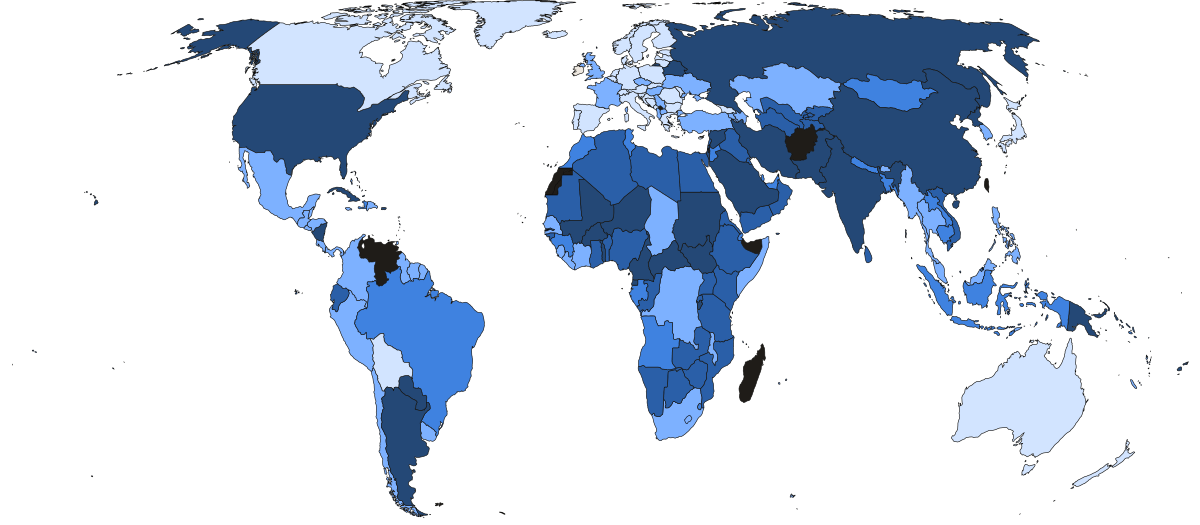
Ireland votes with its EU partners on most issues but breaks from them on nuclear disarmament. In 2025 it agreed with Austria on 99% of recorded votes (votes where each country's choice is listed), with the United Kingdom on 89% and with the United States on 20%. The United States voted no on 174 of 192 recorded votes in 2025. Ireland voted yes on the 2023 and 2025 Gaza ceasefire calls and on Palestine's 2024 UN membership bid.
- 99%
 With Austria
- 89%
 With United KingdomIn 2024: 81%
- 20%
 With the USIn 2024: 61%
- 80%
 With ChinaIn 2024: 60%
- Under 83%
- 83–85%
- 85–86%
- 86–93%
- Over 93%
- Ireland
- No vote or not a member
Share of recorded General Assembly votes on which Ireland and each country voted the same way, 2025.
How does Ireland vote and act on Gaza and Palestine?
Ireland voted yes on each of these Gaza and Palestine votes: the October 2023 call for a humanitarian truce (120 to 14, with 45 abstentions), the December 2023 ceasefire call (153 to 10, with 23 abstentions), the May 2024 vote backing Palestine's UN membership (143 to 9, with 25 abstentions), the September 2024 text on the ICJ advisory opinion (124 to 14, with 43 abstentions), the June 2025 ceasefire resolution (149 to 12, with 19 abstentions) and the New York Declaration on a two-state solution (142 to 10, with 12 abstentions). Ireland co-sponsored the membership and ceasefire texts.
Ireland's then ambassador Fergal Mythen told the Assembly on 27 October 2023: "Ireland unreservedly condemns the heinous and barbaric acts by Hamas on 7 October." He added: "Israel has the right to defend itself but must comply with international law, in particular international humanitarian law."
Ireland recognized Palestine on 28 May 2024. Taoiseach Simon Harris said Ireland acted "to keep the hope of that two-state solution alive." Israeli Foreign Minister Israel Katz recalled Israel's ambassador and said Ireland and Norway were sending the message that "terrorism pays." In December 2024, Ireland decided to intervene in South Africa's genocide case against Israel at the ICJ, and Israel announced it would close its embassy in Dublin. Foreign Minister Gideon Sa'ar said Ireland "has crossed every red line in its relations with Israel." Harris said: "Ireland is pro-peace, pro-human rights and pro-International law." Ireland filed on 6 January 2025. On 15 September 2026, an Irish law banning imports of goods from Israeli settlements took effect.
- Oct 2023Humanitarian truce in Gaza, October 2023120 yes, 14 no, 45 abstainedYes
- Dec 2023Ceasefire in Gaza, December 2023153 yes, 10 no, 23 abstainedYes
- May 2024Palestine's UN membership bid, May 2024143 yes, 9 no, 25 abstainedYes
- Sep 2024ICJ advisory opinion on the occupation, September 2024124 yes, 14 no, 43 abstainedYes
- Jun 2025Ceasefire in Gaza, June 2025149 yes, 12 no, 19 abstainedYes
- Sep 2025New York Declaration on a two-state solution, September 2025142 yes, 10 no, 12 abstainedYes
Why does Ireland vote apart from most of the EU on nuclear weapons?
Foreign Minister Frank Aiken brought draft resolutions to the Assembly from 1958 to 1961. His final text, resolution 1665, was adopted unanimously on 4 December 1961. It called for an agreement under which nuclear states would not hand over control of nuclear weapons and non-nuclear states would not manufacture or acquire them. When the resulting Nuclear Non-Proliferation Treaty opened for signature on 1 July 1968, Aiken was the first person to sign it, at the Moscow ceremony. Ireland was the first country to ratify.
Ireland was one of six core-group states that pushed for the Treaty on the Prohibition of Nuclear Weapons, alongside Austria, Brazil, Mexico, Nigeria and South Africa. Ireland ratified on 6 August 2020, the 75th anniversary of Hiroshima. Foreign Minister Simon Coveney said the treaty "honours the memory of the victims of nuclear weapons." In 2025 Ireland voted yes on the TPNW resolution (119 to 45, with 12 abstentions), while 23 other EU members voted no. NATO's North Atlantic Council said on 20 September 2017: "The ban treaty is at odds with the existing non-proliferation and disarmament architecture." Ireland is not a NATO member.
In 2025, 12 of Ireland's 14 breaks from the EU majority were on disarmament texts. Ireland voted yes on resolutions the EU majority rejected, including the ICJ nuclear-weapons follow-up and the "Ethical imperatives for a nuclear-weapon-free world" text. On Japan's "common roadmap" resolution, which most EU states supported, Ireland abstained. Its delegate said: "We do not accept the implication that some nuclear rhetoric or threats can be considered responsible."
- Dec 2016Negotiations on a nuclear weapons ban, 2016113 yes, 35 no, 13 abstainedYes
- Dec 2025Treaty on the Prohibition of Nuclear Weapons, 2025119 yes, 45 no, 12 abstainedYes
- Dec 2025Humanitarian consequences of nuclear weapons, 2025135 yes, 11 no, 33 abstainedYes
Who does Ireland vote with, and what is its wider UN role?
Ireland agreed with the United Kingdom on 89% of recorded votes in 2025 and with France on 92%. As an EU member, Ireland coordinates foreign policy with its partners under the Treaty on European Union. Its ambassador usually opens Assembly statements by aligning with the EU position, then adds national remarks.
Agreement with the United States fell from 61% in 2024 to 20% in 2025, mostly because the United States voted no on 174 of the Assembly's 192 recorded votes, which cut the average member's agreement with the United States from 46% to 14%. Ireland ranked 49th of 189 countries by agreement with the United States in 2025. On 24 February 2025, Ireland voted yes on the Ukrainian-led resolution on peace in Ukraine (93 to 18, with 65 abstentions), against the United States.
Taoiseach Micheál Martin told the Assembly on 26 September 2025: "Since Ireland joined in 1955, the United Nations has been the cornerstone of our foreign policy. There is no Member State more committed to its ideals." Ireland served on the Security Council in 1962, 1981 to 1982, 2001 to 2002 and 2021 to 2022. It was elected to the Human Rights Council for 2027 to 2029 on 13 October 2026. Ireland has served in UNIFIL, the UN peacekeeping force in Lebanon, since 1978. As of November 2026, the force's mandate ends on 31 December 2026. Private Seán Rooney was killed on 14 December 2022 when a mob fired on a UNIFIL convoy. Lebanon's military court convicted six people on 28 July 2025.
Which countries vote most like Ireland?
Compare with any country →Ireland's closest matches in 2025 are Austria, Malta, Andorra, Liechtenstein and San Marino, each at 99% agreement. They share EU membership or close alignment with EU positions. Its least alike countries are the United States (20%), Israel (37%), Argentina (44%) and Nauru (56%).
 Andorra
 Liechtenstein
 Malta
 San Marino
 Cyprus
 Israel
 Argentina
 Nauru
 Russia
How did Ireland vote on the big votes?
| Vote | Ireland | United States | United Kingdom | China | Result |
|---|---|---|---|---|---|
| Demanding a permanent ceasefire in GazaJune 12, 2025 | Yes | No | Yes | Yes | Adopted 149–12 |
| The New York Declaration on two statesSeptember 12, 2025 | Yes | No | Yes | Yes | Adopted 142–10 |
| Palestine's bid for UN membershipMay 10, 2024 | Yes | No | Abstained | Yes | Adopted 143–9 |
| The treaty banning nuclear weaponsDecember 1, 2025 | Yes | No | No | No | Adopted 119–45 |
| A just and lasting peace in UkraineFebruary 24, 2025 | Yes | No | Yes | Abstained | Adopted 93–18 |
Where does Ireland sit?
Ireland sits next to Austria, Andorra and Bosnia and Herzegovina on the strip, between Russia and the United Kingdom.
 Spain
 Norway
 France