Alliance · Club
OECD
Organisation for Economic Co-operation and Development
The Organisation for Economic Co-operation and Development is a club of 38 countries, most of them rich democracies. It was founded in 1961 as a successor to the body that ran Marshall Plan aid in Europe. Its headquarters are in Paris. The OECD collects data, runs peer reviews and sets standards on tax, trade, education and more. Its members have about 18% of the world's people and about 60% of its economy at market exchange rates (2025).

- Members
- 38
- Costa Rica joined last, in 2021
- Founded
- 1961
- Replaced the OEEC, founded in 1948
- Headquarters
- Paris
- Château de la Muette
- Candidates
- 8
- Romania, Bulgaria and Croatia closest
- Secretary-General
 Mathias Cormann
- Since June 2021, second term to 2031
Which countries are in the OECD?
The OECD has 38 members. Twenty countries signed the Convention on December 14, 1960 in Paris. It entered into force on September 30, 1961, replacing the Organisation for European Economic Co-operation, which had run Marshall Plan aid since 1948. The United States and Canada became full members for the first time.
Japan joined in 1964, Finland in 1969, Australia in 1971 and New Zealand in 1973. Mexico became the first Latin American member in 1994. After the Cold War, the Czech Republic, Hungary and Poland joined in 1995 and 1996. South Korea joined in 1996 and Slovakia in 2000. Chile, Slovenia, Israel and Estonia joined in 2010. Latvia, Lithuania and Colombia followed. Costa Rica became the 38th member on May 25, 2021. No country has joined since, and no country has ever left.
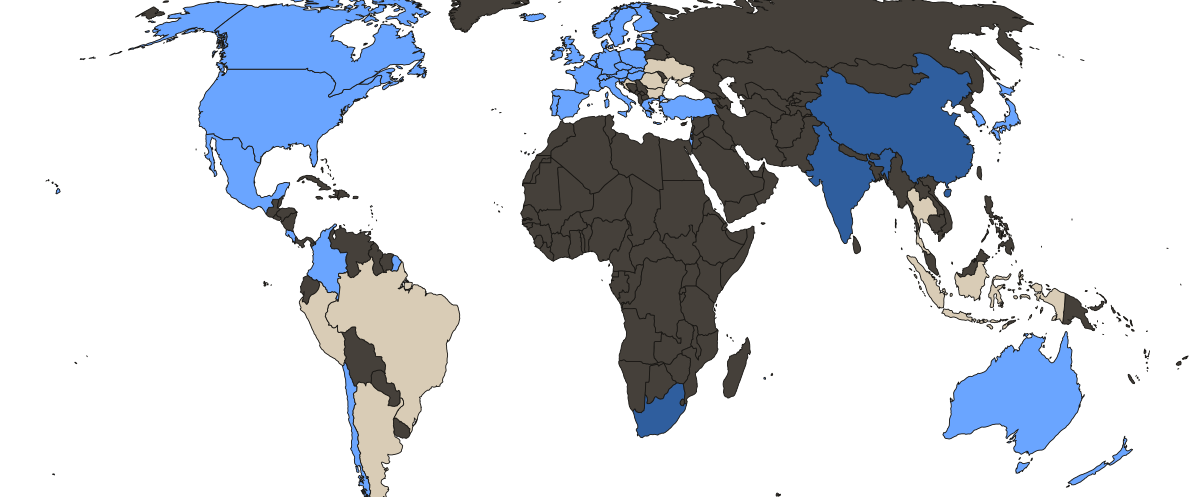
- Member
- Candidate
- Key partner
- Not a member
How the OECD grew
Countries that joined in each year, and the total after


 196119 founders
 196220
 196421
 196922
- 197123
 197324
 199425
 199526


 199629
 200030


 201034
 201635
 201836
 202037
 202138
All 38 members and the year each joined
- Australia1971
- Austria1961
- Belgium1961
- Canada1961
- Chile2010
- Colombia2020
- Costa Rica2021
- Czechia1995
- Denmark1961
- Estonia2010
- Finland1969
- France1961
- Germany1961
- Greece1961
- Hungary1996
- Iceland1961
- Ireland1961
- Israel2010
- Italy1962
- Japan1964
- Latvia2016
- Lithuania2018
- Luxembourg1961
- Mexico1994
- Netherlands1961
- New Zealand1973
- Norway1961
- Poland1996
- Portugal1961
- Slovakia2000
- Slovenia2010
- South Korea1996
- Spain1961
- Sweden1961
- Switzerland1961
- Turkey1961
- United Kingdom1961
- United States1961
Which countries want to join the OECD?
Eight countries are accession candidates. The OECD Council opened talks with six of them on January 25, 2022: Argentina, Brazil, Bulgaria, Croatia, Peru and Romania. Indonesia and Thailand entered the process in 2024. Each candidate is reviewed by about 25 committees. A unanimous Council vote is needed to invite a country in.
Romania is closest. It had 24 of 25 committee opinions by April 2026. The last, from the Trade Committee, was still outstanding in August 2026. Bulgaria had 18 or 19 of 25 done by mid-2026. Croatia had about 19 done. In March 2025, Croatian television reported that its Trade Committee vote had been postponed, largely because of objections from the United States. All three countries aimed for an invitation in 2026.
-
 Romania24 of 25 opinions
Romania is the closest candidate. Only the Trade Committee opinion was still missing in August 2026. That month, Romania's Social Democratic Party (PSD) called the delay "a political decision".
-
 Bulgaria18-19 of 25
Corporate governance, public governance and environment reviews remained in mid-2026. Bulgaria's target is an invitation in 2026.
-
 CroatiaAbout 19 of 25
In June 2026, five committees and one subcommittee still had to give opinions, and four regulations on state-owned enterprises were missing. In March 2025, Croatian television reported that the Trade Committee vote had been postponed, largely because of US objections. Croatian officials described it as a postponement.
-
 BrazilCandidate since 2022
Brazil is in the technical phase of the accession process. It is also one of the OECD's five Key Partners.
-
 PeruCandidate since 2022
Peru is in the technical phase of the accession process. It is reviewed by 24 committees.
-
 ArgentinaCandidate since 2022
Argentina submitted its Initial Memorandum in November 2025. Secretary-General Cormann called the bid "a marathon, not a sprint."
-
 IndonesiaCandidate since 2024
Indonesia submitted its Initial Memorandum in June 2025. It is also one of the OECD's five Key Partners.
-
 ThailandCandidate since 2024
Thailand submitted its Initial Memorandum in December 2025. In May 2026, its cabinet set a membership target of 2028.
-
 RussiaTerminated
Russia's accession talks opened after a 2007 decision and were postponed in 2014 over Crimea. The Council formally ended them on February 25, 2022.
-
 UkraineProspective member
The OECD Council recognized Ukraine as a prospective member in 2022. Ukraine is in an initial accession dialogue with the OECD, and the OECD has a liaison office in Kyiv.
What does the OECD do?
The OECD collects data, runs peer reviews and writes policy recommendations. The 2026 Ministerial Chair's Statement describes the OECD's work as combining "internationally comparable and transparent data, rigorous analysis and robust standards." It is not a military body and has no troops.
Its best-known project in education is PISA. The 2025 round, published on September 8, 2026, tested more than 760,000 students in 91 countries and economies. In tax, the OECD hosts the Inclusive Framework, where 136 jurisdictions agreed a 15% global minimum tax on large companies in October 2021. Its Anti-Bribery Convention has 46 parties. The OECD's core budget for 2026 is 238 million euros. The United States has the largest assessed share, 18% of that budget.
The aims of the Organisation for Economic Co-operation and Development ... shall be to promote policies designed: (a) to achieve the highest sustainable economic growth and employment and a rising standard of living in Member countries, while maintaining financial stability, and thus to contribute to the development of the world economy
More than 760,000 students tested in 91 countries and economies. Results published September 8, 2026, with science as the main focus.
136 jurisdictions agreed a 15% floor for companies with turnover above 750 million euros. The Inclusive Framework adopted a Side-by-Side Package on January 5, 2026.
Ukraine was invited to join in December 2025. Indonesia has formally asked to join.
Is the OECD a club of rich countries?
The OECD is mostly a club of rich countries, but not every member is rich. The OECD's members have about 60% of the world's economy at market exchange rates but only about 18% of its people. At purchasing power parity their share is about 40%. The richest member, Luxembourg, had a GDP per person of $148,247 in 2025. The poorest, Colombia, had $8,617.
Five current members have a GDP per person below $20,000: Colombia, Mexico, Chile, Turkey and Costa Rica. Three candidates, Croatia, Romania and Bulgaria, are already richer per person than those five members. The gap between the richest and poorest members is more than 17 to 1.
GDP per person in OECD countries, 2025
Full ranking →- Luxembourg$148,247
- Ireland$123,789
- Switzerland$117,191
- Iceland$98,783
- Norway$94,360
- United States$90,267
- Denmark$78,587
- Netherlands$73,264
- Australia$66,379
- Sweden$63,368
- Austria$63,180
- Germany$61,255
- Belgium$61,014
- Israel$60,899
- United Kingdom$57,741
- Finland$56,753
- Canada$55,796
- France$49,129
- New Zealand$48,749
- Italy$43,270
- Spain$38,595
- Slovenia$37,720
- South Korea$36,408
- Czechia$36,288
- Japan$36,119
- Estonia$34,636
- Lithuania$32,916
- Portugal$32,064
- Poland$28,510
- Slovakia$28,498
- Greece$27,041
- Latvia$26,116
- Hungary$25,850
- Costa Rica$19,162
- Turkey$18,676
- Chile$17,837
- Mexico$13,759
- Colombia$8,617
Who leads the OECD?
Mathias Cormann has been Secretary-General since June 1, 2021. The OECD Council renewed him by consensus for a second and final term in July 2025, running to 2031. He was born in 1970 in Eupen, in Belgium's German-speaking community. German was his first language, and he learned English only in 1993 on an exchange year in Norwich. He became an Australian citizen in 2000 and served as Australia's longest-serving finance minister from 2013 to 2020.
Cormann was chosen on March 12, 2021, narrowly beating Sweden's Cecilia Malmström. His predecessor was Ángel Gurría of Mexico, who led the OECD from 2006 to 2021. A different member chairs the OECD's annual Ministerial Council Meeting each year. Finland chaired in 2026. Czechia will chair in 2027, its first time.
The OECD's history
- 1948The OEEC is founded to run Marshall Plan aid in Western Europe
- 1960Twenty countries sign the Convention on the OECD in Paris
- 1961The OECD replaces the OEEC on September 30, with the US and Canada as full members
- 1964Japan joins, the first member from East Asia
- 1994Mexico joins, the first Latin American member
- 2010Chile, Slovenia, Israel and Estonia join in the same year
- 2021Costa Rica becomes the 38th member. Mathias Cormann takes office as Secretary-General
- 2022The Council opens accession talks with six candidates and terminates Russia's process
Is it in the OECD?
Short answers for the countries people ask about most.

Is China in the OECD?
NoChina is one of the OECD's five Key Partners. It is not a candidate for membership.

Is India in the OECD?
NoIndia is a Key Partner. The OECD Council welcomed a Strategic Framework for cooperation with India in June 2025.
Is Russia in the OECD?
NoRussia was never a member. Accession talks were halted in 2014 over Crimea and terminated on February 25, 2022. Its participation in OECD bodies was suspended on March 8, 2022.
Is Brazil in the OECD?
NoBrazil is both a Key Partner and an accession candidate. The Council opened talks in January 2022.

Is Singapore in the OECD?
NoSingapore is not a member or candidate. The OECD is in discussions to widen cooperation with Singapore.
Is Argentina in the OECD?
NoArgentina is an accession candidate. It submitted its Initial Memorandum in November 2025.
Is Indonesia in the OECD?
NoIndonesia is a Key Partner. It has been an accession candidate since 2024. It submitted its Initial Memorandum in June 2025.
Is Turkey in the OECD?
YesTurkey is a founding member. It deposited its ratification of the Convention on August 2, 1961.
Is Israel in the OECD?
YesIsrael has been a member since September 7, 2010.
Is Ukraine in the OECD?
NoUkraine was recognized as a prospective member in 2022. It is in an initial accession dialogue with the OECD. Formal accession talks have not opened.