Alliance · Open borders
Schengen Area
Schengen Area
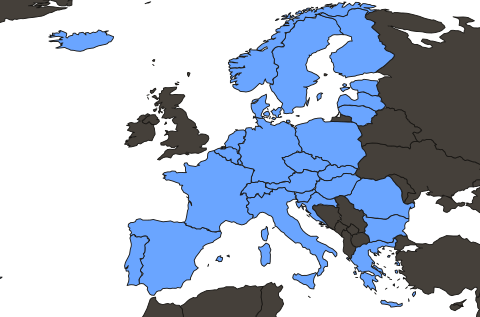
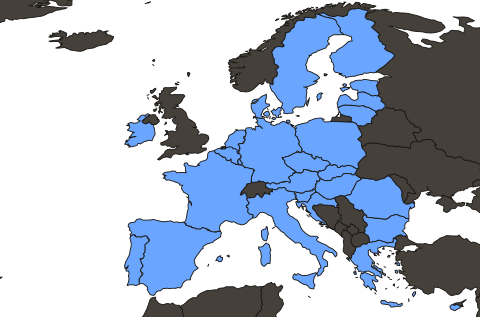
The Schengen Area is a zone of 29 European countries with no passport checks at their shared borders. It includes 25 of the 27 EU members plus Iceland, Norway, Switzerland and Liechtenstein. Ireland has an opt-out. Cyprus has not yet been admitted. Bulgaria and Romania completed their membership on January 1, 2025. The area has about 450 million people.

- Members
- 29
- 25 EU countries plus 4 non-EU
- Agreement signed
- 1985
- On a boat on the Moselle, Luxembourg
- Checks lifted
- 1995
- March 26, among the first 7 countries
- Latest members
- Bulgaria, Romania
- Land borders opened January 1, 2025
- Visitor limit
- 90 days
- In any rolling 180-day period
Which countries are in the Schengen Area?
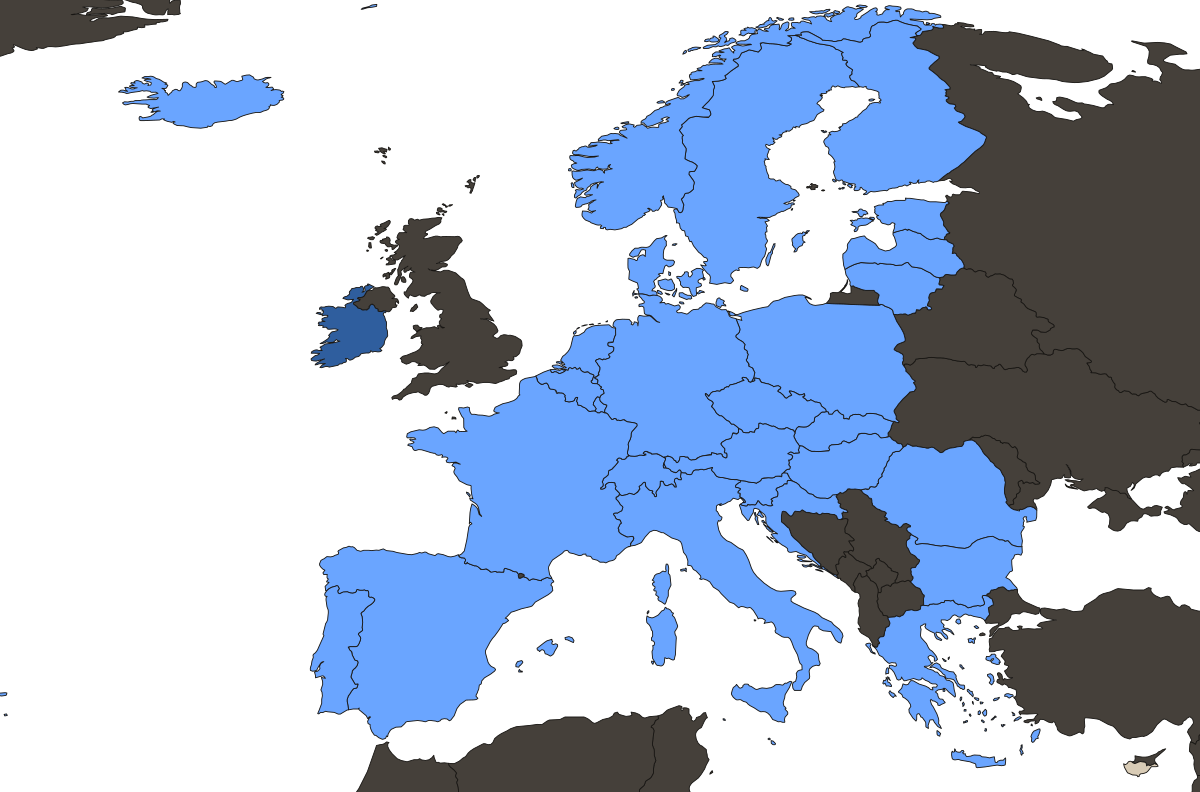
The Schengen Area has 29 members. Twenty-five are EU countries. The four non-EU members are Iceland, Norway, Switzerland and Liechtenstein. The two EU countries not in Schengen are Ireland, which has an opt-out, and Cyprus, which has not yet been admitted. Monaco, San Marino and Vatican City are not members but have no border checks with their neighbors, so they sit inside the area in practice.
Bulgaria and Romania were the last to join. Their air and sea border checks ended on March 31, 2024. Their land border checks ended on January 1, 2025. Croatia joined on January 1, 2023. Earlier, nine countries joined at once on December 21, 2007, the biggest single expansion.
- Member
- Joining
- Opted out
- Not a member
How Schengen grew
Countries that joined in each year, and the total after


 19957 founders

 19979
 200010


 200115


 200724
 200825
 201126
 202327

 202529
All 29 members and the year each joined
- Austria1997
- Belgium1995
- Bulgaria2025
- Croatia2023
- Czechia2007
- Denmark2001
- Estonia2007
- Finland2001
- France1995
- Germany1995
- Greece2000
- Hungary2007
- Iceland2001
- Italy1997
- Latvia2007
- Liechtenstein2011
- Lithuania2007
- Luxembourg1995
- Malta2007
- Netherlands1995
- Norway2001
- Poland2007
- Portugal1995
- Romania2025
- Slovakia2007
- Slovenia2007
- Spain1995
- Sweden2001
- Switzerland2008
How did Schengen start?
Five countries signed the Schengen Agreement on June 14, 1985, aboard the river boat Princesse Marie-Astrid, moored at the village of Schengen in Luxembourg. The village sits where Luxembourg, France and Germany meet. The signatories were junior ministers and state secretaries. No head of government signed. The five countries were Belgium, France, West Germany, Luxembourg and the Netherlands.
The agreement was a promise to gradually remove border checks. A second document, the Implementing Convention, was signed on the same boat in 1990. Checks were finally lifted on March 26, 1995, among seven countries. The Treaty of Amsterdam brought Schengen into EU law in 1999. The boat was sold to Germany in 1992 and spent nearly 30 years on the Danube. The municipality of Schengen and the Luxembourg government bought it back in 2021 and restored it. It was inaugurated as the Prinzessin Marie-Astrid Europa on June 14, 2025, the 40th anniversary.
From a boat on the Moselle to 29 countries
- 1985Five countries sign the Schengen Agreement on a boat at Schengen, Luxembourg
- 1990The Implementing Convention is signed, again on the same boat
- 1995Border checks lifted among 7 countries: Belgium, France, Germany, Luxembourg, the Netherlands, Spain and Portugal
- 1999The Treaty of Amsterdam brings Schengen into EU law
- 2007Nine countries join at once, the biggest expansion
- 2023Croatia joins
- 2025Bulgaria and Romania complete their membership, bringing the total to 29
Which EU countries are not in Schengen?
Two EU members are not in the Schengen Area: Ireland and Cyprus. Ireland has a legal opt-out under Protocol 19 of the EU treaties. It stays out to keep the Common Travel Area with the United Kingdom, which allows free movement between Ireland and the United Kingdom. Ireland does take part in some Schengen systems, including the Schengen Information System.
Cyprus is required by its EU membership to join but has not yet been admitted. The island has been divided since 1974, with a UN-patrolled buffer zone between the south and the Turkish Cypriot-administered north. In June 2026 the European Commission gave a positive assessment of Cyprus's technical readiness. In October 2026 Cyprus's deputy migration minister, Nicholas Ioannides, said the country expects full membership during 2027.
Are there border checks inside Schengen now?
Yes. As of November 2026, eight countries have reintroduced checks at some or all of their internal borders. France, Germany and Austria have had controls almost continuously since 2015 or 2016. The reasons governments give include irregular migration, terrorism and the fallout from the Ceuta crisis in July 2026.
A reform of the Schengen Borders Code took effect in July 2024. It sets a two-year limit on border checks for foreseeable threats, extendable to three years in exceptional cases. The European Commission must give an opinion once controls pass 12 months. In June 2026 the Commission urged nine countries to phase out their controls. Germany's interior minister, Alexander Dobrindt, rejected the call.
-
GermanyChecks to Mar 2027
Germany checks all nine land borders, citing irregular migration, smuggling and security threats.
-
FranceChecks to Apr 2027
France checks all internal borders, citing jihadist threats, antisemitic attacks and smuggling. Controls have been in place almost continuously since November 2015.
-
AustriaChecks to Mar 2027
Austria checks its borders with Slovakia, Czechia, Hungary and Slovenia, citing migration pressure.
-
PolandChecks to Mar 2027
Poland checks its borders with Germany and Lithuania, citing persistent migratory pressure.
-
DenmarkChecks to May 2027
Denmark checks its land and sea border with Germany, citing sabotage, terrorism and organized crime.
-
SwedenChecks to May 2027
Sweden checks all internal borders, citing hybrid threats from Russia and organized crime.
-
NorwayChecks to May 2027
Norway checks ports with ferry links to other Schengen countries, citing threats to the energy sector and sabotage.
-
ItalyChecks to Dec 2026
Italy checks its land border with Slovenia, citing terrorism and migration via the Balkan route.
What are the EES and ETIAS?
The EES is the Entry/Exit System. It records the face, fingerprints, passport data and travel dates of non-EU visitors at Schengen's external borders. It replaces passport stamps. The EES started on October 12, 2025 and became fully operational on April 10, 2026. By spring 2026 it had registered more than 66 million entries and exits.
ETIAS is the European Travel Information and Authorisation System. It will require visa-exempt travelers to get an online authorization before visiting. It is not a visa. The fee is 20 euros. Travellers under 18 or over 70 will not pay but still need the authorization. ETIAS has no official start date. The original target was late 2026, but in July 2026 the Financial Times reported that eu-LISA, the EU agency building it, said that was no longer feasible. It is now expected in 2027.
For intended stays on the territory of the Member States of a duration of no more than 90 days in any 180-day period…
Biometric registration at the border. Fully operational across all 29 members since April 10, 2026. More than 66 million entries and exits recorded by spring 2026.
Online pre-travel authorization for visa-exempt visitors. Fee: 20 euros. No start date set. Expected in 2027.
A visitor may stay up to 90 days in any rolling 180-day window. The count covers all Schengen countries together.
Is it in Schengen?
Short answers for the countries people ask about most.

Is the United Kingdom in Schengen?
NoThe UK was never in the Schengen Area and left the EU in 2020. UK citizens are visa-exempt. They have used the EES since October 2025 and will need ETIAS once it starts.

Is Ireland in Schengen?
NoIreland has an opt-out to keep the Common Travel Area with the United Kingdom. It takes part in the Schengen Information System.
Is Switzerland in Schengen?
YesA member since December 12, 2008. Switzerland is not in the EU.

Is Cyprus in Schengen?
Not yetAn EU member since 2004. The Commission judged it technically ready in 2026. Cyprus is aiming for full membership in 2027.
Is Croatia in Schengen?
YesA member since January 1, 2023. It was the 27th country to join.

Is Monaco in Schengen?
Not a memberMonaco is not a party to Schengen but sits inside the area through its arrangements with France. There are no border checks.
Is Norway in Schengen?
YesA member since March 25, 2001. Norway is not in the EU. Svalbard is excluded.

Is Turkey in Schengen?
NoTurkey is an EU candidate country. Turkish citizens need a Schengen visa for short stays.
Is Bulgaria in Schengen?
YesBulgaria completed its membership on January 1, 2025, when land border checks were lifted. Air and sea checks had ended on March 31, 2024.