Country profile · Western Balkans
 North Macedonia
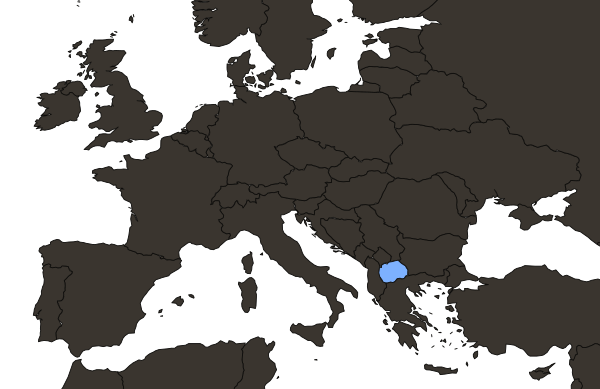
 is a landlocked Balkan country of about 1.8 million people. It left Yugoslavia in 1991. In 2019 it added "North" to its name to end a dispute with Greece, and it joined NATO in 2020. About a quarter of its people are ethnic Albanians. It has been an EU candidate since 2005, but Bulgaria is blocking its membership talks.
Where North Macedonia ranks
All rankings →- #9of 60Gas from Russia46.2%
- #83of 191GDP per person$10,546
- #37of 196Median age41.0 years
- #45of 196Births per woman1.47
- #98of 188Government debt52.6%
- #65of 196Life expectancy77.7 years
Which country has the biggest army? Largest armies in the world →
North Macedonia's region
All regions →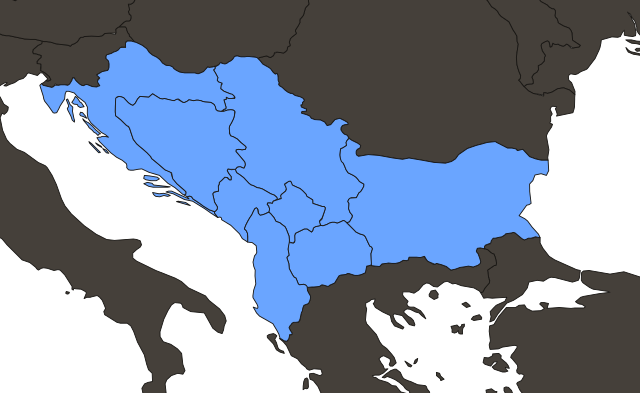
Which alliances is North Macedonia in?
All alliances →Who runs North Macedonia?
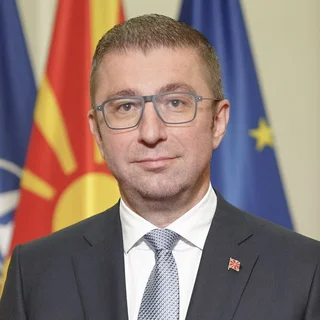
Prime Minister Hristijan Mickoski was born in Skopje on September 29, 1977. He was a professor of mechanical engineering, and his doctorate was on robot arms controlled by fuzzy logic. He ran the state power producer ELEM in 2016 and 2017 and has led the nationalist party VMRO-DPMNE since December 2017. His party's list won 58 of the 120 seats in May 2024 (chart), and he became prime minister on June 23, 2024. He governs with VLEN, an alliance of Albanian parties, and the small party ZNAM. VMRO-DPMNE also won about two-thirds of the 81 mayors' races in 2025. President Gordana Siljanovska-Davkova, a law professor backed by VMRO-DPMNE, took office in May 2024.
On March 16, 2025 a fire at the Pulse nightclub in Kočani killed 63 people. The club had a license even though it broke safety rules, and 35 people are on trial in the main case. The next parliamentary election is due by spring 2028.
- Your Macedonia (VMRO-DPMNE) 58
- SDSM list 18
- European Front (DUI) 18
- VLEN 14
- Levica 6
- ZNAM 6
Official portrait (2024): Government of North Macedonia, Wikimedia Commons, CC BY-SA 4.0 (cropped)
Who are North Macedonia's allies and enemies?
North Macedonia became NATO's 30th member on March 27, 2020. By NATO's count it has about 6,200 military personnel, and it spent 2% of GDP on defense in 2025. It gave Ukraine its Soviet-made T-72 tanks and four Su-25 jets. The United States is selling it 42 Stryker armored vehicles. The first 17 arrived in February 2026, and more followed in July. Greek and Italian jets guard its skies.
Ethnic Albanians are 24.3% of residents (2021 census). In 2001 Albanian rebels fought the army. The Ohrid Framework Agreement ended the fighting and gave Albanians more state jobs and more say in government. A language law that took effect in 2019 extended the official use of Albanian to state institutions across the country. Hungary under Viktor Orbán lent North Macedonia €1 billion in 2024. Orbán's government had given asylum to former Prime Minister Nikola Gruevski of VMRO-DPMNE, who fled a prison sentence in 2018. Hungary's new government is now investigating the loans. North Macedonia follows EU sanctions on Russia, but it still depends on Russian gas that comes through Bulgaria.
Allies and partners
 United StatesNATO ally; sold it Stryker vehicles
 SerbiaSecond-largest export market; warm ties
 TurkeyHelps fund its army
 KosovoTies through the Albanian community


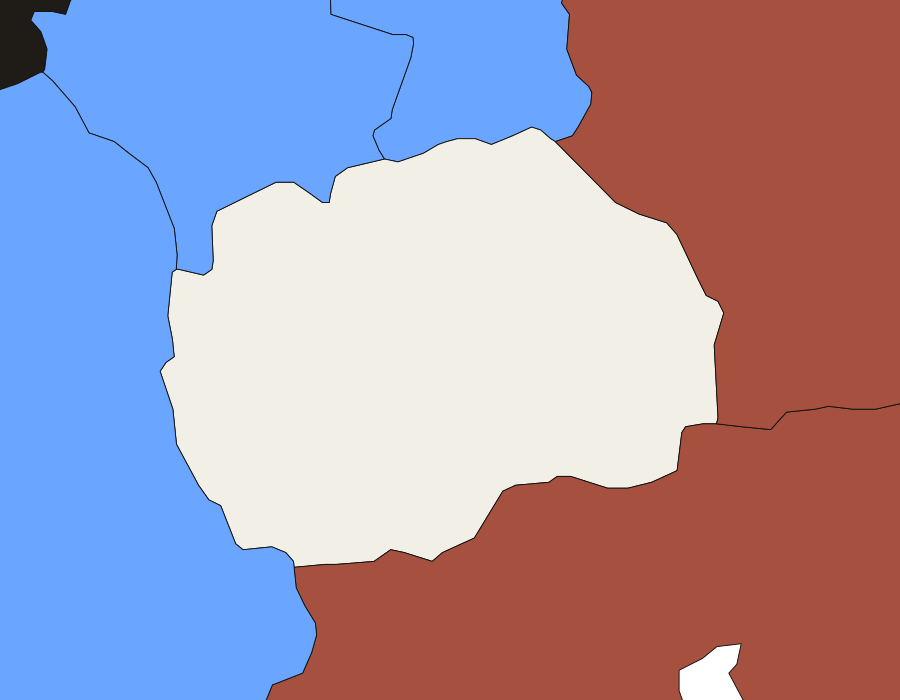
- Tetovo Mainly Albanian city near the center of the 2001 fighting between Albanian rebels and the army.
- Psarades Greek village on Lake Prespa where the 2018 deal that renamed the country was signed.
- Kičevo–Ohrid motorway Built by China's Sinohydro since 2014, first with a Chinese loan and now with loans from local banks. It now costs €803 million and is due by May 2027.
- Gevgelija Start of a gas pipeline being built to Greece, meant to cut reliance on Russian gas that comes through Bulgaria.
- North Macedonia
- Partner
- Tensions
Who does North Macedonia trade with?
In 2025 North Macedonia exported €8.0 billion of goods and imported €11.5 billion (State Statistical Office). Germany bought 36.2% of its exports (chart). The largest export is catalysts for car exhausts. The British company Johnson Matthey makes them in a free trade zone near Skopje, and they make up about a fifth of exports. Car wiring and seat parts come next, from foreign factories such as those of the German company Dräxlmaier, which employs more than 6,000 people in the country. Britain was the largest source of imports, and platinum-group metals were the second and third largest imports.
The economy grew 3.5% in 2025. Unemployment fell to 11.3% in 2026, the lowest since records began in 1993. Income per person is about 43% of the EU average. The population fell 9.2% between the 2002 and 2021 censuses, as people moved abroad. Solar panels made 31.1% of the electricity the country produced in 2025, up from 14.1% in 2024.


Why did Macedonia change its name?
After the country left Yugoslavia in 1991, Greece objected to the name "Macedonia." Greece's own northern region is called Macedonia, and Greeks see Alexander the Great and ancient Macedon as part of Greek history. So the country joined the UN in 1993 as "the former Yugoslav Republic of Macedonia." Under a 1995 deal with Greece, it removed the Vergina sun, an ancient symbol found in northern Greece, from its flag. Greece blocked a NATO invitation in 2008. In 2011 the International Court of Justice ruled that Greece had broken the 1995 deal by doing so. Meanwhile the government of Prime Minister Nikola Gruevski spent over €600 million on Skopje 2014, a project that filled the capital with statues, including a giant horseman widely seen as Alexander.
In 2018 Prime Minister Zoran Zaev and Greece's Prime Minister Alexis Tsipras agreed the Prespa Agreement. The country became the Republic of North Macedonia, and Greece accepted the Macedonian language and nationality. Only 36.9% of voters took part in a referendum on the deal, though 94% of them voted yes. Parliament passed the name change with 81 of 120 votes, and the agreement took effect on February 12, 2019. NATO membership followed in 2020. VMRO-DPMNE leaders still say "Macedonia" at home, and in November 2026 the European Commission criticized officials for not using the constitutional name.
Why is Bulgaria blocking North Macedonia from the EU?
North Macedonia has been an EU candidate since December 2005. In November 2020 Bulgaria vetoed the start of its membership talks. Bulgaria's government says Macedonian is a dialect of Bulgarian, and it claims historical figures such as the revolutionary Goce Delchev as Bulgarian. It also wants rights for people in North Macedonia who see themselves as Bulgarian.
A compromise brokered by France let the talks formally open on July 19, 2022. But no part of them can start until North Macedonia adds Bulgarians to the peoples named in its constitution, along with Croats, Jews and others. The change needs 80 of the 120 votes in parliament, and the government does not have them. The 2021 census counted about 3,500 Bulgarians. Prime Minister Mickoski says he will change the constitution only if the EU guarantees Macedonian identity and language and rules out new vetoes. The EU's enlargement commissioner says such guarantees have never been part of joining. Bulgaria's government under Rumen Radev, in office since May 2026, insists on the change. In its November 2026 report the European Commission found "no progress." Albania, whose talks were separated from North Macedonia's in 2024, has meanwhile opened every part of its talks.