
Relations · Middle East
Saudi Arabia-United States relations
FriendlyClose security partners, with no defense treaty
Saudi Arabia and the United States are close partners, but they are not treaty allies. President Donald Trump announced major non-NATO ally status for Saudi Arabia in November 2025, and the two countries signed a Strategic Defense Agreement. Neither commits the United States to defend the kingdom. The partnership dates to 1945, when President Franklin Roosevelt met King Ibn Saud aboard a US warship in Egypt. Today Saudi Arabia buys most of its weapons from the United States, and about 2,700 US troops are based in the kingdom.
- 1940Diplomatic relations since
- $28.2bnGoods traded in 2024
- 0 warsThey have never fought each other
- 10%Same UN votes in 2025
- $135.9bnSaudi holdings of US Treasury debt
- ~2,700US troops in Saudi Arabia (2026)
Where relations stand today
Checked November 18, 2026Saudi Arabia relies on US arms, intelligence and military advisers against Houthi missile and drone strikes, but the United States has not struck the Houthis itself. The Senate is due to vote on blocking the US-Saudi civil nuclear deal after November 29, 2026.
Latest
- Houthi missile and drone attacks on Saudi airports and oil sites continued through November 2026. The US Embassy in Riyadh issued repeated security alerts, and US government staff need special permission to use any Saudi airport.
- After the deadly October 10 Houthi strike on Riyadh's airport, President Donald Trump said the United States might join Saudi strikes on the Houthis, but he announced no decision. On October 21 the State Department ordered non-emergency US embassy staff and their families to leave Saudi Arabia.
- On September 17 the State Department approved a possible sale of 48 F-35 jets to Saudi Arabia, worth an estimated $24.3 billion. More than 100 US military advisers were giving the Saudi military intelligence and targeting help against the Houthis.
Following the news? Yemen in Conflicts →
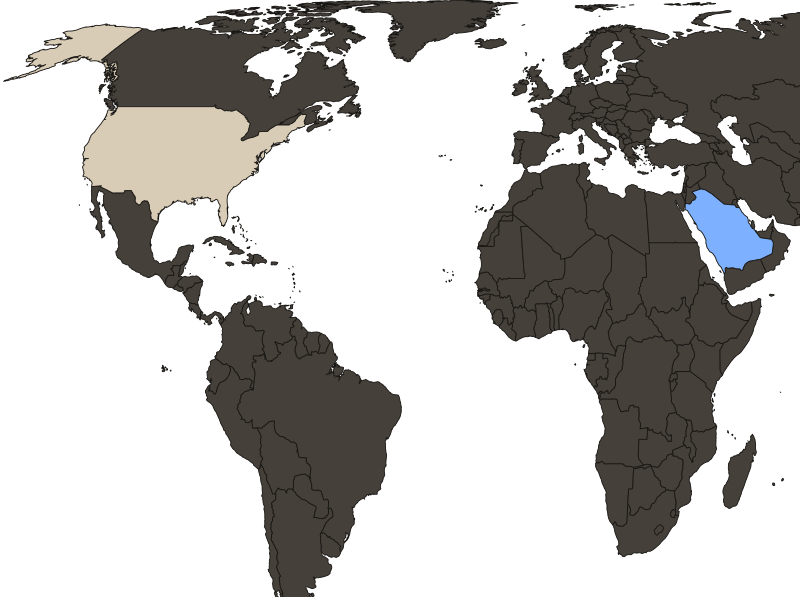 Saudi Arabia
United States
Prince Sultan Air Base
Why are Saudi Arabia and the US close?
What ties them
- Arms. SIPRI says the United States supplied 77% of Saudi Arabia's arms imports from 2021 to 2025. The White House valued the arms package agreed in May 2025 at nearly $142 billion.
- Oil and money. Saudi Arabia held $135.9 billion of US Treasury securities at the end of September 2026. In November 2025 Crown Prince Mohammed bin Salman pledged almost $1 trillion of Saudi investment in the United States.
- Iran. Both governments blame Iran for the Houthis' attacks. US and Saudi jets struck Iran-aligned militias in Iraq together on July 28, 2026, after drone attacks on US forces and Saudi oil sites.
- Counter-terrorism. Saudi Arabia joined the first US-led air strikes on ISIS in Syria on September 22-23, 2014, with four other Arab states. President Barack Obama called them "our friends and partners."
What divides them
- Help against the Houthis. Crown Prince Mohammed bin Salman asked President Trump for US strikes on the Houthis in September 2026. The United States sent advisers and intelligence instead, and Secretary of State Marco Rubio said the United States is "living up to" its commitments.
- The nuclear deal and Israel. Trump said the civil nuclear deal is "totally subject to" Saudi Arabia joining the Abraham Accords. Crown Prince Mohammed bin Salman says Saudi Arabia wants to join, but only with "a clear path" to a two-state solution.
- Human rights. US intelligence said in 2021 that Crown Prince Mohammed bin Salman approved the operation that killed journalist Jamal Khashoggi in 2018. Saudi Arabia "completely rejects" the finding and says the killers broke the rules and were convicted in Saudi courts.
- Saudi base restrictions. In May 2026 Saudi Arabia barred US forces from using its bases and airspace for a US operation to escort ships through the Strait of Hormuz. A Saudi source told AFP the operation "would just escalate the situation and would not work."
How much do Saudi Arabia and the United States trade?
Download CSV Saudi Arabia sells to United States
$13.3bn
- Crude oil63%
- Refined petroleum18%
- Petrochemicals5%
- Fertilizers5%
 United States sells to Saudi Arabia
$14.9bn
- Cars11%
- Gas turbine parts5%
- Medicines5%
- Aircraft parts4%
Saudi Arabia is the United States's #31 trading partner (0.6% of its goods trade). United States is Saudi Arabia's #6 (5.3%). These figures cover goods only. Arms deliveries, a large part of US sales to Saudi Arabia, are generally not captured in trade statistics. Source: CEPII BACI (version 202601), goods only.
Have Saudi Arabia and the US fought a war?
Saudi Arabia and the United States have never fought each other. In 1973, during the Arab oil embargo, US officials considered seizing Saudi oil fields with airborne troops as a last resort, according to a British intelligence report released in 2004. The embargo ended in March 1974 and no military action was taken. The two countries have fought on the same side: in the 1991 Gulf War against Iraq, in the 2014 air campaign against ISIS in Syria and in joint strikes on Iran-aligned militias in Iraq in July 2026.
A short history of Saudi-US relations
WarTreaty or peaceCrisis
Oil and recognition · 1931-1945
- 1933SOCAL oil concessionFinance Minister Abdullah Suleiman and Lloyd Hamilton of Standard Oil of California signed the concession at Khuzam Palace in Jeddah. The company created CASOC to run it.
- 1938Oil strikes at Dammam No. 7The well later called the "Prosperity Well" found oil in commercial quantities in March 1938. It was the kingdom's first commercial oil discovery.
- 1940Diplomatic relationsThe United States established relations on February 4, 1940. Bert Fish, the US minister in Cairo, presented credentials.
- 1945FDR meets Ibn SaudFranklin Roosevelt and King Abdulaziz Ibn Saud met aboard the USS Quincy in Egypt's Great Bitter Lake on February 14, 1945. Roosevelt promised he would do nothing to assist the Jews against the Arabs.
Cold War and oil shocks · 1945-1990
- 1957King Saud visits WashingtonKing Saud became the first Saudi king to visit the United States. President Eisenhower met him at the airport, and Washington declared "King Saud Day".
- 1973Arab oil embargoSaudi Arabia and other Arab oil producers stopped oil shipments to the United States over its airlift of weapons to Israel in the Yom Kippur War. The embargo lasted until March 1974, and oil prices nearly quadrupled.
- 1974Nixon visit and Treasury dealRichard Nixon became the first US president to visit Saudi Arabia in June 1974. A month later, Treasury Secretary William Simon arranged secret Saudi purchases of US debt, which the Treasury did not report separately until 2016.
- 1981AWACS sale survives the SenateThe Senate failed, 52 to 48, to block President Ronald Reagan's $8.5 billion arms sale to Saudi Arabia. The package centered on five AWACS radar planes.
Gulf War to 9/11 · 1990-2003
- 1990Gulf WarAfter Iraq invaded Kuwait, King Fahd agreed on August 6, 1990 to let US forces into the kingdom. More than 500,000 US troops deployed to the Gulf, and Iraq was driven out of Kuwait in February 1991.
- 1996Khobar Towers bombingA truck bomb at a US Air Force housing complex near Dhahran killed 19 Americans. A 2001 US indictment charged members of Saudi Hezbollah and alleged Iranian support, which Iran denied.
- 2001September 11 attacksFifteen of the 19 hijackers were Saudi citizens. The 9/11 Commission found "no evidence that the Saudi government as an institution or senior Saudi officials individually funded" al-Qaeda.
- 2003US forces leaveDefense Secretary Donald Rumsfeld announced in April 2003 that most US forces would leave Saudi Arabia. Operations moved to Al Udeid Air Base in Qatar.
New partnership · 2018-2026
- 2018Khashoggi killingSaudi agents killed journalist Jamal Khashoggi in the Saudi consulate in Istanbul on October 2, 2018. A US intelligence report in 2021 said Crown Prince Mohammed bin Salman approved the operation. Saudi Arabia rejected the finding.
- 2025White House visit and defense dealsCrown Prince Mohammed bin Salman visited the White House on November 18, 2025, his first visit in seven years. He and Trump signed a Strategic Defense Agreement, and Trump announced major non-NATO ally status for Saudi Arabia.
- 2026Iran strikes and Houthi warIranian missiles and drones hit Prince Sultan Air Base on March 27, 2026, wounding between 10 and 15 US troops by different counts. On July 28, US and Saudi jets struck Iran-aligned militias in Iraq together.
- 2026F-35s and nuclear dealThe State Department approved a $24.3 billion sale of 48 F-35 jets in September 2026. Trump said the civil nuclear agreement signed in July depends on Saudi Arabia joining the Abraham Accords.
Treaties and agreements between Saudi Arabia and the US
- 1951Mutual Defense Assistance AgreementAn exchange of notes on June 18, 1951 set up US arms aid and training, not a promise to defend Saudi Arabia. A US lease on Dhahran air base was renewed the same day and ended in 1962. The US Military Training Mission, formed under the agreement in 1953, still works in the kingdom.Training mission active
- 2025Strategic Defense AgreementSigned by Trump and Crown Prince Mohammed bin Salman at the White House on November 18, 2025. The White House says it deepens defense coordination and that Saudi Arabia sees the United States as its primary strategic partner. Its full text has not been published, and no mutual defense clause is known.In force
- 2026Major non-NATO ally designationA US decision, not a treaty. Trump announced it on November 18, 2025, and the formal determination was signed on January 13, 2026. It gives Saudi Arabia easier access to US arms sales and defense trade but does not oblige the United States to defend it.In force
- 2026Civil nuclear agreement (123 agreement)Signed in July 2026 by Energy Secretary Chris Wright and Saudi Energy Minister Prince Abdulaziz bin Salman. Saudi Arabia may enrich uranium only if both sides agree in writing after a two-year joint study, and at first only up to 5%. Congress is reviewing it, and the Senate is due to vote on a resolution to block it after November 29, 2026.Before Congress
How often do Saudi Arabia and the United States vote the same way at the UN?
In 2025, Saudi Arabia and the United States voted the same way on 10% of the recorded votes in the UN General Assembly. The United States voted against most General Assembly resolutions on Israel and Palestine, which Saudi Arabia backed. Agreement fell to 10% in 2025, the lowest level in this data. Compare their votes →
Abstaining while the other votes yes or no counts as half agreement. Data: UN Digital Library voting data, 1991 to 2025.
How well do you know Saudi Arabia and the United States?
10 questions on their wars, treaties, trade and size. About three minutes, no signup.
Orbis teaches the history behind the news
Orbis teaches geopolitics, history, and power in bite-sized lessons, 800+ of them, with flashcards that make it stick.

Saudi Arabia vs United States: how they compare
All rankings →Saudi Arabia
vs
United States
- Population 35M347M The United States has 10 times as many people as Saudi Arabia
- Economy $1.27tn$30.9tn The United States's economy is 24 times the size of Saudi Arabia's
- GDP per person $35.4k$90.3k People in the United States are 2.6 times as rich on average
- Military spending $83.2bn$954bn The United States spends 11 times as much on its military
- Active troops 390,0001.32M The United States has 3.4 times as many soldiers
- Nuclear warheads None5,042 Saudi Arabia has none
- Life expectancy 79.279.6 About the same
- Area 2.2M km²9.8M km² The United States is 4.5 times the size of Saudi Arabia
From the Orbis rankings: UN, IMF, SIPRI, Governments, Orbis, FAS. Each tile links to its ranking.
Saudi Arabia
- Crown Prince
- Mohammed bin Salman
- Population
- 34.6 million
- Economy
- $1.27tn, #19 in the world
- Region
- Arabian Peninsula
United States
- President
- Donald Trump
- Population
- 347.3 million
- Economy
- $30.9tn, #1 in the world
- Region
- North America
Questions about Saudi Arabia and the United States
Are Saudi Arabia and the United States allies?
They are close security partners but not treaty allies. President Trump announced major non-NATO ally status for Saudi Arabia in November 2025 and made it formal in January 2026. The two countries also signed a Strategic Defense Agreement. Neither commits the United States to defend the kingdom. Unlike NATO members or Japan, Saudi Arabia has no mutual defense treaty with the United States.
Does the United States have to defend Saudi Arabia?
No treaty obliges it. The 2025 Strategic Defense Agreement's full text has not been published, and an analyst at the Washington Institute called it an executive agreement the Senate will not ratify. In September 2026 the United States declined Saudi requests to strike the Houthis and sent military advisers and intelligence instead. Secretary of State Marco Rubio said the United States is "living up to" its commitments.
How much US debt does Saudi Arabia own?
Saudi Arabia held $135.9 billion of US Treasury securities at the end of September 2026, according to US Treasury data. From 1974 until May 2016, the Treasury reported Saudi holdings only inside a group of "oil exporters". Bloomberg traced this to a request from King Faisal in July 1974 to keep Saudi purchases secret.
Were the September 11 hijackers Saudi?
Fifteen of the 19 hijackers were Saudi citizens. The 9/11 Commission found no evidence that the Saudi government as an institution or senior Saudi officials individually funded al-Qaeda. Saudi Arabia says US investigations cleared it. Lawsuits by 9/11 families under the Justice Against Sponsors of Terrorism Act continue in New York, where a judge refused to dismiss them in August 2025.
Is there a petrodollar agreement that expired in 2024?
No. Fact-checkers found no 50-year petrodollar deal. The June 8, 1974 agreement set up joint economic commissions and did not oblige Saudi Arabia to sell oil only in dollars. The claim of an expiring deal was traced to Chinese-language social media. Saudi Arabia in practice still prices its oil in dollars without any formal obligation to do so.
Are there US troops in Saudi Arabia?
Yes, about 2,700 in 2026, mostly at Prince Sultan Air Base southeast of Riyadh, where they work mainly on air and missile defense. More than 100 military advisers also give intelligence and targeting help against the Houthis. Most US forces left Saudi Arabia in 2003 and returned in 2019.
More relations
All relations →- Iran and Saudi ArabiaNo wars, three diplomatic breaks and proxy conflicts across the Middle East.Hostile
- Singapore and the United StatesNo defense treaty, but US forces use Singapore's bases and they trade $78 billion a year.Friendly
- China and the United StatesThe Korean War, a dispute over Taiwan, $604 billion in trade and tariffs on both sides.Tense
- Iran and the United StatesAt war, no embassies, almost no trade and 70 years of grievances.At war
- North Korea and the United StatesOne war, no peace treaty, nuclear weapons and three Trump-Kim meetings without a deal.Hostile
- The United States and VenezuelaThe US captured Maduro in 2026, then signed oil and military deals with his successor.Hostile
- Cuba and the United StatesA US embargo since 1962, a fuel cutoff since 2026 and embassies open since 2015.Hostile
- Saudi Arabia and YemenSaudi Arabia backs Yemen's government and fights the Houthis, who hold Sanaa.At war
- Japan and the United StatesTreaty allies since 1952. One war, $225 billion in trade and 54,000 US troops.Allies
- Canada and the United StatesAllies with the world's longest border, in a trade war since 2025.Allies
- The United Kingdom and the United StatesTwo wars, a "special relationship" and $131 billion in goods trade.Allies
- Israel and the United StatesThe largest US aid relationship, joint wars with Iran and a debate over what comes next.Friendly
- Taiwan and the United StatesNo embassy, no defense treaty, but $151 billion in trade and $30 billion in arms on order.Friendly
- India and the United StatesNo treaty, three defense agreements, $128 billion in trade and a long tariff fight.Friendly
- Israel and Saudi ArabiaNo diplomatic relations, shared enemies and normalization tied to a Palestinian state.Hostile
- Mexico and the United StatesOne war, $728 billion in trade, and disputes over cartels, tariffs and migration.Mixed
- Russia and the United StatesNo wars, 80 years of rivalry, expired nuclear treaties and sanctions over Ukraine.Tense
- Panama and the United StatesOne invasion, the canal handover, the dollar and a fight over Hong Kong-run ports.Friendly
- Iraq and Saudi ArabiaOne war, drone attacks from Iraq, Saudi strikes in 2026 and rising trade.Tense
- Russia and Saudi ArabiaOPEC+ co-leaders since 2016, with a century of on-and-off diplomacy.Friendly
- China and Saudi ArabiaNo wars, $111 billion in trade, secret missiles and a strategic partnership.Friendly


