
193 UN members · October 2026
Which countries recognize Palestine?
As of October 2026, 154 of the 193 UN member states recognize the State of Palestine. Belgium announced recognition in September 2025 but has not completed the legal formalities. Hungary and Papua New Guinea are on the Palestinian side's lists, but Hungary's previous government and Papua New Guinea's government have cast doubt on recognition. Palestine declared independence on November 15, 1988, and about 80 states recognized it by the end of that year. In 2024, Spain, Ireland, Norway, Slovenia and Armenia recognized it, along with four Caribbean states. In September 2025, the United Kingdom, France, Canada, Australia and six other states followed. The United States, Germany, Italy and Japan do not recognize it. Palestine is a non-member observer state at the United Nations.
- Recognize
- 154
- Announced
- 1
- Disputed
- 2
- Don't
- 36
Of the 193 UN members, as of October 2026.
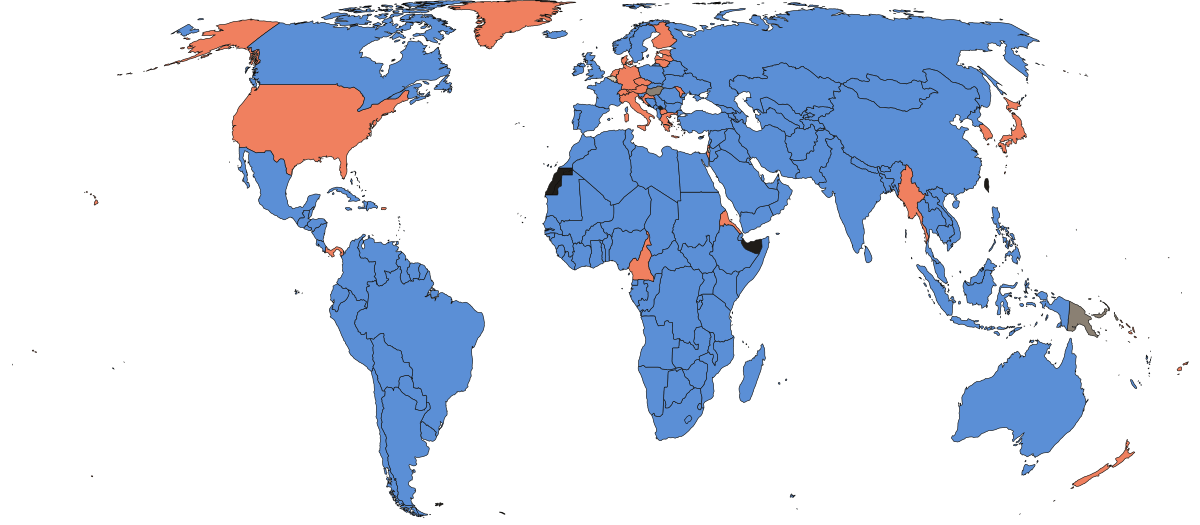
- Recognizes
- Announced, not in force
- Disputed
- Does not recognize
- Palestine
- 1988
- 1989 to 2009
- 2010 to 2023
- 2024
- 2025 to 2026
- Announced, not in force
- Disputed
- Does not recognize
Which countries don't recognize Palestine?
As of October 2026, 36 UN members do not recognize the State of Palestine. Sixteen are in Europe, including Germany, Italy, the Netherlands, Austria, Denmark, Finland, Greece and the three Baltic states. Eleven are in Oceania: New Zealand and 10 Pacific island states. Four are in Asia: Japan, South Korea, Singapore and Myanmar. Israel is among them, as are Cameroon, Eritrea, the United States and Panama. Belgium (announced) and Hungary and Papua New Guinea (disputed) are counted separately.
 Austria
 Belgium (announced)
 Cameroon
 Croatia
 Czechia
 Denmark
 Eritrea
 Estonia
 Fiji
 Finland
 Germany
 Greece
 Hungary (disputed)
 Israel
 Italy
 Japan
 Kiribati
 Latvia
 Liechtenstein
 Lithuania
 Marshall Islands
 Micronesia
 Moldova
 Myanmar
 Nauru
 Netherlands
 New Zealand
 North Macedonia
 Palau
 Panama
 Papua New Guinea (disputed)
 Samoa
 Singapore
 Solomon Islands
 South Korea
 Switzerland
 Tonga
 Tuvalu
 United States
When did most countries recognize Palestine?
On November 15, 1988, the Palestine National Council proclaimed the State of Palestine in Algiers. About 80 of today's UN members recognized it by the end of 1988, and nearly 90 by the end of 1989. Between 2008 and 2013, most of Latin America recognized Palestine, starting with Costa Rica in 2008. Brazil and Argentina followed in December 2010, and most of South America had done so by early 2011. In 2014, Sweden became the first European Union member to recognize Palestine while it was an EU member.
Spain, Ireland and Norway recognized it on May 28, 2024, followed by Slovenia on June 4 and Armenia on June 21. Four Caribbean states, Barbados, Jamaica, Trinidad and Tobago, and the Bahamas, recognized it earlier that spring. In September 2025, around a conference on the two-state solution co-chaired by France and Saudi Arabia, 10 more states recognized Palestine. The United Kingdom, Canada, Australia and Portugal did so on September 21. France, Luxembourg, Malta, Monaco and Andorra announced recognition at the conference on September 22, and San Marino decided on September 23. Belgium also announced recognition at the conference but has not given it legal effect. As of October 2026, no UN member has recognized Palestine since San Marino on September 23, 2025.
Where do the major powers stand?
Of the five permanent members of the Security Council, four recognize Palestine. Russia and China have recognized it since 1988. France and the United Kingdom recognized it in September 2025. The United States does not. Among the G7, the United Kingdom, France and Canada recognized Palestine in September 2025. Germany, Italy, Japan and the United States do not.
In the European Union, 13 of 27 members recognize Palestine. Five, Bulgaria, Cyprus, Poland, Romania and Slovakia, recognized it in 1988 before they joined. Sweden recognized it in 2014, Spain, Ireland and Slovenia in 2024, and France, Luxembourg, Malta and Portugal in 2025. In June 2026, Slovenian Prime Minister Janez Janša said his government would freeze the 2024 decision. No such decision had been published as of October 2026. Belgium announced recognition in September 2025 but set conditions: all hostages released and Hamas removed from governance. In July 2026, Foreign Minister Maxime Prévot said he had asked his ministry to prepare formal recognition. The royal decree had not been signed as of October 2026. Twelve EU members, including Germany, Italy, the Netherlands, Austria, Denmark and Finland, do not recognize Palestine, and Hungary's recognition is disputed.
- United StatesNo
 ChinaSince 1988
 RussiaSince 1988
 United KingdomSince 2025
 FranceSince 2025
- GermanyNo
- JapanNo
- ItalyNo
 CanadaSince 2025
 IndiaSince 1988
 BrazilSince 2010
 AustraliaSince 2025
- South KoreaNo
 Saudi ArabiaSince 1988
 TurkeySince 1988
 SpainSince 2024
Why do some countries not recognize Palestine?
Several governments say recognition should come at the end of negotiations between Israel and the Palestinians, not before. A United States State Department spokesperson said on September 21, 2025: "Our focus remains on serious diplomacy, not performative gestures." German Chancellor Friedrich Merz said on December 7, 2025 that Germany would not recognize Palestine "in the foreseeable future" and that recognition "should come at the end" of a negotiated process. Italian Prime Minister Giorgia Meloni said on September 23, 2025: "I am not against the recognition of Palestine, but we should set ourselves the right priorities." In September 2025, Italy set two conditions: that all hostages be freed and that Hamas be excluded from government. As of October 2026, Italy had not recognized Palestine.
Takeshi Iwaya, then Japan's foreign minister, said on September 22, 2025 that recognition is "not a matter of 'if,' but of 'when.'" South Korean Foreign Minister Cho Hyun said on September 23, 2025 that South Korea is "committed to recognizing Palestinian statehood at a time when it would be genuinely conducive to realizing the two-state solution."
What do Israel and the Palestinians say about recognition?
Israeli Prime Minister Benjamin Netanyahu said on September 21, 2025 that recognition is "a huge reward to terrorism." At the General Assembly on September 26, 2025, he said: "Israel will not allow you to shove a terrorist state down our throats." On May 22, 2024, the day Ireland, Norway and Spain announced they would recognize Palestine, Israel recalled its ambassadors to all three countries. In August 2025, Israel gave final approval to the E1 settlement plan. Finance Minister Bezalel Smotrich said it would "bury" the idea of a Palestinian state.
The office of Palestinian President Mahmoud Abbas said on September 21, 2025 that recognition "constitutes an important and necessary step toward achieving a just and lasting peace." Palestinian Ambassador Riyad Mansour said on September 22, 2025: "We have already recognized the right of Israel to existence in 1988 and in 1993." In a video address to the General Assembly on September 25, 2025, Abbas said the actions of Hamas on October 7, 2023 "do not represent the Palestinian people" and that "we do not want an armed state."
Is Palestine a member of the United Nations?
No. Since November 29, 2012, Palestine has been a non-member observer state at the United Nations, granted that status by resolution 67/19, which passed 138 to 9 with 41 abstentions. Full membership requires a Security Council recommendation, with at least 9 of 15 votes and no veto from any permanent member, followed by a two-thirds majority of General Assembly members present and voting.
On April 18, 2024, the United States vetoed a Security Council draft that would have recommended Palestine's admission. The vote was 12 in favor, 1 against and 2 abstentions. On May 10, 2024, the General Assembly passed resolution ES-10/23 by 143 to 9 with 25 abstentions, finding Palestine qualified for membership and asking the Security Council to "reconsider the matter favourably." Palestinian Ambassador Riyad Mansour said: "A 'yes' vote is a vote for Palestinian existence; it is not against any State." US Deputy Ambassador Robert Wood said the US vote against was "an acknowledgement that statehood will only come from a process that involves direct negotiations between the parties." From September 2024, Palestine gained additional rights but still cannot vote in the General Assembly or run for UN organs.
What does it mean to recognize a state?
Recognition is a decision made by each government individually. The Montevideo Convention of 1933 lists four criteria commonly used to define a state: a permanent population, a defined territory, a government, and the capacity to enter into relations with other states. Under the declaratory view, a state exists once it meets these criteria. Under the constitutive view, a state becomes a legal person only through recognition by other states.
Recognition is separate from opening an embassy or establishing diplomatic relations. For example, the United Kingdom recognized Palestine on September 21, 2025, and the Palestinian mission in London was upgraded to an embassy on January 5, 2026.
Which countries don't recognize Israel?
As of October 2026, at least 23 UN members have never recognized Israel or have withdrawn recognition. They include Afghanistan, Algeria, Bangladesh, Brunei, Indonesia, Iran, Iraq, Kuwait, Lebanon, Libya, Malaysia, North Korea, Pakistan, Qatar, Saudi Arabia, Somalia, Syria, Tunisia, Yemen, Comoros, Djibouti, Oman and Sudan. Several other states, including Cuba and Venezuela, recognized Israel but later cut diplomatic relations. Venezuela restored consular ties with Israel in August 2026.
The Abraham Accords, brokered by the United States in 2020, led to normalization agreements between Israel and the United Arab Emirates, Bahrain, Morocco and Sudan, though Sudan's normalization was never completed.
Every UN member, and since when
Dates are those of each government's announcement or the date diplomatic relations were established. Where no government statement was found, the date is from the 2024 list of Arab, Islamic and Non-Aligned groups at the UN (document A/78/846). States that recognized as part of a predecessor country are noted: for example, Russia's recognition dates to the Soviet Union in 1988, and Slovakia's to Czechoslovakia in 1988. The buttons filter by status.
| Country | Region | Since | Status |
|---|---|---|---|
 Afghanistan | Asia | November 16, 1988 | Since 1988 |
 Albania | Europe | November 17, 1988 | Since 1988 |
 Algeria | Africa | November 15, 1988 | Since 1988 |
 Andorra | Europe | September 22, 2025 | Since 2025 |
 Angola | Africa | December 6, 1988 | Since 1988 |
 Antigua and Barbuda | Americas | September 22, 2011 | Since 2011 |
 Argentina | Americas | December 6, 2010 | Since 2010 |
 Armenia | Europe | June 21, 2024 | Since 2024 |
| Australia | Oceania | September 21, 2025 | Since 2025 |
| Austria | Europe | No | |
 Azerbaijan | Europe | April 15, 1992 | Since 1992 |
 Bahamas | Americas | May 7, 2024 | Since 2024 |
 Bahrain | Middle East | November 15, 1988 | Since 1988 |
 Bangladesh | Asia | November 16, 1988 | Since 1988 |
 Barbados | Americas | April 19, 2024 | Since 2024 |
 BelarusRecognized in 1988 as the Byelorussian SSR, then a UN member. | Europe | November 19, 1988 | Since 1988 |
| BelgiumAnnounced on September 22, 2025. The royal decree that gives it legal effect had not been signed as of October 2026. | Europe | September 22, 2025 | Announced |
 Belize | Americas | September 9, 2011 | Since 2011 |
 Benin | Africa | May 12, 1989 | Since 1989 |
 Bhutan | Asia | December 25, 1988 | Since 1988 |
 Bolivia | Americas | December 17, 2010 | Since 2010 |
 Bosnia and Herzegovina | Europe | May 27, 1992 | Since 1992 |
 Botswana | Africa | December 19, 1988 | Since 1988 |
| Brazil | Americas | December 1, 2010 | Since 2010 |
 Brunei | Asia | November 17, 1988 | Since 1988 |
 Bulgaria | Europe | November 25, 1988 | Since 1988 |
 Burkina Faso | Africa | November 21, 1988 | Since 1988 |
 Burundi | Africa | December 22, 1988 | Since 1988 |
 Cambodia | Asia | November 21, 1988 | Since 1988 |
| Cameroon | Africa | No | |
| Canada | Americas | September 21, 2025 | Since 2025 |
 Cape Verde | Africa | November 24, 1988 | Since 1988 |
 Central African Republic | Africa | December 23, 1988 | Since 1988 |
 Chad | Africa | December 1, 1988 | Since 1988 |
 Chile | Americas | January 7, 2011 | Since 2011 |
| China | Asia | November 20, 1988 | Since 1988 |
 Colombia | Americas | August 3, 2018 | Since 2018 |
 Comoros | Africa | November 21, 1988 | Since 1988 |
 Costa Rica | Americas | February 5, 2008 | Since 2008 |
 Côte d'Ivoire | Africa | December 1, 2008 | Since 2008 |
| Croatia | Europe | No | |
 Cuba | Americas | November 16, 1988 | Since 1988 |
 Cyprus | Europe | November 18, 1988 | Since 1988 |
| CzechiaCzechoslovakia recognized Palestine in 1988. Czechia's foreign ministry says that act was not a recognition. | Europe | No | |
| Denmark | Europe | No | |
 Djibouti | Africa | November 17, 1988 | Since 1988 |
 Dominica | Americas | September 19, 2011 | Since 2011 |
 Dominican Republic | Americas | July 15, 2009 | Since 2009 |
 DR Congo | Africa | December 18, 1988 | Since 1988 |
 Ecuador | Americas | December 24, 2010 | Since 2010 |
 Egypt | Africa | November 18, 1988 | Since 1988 |
 El Salvador | Americas | August 25, 2011 | Since 2011 |
 Equatorial Guinea | Africa | May 1989 | Since 1989 |
| Eritrea | Africa | No | |
| Estonia | Europe | No | |
 Eswatini | Africa | July 1, 1991 | Since 1991 |
 Ethiopia | Africa | February 4, 1989 | Since 1989 |
| Fiji | Oceania | No | |
| Finland | Europe | No | |
| France | Europe | September 22, 2025 | Since 2025 |
 Gabon | Africa | December 12, 1988 | Since 1988 |
 Gambia | Africa | November 18, 1988 | Since 1988 |
 Georgia | Europe | April 25, 1992 | Since 1992 |
| GermanyEast Germany recognized Palestine in 1988. Unified Germany does not. | Europe | No | |
 Ghana | Africa | November 29, 1988 | Since 1988 |
| Greece | Europe | No | |
 Grenada | Americas | September 25, 2011 | Since 2011 |
 Guatemala | Americas | April 9, 2013 | Since 2013 |
 Guinea | Africa | November 21, 1988 | Since 1988 |
 Guinea-Bissau | Africa | November 21, 1988 | Since 1988 |
 Guyana | Americas | January 13, 2011 | Since 2011 |
 Haiti | Americas | September 27, 2013 | Since 2013 |
 Honduras | Americas | August 26, 2011 | Since 2011 |
| HungaryRecognized in 1988 and never withdrawn, but in 2024 the government of the time said it did not agree with recognizing a Palestinian state. | Europe | November 23, 1988 | Disputed |
 Iceland | Europe | December 15, 2011 | Since 2011 |
| India | Asia | November 18, 1988 | Since 1988 |
 Indonesia | Asia | November 15, 1988 | Since 1988 |
 Iran | Middle East | February 4, 1989 | Since 1989 |
 Iraq | Middle East | November 15, 1988 | Since 1988 |
 Ireland | Europe | May 28, 2024 | Since 2024 |
| Israel | Middle East | No | |
| Italy | Europe | No | |
 Jamaica | Americas | April 22, 2024 | Since 2024 |
| Japan | Asia | No | |
 Jordan | Middle East | November 16, 1988 | Since 1988 |
 Kazakhstan | Asia | April 6, 1992 | Since 1992 |
 Kenya | Africa | May 12, 1989 | Since 1989 |
| Kiribati | Oceania | No | |
 Kuwait | Middle East | November 15, 1988 | Since 1988 |
 Kyrgyzstan | Asia | November 1995 | Since 1995 |
 Laos | Asia | December 2, 1988 | Since 1988 |
| Latvia | Europe | No | |
 Lebanon | Middle East | November 30, 2008 | Since 2008 |
 Lesotho | Africa | May 3, 2011 | Since 2011 |
 Liberia | Africa | July 19, 2011 | Since 2011 |
 Libya | Africa | November 15, 1988 | Since 1988 |
| Liechtenstein | Europe | No | |
| Lithuania | Europe | No | |
 Luxembourg | Europe | September 22, 2025 | Since 2025 |
 Madagascar | Africa | November 16, 1988 | Since 1988 |
 Malawi | Africa | October 23, 1998 | Since 1998 |
 Malaysia | Asia | November 15, 1988 | Since 1988 |
 Maldives | Asia | November 28, 1988 | Since 1988 |
 Mali | Africa | November 21, 1988 | Since 1988 |
 MaltaA 1988 letter is on the Palestinian side's list, but Malta formally recognized Palestine in 2025. | Europe | September 22, 2025 | Since 2025 |
| Marshall Islands | Oceania | No | |
 Mauritania | Africa | November 15, 1988 | Since 1988 |
 Mauritius | Africa | November 17, 1988 | Since 1988 |
 MexicoNo single formal act. The date is from the 2024 list of Arab, Islamic and Non-Aligned groups at the UN (A/78/846). | Americas | June 2, 2023 | Since 2023 |
| Micronesia | Oceania | No | |
| Moldova | Europe | No | |
 Monaco | Europe | September 22, 2025 | Since 2025 |
 Mongolia | Asia | November 22, 1988 | Since 1988 |
 Montenegro | Europe | July 24, 2006 | Since 2006 |
 Morocco | Africa | November 15, 1988 | Since 1988 |
 Mozambique | Africa | December 8, 1988 | Since 1988 |
| Myanmar | Asia | No | |
 NamibiaRecognized in 1988 by SWAPO, before Namibia's independence in 1990. | Africa | November 19, 1988 | Since 1988 |
| Nauru | Oceania | No | |
 Nepal | Asia | December 19, 1988 | Since 1988 |
| Netherlands | Europe | No | |
| New Zealand | Oceania | No | |
 Nicaragua | Americas | November 16, 1988 | Since 1988 |
 Niger | Africa | November 24, 1988 | Since 1988 |
 Nigeria | Africa | November 18, 1988 | Since 1988 |
 North Korea | Asia | November 24, 1988 | Since 1988 |
| North Macedonia | Europe | No | |
 Norway | Europe | May 28, 2024 | Since 2024 |
 Oman | Middle East | December 13, 1988 | Since 1988 |
 Pakistan | Asia | November 16, 1988 | Since 1988 |
| Palau | Oceania | No | |
| Panama | Americas | No | |
| Papua New GuineaListed by the Palestinian side since 1995. In 2025 its foreign secretary said he knew of no position on relations with Palestine. | Oceania | January 13, 1995 | Disputed |
 ParaguayDiplomatic relations since 2005. Recognition within the 1967 borders in January 2011. | Americas | January 28, 2011 | Since 2011 |
 Peru | Americas | January 24, 2011 | Since 2011 |
 Philippines | Asia | September 4, 1989 | Since 1989 |
 Poland | Europe | December 14, 1988 | Since 1988 |
 Portugal | Europe | September 21, 2025 | Since 2025 |
 Qatar | Middle East | November 16, 1988 | Since 1988 |
 Republic of the Congo | Africa | December 5, 1988 | Since 1988 |
 Romania | Europe | November 24, 1988 | Since 1988 |
| RussiaRecognized in 1988 as the Soviet Union. Russia keeps the recognition. | Europe | November 19, 1988 | Since 1988 |
 Rwanda | Africa | January 2, 1989 | Since 1989 |
 Saint Kitts and Nevis | Americas | July 29, 2019 | Since 2019 |
 Saint Lucia | Americas | September 14, 2015 | Since 2015 |
 Saint Vincent and the Grenadines | Americas | August 29, 2011 | Since 2011 |
| Samoa | Oceania | No | |
 San Marino | Europe | September 23, 2025 | Since 2025 |
 São Tomé and Príncipe | Africa | December 10, 1988 | Since 1988 |
| Saudi Arabia | Middle East | November 16, 1988 | Since 1988 |
 Senegal | Africa | November 22, 1988 | Since 1988 |
 SerbiaRecognized in 1988 as Yugoslavia. Serbia keeps the recognition. | Europe | November 16, 1988 | Since 1988 |
 Seychelles | Africa | November 18, 1988 | Since 1988 |
 Sierra Leone | Africa | December 3, 1988 | Since 1988 |
| Singapore | Asia | No | |
 SlovakiaRecognized in 1988 as part of Czechoslovakia. Slovakia confirmed it in 1993. | Europe | November 18, 1988 | Since 1988 |
 SloveniaIn June 2026 Prime Minister Janez Janša said his government would freeze the 2024 decision. No such decision had been published as of October 2026. | Europe | June 4, 2024 | Since 2024 |
| Solomon Islands | Oceania | No | |
 Somalia | Africa | November 15, 1988 | Since 1988 |
 South Africa | Africa | February 15, 1995 | Since 1995 |
| South Korea | Asia | No | |
 South Sudan | Africa | July 14, 2011 | Since 2011 |
| Spain | Europe | May 28, 2024 | Since 2024 |
 Sri Lanka | Asia | November 18, 1988 | Since 1988 |
 Sudan | Africa | November 17, 1988 | Since 1988 |
 Suriname | Americas | January 26, 2011 | Since 2011 |
 Sweden | Europe | October 30, 2014 | Since 2014 |
| Switzerland | Europe | No | |
 Syria | Middle East | July 18, 2011 | Since 2011 |
 Tajikistan | Asia | April 2, 1994 | Since 1994 |
 Tanzania | Africa | November 24, 1988 | Since 1988 |
 Thailand | Asia | January 18, 2012 | Since 2012 |
 Timor-Leste | Asia | March 1, 2004 | Since 2004 |
 Togo | Africa | November 29, 1988 | Since 1988 |
| Tonga | Oceania | No | |
 Trinidad and Tobago | Americas | May 2, 2024 | Since 2024 |
 Tunisia | Africa | November 15, 1988 | Since 1988 |
| Turkey | Middle East | November 15, 1988 | Since 1988 |
 Turkmenistan | Asia | April 17, 1992 | Since 1992 |
| Tuvalu | Oceania | No | |
 Uganda | Africa | December 3, 1988 | Since 1988 |
 UkraineRecognized in 1988 as the Ukrainian SSR, then a UN member. | Europe | November 19, 1988 | Since 1988 |
 United Arab Emirates | Middle East | November 16, 1988 | Since 1988 |
| United Kingdom | Europe | September 21, 2025 | Since 2025 |
| United States | Americas | No | |
 Uruguay | Americas | March 15, 2011 | Since 2011 |
 Uzbekistan | Asia | September 25, 1994 | Since 1994 |
 Vanuatu | Oceania | August 21, 1989 | Since 1989 |
 Venezuela | Americas | April 27, 2009 | Since 2009 |
 Vietnam | Asia | November 19, 1988 | Since 1988 |
 YemenNorth and South Yemen both recognized Palestine in 1988. United Yemen keeps the recognition. | Middle East | November 15, 1988 | Since 1988 |
 Zambia | Africa | November 16, 1988 | Since 1988 |
 Zimbabwe | Africa | November 29, 1988 | Since 1988 |