
Ranking · Land and sea
Landlocked countries
There are 44 landlocked sovereign states and one partly recognized one, Kosovo. Kazakhstan is the largest by area, at 2.7 million km². Ethiopia has the most people, about 135.5 million, roughly a fifth of all people living in landlocked countries. Together the 45 entries on this list hold about 668 million people, 8.1% of the world's population.
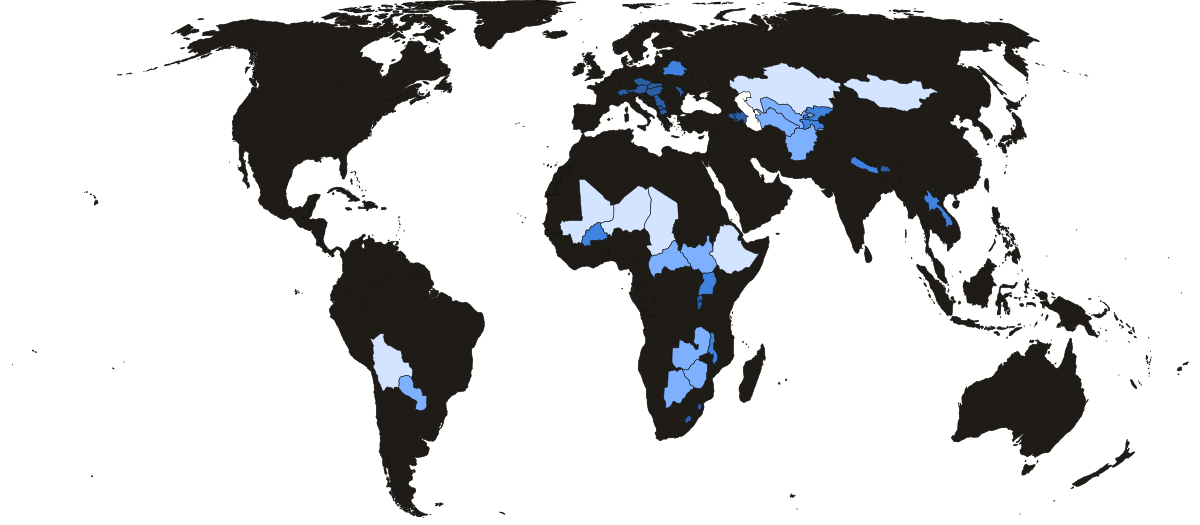
- Under 10,000
- 10,000–100,000
- 100,000–300,000
- 300,000–1 million
- Over 1 million
- Not in this ranking
- Under 1m
- 1m–10m
- 10m–30m
- Over 30m
- Not in this ranking
| # | Country | Area | Population |
|---|---|---|---|
| 1 |  Kazakhstan |
2,724,910 | 20.8 million |
| 2 |  Mongolia |
1,564,116 | 3.5 million |
| 3 |  Chad |
1,284,000 | 21.0 million |
| 4 |  Niger |
1,267,000 | 27.9 million |
| 5 |  Mali |
1,240,192 | 25.2 million |
| 6 |  Ethiopia |
1,104,300 | 135.5 million |
| 7 |  Bolivia |
1,098,581 | 12.6 million |
| 8 |  Zambia |
752,612 | 21.9 million |
| 9 |  South Sudan |
658,841 | 12.2 million |
| 10 |  Afghanistan |
652,864 | 43.8 million |
| 11 |  Central African Republic |
622,984 | 5.5 million |
| 12 |  Botswana |
581,730 | 2.6 million |
| 13 |  Turkmenistan |
488,100 | 7.6 million |
| 14 |  Uzbekistan |
448,969 | 37.1 million |
| 15 |  Paraguay |
406,752 | 7.0 million |
| 16 |  Zimbabwe |
390,757 | 17.0 million |
| 17 |  Burkina Faso |
272,969 | 24.1 million |
| 18 |  Uganda |
241,550 | 51.4 million |
| 19 |  Laos |
236,800 | 7.9 million |
| 20 |  Belarus |
207,600 | 9.0 million |
| 21 |  Kyrgyzstan |
199,949 | 7.3 million |
| 22 |  Nepal |
147,181 | 29.6 million |
| 23 |  Tajikistan |
141,400 | 10.8 million |
| 24 |  Malawi |
117,726 | 22.2 million |
| 25 |  Hungary |
93,025 | 9.6 million |
| 26 |  Azerbaijan |
86,600 | 10.4 million |
| 27 |  Austria |
83,878 | 9.1 million |
| 28 |  Czechia |
78,871 | 10.6 million |
| 29 |  Serbia |
77,474 | 6.7 million |
| 30 |  Slovakia |
49,035 | 5.5 million |
| 31 |  Switzerland |
41,291 | 9.0 million |
| 32 |  Bhutan |
38,394 | 0.8 million |
| 33 |  Moldova |
33,847 | 3.0 million |
| 34 |  Lesotho |
30,355 | 2.4 million |
| 35 |  Armenia |
29,743 | 3.0 million |
| 36 |  Burundi |
27,834 | 14.4 million |
| 37 |  Rwanda |
26,338 | 14.6 million |
| 38 |  North Macedonia |
25,713 | 1.8 million |
| 39 |  Eswatini |
17,363 | 1.3 million |
| 40 |  Kosovo |
10,887 | 1.7 million |
| 41 |  Luxembourg |
2,586 | 0.7 million |
| 42 |  Andorra |
468 | 0.1 million |
| 43 |  Liechtenstein |
160 | 0.0 million |
| 44 |  San Marino |
61 | 0.0 million |
| 45 |  Vatican City |
0.44 | 0.0 million |
| # | Country | Population | Area |
|---|---|---|---|
| 1 | Ethiopia |
135.5 million | 1,104,300 |
| 2 | Uganda |
51.4 million | 241,550 |
| 3 | Afghanistan |
43.8 million | 652,864 |
| 4 | Uzbekistan |
37.1 million | 448,969 |
| 5 | Nepal |
29.6 million | 147,181 |
| 6 | Niger |
27.9 million | 1,267,000 |
| 7 | Mali |
25.2 million | 1,240,192 |
| 8 | Burkina Faso |
24.1 million | 272,969 |
| 9 | Malawi |
22.2 million | 117,726 |
| 10 | Zambia |
21.9 million | 752,612 |
| 11 | Chad |
21.0 million | 1,284,000 |
| 12 | Kazakhstan |
20.8 million | 2,724,910 |
| 13 | Zimbabwe |
17.0 million | 390,757 |
| 14 | Rwanda |
14.6 million | 26,338 |
| 15 | Burundi |
14.4 million | 27,834 |
| 16 | Bolivia |
12.6 million | 1,098,581 |
| 17 | South Sudan |
12.2 million | 658,841 |
| 18 | Tajikistan |
10.8 million | 141,400 |
| 19 | Czechia |
10.6 million | 78,871 |
| 20 | Azerbaijan |
10.4 million | 86,600 |
| 21 | Hungary |
9.6 million | 93,025 |
| 22 | Austria |
9.1 million | 83,878 |
| 23 | Belarus |
9.0 million | 207,600 |
| 24 | Switzerland |
9.0 million | 41,291 |
| 25 | Laos |
7.9 million | 236,800 |
| 26 | Turkmenistan |
7.6 million | 488,100 |
| 27 | Kyrgyzstan |
7.3 million | 199,949 |
| 28 | Paraguay |
7.0 million | 406,752 |
| 29 | Serbia |
6.7 million | 77,474 |
| 30 | Central African Republic |
5.5 million | 622,984 |
| 31 | Slovakia |
5.5 million | 49,035 |
| 32 | Mongolia |
3.5 million | 1,564,116 |
| 33 | Moldova |
3.0 million | 33,847 |
| 34 | Armenia |
3.0 million | 29,743 |
| 35 | Botswana |
2.6 million | 581,730 |
| 36 | Lesotho |
2.4 million | 30,355 |
| 37 | North Macedonia |
1.8 million | 25,713 |
| 38 | Kosovo |
1.7 million | 10,887 |
| 39 | Eswatini |
1.3 million | 17,363 |
| 40 | Bhutan |
0.8 million | 38,394 |
| 41 | Luxembourg |
0.7 million | 2,586 |
| 42 | Andorra |
0.1 million | 468 |
| 43 | Liechtenstein |
0.0 million | 160 |
| 44 | San Marino |
0.0 million | 61 |
| 45 | Vatican City |
0.0 million | 0.44 |
Why they rank where they do
-
Kazakhstan
Kazakhstan is the largest landlocked country by a wide margin. Its 2.7 million km² is nearly twice Mongolia's 1.6 million. Kazakhstan's Naval Forces are based in Aktau on the Caspian Sea.
-
Mongolia
Mongolia is the second-largest landlocked country by area but one of the least densely populated. Its 3.5 million people live across 1.6 million km², about 2.3 people per km².
-
Ethiopia
Ethiopia is home to about 135.5 million people, roughly one in five of all people living in landlocked countries. It lost its coast when Eritrea became independent in 1993. In October 2026 Abiy Ahmed told parliament he would secure an outlet to the sea.
-
Bolivia
Bolivia lost its Pacific coast to Chile in the War of the Pacific, which began in 1879. The 1904 Treaty of Peace and Friendship made the loss permanent. Bolivia still marks the Day of the Sea every March 23, and its navy patrols Lake Titicaca.
-
South Sudan
South Sudan became independent on July 9, 2011, after 98.83% voted for independence in a January 2011 referendum. It is the newest landlocked country and both an LLDC and a Least Developed Country.
-
Uzbekistan
Uzbekistan is one of only two doubly landlocked countries. All five of its neighbors are themselves landlocked. It has been doubly landlocked since independence in 1991.
-
Uganda
Uganda has the second-largest population among landlocked countries, about 51.4 million. It is both a landlocked developing country and a UN Least Developed Country.
-
Azerbaijan
Azerbaijan's navy is based in Baku on the Caspian Sea. It inherited about 15 combat ships from the Soviet Caspian Flotilla in 1992 and is ranked by analysts as the second-strongest Caspian navy after Russia's.
-
Serbia
Serbia became landlocked in June 2006, when Montenegro left their union and took all of its coastline. The Serbian Army's River Flotilla patrols the Danube and Sava from its headquarters in Novi Sad.
-
Switzerland
Switzerland shows that being landlocked need not mean being poor. By the IMF's figures for 2025, Switzerland has the fourth-highest GDP per person in the world, behind Liechtenstein, Luxembourg and Ireland. Two of the top three are landlocked.
-
Moldova
Moldova is landlocked, though its Giurgiulești port on the Danube can receive seagoing ships. The port sits about 134 km from the Black Sea. The UN classifies Moldova as a landlocked developing country.
-
Kosovo
Kosovo is partly recognized and not a UN member state. It is included in this list separately from the 44 sovereign landlocked states.
-
Liechtenstein
Liechtenstein is the other doubly landlocked country, bordered by Switzerland and Austria. It became doubly landlocked in 1918, when Austria-Hungary broke up and Austria lost its Adriatic coast. By the IMF's figures for 2025, it has the highest GDP per person in the world.
-
Vatican City
Vatican City is the smallest landlocked country and the smallest state in the world, at 0.44 km². The UN's population estimate for 2025 is 501.
Which is the largest landlocked country?
Kazakhstan is by far the largest landlocked country, at about 2.7 million km². Mongolia is second with 1.6 million km², and Chad is third with 1.3 million km². Kazakhstan is the ninth-largest country in the world.
The smallest landlocked countries are all in Europe. Vatican City covers just 0.44 km². San Marino covers 61 km² and Liechtenstein 160 km².
- Kazakhstan2,724,910
- Mongolia1,564,116
- Chad1,284,000
- Niger1,267,000
- Mali1,240,192
- Ethiopia1,104,300
- Bolivia1,098,581
- Zambia752,612
Which landlocked country has the most people?
Ethiopia has by far the most people of any landlocked country, about 135.5 million in 2025. That is roughly one in five of all people living in landlocked countries. Uganda is a distant second with about 51.4 million, followed by Afghanistan with about 43.8 million.
Ethiopia is the 10th most populous country in the world by the UN's estimate, and the second most populous in Africa, after Nigeria.
- Ethiopia135.5 million
- Uganda51.4 million
- Afghanistan43.8 million
- Uzbekistan37.1 million
- Nepal29.6 million
- Niger27.9 million
- Mali25.2 million
- Burkina Faso24.1 million
What is a doubly landlocked country?
A doubly landlocked country is surrounded entirely by other landlocked countries. To reach the sea from one, you have to cross at least two borders. There are only two: Liechtenstein and Uzbekistan.
Liechtenstein borders Switzerland and Austria. It became doubly landlocked in 1918, when Austria-Hungary broke up and Austria lost its Adriatic coast. Uzbekistan borders Kazakhstan, Kyrgyzstan, Tajikistan, Afghanistan and Turkmenistan, all of them landlocked. Kazakhstan and Turkmenistan touch the Caspian Sea, but the Caspian does not count as sea access.
How did countries lose their coasts?
Bolivia, Ethiopia, Serbia and South Sudan all had a coast, or belonged to a country with one. Bolivia lost its Pacific coast to Chile in the War of the Pacific, which began in 1879. The 1904 treaty made the loss permanent, and in 2018 the International Court of Justice ruled that Chile had no obligation to negotiate sovereign access.
Ethiopia lost its coast when Eritrea became independent in 1993. On January 1, 2024, Prime Minister Abiy Ahmed signed a memorandum with Somaliland, a breakaway region of Somalia. Somaliland said it would lease Ethiopia 20 km of coast for a naval base. In October 2026 Ethiopia and Eritrea broke off diplomatic ties and accused each other of starting a war in Tigray. Eritrea's information minister said Ethiopia was using the conflict to take Eritrea's port of Assab. On October 5, 2026, starting his second term, Abiy told parliament he would secure an outlet to the sea through dialogue.
Serbia became landlocked in June 2006, when Montenegro left their union and took all of its coastline. South Sudan was part of Sudan, which has a Red Sea coast, until it became independent on July 9, 2011.
Why does being landlocked matter?
Landlocked developing countries face trade costs on average 1.4 times those of coastal countries, according to UNCTAD. The UN counts 32 landlocked developing countries. They hold more than 7% of the world's population but make just 1.2% of global exports, and primary commodities such as minerals and crops make up 83% of what they sell.
UNCLOS Article 125 gives landlocked states the right of access to and from the sea and freedom of transit through neighboring countries. In practice, the terms depend on bilateral agreements. The UN adopted the Awaza Programme of Action in December 2024 as a ten-year plan to address these disadvantages. The LLDC3 conference in Awaza, Turkmenistan, endorsed it in August 2025.
Do landlocked countries have navies?
Several do. Bolivia's navy patrols Lake Titicaca and navigable rivers. Paraguay's navy defends its river system. Serbia's River Flotilla covers the Danube and Sava from its headquarters in Novi Sad.
The Caspian Sea states have proper naval forces. Kazakhstan's navy is based in Aktau, Azerbaijan's in Baku, and Turkmenistan's in Türkmenbaşy. Azerbaijan inherited about 15 combat ships from the Soviet Caspian Flotilla in 1992. The 2018 Convention on the Legal Status of the Caspian Sea bars non-Caspian military forces from the Caspian.


