
General Assembly vote · December 15, 2025
How countries vote on the UN resolution against glorifying Nazism
As of November 17, 2026, the UN General Assembly has voted 21 times on a resolution condemning the glorification of Nazism. Russia introduced the first draft in 2005. The most recent plenary vote, on December 15, 2025, passed 119 to 51, with 10 abstentions. The United States has voted no every year. Most European countries abstained until 2022, except in 2011, when many voted no. In 2022 they switched to no after Russia invoked "denazification" to justify its invasion of Ukraine.
- Yes
- 119
- No
- 51
- Abstained
- 10
- Didn't vote
- 13
Adopted: it needed more yes votes than no votes, and abstentions count for neither side.
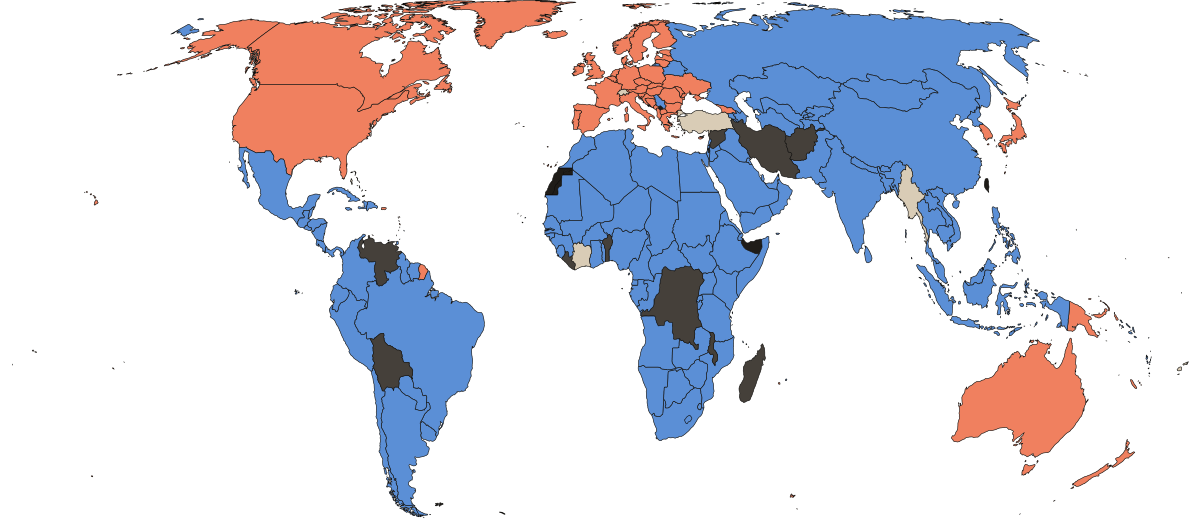
- Yes
- No
- Abstained
- Didn't vote
- Not a UN member
Which countries voted against?
The 51 countries that voted no in December 2025 included the United States, Ukraine, all 27 EU members, the United Kingdom, Canada, Australia, Japan and South Korea. The United States objects to provisions it says restrict freedom of expression. European and other Western countries say Russia uses the resolution to justify its war against Ukraine. Ukraine has voted no since 2014. In 2014 its delegate called Russia's attempt "to present itself as a champion of combating Nazism and neo-Nazism" cynical.
 United States
 Albania
 Andorra
 Australia
 Austria
 Belgium
 Bosnia and Herzegovina
 Bulgaria
 Canada
 Croatia
 Cyprus
 Czechia
 Denmark
 Estonia
 Finland
 France
 Georgia
 Germany
 Greece
 Hungary
 Iceland
 Ireland
 Italy
 Japan
 Latvia
 Liechtenstein
 Lithuania
 Luxembourg
 Malta
 Marshall Islands
 Micronesia
 Moldova
 Monaco
 Montenegro
 Netherlands
 New Zealand
 North Macedonia
 Norway
 Palau
 Papua New Guinea
 Poland
 Portugal
 Romania
 San Marino
 Slovakia
 Slovenia
 South Korea
 Spain
 Sweden
 Ukraine
 United Kingdom
How did the big powers vote?
How has the vote changed since 2005?
The Assembly first adopted the resolution on December 16, 2005, by 114 to 4, with 57 abstentions. The 4 no votes were Japan, the Marshall Islands, Micronesia and the United States. From 2007 to 2021, between 1 and 4 countries voted no each year, except in 2011. Most Western countries abstained. Support peaked at 136 yes votes in 2016.
In 2011, 24 countries voted no. Poland, speaking for the EU, said the text had deteriorated on freedom of expression, the role of civil society and the independence of the Special Rapporteur. It also said monuments were "an internal matter for States." Germany, Italy and Austria abstained. In 2012 most of those countries returned to abstaining. Cyprus, speaking for the EU, said "some of the most controversial language introduced into the draft resolution in 2011 had been removed."
In 2022, after Russia's invasion of Ukraine, 43 countries switched from abstaining to no. They included all 27 EU members, the United Kingdom, Australia, Canada and Japan. The number of no votes rose from 2 to 50. Since then the result has stayed close to that level. In 2025 the resolution passed 119 to 51, with 10 abstentions.
- Yes
- No
- Abstained
- Didn't vote
Why does the United States vote no?
The United States has voted no every year since the resolution was first introduced in 2005. Its objections fall into two categories: free expression and politicization.
On free expression, the United States says the resolution conflicts with the First Amendment. Deputy Representative Jonathan Shrier told the Third Committee on November 14, 2025: "Free speech, even odious speech, is protected under the U.S. Constitution." The resolution's operative paragraph 22 says racist acts "may not be justifiable as exercises of freedom of peaceful assembly, freedom of association and freedom of expression." Deputy Representative Nicholas Hill said in 2021 that "the United States Supreme Court has consistently affirmed the constitutional right to freedom of speech and the rights of peaceful assembly and association, including by avowed Nazis."
On politicization, the United States has said Russia uses the resolution for its own aims. Deputy Representative Nicholas Hill said in 2021 that the text tried "to legitimize Russian disinformation campaigns denigrating neighboring nations." In 2024, Counselor Edward Heartney called it "a shameful political ploy" and "a thinly veiled effort to justify Russia's war of aggression against Ukraine." In 2025 the United States did not mention Russia. It voted no on the amendment about Russia's war, saying "The UN can no longer afford to waste its resources where there is little or no impact." On November 10, 2026, Deputy Representative Yaryna Ferencevych said "this resolution is not designed to actually combat modern Nazism, anti-Semitism, and other dehumanizing and dangerous ideologies."
Did only the US and Ukraine vote against condemning Nazism?
From 2016 to 2021, the United States and Ukraine were the only 2 countries that voted no in every plenary. That fact circulated on social media, often framed as evidence that both countries support Nazism. Myth Detector is a Georgian fact-checking organization. In January 2022, when it was part of Facebook's fact-checking program, it labelled this framing "Manipulation." It said the information about the resolution was "being disseminated without context" and noted that the United States objected on free-expression grounds.
The framing leaves out that most Western countries abstained rather than voting yes. It also leaves out who sponsored the text. The 2005 draft was introduced on behalf of Belarus, Cuba, Russia and Tajikistan. North Korea, Nigeria, South Africa, Sudan and Venezuela joined later. Ukraine voted no from 2014, after Russia's annexation of Crimea. According to the UN summary record, Ukraine's delegate said in November 2014 that Ukrainians "condemned Hitler and Stalin equally." He opposed "the cynical attempt of the Russian Federation to present itself as a champion of combating Nazism and neo-Nazism." He said Ukraine could not support the text unless Stalinism was condemned along with Nazism.
After Russia's full-scale invasion in February 2022, 50 countries voted no in December 2022.
Why did Europe switch to no in 2022?
On February 24, 2022, President Vladimir Putin announced the invasion of Ukraine, saying Russia would "seek to demilitarise and denazify Ukraine." When the resolution came up for a vote in December 2022, 43 countries that had previously abstained switched to no. Of these, 39 were European. The others were Australia, Canada, Japan and New Zealand.
The EU's representative, Czechia's Mrs. Aldorf, told the General Assembly on December 15, 2022: "Today, under a false pretence of fighting Nazism, Russia has brought the horrors of war back to Europe." She said the EU rejected "the inaccurate and inappropriate use of the term 'de-Nazification' by Russia." The United Kingdom's Mr. Croker said in the Third Committee that "despite President Putin's absurd claims that he was denazifying Ukraine, he was in fact engaged in an illegal war." Australia's Mr. Fifield said Australia "had changed its long-standing position of abstaining" because of "serious concerns that the draft resolution would continue to be used to justify the illegal war in Ukraine."
Since 2022, the Third Committee has adopted an amendment each year saying Russia "has sought to justify its territorial aggression against Ukraine on the purported basis of eliminating neo-Nazism." In 2025 its sponsors were Albania, Australia, Japan, Liechtenstein, the Marshall Islands, New Zealand, Norway and Ukraine. It has been operative paragraph 4 of the adopted resolution every year since 2022.
Abstained→No43
- Albania
- Andorra
- Australia
- Austria
- Belgium
- Bulgaria
- Canada
- Croatia
- Cyprus
- Czechia
- Denmark
- Estonia
- Finland
- France
- Georgia
- Germany
- Greece
- Hungary
- Iceland
- Ireland
- Italy
- Japan
- Latvia
- Liechtenstein
- Lithuania
- Luxembourg
- Malta
- Moldova
- Monaco
- Montenegro
- Netherlands
- New Zealand
- North Macedonia
- Norway
- Poland
- Portugal
- Romania
- San Marino
- Slovakia
- Slovenia
- Spain
- Sweden
- United Kingdom
Yes→Abstained4
 Ecuador
 Myanmar
 Panama
- Papua New Guinea
Yes→No2
- Bosnia and Herzegovina
 Kiribati
Abstained→Yes1
 Solomon Islands
Unchanged: 115 yes both times, 4 abstained both times, 2 no both times. Countries that didn't vote on one of the two, or weren't members yet, are left out.
What do Russia and the supporters say?
Russia introduced the first draft in 2005. Its delegate, Grigory Lukiyantsev, said "persons who took part in Nazist manifestations, including Nazi veterans, must not be made into heroes." He cited the erection of monuments to Nazis and the arrest of anti-fascists. Lukiyantsev was still presenting the resolution in 2025, two decades later, as a director in Russia's foreign ministry. In 2011 he said "a central thoroughfare in a European town had been renamed in honour of a Waffen SS battalion" and called attempts to revisit the Nuremberg judgments "blasphemy."
Russia frames the resolution as thematic, not country-specific. After the 2022 amendment was adopted, Russia's delegate Kuzmin told the General Assembly: "De-Nazification is not a pretext. It is one of the goals of the special operation, and we will see it through to the end." From 2023 onward, Russia has instead stressed the text's thematic character and called the amendment a "procedural ploy."
Supporters differ on the amendment. Israel, which votes yes, said in 2022 that its vote "should not be seen as a green light for countries to use unacceptable comparisons with Nazi ideology or the Holocaust in the context of the war in Ukraine." China said in 2024 that the amendment "seeks to force country-specific elements into that thematic resolution." South Africa said in 2024 that "thematic debates were not the appropriate setting to discuss country-specific issues."
How did each region vote?
In Europe, 41 of 47 members voted no, 5 voted yes and 1 abstained. In Africa, 47 of 54 voted yes. In the Americas, 28 of 35 voted yes and 2 voted no. In Asia, 25 of 29 voted yes. In the Middle East, 11 of 14 voted yes. In Oceania, 6 of 14 voted no and 4 abstained.
- Europe47 countries 5 yes41 no1 abstained
- Americas35 countries 28 yes2 no2 abstained
- Asia29 countries 25 yes2 no1 abstained
- Oceania14 countries 3 yes6 no4 abstained
- Middle East14 countries 11 yes0 no1 abstained
- Africa54 countries 47 yes0 no1 abstained
What did the resolution say?
- The resolution "expresses deep concern about the glorification, in any form, of the Nazi movement, neo-Nazism and former members of the Waffen SS organization, including by erecting monuments and memorials" (operative paragraph 6).
- It "notes with alarm that the Russian Federation has sought to justify its territorial aggression against Ukraine on the purported basis of eliminating neo-Nazism" (operative paragraph 4, inserted by amendment).
- It says racist acts "may not be justifiable as exercises of freedom of peaceful assembly, freedom of association and freedom of expression" (operative paragraph 22).
- It "condemns without reservation any denial of or attempt to deny the Holocaust, as well as any manifestation of religious intolerance, incitement, harassment or violence against persons or communities, on the basis of ethnic origin or religious belief" (operative paragraph 26).
- It "expresses serious concern regarding attempts to prohibit, at the legislative level, symbols associated in States with the victory over Nazism" (operative paragraph 30).
How did every country vote?
| Country | Region | Vote |
|---|---|---|
 Afghanistan | Asia | Didn't vote |
| Albania | Europe | No |
 Algeria | Africa | Yes |
| Andorra | Europe | No |
 Angola | Africa | Yes |
 Antigua and Barbuda | Americas | Yes |
 Argentina | Americas | Yes |
 Armenia | Europe | Yes |
| Australia | Oceania | No |
| Austria | Europe | No |
 Azerbaijan | Europe | Yes |
 Bahamas | Americas | Abstained |
 Bahrain | Middle East | Yes |
 Bangladesh | Asia | Yes |
 Barbados | Americas | Yes |
 Belarus | Europe | Yes |
| Belgium | Europe | No |
 Belize | Americas | Yes |
 Benin | Africa | Didn't vote |
 Bhutan | Asia | Yes |
 Bolivia | Americas | Didn't vote |
| Bosnia and Herzegovina | Europe | No |
 Botswana | Africa | Yes |
 Brazil | Americas | Yes |
 Brunei | Asia | Yes |
| Bulgaria | Europe | No |
 Burkina Faso | Africa | Yes |
 Burundi | Africa | Yes |
 Cambodia | Asia | Yes |
 Cameroon | Africa | Yes |
| Canada | Americas | No |
 Cape Verde | Africa | Yes |
 Central African Republic | Africa | Yes |
 Chad | Africa | Yes |
 Chile | Americas | Yes |
 China | Asia | Yes |
 Colombia | Americas | Yes |
 Comoros | Africa | Yes |
 Costa Rica | Americas | Yes |
 Côte d'Ivoire | Africa | Abstained |
| Croatia | Europe | No |
 Cuba | Americas | Yes |
| Cyprus | Europe | No |
| Czechia | Europe | No |
| Denmark | Europe | No |
 Djibouti | Africa | Yes |
 Dominica | Americas | Abstained |
 Dominican Republic | Americas | Yes |
 DR Congo | Africa | Didn't vote |
| Ecuador | Americas | Yes |
 Egypt | Africa | Yes |
 El Salvador | Americas | Yes |
 Equatorial Guinea | Africa | Yes |
 Eritrea | Africa | Yes |
| Estonia | Europe | No |
 Eswatini | Africa | Yes |
 Ethiopia | Africa | Yes |
 Fiji | Oceania | Abstained |
| Finland | Europe | No |
| France | Europe | No |
 Gabon | Africa | Yes |
 Gambia | Africa | Yes |
| Georgia | Europe | No |
| Germany | Europe | No |
 Ghana | Africa | Yes |
| Greece | Europe | No |
 Grenada | Americas | Yes |
 Guatemala | Americas | Yes |
 Guinea | Africa | Yes |
 Guinea-Bissau | Africa | Yes |
 Guyana | Americas | Yes |
 Haiti | Americas | Yes |
 Honduras | Americas | Yes |
| Hungary | Europe | No |
| Iceland | Europe | No |
 India | Asia | Yes |
 Indonesia | Asia | Yes |
 Iran | Middle East | Didn't vote |
 Iraq | Middle East | Yes |
| Ireland | Europe | No |
 Israel | Middle East | Yes |
| Italy | Europe | No |
 Jamaica | Americas | Yes |
| Japan | Asia | No |
 Jordan | Middle East | Yes |
 Kazakhstan | Asia | Yes |
 Kenya | Africa | Yes |
| Kiribati | Oceania | Didn't vote |
 Kuwait | Middle East | Yes |
 Kyrgyzstan | Asia | Yes |
 Laos | Asia | Yes |
| Latvia | Europe | No |
 Lebanon | Middle East | Yes |
 Lesotho | Africa | Yes |
 Liberia | Africa | Didn't vote |
 Libya | Africa | Yes |
| Liechtenstein | Europe | No |
| Lithuania | Europe | No |
| Luxembourg | Europe | No |
 Madagascar | Africa | Didn't vote |
 Malawi | Africa | Didn't vote |
 Malaysia | Asia | Yes |
 Maldives | Asia | Yes |
 Mali | Africa | Yes |
| Malta | Europe | No |
| Marshall Islands | Oceania | No |
 Mauritania | Africa | Yes |
 Mauritius | Africa | Yes |
 Mexico | Americas | Yes |
| Micronesia | Oceania | No |
| Moldova | Europe | No |
| Monaco | Europe | No |
 Mongolia | Asia | Yes |
| Montenegro | Europe | No |
 Morocco | Africa | Yes |
 Mozambique | Africa | Yes |
| Myanmar | Asia | Abstained |
 Namibia | Africa | Yes |
 Nauru | Oceania | Yes |
 Nepal | Asia | Yes |
| Netherlands | Europe | No |
| New Zealand | Oceania | No |
 Nicaragua | Americas | Yes |
 Niger | Africa | Yes |
 Nigeria | Africa | Yes |
 North Korea | Asia | Yes |
| North Macedonia | Europe | No |
| Norway | Europe | No |
 Oman | Middle East | Yes |
 Pakistan | Asia | Yes |
| Palau | Oceania | No |
| Panama | Americas | Yes |
| Papua New Guinea | Oceania | No |
 Paraguay | Americas | Yes |
 Peru | Americas | Yes |
 Philippines | Asia | Yes |
| Poland | Europe | No |
| Portugal | Europe | No |
 Qatar | Middle East | Yes |
 Republic of the Congo | Africa | Yes |
| Romania | Europe | No |
 Russia | Europe | Yes |
 Rwanda | Africa | Yes |
 Saint Kitts and Nevis | Americas | Yes |
 Saint Lucia | Americas | Yes |
 Saint Vincent and the Grenadines | Americas | Didn't vote |
 Samoa | Oceania | Abstained |
| San Marino | Europe | No |
 São Tomé and Príncipe | Africa | Didn't vote |
 Saudi Arabia | Middle East | Yes |
 Senegal | Africa | Yes |
 Serbia | Europe | Yes |
 Seychelles | Africa | Yes |
 Sierra Leone | Africa | Yes |
 Singapore | Asia | Yes |
| Slovakia | Europe | No |
| Slovenia | Europe | No |
| Solomon Islands | Oceania | Yes |
 Somalia | Africa | Yes |
 South Africa | Africa | Yes |
| South Korea | Asia | No |
 South Sudan | Africa | Yes |
| Spain | Europe | No |
 Sri Lanka | Asia | Yes |
 Sudan | Africa | Yes |
 Suriname | Americas | Yes |
| Sweden | Europe | No |
 Switzerland | Europe | Abstained |
 Syria | Middle East | Didn't vote |
 Tajikistan | Asia | Yes |
 Tanzania | Africa | Yes |
 Thailand | Asia | Yes |
 Timor-Leste | Asia | Yes |
 Togo | Africa | Yes |
 Tonga | Oceania | Abstained |
 Trinidad and Tobago | Americas | Yes |
 Tunisia | Africa | Yes |
 Turkey | Middle East | Abstained |
 Turkmenistan | Asia | Yes |
 Tuvalu | Oceania | Abstained |
 Uganda | Africa | Yes |
| Ukraine | Europe | No |
 United Arab Emirates | Middle East | Yes |
| United Kingdom | Europe | No |
| United States | Americas | No |
 Uruguay | Americas | Yes |
 Uzbekistan | Asia | Yes |
 Vanuatu | Oceania | Yes |
 Venezuela | Americas | Didn't vote |
 Vietnam | Asia | Yes |
 Yemen | Middle East | Yes |
 Zambia | Africa | Yes |
 Zimbabwe | Africa | Yes |