
192 UN members · November 2026
Which countries recognize Israel?
As of November 2026, 164 of the 192 UN member states other than Israel recognize it. 21 members do not recognize Israel. 6 members have a disputed status, and 1 (Sudan) announced recognition that has not taken effect. The 21 non-recognizers include Saudi Arabia, Iran, Iraq, Indonesia, Pakistan, Malaysia, Algeria and Kuwait. Most are in the Middle East and Muslim-majority Asia and Africa. The most recent recognitions came in 2020, when the United Arab Emirates, Bahrain, Morocco and Bhutan established relations. Bolivia restored relations in December 2025, and Colombia restored them in August 2026. No member withdrew recognition in 2025 or 2026.
- Recognize
- 164
- Announced
- 1
- Disputed
- 6
- Don't
- 21
Of the 192 UN members, as of November 2026.
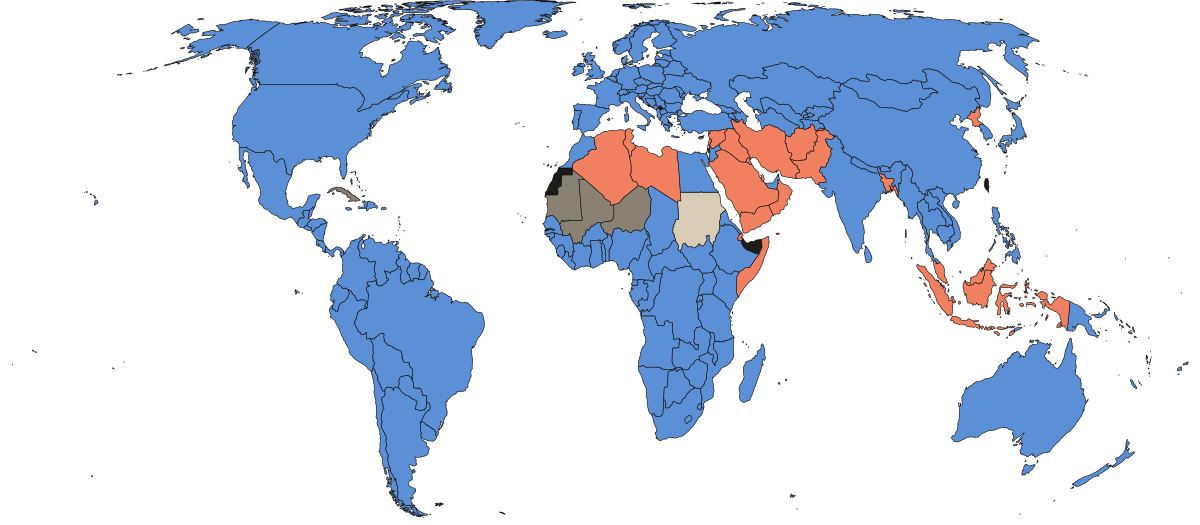
- Recognizes
- Announced, not in force
- Disputed
- Does not recognize
- Israel
- 1948 to 1949
- 1950 to 1991
- Since 1992
- Announced, not in force
- Disputed
- Does not recognize
Which countries don't recognize Israel?
As of November 2026, 21 of the 192 UN member states do not recognize Israel. They include 9 Middle Eastern states (Iran, Iraq, Saudi Arabia, Kuwait, Lebanon, Syria, Yemen, Oman and Qatar), 5 in Africa (Algeria, Djibouti, Libya, Somalia and Tunisia) and 7 in Asia (Afghanistan, Bangladesh, Brunei, Indonesia, Malaysia, North Korea and Pakistan). Saudi Arabia and Indonesia are G20 members. Other counts differ. In November 2026 Wikipedia counted 23 non-recognizers: these 21, Sudan and Comoros. An older, often-quoted figure of 28 adds the 6 disputed members and Venezuela.
 Afghanistan
 Algeria
 Bangladesh
 Brunei
 Comoros (disputed)
 Cuba (disputed)
 Djibouti
 Indonesia
 Iran
 Iraq
 Kuwait
 Lebanon
 Libya
 Malaysia
 Maldives (disputed)
 Mali (disputed)
 Mauritania (disputed)
 Niger (disputed)
 North Korea
 Oman
 Pakistan
 Qatar
 Saudi Arabia
 Somalia
 Sudan (announced)
 Syria
 Tunisia
 Yemen
When did countries recognize Israel?
Israel declared independence on May 14, 1948. The United States recognized it the same day, 11 minutes after the declaration. President Truman's typed press release said "Jewish state," but he crossed those words out by hand and wrote "State of Israel." The Soviet Union gave full recognition on May 17, 1948. Nicaragua, Czechoslovakia, Poland and Yugoslavia followed on 18 May. By the end of 1948, 22 of today's UN members had recognized Israel. Another 28 recognized it in 1949, and the General Assembly admitted Israel on May 11, 1949.
Most newly independent African states established relations between 1960 and 1967. By early 1972, Israel had relations with 32 of the 41 member states of the Organisation of African Unity. After the 1967 war, the Soviet Union and most Eastern Bloc states cut ties. In 1973, 25 African states broke relations, most of them during and after the October 1973 war. Among OAU members, only Malawi, Eswatini, Lesotho and Mauritius kept their ties, and Mauritius cut them in 1976.
Most post-Soviet states and China recognized Israel in 1991 and 1992. In 1992 alone, 17 of today's UN members recognized Israel for the first time. India had recognized Israel in 1950 but opened full relations only on January 29, 1992. The Abraham Accords brought the UAE, Bahrain, Morocco and Sudan in 2020 and 2021, though Sudan's deal has not taken effect. Bhutan also established relations in December 2020.
Where do the major powers stand?
All five permanent members of the Security Council recognize Israel. The United States was the first country to recognize it, in 1948. The Soviet Union recognized it the same week, and Russia continued relations after 1991. China established relations on January 24, 1992. The United Kingdom gave de facto recognition in January 1949 and full recognition in April 1950. France recognized Israel in January 1949.
Among the G20, 17 of 19 member states recognize Israel. The two that do not are Indonesia and Saudi Arabia. Indonesia's President Prabowo Subianto said at the United Nations on September 22, 2025 that Indonesia would recognize Israel once Israel recognizes an independent Palestine. Saudi Arabia's Crown Prince Mohammed bin Salman said in September 2024 that the Kingdom will not establish relations without an independent Palestinian state with East Jerusalem as its capital.
Turkey was the first Muslim-majority country to recognize Israel, in March 1949. It has recalled its ambassador and cut trade over the war in Gaza, but relations remain formally in place. Egypt recognized Israel in the 1979 peace treaty, and Jordan did so in the 1994 peace treaty. The UAE normalized relations under the Abraham Accords in 2020. Iran recognized Israel de facto under the Shah in 1950 but has not recognized it since the 1979 revolution.
 United StatesSince 1948
 ChinaSince 1992
 RussiaSince 1948
 United KingdomSince 1949
 FranceSince 1949
 GermanySince 1965
 JapanSince 1952
 IndiaSince 1950
 BrazilSince 1949
 TurkeySince 1949
 EgyptSince 1979
 JordanSince 1994
 United Arab EmiratesSince 2020
- Saudi ArabiaNo
- IndonesiaNo
- PakistanNo
- IranNo
- MalaysiaNo
- AlgeriaNo
 NigeriaSince 1960
Why do some countries not recognize Israel?
Most of the 21 non-recognizing states cite the unresolved status of Palestine. The 1967 Arab League summit in Khartoum declared "no peace with Israel, no recognition of Israel, no negotiations with it." The Arab Peace Initiative of 2002 offered normal relations with Israel in return for a full withdrawal and a Palestinian state. Saudi Arabia, Algeria and Indonesia have each tied normalization to a Palestinian state.
Iraq went further. A 2022 law makes any normalization with Israel a crime punishable by death or life imprisonment. Tunisia's President Kais Saied has called normalization "high treason." Pakistan's Foreign Office said in March 2025 that Pakistan does not recognize Israel and supports a Palestinian state based on pre-1967 borders.
Israel's leaders have presented wider recognition as a path to peace in the region. Israel's Declaration of Independence of May 14, 1948 says: "WE EXTEND our hand to all neighbouring states and their peoples in an offer of peace and good neighbourliness." Prime Minister Benjamin Netanyahu told the UN General Assembly in September 2023 that "we must not give the Palestinians a veto over new peace treaties with Arab states." In September 2025, Netanyahu told the General Assembly that "our victory would lead to a dramatic expansion of the historic Abraham Accords." He also said his opposition to a Palestinian state is "the policy of the state and people of the State of Israel."
Which countries recognize Israel but have cut ties?
Several countries recognize Israel but have broken, suspended or reduced relations, mostly since the war in Gaza began in October 2023. Belize suspended relations on November 14, 2023, and the suspension was still in place as of September 2026. Nicaragua broke relations on October 11, 2024. Bolivia broke them on October 31, 2023 and restored them on December 9, 2025. Colombia broke them in May 2024 and restored them on August 11, 2026, then opened an embassy in Jerusalem in October 2026. Venezuela cut relations in January 2009 and restored consular ties on August 11, 2026. Full relations had not been restored as of November 2026.
Turkey recalled its ambassador in November 2023, cut trade in May 2024 and closed its ports and airspace to Israel in 2025. On November 13, 2024, President Erdogan said Turkey had "cut off relations with Israel." Israel's foreign ministry denied that ties had been cut, and analysts concluded that relations continue at a low level. South Africa recalled its diplomats in November 2023, and in January 2026 each side expelled the other's top envoy. Relations have not been formally cut.
Jordan recalled its ambassador on November 1, 2023. As of July 2026, Jordan had named a new ambassador but had not sent the envoy to Israel. Brazil recalled its ambassador in May 2024. Chile and Honduras recalled their ambassadors in late 2023 but sent new ones back by August 2026.
Will more countries recognize Israel?
The Abraham Accords, signed in 2020 by the UAE and Bahrain, were meant to expand. In May 2026, President Trump posted that he was "mandatorily requesting that all Countries immediately sign the Abraham Accords," naming Saudi Arabia and Qatar first. Kazakhstan announced in November 2025 that it would join, but a signing ceremony had not taken place as of November 2026.
Saudi Arabia has not agreed. An anonymous Saudi source told Israel's Kan news service on November 5, 2026 that normalization is "not on the agenda" while Netanyahu governs with his current coalition. Israel held an election on October 27, 2026, and on November 8, 2026 President Isaac Herzog asked Gadi Eisenkot to form the next government. President Trump said in July 2026 that a US civilian nuclear deal with Saudi Arabia depends on normalization, but the text of the agreement sent to Congress does not require it.
Indonesia's conditional offer (recognize Israel once Israel recognizes Palestine) is unchanged. Syria held US-backed security talks with Israel in 2025 and 2026, but those talks concern security and borders, not recognition, and have stalled since September 2026. Lebanon began direct talks with Israel in April 2026, also focused on a ceasefire and borders. Lebanon's President Joseph Aoun said on September 12, 2026 that there were no new negotiations. Sudan's 2021 Abraham Accords declaration has not been implemented because of the October 2021 coup and the civil war that began in April 2023.
Can Israelis visit countries that don't recognize Israel?
Most countries that do not recognize Israel refuse Israeli passports. Iran, Lebanon, Libya, Kuwait, Syria, Saudi Arabia, Iraq, Algeria, Bangladesh, Brunei, Pakistan, Yemen and Afghanistan all bar entry on an Israeli passport, according to the UK Foreign Office and other sources. Malaysia does not admit Israeli passport holders without special government permission. Indonesia allows them only with a "calling visa" cleared by several agencies, and very few are admitted.
The Maldives, whose status is disputed, banned Israeli passports under a law that took effect on April 15, 2025. In November 2026, President Muizzu said a new bill would make the ban permanent. Dual nationals can sometimes use another passport, but several countries also check for Israeli stamps or travel evidence.
Some passports exclude Israel by name. Pakistani passports say they are "valid for all countries of the world except Israel." Bangladesh dropped that wording in 2021 but reinstated it in a government order on July 19, 2026. Israeli law bars its own citizens from visiting Lebanon, Syria, Iraq, Yemen, Iran and Saudi Arabia without a government permit. Since January 2020, Israel has allowed travel to Saudi Arabia for religious and business reasons.
Every UN member, and since when
Dates are those when recognition or diplomatic relations were first established. For countries that cut relations and later restored them, the date shown is the original recognition. Some early dates reflect de facto recognition or the UN admission vote of May 11, 1949 rather than a formal announcement. A few dates differ between sources by a day or a month.
| Country | Region | Since | Status |
|---|---|---|---|
| AfghanistanHas never recognized Israel. The Taliban government, in power since August 2021, has said it will not recognize Israel. | Asia | No | |
 Albania | Europe | April 16, 1949 | Since 1949 |
| AlgeriaHas never recognized Israel and does not accept Israeli passports. President Tebboune said in 2025 that Algeria would normalize ties on the day a Palestinian state exists. | Africa | No | |
 Andorra | Europe | April 13, 1994 | Since 1994 |
 Angola | Africa | April 16, 1992 | Since 1992 |
 Antigua and Barbuda | Americas | June 22, 1983 | Since 1983 |
 Argentina | Americas | February 14, 1949 | Since 1949 |
 Armenia | Europe | April 4, 1992 | Since 1992 |
 Australia | Oceania | January 29, 1949 | Since 1949 |
 AustriaDe facto recognition on March 15, 1949; full recognition or relations on May 8, 1956. | Europe | March 15, 1949 | Since 1949 |
 Azerbaijan | Europe | April 7, 1992 | Since 1992 |
 Bahamas | Americas | September 24, 1974 | Since 1974 |
 BahrainNormalized relations under the Abraham Accords on September 15, 2020. In November 2023 its parliament said ambassadors had been recalled, but the government kept relations; ambassadors were serving in both capitals in 2026. | Middle East | September 15, 2020 | Since 2020 |
| BangladeshHas never recognized Israel. It dropped the words "except Israel" from its passports in 2021; a government order in July 2026 puts them back on all new passports. | Asia | No | |
 Barbados | Americas | August 29, 1967 | Since 1967 |
 BelarusAs the Byelorussian SSR, part of the Soviet Union, it voted for Israel's admission to the UN in 1949; that vote is not counted here as recognition. Independent Belarus established relations with Israel in 1992. | Europe | 1992 | Since 1992 |
 Belgium | Europe | January 15, 1950 | Since 1950 |
 BelizeSuspended relations on November 14, 2023 over the Gaza war; the suspension was still in place as of September 2026. | Americas | September 6, 1984 | Since 1984 |
 BeninCut relations in October 1973 and restored them in July 1992. | Africa | December 5, 1961 | Since 1961 |
 BhutanEstablished diplomatic relations on December 12, 2020. | Asia | December 12, 2020 | Since 2020 |
 BoliviaDe facto recognition on February 22, 1949. Cut relations in January 2009, restored them in November 2019, cut them again on October 31, 2023 over the Gaza war, and restored them on December 9, 2025. | Americas | February 22, 1949 | Since 1949 |
 Bosnia and Herzegovina | Europe | September 26, 1997 | Since 1997 |
 BotswanaCut relations on November 12, 1973 and restored them on December 7, 1993. | Africa | May 24, 1967 | Since 1967 |
| BrazilRecalled its ambassador in May 2024 after a dispute over the Gaza war; relations remain in place without ambassadors. | Americas | February 7, 1949 | Since 1949 |
| BruneiHas never recognized Israel and does not accept Israeli passports. | Asia | No | |
 BulgariaCut relations on June 10, 1967 and restored them on May 3, 1990. | Europe | December 4, 1948 | Since 1948 |
 Burkina FasoCut relations in October 1973 and restored them in October 1993. | Africa | July 5, 1961 | Since 1961 |
 BurundiCut relations on May 16, 1973 and restored them in March 1995. | Africa | December 22, 1962 | Since 1962 |
 CambodiaBroke off relations in 1975 and restored them on October 5, 1993. | Asia | August 30, 1960 | Since 1960 |
 CameroonCut relations in October 1973 and restored them in August 1986. | Africa | September 15, 1960 | Since 1960 |
 CanadaDe facto recognition announced on December 24, 1948; full recognition and relations on May 11, 1949. | Americas | December 24, 1948 | Since 1948 |
 Cape Verde | Africa | July 17, 1994 | Since 1994 |
 Central African RepublicCut relations in October 1973 and restored them on January 16, 1989. | Africa | November 10, 1961 | Since 1961 |
 ChadCut relations on November 28, 1972 and restored them on January 20, 2019. Recalled its chargé d'affaires in November 2023 over the Gaza war. | Africa | January 10, 1961 | Since 1961 |
 ChileRecalled its ambassador on October 31, 2023 over the Gaza war; President José Antonio Kast's new ambassador presented credentials on August 3, 2026. | Americas | May 11, 1949 | Since 1949 |
| ChinaThe People's Republic of China established relations on January 24, 1992. Israel had recognized the People's Republic in January 1950. The earlier Republic of China government recognized Israel on March 1, 1949. | Asia | January 24, 1992 | Since 1992 |
 ColombiaCut relations in May 2024 under President Gustavo Petro over the Gaza war. President Abelardo de la Espriella's government restored them on August 11, 2026 and opened an embassy in Jerusalem in October 2026. | Americas | February 1, 1949 | Since 1949 |
| ComorosIts president signed an agreement with Israel in Paris on November 10, 1994 to establish full relations. Within days Comoros said normalization would wait for a full Middle East peace, and no relations followed. Israel said at the time that the recognition remained valid; most lists count Comoros as not recognizing Israel. | Africa | November 10, 1994 | Disputed |
 Costa Rica | Americas | June 19, 1948 | Since 1948 |
 Côte d'IvoireCut relations on November 8, 1973 and restored them on February 12, 1986. | Africa | May 24, 1961 | Since 1961 |
 Croatia | Europe | September 4, 1997 | Since 1997 |
| CubaRecognized Israel in January 1949, before the revolution. Fidel Castro's government broke relations in September 1973 and has made no statement on recognition since. Some lists count Cuba as recognizing Israel, others as not. | Americas | January 1949 | Disputed |
 Cyprus | Europe | January 21, 1961 | Since 1961 |
 CzechiaRecognized as part of Czechoslovakia. Relations were cut from June 1967 to February 1990. | Europe | May 18, 1948 | Since 1948 |
 DenmarkDe facto recognition on February 2, 1949; full recognition or relations on July 12, 1950. | Europe | February 2, 1949 | Since 1949 |
| DjiboutiHas never recognized Israel. | Africa | No | |
 Dominica | Americas | January 1978 | Since 1978 |
 Dominican Republic | Americas | December 29, 1948 | Since 1948 |
 DR CongoCut relations in October 1973 and restored them in May 1982. | Africa | June 26, 1960 | Since 1960 |
 Ecuador | Americas | February 2, 1949 | Since 1949 |
| EgyptFirst Arab state to recognize Israel, in the peace treaty signed on March 26, 1979 (relations from 1980). President Sadat's visit to Jerusalem in November 1977 is sometimes counted as de facto recognition. | Africa | March 26, 1979 | Since 1979 |
 El Salvador | Americas | September 11, 1948 | Since 1948 |
 Equatorial GuineaCut relations in 1973 and restored them in January 1994. | Africa | 1968 | Since 1968 |
 Eritrea | Africa | May 6, 1993 | Since 1993 |
 Estonia | Europe | January 9, 1992 | Since 1992 |
 EswatiniOne of the few African states that never cut relations with Israel. | Africa | September 1968 | Since 1968 |
 EthiopiaCut relations in October 1973 and restored them in November 1989. | Africa | October 24, 1961 | Since 1961 |
 Fiji | Oceania | August 1970 | Since 1970 |
 FinlandDe facto recognition on June 11, 1948; full recognition or relations on March 18, 1949. | Europe | June 11, 1948 | Since 1948 |
| FranceDe facto recognition on January 24, 1949; full recognition on May 11, 1949. | Europe | January 24, 1949 | Since 1949 |
 GabonCut relations in October 1973 and restored them in September 1993. | Africa | November 15, 1960 | Since 1960 |
 GambiaCut relations in October 1973 and restored them in September 1992. | Africa | June 3, 1965 | Since 1965 |
 Georgia | Europe | June 1, 1992 | Since 1992 |
| GermanyWest Germany signed a reparations agreement with Israel on September 10, 1952 and established full diplomatic relations on May 12, 1965. East Germany never recognized Israel. | Europe | May 12, 1965 | Since 1965 |
 GhanaIsrael opened a consulate on the day of Ghana's independence. Ghana cut relations on October 28, 1973 and restored them on August 9, 1994. | Africa | March 6, 1957 | Since 1957 |
 GreeceDe facto recognition on March 15, 1949; full diplomatic relations only on May 21, 1990. | Europe | March 15, 1949 | Since 1949 |
 Grenada | Americas | January 1975 | Since 1975 |
 GuatemalaAmong the first countries to recognize Israel; its UN envoy Jorge García Granados had pushed for the 1947 partition plan. | Americas | May 19, 1948 | Since 1948 |
 GuineaRelations were set up in 1959. Guinea cut them on June 12, 1967 and restored them on July 20, 2016. | Africa | 1959 | Since 1959 |
 Guinea-Bissau | Africa | March 1994 | Since 1994 |
 GuyanaCut relations in March 1974 and restored them in March 1992. | Americas | April 1967 | Since 1967 |
 HaitiDe facto recognition on February 26, 1949; full recognition or relations in January 1950. | Americas | February 26, 1949 | Since 1949 |
 HondurasRecognized de facto on September 11, 1948. Recalled its ambassador on November 3, 2023 over the Gaza war; under President Nasry Asfura, ambassadors were back in both capitals by August 2026. | Americas | September 11, 1948 | Since 1948 |
 HungaryRecognized de facto on May 24, 1948. Cut relations in 1967 and restored them in September 1989. | Europe | May 24, 1948 | Since 1948 |
 IcelandDe facto recognition in February 1949; full recognition in December 1950. | Europe | February 1949 | Since 1949 |
| IndiaRecognized Israel on September 17, 1950 but established full diplomatic relations only on January 29, 1992. | Asia | September 17, 1950 | Since 1950 |
| IndonesiaHas never recognized Israel. On September 22, 2025 at the UN, President Prabowo said Indonesia would recognize Israel once Israel recognizes an independent Palestine; the foreign ministry says there will be no recognition before that. | Asia | No | |
| IranUnder the Shah, Iran recognized Israel de facto on March 6, 1950 (some sources say 14 March) but never de jure. The Islamic Republic cut all ties on February 18, 1979 and does not recognize Israel. | Middle East | No | |
| IraqHas never recognized Israel. A 2022 law makes any normalization of relations with Israel a crime punishable by death or life imprisonment. | Middle East | No | |
 IrelandDe facto recognition on February 12, 1949; full recognition in 1963; embassies opened in 1993 (Israel's) and 1996 (Ireland's). Israel closed its Dublin embassy in December 2024. | Europe | February 12, 1949 | Since 1949 |
 ItalyDe facto recognition on February 8, 1949; full recognition or relations on January 19, 1950. | Europe | February 8, 1949 | Since 1949 |
 Jamaica | Americas | August 29, 1962 | Since 1962 |
| Japan | Asia | May 15, 1952 | Since 1952 |
| JordanRecognized Israel in the peace treaty of October 26, 1994. Recalled its ambassador on November 1, 2023 over the Gaza war. As of July 2026, Jordan had named a new ambassador but had not sent the envoy to Israel. | Middle East | October 26, 1994 | Since 1994 |
 KazakhstanRelations since April 10, 1992. Announced on November 6, 2025 that it would join the Abraham Accords; a formal signing ceremony had not been reported as of November 2026. | Asia | April 10, 1992 | Since 1992 |
 KenyaCut relations in November 1973 and restored them on December 30, 1988. | Africa | December 1963 | Since 1963 |
 Kiribati | Oceania | May 21, 1984 | Since 1984 |
| KuwaitHas never recognized Israel and does not accept Israeli passports. | Middle East | No | |
 Kyrgyzstan | Asia | March 1992 | Since 1992 |
 LaosBroke off relations in 1973 and restored them on December 6, 1993. | Asia | February 1957 | Since 1957 |
 Latvia | Europe | January 6, 1992 | Since 1992 |
| LebanonHas never had relations with Israel. The May 17, 1983 agreement with Israel, sometimes counted as brief recognition, was cancelled by Lebanon on March 5, 1984. Direct talks with Israel began in Washington in April 2026 but are about a ceasefire and borders, not recognition. | Middle East | No | |
 Lesotho | Africa | October 4, 1966 | Since 1966 |
 LiberiaDe facto recognition in February 1949. Cut relations on November 2, 1973 and restored them on August 13, 1983. | Africa | February 1949 | Since 1949 |
| LibyaHas never recognized Israel. In August 2023 the foreign minister of the Tripoli government was suspended and left the country after news of her meeting with Israel's foreign minister in Rome. | Africa | No | |
 Liechtenstein | Europe | January 1992 | Since 1992 |
 Lithuania | Europe | January 8, 1992 | Since 1992 |
 LuxembourgVoted for Israel's admission to the UN on May 11, 1949, which is counted as de facto recognition; full relations on January 16, 1950. | Europe | May 11, 1949 | Since 1949 |
 MadagascarCut relations in October 1973 and restored them in January 1994. | Africa | July 1, 1960 | Since 1960 |
 MalawiOne of the few African states that never cut relations with Israel. | Africa | July 15, 1964 | Since 1964 |
| MalaysiaHas never recognized Israel. Israeli passport holders cannot enter without special government permission. | Asia | No | |
| MaldivesEstablished relations with Israel in 1965 and suspended them in 1974. Cooperation agreements signed in 2009 were cancelled in 2014. A law in force since April 15, 2025 bars Israeli passport holders. Sources disagree on whether it still recognizes Israel. | Asia | October 29, 1965 | Disputed |
| MaliHad relations with Israel from 1960 and cut them on January 5, 1973. It has not restored them or commented on recognition since. Some lists count Mali as recognizing Israel, others as not. | Africa | 1960 | Disputed |
 MaltaDe facto recognition in January 1965; full recognition or relations in December 1965. | Europe | January 1965 | Since 1965 |
 Marshall Islands | Oceania | September 16, 1987 | Since 1987 |
| MauritaniaEstablished full relations on October 28, 1999, the third Arab League state to do so. It froze ties in 2009, and on March 20, 2010 its foreign minister said they were cut "in a complete and definitive way". It did not say it withdrew recognition, and sources disagree on whether it did. | Africa | October 28, 1999 | Disputed |
 MauritiusCut relations in July 1976 and restored them on September 30, 1993. | Africa | April 23, 1968 | Since 1968 |
 MexicoVoted for Israel's admission to the UN on May 11, 1949, which is counted as de facto recognition; full relations on April 4, 1952. | Americas | May 11, 1949 | Since 1949 |
 Micronesia | Oceania | November 23, 1988 | Since 1988 |
 Moldova | Europe | June 22, 1992 | Since 1992 |
 Monaco | Europe | January 1964 | Since 1964 |
 Mongolia | Asia | October 2, 1991 | Since 1991 |
 Montenegro | Europe | July 12, 2006 | Since 2006 |
 MoroccoAgreed to normalize relations on December 10, 2020 and signed a joint declaration on December 22, 2020. Earlier, low-level liaison offices operated from 1994 until Morocco closed them in October 2000. | Africa | December 10, 2020 | Since 2020 |
 Mozambique | Africa | July 23, 1993 | Since 1993 |
 Myanmar | Asia | July 13, 1953 | Since 1953 |
 Namibia | Africa | February 11, 1994 | Since 1994 |
 Nauru | Oceania | December 1994 | Since 1994 |
 Nepal | Asia | June 1, 1960 | Since 1960 |
 NetherlandsVoted for Israel's admission to the UN on May 11, 1949, which is counted as de facto recognition; full relations on January 16, 1950. | Europe | May 11, 1949 | Since 1949 |
 New ZealandDe facto recognition on January 29, 1949; full recognition or relations on July 28, 1950. | Oceania | January 29, 1949 | Since 1949 |
 NicaraguaRecognized Israel in May 1948. Cut relations in 1982 and restored them in October 1992. Cut them again in 2010, restored them in 2017, and cut them again on October 11, 2024 over the Gaza war. | Americas | May 18, 1948 | Since 1948 |
| NigerHad relations with Israel from about 1960. Cut them on January 4, 1973, restored them on November 28, 1996, and cut them again on April 21, 2002. It has not commented on recognition since. Some lists count Niger as recognizing Israel, others as not. | Africa | 1960 | Disputed |
| NigeriaCut relations on October 25, 1973 and restored them in May 1992. | Africa | October 1, 1960 | Since 1960 |
| North KoreaHas never recognized Israel. Contacts in 1993 did not lead to relations. | Asia | No | |
 North Macedonia | Europe | December 7, 1995 | Since 1995 |
 Norway | Europe | February 4, 1949 | Since 1949 |
| OmanDoes not recognize Israel. The two countries exchanged trade offices in January 1996, which Oman closed in October 2000. Prime Minister Netanyahu visited Muscat in October 2018. | Middle East | No | |
| PakistanHas never recognized Israel. Pakistani passports are not valid for travel to Israel. | Asia | No | |
 Palau | Oceania | October 2, 1994 | Since 1994 |
 Panama | Americas | June 19, 1948 | Since 1948 |
 Papua New Guinea | Oceania | 1978 | Since 1978 |
 Paraguay | Americas | September 7, 1948 | Since 1948 |
 Peru | Americas | February 9, 1949 | Since 1949 |
 PhilippinesVoted for Israel's admission to the UN on May 11, 1949, which is counted as de facto recognition; full relations on May 13, 1957. | Asia | May 11, 1949 | Since 1949 |
 PolandCut relations in June 1967 and restored them in February 1990. | Europe | May 18, 1948 | Since 1948 |
 Portugal | Europe | May 12, 1977 | Since 1977 |
| QatarDoes not recognize Israel. An Israeli trade office opened in Doha in 1996 and was closed in 2009. Qatar has hosted Israeli negotiators for Gaza ceasefire talks. | Middle East | No | |
 Republic of the CongoCut relations in December 1972 and restored them in August 1991. | Africa | November 9, 1960 | Since 1960 |
 Romania | Europe | June 12, 1948 | Since 1948 |
| RussiaThe Soviet Union was the first country to give full (de jure) recognition. It cut relations in June 1967; they were restored in October 1991 and Russia continued them. | Europe | May 17, 1948 | Since 1948 |
 RwandaCut relations in October 1973 and restored them on October 11, 1994. | Africa | July 1, 1962 | Since 1962 |
 Saint Kitts and Nevis | Americas | January 1984 | Since 1984 |
 Saint Lucia | Americas | January 1979 | Since 1979 |
 Saint Vincent and the Grenadines | Americas | January 1981 | Since 1981 |
 Samoa | Oceania | June 1977 | Since 1977 |
 San Marino | Europe | March 1, 1995 | Since 1995 |
 São Tomé and Príncipe | Africa | November 1993 | Since 1993 |
| Saudi ArabiaHas never recognized Israel. Says it will not establish relations without an independent Palestinian state with East Jerusalem as its capital. | Middle East | No | |
 SenegalCut relations in October 1973 and restored them in August 1994. | Africa | November 10, 1960 | Since 1960 |
 SerbiaRecognized as part of Yugoslavia in May 1948. Yugoslavia cut relations in 1967; Serbia's relations date from 1992. | Europe | May 1948 | Since 1948 |
 Seychelles | Africa | September 1992 | Since 1992 |
 Sierra LeoneCut relations in October 1973 and restored them in May 1992. | Africa | April 1961 | Since 1961 |
 Singapore | Asia | May 11, 1969 | Since 1969 |
 SlovakiaRecognized as part of Czechoslovakia. Relations were cut from June 1967 to February 1990. | Europe | May 18, 1948 | Since 1948 |
 Slovenia | Europe | April 28, 1992 | Since 1992 |
 Solomon Islands | Oceania | January 1989 | Since 1989 |
| SomaliaHas never recognized Israel. Israel recognized Somaliland on December 26, 2025. Somalia, which considers Somaliland part of its territory, condemned the move. | Africa | No | |
 South AfricaPrime Minister Jan Smuts gave de facto recognition on May 24, 1948; full recognition followed on May 14, 1949. Recalled its diplomats in November 2023 over the Gaza war; in January 2026 each side expelled the other's top envoy. Relations have not been formally cut. | Africa | May 24, 1948 | Since 1948 |
 South Korea | Asia | April 10, 1962 | Since 1962 |
 South SudanIsrael recognized South Sudan on July 10, 2011, a day after its independence; the two established full relations on July 28, 2011. | Africa | July 28, 2011 | Since 2011 |
 SpainSpain established relations only on January 17, 1986, after Franco's death. | Europe | January 17, 1986 | Since 1986 |
 Sri LankaCut relations in 1970; partial ties from 1984 were broken off again in the early 1990s, and full relations were restored in May 2000. | Asia | September 16, 1950 | Since 1950 |
| SudanAgreed on October 23, 2020 to normalize relations and signed the Abraham Accords declaration on January 6, 2021. No relations have been established: the 2021 coup and the civil war that began in April 2023 stalled the deal. | Africa | January 6, 2021 | Announced |
 Suriname | Americas | February 1976 | Since 1976 |
 SwedenDe facto recognition on February 15, 1949; full recognition or relations on June 13, 1950. | Europe | February 15, 1949 | Since 1949 |
 SwitzerlandDe facto recognition on January 28, 1949; full recognition or relations on March 18, 1949. | Europe | January 28, 1949 | Since 1949 |
| SyriaHas never recognized Israel and has been formally at war with it since 1948. The government of President Ahmed al-Sharaa held US-backed security talks with Israel in 2025 and 2026, but not about recognition. | Middle East | No | |
 Tajikistan | Asia | April 1992 | Since 1992 |
 TanzaniaRelations date from Tanganyika's independence. Cut them on October 19, 1973 and restored them on February 24, 1995. | Africa | December 20, 1961 | Since 1961 |
 Thailand | Asia | September 26, 1950 | Since 1950 |
 Timor-Leste | Asia | August 29, 2002 | Since 2002 |
 TogoCut relations on September 21, 1973 and restored them on June 9, 1987. | Africa | September 8, 1960 | Since 1960 |
 Tonga | Oceania | June 1977 | Since 1977 |
 Trinidad and Tobago | Americas | August 31, 1962 | Since 1962 |
| TunisiaDoes not recognize Israel. Low-level offices were opened in 1996 and closed in October 2000. President Kais Saied calls normalization with Israel high treason. | Africa | No | |
| TurkeyFirst Muslim-majority country to recognize Israel. Recalled its ambassador in November 2023, cut trade in May 2024 and closed its ports and airspace to Israel in 2025 over the Gaza war. Relations remain formally in place at a low level. | Middle East | March 28, 1949 | Since 1949 |
 Turkmenistan | Asia | October 6, 1993 | Since 1993 |
 Tuvalu | Oceania | July 1984 | Since 1984 |
 UgandaIdi Amin cut relations on March 30, 1972; they were restored on July 29, 1994. | Africa | October 9, 1962 | Since 1962 |
 UkraineAs the Ukrainian SSR, part of the Soviet Union, it voted for Israel's admission to the UN in 1949; that vote is not counted here as recognition. Independent Ukraine recognized Israel on December 26, 1991. | Europe | December 26, 1991 | Since 1991 |
| United Arab EmiratesNormalized relations under the Abraham Accords, signed at the White House on September 15, 2020. | Middle East | September 15, 2020 | Since 2020 |
| United KingdomDe facto recognition at the end of January 1949; full (de jure) recognition in April 1950. | Europe | January 1949 | Since 1949 |
| United StatesFirst country to recognize Israel: President Truman gave de facto recognition 11 minutes after independence was declared. Full (de jure) recognition followed on January 31, 1949. | Americas | May 14, 1948 | Since 1948 |
 Uruguay | Americas | May 19, 1948 | Since 1948 |
 Uzbekistan | Asia | February 21, 1992 | Since 1992 |
 Vanuatu | Oceania | December 16, 1993 | Since 1993 |
 VenezuelaCut relations in January 2009 under Hugo Chávez. The two countries restored consular ties on August 11, 2026; full diplomatic relations had not been restored as of November 2026. | Americas | June 27, 1948 | Since 1948 |
 Vietnam | Asia | July 12, 1993 | Since 1993 |
| YemenHas never recognized Israel and does not accept Israeli passports. | Middle East | No | |
 ZambiaIsrael's first ambassador presented credentials on March 17, 1965. Zambia cut relations on October 26, 1973 and restored them on December 25, 1991. | Africa | March 17, 1965 | Since 1965 |
 Zimbabwe | Africa | November 26, 1993 | Since 1993 |